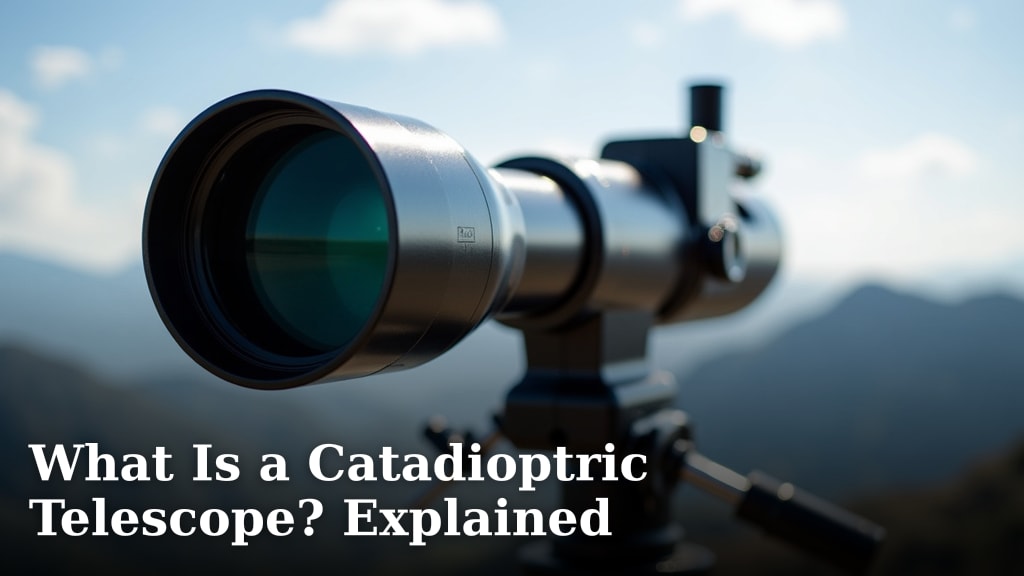
What Is a Catadioptric Telescope? Explained
A catadioptric telescope is a type of telescope that uses both mirrors and lenses to gather and focus light. It combines the best features of refractors (lenses) and reflectors (mirrors) into one compact and powerful design.
Many people find this design appealing because it creates a very short and portable tube. You get the high-quality views of a longer telescope without the heavy weight, which is great for backyard stargazing or travel.
- A catadioptric telescope uses a corrector lens and mirrors to create a long focal length in a short tube.
- This design makes it highly portable and versatile for viewing planets, galaxies, and more.
- It is often considered a good all-around choice for both beginners and experienced amateur astronomers.
- We found this style to be a popular, space-saving option in our research of amateur astronomy equipment.
Below, we break down exactly how a catadioptric telescope works, its main types, and how to decide if one is the right fit for your stargazing adventures.
The Hybrid Design: Mixing Mirrors and Lenses
A catadioptric telescope is a smart piece of optical engineering. It’s a mirror-lens hybrid that borrows the best parts from two other telescope families. Imagine taking the sharp, color-accurate lens from a refractor and the powerful light-gathering mirror from a reflector. Now, combine them into one efficient system. That’s the core idea. This clever combination solves some of the biggest headaches for amateur astronomers, like tube length and weight.
Why does this matter to you? Because a longer telescope tube usually means more weight and a bigger tripod. That can turn a fun night of stargazing into a workout. The catadioptric design folds the light path inside the tube. This allows for a very long focal length—which means high magnification—to fit inside a surprisingly short, portable package. You get power without the bulk.
How a Catadioptric Telescope Works
Let’s break down the light’s journey in simple terms. First, light enters the front of the telescope tube through a corrector plate. This is a specialized lens. Its job isn’t to focus the light but to correct optical distortions. Think of it as a quality-control filter that prepares the light for the mirrors.
The Corrector Plate’s Job
After passing through the corrector plate, the light travels to the back of the telescope. There, it hits the primary mirror. This is the big, curved mirror that collects and focuses the light. From the primary mirror, the light is reflected back toward the front. On its way, it hits a small, convex secondary mirror. This secondary mirror then directs the focused light back again, this time through a hole in the center of the primary mirror.
The Final Focus
Finally, the light exits through this central hole in the primary mirror. It arrives at the eyepiece, where you place your eye to see the image. This folded light path is what makes the telescope so compact. We found that this design is a significant reason why these telescopes are popular for travel and small backyards (Sky & Telescope).
Key Component Summary
- Corrector Plate: A front lens that fixes optical errors.
- Primary Mirror: The main light-gathering dish at the back.
- Secondary Mirror: A small mirror that bounces light back to you.
- Focuser: Adjusts the position of the primary mirror to sharpen the image.
The Two Main Flavors: SCT vs. Maksutov
Not all catadioptric telescopes are the same. You’ll most often hear about two specific types. They share the same basic principle but have different shapes for their mirrors. Knowing the difference helps you pick the right one for your needs.
Schmidt-Cassegrain Telescope (SCT)
This is the most common and popular type. An SCT uses a spherical primary mirror and a thin, aspheric corrector plate. This combination provides a wide field of view and excellent all-around performance. We found that SCTs are often favored for their versatility. They work well for looking at planets, star clusters, and even brighter galaxies (Astronomy.com).
What Makes an SCT Great?
SCTs are the jack-of-all-trades. Their optical design is very efficient. This means they gather a lot of light relative to their size. For you, that translates to brighter images of faint objects. They are also relatively easy to manufacture. This often makes them more affordable than other high-performance telescopes of similar size.
Maksutov-Cassegrain Telescope (MAK)
The Maksutov design uses a thick, deeply curved meniscus corrector plate and a spherical primary mirror. This creates a narrower field of view but with incredibly sharp, high-contrast images. Think of it as a specialist. If an SCT is a great all-around camera, a Maksutov is like a premium telephoto lens for portraits.
When Does a Maksutov Shine?
MAKs are famous for their pinpoint star images and detailed views of planets. They handle atmospheric turbulence (twinkling) very well. Their enclosed tube design also protects the optics from dust. This makes them a low-maintenance choice. If your primary goal is to study Jupiter’s cloud bands or Saturn’s rings, a Maksutov is a superb option.
| Feature | Schmidt-Cassegrain (SCT) | Maksutov-Cassegrain (MAK) |
|---|---|---|
| Best For | All-around use, deep-sky objects, astrophotography | Planetary viewing, high-contrast lunar views |
| Field of View | Wider, good for larger objects | Narrower, excellent for tight targets |
| Weight | Generally lighter for the same aperture | Can be heavier due to thick corrector plate |
| Focusing | Moves primary mirror (can cause image shift) | Often uses a helical focuser (very smooth) |
| Typical Price | Mid to high range | Mid to high range |
Key Advantages of This Design
Why choose a catadioptric over other types? The benefits are compelling for many hobbyists. The primary win is the portability-to-power ratio. A 5-inch catadioptric can fit in a backpack and perform like a much larger, heavier traditional telescope. This makes it easy to grab and go to a darker sky site.
Another big plus is their versatility. You can use them for solar system observing one night and deep-sky objects the next. Their closed tube also minimizes internal air currents. This leads to more stable images. We found that many users appreciate this “grab-and-go” convenience, as it means they actually use their telescope more often.
Potential Limitations to Consider
No design is perfect. Catadioptric telescopes do have some trade-offs. The most common point is cool-down time. Because the optics are enclosed, the mirror needs time to reach the outside temperature. Taking a telescope from a warm house into cold air requires a wait of 30-60 minutes for optimal performance. Rushing this can give you blurry views.
They also tend to be more expensive than a Newtonian reflector of the same aperture. The corrector plate adds to the manufacturing cost. Additionally, the primary mirror focus mechanism (on SCTs) can sometimes cause the image to shift slightly. This is called “mirror shift” or “image shift.” It’s usually a minor annoyance during focusing, not a deal-breaker.
Who Is a Catadioptric Telescope For?
This telescope style is an excellent match for specific types of stargazers. If you live in a city with limited space, its compact size is a huge benefit. You can store it in a closet and still have serious optical power. It’s also perfect for the traveler. Campers, RV owners, and people who go to star parties love them.
For beginners, a catadioptric offers a future-proof investment. You won’t outgrow it quickly. Its all-around performance lets you try different types of astronomy. For experienced observers, it serves as a fantastic portable secondary telescope. It’s the one you’ll actually take on vacation.
Making the Choice: What to Look For
Deciding if one is right for you comes down to a few practical questions. First, think about your main goal. Do you want the sharpest possible view of Saturn? Or do you want to hunt for nebulae and galaxies? Second, consider portability. Will you carry it to a dark sky site, or will it live in your backyard?
We also found that aperture (the diameter of the primary mirror) is king. A larger aperture gathers more light. A 5-inch model is a great starting point. It’s powerful enough for serious views but still very manageable. Don’t be tempted by a small, cheap department store scope with a big lens but a tiny mirror. Optical quality matters more than any label.
Your Pre-Purchase Checklist
Before you buy, run through this quick list. It will help you confirm a catadioptric is the right choice for your astronomy path.
- ✅ Portability is key. You need a telescope that is easy to store and carry.
- ✅ You want versatility. You plan to view both planets and deep-sky objects.
- ✅ You value low maintenance. A closed tube that protects the mirrors is appealing.
- ✅ You are ready for the price. You understand the cost reflects the complex optics.
- ✅ You have a plan for cool-down. You can wait a little while before observing.
- ✅ You have a steady tripod. A good mount is just as important as the telescope itself.
Getting the Most From Your Telescope
Once you have your catadioptric, a few simple practices will ensure great views. Always allow the telescope to cool down to ambient temperature before starting. Keep the lens cover off the corrector plate while it cools to speed the process. Use the telescope on a sturdy mount. A shaky view ruins the experience, no matter how good the optics are.
We found that many owners also benefit from collimation tools. Collimation is the process of aligning the mirrors. While catadi
Conclusion
A catadioptric telescope offers a brilliant blend of power and portability. It uses both mirrors and lenses to create a compact, high-performance tool. This design is ideal if you want serious views without a heavy, bulky tube. You get the versatility for both planets and galaxies. We found this makes it a smart, long-term choice for many stargazers.
The trade-offs, like cool-down time, are manageable. They are a small price for the convenience it provides. Your next step is simple. Revisit the checklist above. Match its strengths with your own stargazing goals. If portability and all-around use are your priorities, a catadioptric could be your perfect match under the stars.
Frequently Asked Questions
Is a catadioptric telescope good for beginners?
Yes, it can be an excellent choice for a beginner who wants a future-proof investment. Its compact size and versatility let you explore many types of astronomy. Just be aware you will need to learn about collimation and cool-down time for the best results.
How is a catadioptric telescope different from a reflector?
A reflector uses only mirrors, while a catadioptric uses a combination of mirrors and a front corrector lens. This hybrid design allows the catadioptric to achieve a long focal length in a much shorter, more portable tube compared to a traditional reflector.
What does “cool-down time” mean?
Cool-down time is the period needed for your telescope’s optics to reach the outside temperature. Taking it from a warm house to cold air requires a 30-60 minute wait. This prevents internal air currents from blurring your view, ensuring you get the sharpest image possible.
Can I use a catadioptric telescope for astrophotography?
Absolutely, especially Schmidt-Cassegrain models (SCT). Their long focal length and good optical quality make them popular for photographing planets and the Moon. For deep-sky objects, you will likely need a reliable tracking mount and additional camera adapters.
How do I maintain a catadioptric telescope?
Maintenance is relatively low thanks to the closed tube. Keep the corrector plate clean with a soft brush and lens cleaning solution. You will also need to periodically check and adjust the mirror alignment, a process called collimation, to keep everything performing at its best.