Do You Need a Dark Sky to Use a Telescope?
You don’t always need a completely dark sky to use a telescope. While darker skies offer the best views of faint objects like galaxies, you can still enjoy many celestial sights from your backyard with a telescope, especially if you’re observing the Moon and planets.
Light pollution can be a challenge for astronomers. It washes out dimmer objects, making them hard to see. However, certain celestial targets are bright enough to overcome some of this interference. Knowing what to look for can make a big difference in your stargazing experience, even without traveling to a dark site.
- Dark skies are ideal but not always required.
- The Moon and planets are great targets in lighter skies.
- Light pollution affects faint objects the most.
- You can still enjoy stargazing from your backyard.
- Planning your observations helps.
Let’s walk through how light pollution affects your view and what you can do to make the most of your telescope, even when the stars aren’t perfectly dark.
So, you’ve got a telescope and you’re itching to see the stars. A big question often pops up: do you really need to escape to the darkest corners of the countryside to get good views? The short answer is: not always.
It’s true, the experts and seasoned astronomers often talk about dark skies. They rave about how much more you can see. But let’s be real, not everyone can easily access a Bortle 1 or 2 site. Many of us stargaze from our backyards, balconies, or local parks. You might be wondering if your telescope is just going to be a fancy paperweight under city lights. The good news is, it doesn’t have to be!
We’re going to break down how light pollution affects your stargazing and, more importantly, what you can see even with streetlights buzzing nearby. You can still have fantastic nights under the stars. Let’s find out how.
Stargazing Under City Lights: What to Expect
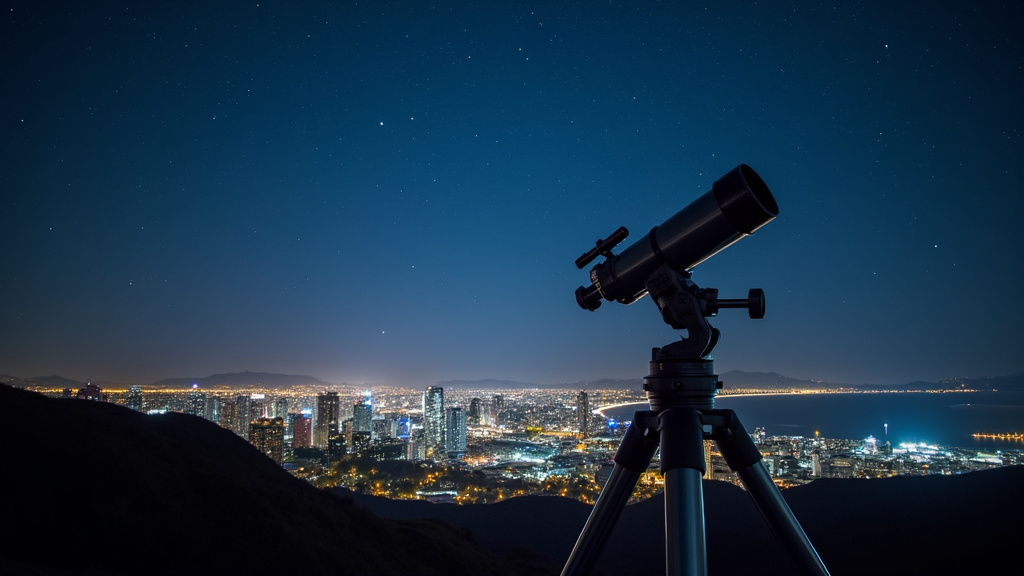
Light pollution is basically the excessive, misdirected, or obtrusive use of artificial light. Think of streetlights, building lights, even your neighbor’s porch light. This light scatters in the atmosphere, creating a glow that makes the night sky much brighter than it naturally should be. This glow competes with the faint light coming from stars and galaxies.
When you’re in a heavily light-polluted area, the sky background isn’t black; it’s often a hazy orange or gray. This makes it really tough to see anything that doesn’t shine very brightly. Faint fuzzies, like distant galaxies and nebulae, often get completely washed out. It’s like trying to see a tiny candle flame during a daytime parade. You can probably see the candle, but it’s not the main event.
But don’t pack up your telescope just yet! Many celestial objects are quite bright. These don’t need a perfectly dark sky to be enjoyed. Your telescope can still pull in a lot of detail from these closer, shinier targets. You just need to know what to aim for.
Celestial Targets That Shine Bright
When light pollution is a factor, your best friends are going to be the brighter objects in our solar system and sky.
Our Nearest Neighbor: The Moon
The Moon is an absolute showstopper, no matter your location. Even with bright city lights, the Moon is so close and reflects so much sunlight that it looks amazing. You don’t need a dark sky at all to appreciate its craters, mountains, and plains. You don’t need a dark sky at all to see the Moon and appreciate its craters, mountains, and plains.
Using a telescope on the Moon will reveal incredible detail. You can see the edges of craters, the textures of the lunar maria (the dark “seas”), and dramatic mountain ranges along the terminator (the line between day and night on the Moon). Observing the Moon when it’s a crescent or gibbous phase is often best, as the shadows cast by the low sun highlight surface features.
A tip from experienced observers: avoid looking at a full Moon for too long. It can be overwhelmingly bright, almost like looking at a headlight. A low-power eyepiece is usually all you need.
The Gas Giants and Their Moons
Jupiter and Saturn are other fantastic targets that hold up well against light pollution. They are the brightest planets in our night sky and are often visible even from suburban backyards.
Jupiter’s Stripes and Moons
With a moderate-sized telescope, you can often see Jupiter’s main cloud bands. These are the darker and lighter horizontal stripes that stretch across its surface. You might even be able to spot the Great Red Spot during favorable views, though this feature can be elusive under bright skies.
The most exciting part for many is seeing Jupiter’s four largest moons: Io, Europa, Ganymede, and Callisto. They appear as tiny pinpricks of light lined up next to the planet. Seeing them appear and disappear as they orbit Jupiter is a wonderful introduction to celestial mechanics. They are bright enough to be seen even when the sky isn’t perfectly dark.
Saturn’s Rings
Saturn is the jewel of the night sky. Even in moderately light-polluted areas, you should be able to see its magnificent rings. They appear as a clear, distinct halo around the planet. It’s a sight that never fails to impress.
Depending on your telescope and the seeing conditions, you might even be able to spot the Cassini Division, a gap in Saturn’s rings. You can also usually see Titan, Saturn’s largest moon, as a small dot of light near the planet.
Other Planets to Consider
While Jupiter and Saturn are the stars of planetary viewing in light-polluted skies, don’t forget Venus and Mars.
Venus: A Brilliant Haze
Venus is often the brightest object in the night sky after the Moon. It appears as a dazzling white point of light. Through a telescope, you can see that it goes through phases, much like our Moon. These phases can be observed even from a light-polluted area.
Its thick atmosphere prevents us from seeing surface details, but observing the changing shape of Venus is still fascinating. Just be sure to use a filter if Venus is very high in the sky, as it can be intensely bright.
Mars: A Red Disc
Mars can be a bit more challenging. When it’s close to Earth (which happens about every 26 months), it appears as a distinct reddish-orange disc. You might be able to see some of its polar ice caps, especially during its closest approaches.
However, Mars is much smaller than Jupiter and Saturn, making it a fainter target. Light pollution can make it harder to pick out surface features. Still, its distinctive color makes it an easy planet to identify and track.
What About Deep-Sky Objects?
This is where light pollution really starts to bite. Deep-sky objects (DSOs) are things like nebulae, star clusters, and galaxies. These are incredibly distant and their light has traveled for millions of years to reach us. They are often very faint.
In a light-polluted sky, you’re unlikely to see the beautiful colors or intricate structures of most nebulae, like the Orion Nebula. Galaxies, which are vast collections of stars, often appear as faint, fuzzy smudges at best, or are completely invisible.
However, there are a few exceptions that might be visible even with some light pollution:
- The Andromeda Galaxy (M31): This is the most distant object you can see with the naked eye. In a telescope, even from a moderately light-polluted area, you can often see its central bright core and perhaps a hint of its wider disk.
- The Pleiades (M45): This is a beautiful open star cluster. While the fainter stars might be lost to light pollution, the brighter stars of the Pleiades are still stunning through a telescope.
- Globular Clusters: Some of the brightest globular clusters, like Messier 13 in Hercules, can be resolved into individual stars even in suburban skies with a good telescope.
It’s about managing expectations. You won’t see the Hubble-like images from your backyard, but you can still get a sense of these distant wonders. Using the largest aperture telescope you can manage will also help gather more light. Using the largest aperture telescope you can manage will also help gather more light.
Tips for Stargazing in Lighter Skies
Even if you can’t get away from city lights, there are several things you can do to improve your stargazing experience.
Choosing the Right Time
Some celestial events are better than others for light-polluted skies.
- Moon Phase: As mentioned, avoid the full Moon for planetary and deep-sky viewing. A crescent or quarter Moon is perfect for lunar observation. When the Moon is new (dark), it’s the best time for trying to see fainter objects.
- Time of Night: The Moon and planets rise and set. They are also at their highest point in the sky around midnight. When these objects are higher up, their light travels through less of Earth’s atmosphere, which can help.
Using Your Telescope Effectively
How you use your equipment matters.
Eyepiece Selection
For planets, you’ll want to use eyepieces that provide higher magnification. This helps you see finer details on Jupiter or Saturn’s rings. However, extreme magnification can sometimes make the image dimmer and more susceptible to atmospheric distortion and light pollution.
For dimmer deep-sky objects, you generally want lower magnification and wider fields of view. This lets your telescope gather as much light as possible and present a broader picture. A good starting point for many deep-sky objects is a magnification of around 10-15x per inch of your telescope’s aperture.
Filters Can Help
There are special telescope filters designed to cut down on specific wavelengths of light that are common in light pollution. Light pollution filters, also known as broadband or skyglow filters, can make a noticeable difference when viewing nebulae.
They work by blocking some of the orange and yellow light from streetlights while allowing the light from nebulae to pass through. They won’t magically turn a city sky into a dark desert sky, but they can improve contrast and reveal more detail. Filters are generally not recommended for viewing planets or the Moon, as they can alter the true color and brightness.
Red Light is Your Friend
When you’re looking at the stars, your eyes adapt to the darkness. This adaptation, called dark adaptation, makes your pupils larger and your eyes more sensitive to light. White lights, like your phone screen or a regular flashlight, will ruin this adaptation.
Use a red flashlight or a red-light setting on your phone. Red light has the least impact on your eyes’ dark adaptation. This way, you can switch between looking at your star charts and looking at the sky without losing your night vision.
Location, Location, Location (Even in the City)
Even within a light-polluted area, some spots are better than others.
- Face Away from Lights: Try to position yourself so that the brightest lights are behind you or to the side.
- Find the Darkest Patch: Look for parks or open spaces away from the direct glare of streetlights and buildings. Sometimes, just a few blocks away from the main commercial areas can make a difference.
- Use Trees or Buildings as Shields: Natural or man-made obstructions can sometimes block direct light pollution.
Managing Your Expectations
It’s essential to go into your stargazing session with realistic expectations. You won’t see the same things from your backyard as someone at a remote observatory.
Think of it this way: if you’re a cook, would you refuse to make a meal because you don’t have every high-end gadget? Probably not. You’d work with what you have and make the best meal possible. Stargazing is similar. You adapt your goals to your conditions.
The Moon and planets are incredibly rewarding targets that are accessible to almost everyone. You can learn so much about our solar system just by observing them. For deep-sky objects, focus on the brightest ones and be happy with seeing them as faint smudges. That smudge is a galaxy millions of light-years away – pretty amazing!
Here’s a quick rundown of what you can do to maximize your stargazing in less-than-ideal conditions:
- Prioritize bright targets like the Moon and planets.
- Use a red light to preserve your night vision.
- Invest in a light pollution filter for nebulae viewing.
- Position yourself to minimize direct light glare.
- Understand that faint objects will be harder to see.
- Be patient and enjoy the process!
So, while dark skies are wonderful, they aren’t the only way to enjoy your telescope. With a little knowledge and preparation, you can still have many rewarding nights under the stars, even from your own neighborhood.
Conclusion
You don’t need a perfectly dark sky to enjoy your telescope. While light pollution can hide faint galaxies, you can still see incredible sights like the Moon and planets right from your backyard. Focus on these brighter targets, and you’ll discover so much about our solar system. Remember to use red light to protect your night vision and position yourself away from direct light sources. Managing your expectations is key; even a faint smudge through your telescope is a distant wonder. Keep observing, and happy stargazing!
Frequently Asked Questions
Can I see any galaxies from a light-polluted city?
Yes, you can see a few of the brightest galaxies, like the Andromeda Galaxy (M31). It might appear as a faint, fuzzy patch. The brighter core is usually visible, giving you a sense of its vastness, even with some light pollution.
What’s the best telescope for viewing planets in a light-polluted area?
For planets, a telescope with a moderate aperture (around 4-8 inches) is often best. You’ll want to use higher magnification eyepieces to see details like Jupiter’s cloud bands or Saturn’s rings. Look for a telescope with good optics that minimize chromatic aberration.
Are star clusters visible from my backyard?
Some bright star clusters, like the Pleiades (M45), are still quite stunning even with city lights. While fainter stars might be lost, the main stars of the cluster will shine through. Brighter globular clusters can also be resolved into individual stars with a good telescope.
How much does a light pollution filter actually help?
Light pollution filters can make a noticeable difference for viewing nebulae. They block specific wavelengths of light that cause skyglow, improving contrast. They won’t make your sky perfectly dark, but they can help reveal more detail on faint objects.
When is the best time of night to stargaze with light pollution?
The best time is generally when the Moon is new or not visible in the sky. Also, try to observe celestial objects when they are higher in the sky, typically around midnight. This means their light travels through less of Earth’s atmosphere.