8 Best Budget Telescopes (November 2026)
The best budget friendly telescopes include the Celestron AstroMaster 70AZ Refractor Telescope for Moon for first backyard sessions, the Celestron Travel Scope 70mm Beginner Portable Telescope for travel and camping, and the Gskyer Telescope for phone photos on a budget.
On this page (16 sections)
- Best budget friendly telescopes at a glance
- Best budget friendly telescopes: our top picks compared
- How to choose a budget friendly telescope
- Celestron AstroMaster 70AZ Refractor Telescope for Moon
- Celestron Travel Scope 70mm Beginner Portable Telescope
- Gskyer Telescope
- Koolpte Telescope for Adults
- MEEZAA Telescope for Adults & Kids
- Hawkko Portable Telescope for Kids & Beginners
- Aomekie Telescope for Adults
- SARBLUE Maksutov-Cassegrain Telescope for Adults Kids Astronomy
- What is the best budget friendly telescope for different budgets?
- How do mounts and eyepieces affect a budget telescope?
- Can a budget telescope show planets and take phone photos?
- More guides on this topic
- Which budget friendly telescope should you buy?
The best budget friendly telescope for most beginners is the Celestron AstroMaster 70AZ Refractor Telescope for Moon, because its 70mm optics and 900mm focal length give detailed Moon views with simple controls.
The Celestron Travel Scope 70 wins for travel, the Koolpte wins for light gathering, and the SARBLUE wins for compact design.
A budget friendly telescope should give you useful optics, a stable mount and honest compromises.
Aperture controls brightness, focal length controls magnification and field of view, and the tripod controls how steady your view feels.
Our score weighs specs, features and buyer feedback against what you're shopping for.
If you want a broader price context, start with how much does a telescope cost and compare our best telescope for the money picks.
For higher budgets, see the best telescope under 1000, the best telescope under 500 and the best mid range telescope guides.
Best budget friendly telescopes at a glance
Celestron AstroMaster 70AZ Refractor Telescope for Moon: Best for first backyard sessions

- 70mm fully coated achromatic refractor
- 900mm focal length
- 20mm and 10mm eyepieces
- StarPointer red dot finderscope
- Adjustable tripod and alt-azimuth mount
A longer refractor tube for detailed Moon and planet views, with two eyepieces and a red dot finder to make aiming easier.
Pros
- Long 900mm focal length for lunar detail
- Two eyepieces included
- Red dot finder helps locate targets
- No-tool setup
Cons
- Longer tube is less travel friendly
- Manual mount needs steady hands for tracking
Celestron Travel Scope 70mm Beginner Portable Telescope: Best for travel and camping

- 70mm fully coated refractor
- 400mm focal length
- 20mm and 10mm eyepieces
- Backpack included
- Full-height tripod
A short, light 70mm refractor that packs into a backpack, built for campsites, trips and quick backyard sessions.
Pros
- Light at 4.2 lb
- Backpack storage included
- Quick no-tool setup
- Good for daytime and night use
Cons
- Shorter focal length gives wider, less detailed Moon views
- Less power for planets than longer tubes
Gskyer Telescope: Best for phone photos on a budget
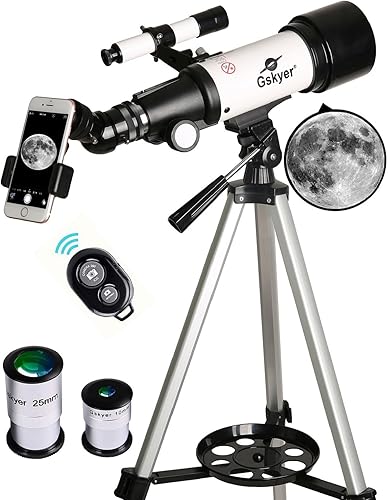
- 70mm aperture, 400mm focal length
- 25mm and 10mm eyepieces
- 3x Barlow lens
- Phone adapter and wireless remote
- Adjustable aluminum tripod and carry bag
A 70mm travel refractor with a Barlow lens, phone adapter and wireless remote for sharing Moon photos.
Pros
- Barlow lens included
- Phone adapter and remote included
- Carry bag for storage
- Adjustable tripod
Cons
- High magnification with Barlow can be shaky
- Best for wide Moon views, not detailed planets
Koolpte Telescope for Adults: Best for more light gathering

- 80mm aperture, 600mm focal length
- 25mm and 10mm eyepieces
- 3x Barlow lens
- Phone adapter, wireless remote and carry bag
- Adjustable aluminum tripod
An 80mm refractor with a 600mm focal length, giving a brighter image than 70mm models and a wider magnification range.
Pros
- 80mm aperture gathers more light
- 600mm focal length balances detail and field
- Barlow, phone adapter and remote included
- No-tool setup
Cons
- Larger tube than 70mm travel models
- High power views need a steady tripod
MEEZAA Telescope for Adults & Kids: Best for families with kids

- 80mm aperture, 500mm focal length
- 25mm and 10mm eyepieces, 3x Barlow lens
- 20x to 150x magnification range
- Phone adapter and waterproof backpack
- Adjustable tripod
An 80mm family kit with a wide magnification range, backpack, phone adapter and stickers for younger observers.
Pros
- 80mm aperture
- Wide 20x to 150x range
- Waterproof backpack included
- Adjustable tripod for kids and adults
Cons
- Very high magnification can look shaky
- More accessories to store and pack
Hawkko Portable Telescope for Kids & Beginners: Best for personalized family kits

- 80mm fully multi-coated aperture, 500mm focal length
- 25mm and 10mm eyepieces, 3x Barlow lens
- 20x to 150x magnification
- Decorate stickers and phone adapter
- Storage backpack and adjustable tripod
An 80mm portable refractor with stickers, a phone adapter and a backpack, aimed at family STEM use and gifts.
Pros
- 80mm multi-coated lens
- Stickers add personalization
- Backpack for travel
- Phone adapter included
Cons
- 150x is often too high for steady viewing
- Sticker decoration may not suit all adults
Aomekie Telescope for Adults: Best for comfortable Moon viewing

- 70mm aperture, 400mm focal length
- K25mm and K6mm Kellner eyepieces
- 5x24 finderscope
- Moon filter and 45-degree erect-image diagonal
- Phone adapter and adjustable tripod
A 70mm refractor with a moon filter to soften bright lunar glare, plus a phone adapter and upright daytime view.
Pros
- Moon filter included
- Erect-image diagonal for daytime use
- Tripod adjusts from 15 to 51 in
- Phone adapter included
Cons
- 70mm aperture has less light than 80mm models
- Short focal length limits planetary detail
SARBLUE Maksutov-Cassegrain Telescope for Adults Kids Astronomy: Best compact compound design

- 60mm Maksutov-Cassegrain, 750mm focal length
- 20mm eyepiece for 37.5x
- 200mm tube length
- Tabletop tripod, phone adapter and erect-image diagonal
- Detachable educational lid
A compact 60mm compound telescope with a long 750mm focal length in a short tube, built for travel and learning.
Pros
- Very compact 200mm tube
- Long focal length for its size
- Educational detachable lid
- Phone adapter included
Cons
- 60mm aperture gathers less light
- Tabletop tripod is less stable than full-height tripods
Best budget friendly telescopes: our top picks compared
The top three share a 9.7 score but solve different problems.
AstroMaster 70AZ has the longest tube for detail, Travel Scope 70 has the lightest travel design, and Gskyer adds a Barlow lens and phone gear.
Choose by how you will carry and use it, not by score alone.
How we compared these telescopes
We compared aperture, focal length, mount type, eyepieces, finders, tripod height, weight and included accessories.
We also checked what each design trades away.
A short tube travels well but shows less detail.
A long tube shows more detail but needs more storage.
A tabletop tripod is portable but less stable than a full-height tripod.
We did not test these telescopes.
We researched specs and owner patterns, and we label maker claims as claims.
That keeps the comparison honest for a first purchase.
Weight and packed size deserve close attention because they change where you will actually observe.
A 4.2 lb travel scope can go in a car boot or a backpack for a campsite, while a backyard setup is better kept in one place.
Optical design also matters for daily use, since a refractor gives a right side up image for daytime viewing and simple cleaning.
A compound design folds a long focal length into a short tube, but it brings a smaller aperture and a different mount style.
We therefore ranked each pick by the job it does best rather than by one headline number.
How to choose a budget friendly telescope
Start with aperture and focal length.
Aperture is the diameter of the main lens.
More aperture means more light and a brighter image.
Focal length, combined with eyepiece size, sets magnification.
A longer focal length gives higher magnification with the same eyepiece, but a narrower view.
Aperture: 70mm versus 80mm
70mm is the sweet spot for portable beginner refractors.
It is light, short and bright enough for the Moon, planets and many star clusters.
80mm gathers about 30 percent more light than 70mm in area terms, which helps on fainter targets.
The trade-off is a larger tube and more weight to carry.
Focal length and magnification
400mm tubes at 70mm or 80mm give wide, easy views.
They suit finding targets and daytime scenery.
500mm to 600mm tubes give a better balance for Moon detail.
The 750mm to 900mm tubes in this group give the most detail for their aperture, but the view is narrower and tracking feels harder.
Mounts and tripods
Every pick here uses a simple manual mount.
That is normal at this level.
A steady tripod matters more than extras.
Full-height adjustable tripods work for standing adults and seated kids.
Tabletop tripods are compact but shake more when you touch the telescope to focus.
Tripod height and stability for shared use
Tripod range matters when children and adults share one telescope in the same session.
Adjustable legs let a young observer start seated and an adult continue standing without lifting the tube between mounts.
Height also affects vibration, since a tripod set near its maximum extension can feel less firm than one set lower.
Save the tripod time by checking the stated height range before you buy, and plan to set it on firm ground rather than soft grass.
A preassembled mount and tripod, as listed for the Celestron models, can save setup steps on a first night.
That detail helps when the goal is to find the Moon quickly rather than spend the session assembling parts.
Celestron AstroMaster 70AZ Refractor Telescope for Moon
The AstroMaster 70AZ suits beginners who will mostly observe from a backyard.
Its 70mm fully coated achromatic refractor gives bright, clear views, and the 900mm focal length is the longest in this group.
That length helps you see Moon craters and planetary detail at 45x with the 20mm eyepiece and 90x with the 10mm eyepiece.
The alt-azimuth mount with a panhandle lets you point up, down and side to side with simple movement.
The StarPointer red dot finderscope helps you aim at bright targets quickly.
Celestron says setup needs no tools and takes minutes, with an adjustable tripod for adults or kids.
It also includes an erect image star diagonal for upright daytime viewing and a free download of astronomy software for planning.
The tube weighs 10.8 lb when fully assembled, which is easy to move around a garden but not light for long walks.
The trade-off is size and manual tracking, so planets will drift across the view and need steady nudges.
For a fixed backyard spot, that trade-off is worth the extra detail and the included finder.
Celestron Travel Scope 70mm Beginner Portable Telescope
The Travel Scope 70 suits beginners who want to carry a telescope to campsites, parks and dark-sky spots.
It uses a 70mm aperture with a shorter 400mm focal length than the AstroMaster.
That short tube weighs 4.2 lb and packs into the included backpack.
Fully coated glass optics give crisp views of the Moon, planets and daytime scenery.
The 20mm and 10mm eyepieces give wide and closer views, and the 45-degree erect image diagonal gives an upright image for land viewing.
Celestron says setup takes seconds with no tools, and the full height tripod is preassembled with the mount.
It also includes a 5x24 finderscope, the SkyPortal app and a free download of Starry Night software to help plan sessions.
The trade-off is detail, because a 400mm focal length gives a wider field and lower magnification than a 900mm tube.
Moon craters will look smaller and planets will show less surface detail than with a longer refractor.
Choose a longer tube for maximum lunar detail at home, and choose this one if you want to actually carry it to a dark site.
Gskyer Telescope
The Gskyer suits beginners who want phone photos and extra magnification in one kit.
It has a 70mm aperture and 400mm focal length, with fully coated optics.
The kit adds a 3x Barlow lens, which trebles the power of each eyepiece, plus a 5x24 finder scope.
A phone adapter and wireless remote are included for capturing the Moon or bright planets.
The adjustable aluminum tripod and carry bag help with travel and storage.
The low eyepiece gives 16x and the high eyepiece gives 40x before the Barlow, with 120x maximum listed.
The finderscope has crosshair lines to help locate objects more precisely than aiming by eye.
The trade-off is that high magnification also magnifies shake, so start with the lower eyepiece and raise power only when the image stays steady.
Koolpte Telescope for Adults
The Koolpte suits adults and beginners who want more light than a 70mm scope gives.
Its 80mm aperture and 600mm focal length give a brighter image and more reach for planets and star clusters.
It includes 25mm and 10mm eyepieces for 24x and 60x, plus a 3x Barlow lens.
A 5x24 finder scope helps you locate targets.
A phone adapter, wireless remote, carrying bag and adjustable aluminum tripod are also included.
The fully multi coated optics help enhance brightness and clarity compared with a smaller lens.
Setup needs no tools, which suits a first session in a backyard or at a campsite.
The trade-off is portability, because the tube needs more packing space than a 400mm travel refractor.
High power views also need a steady tripod, so use the Barlow lens with care on windy nights.
MEEZAA Telescope for Adults & Kids
The MEEZAA suits families with kids ages 8 to 12 and adults who share one telescope.
Its 80mm aperture and 500mm focal length give a good balance of brightness and detail.
Fully multi-coated optics help reduce glare and improve clarity.
The magnification range runs from 20x to 150x using 25mm and 10mm eyepieces plus a 3x Barlow lens.
A 5x24 finder scope helps locate objects, and a 45-degree zenith mirror gives upright images.
The aluminum tripod adjusts from about 17 to 44 inches, so kids and adults can share it.
A phone adapter and waterproof backpack are included, plus space stickers for personalization.
The backpack keeps the tube and accessories organized for travel, hiking or camping, and the foldable design helps with storage at home.
The kit lists every part in one set, including the finder scope base, eyepieces, Barlow lens and manual, so there is no need to buy basic parts separately.
The trade-off is the top end of that range, because at 150x the image is often shaky and dim.
Most families will get the best views at low to middle power, using higher power only for short looks at a steady Moon.
Hawkko Portable Telescope for Kids & Beginners
The Hawkko suits families who want a gift-ready kit with personalization.
It has an 80mm fully multi-coated objective lens and a 500mm focal length.
Hawkko says the 80mm lens captures 60 percent more light than 70mm telescopes.
Magnification runs from 20x to 150x with 25mm and 10mm eyepieces and a 3x Barlow lens.
A smartphone adapter lets families capture and share views.
Decorate stickers let kids personalize the tube, and a storage backpack holds the telescope, tripod and accessories.
The tripod has four adjustable stages for different heights, and setup is described as simple with step by step instruction included.
The trade-off is that very high magnification is hard to hold steady on a light tripod.
Stickers may also not appeal to adult only buyers, so consider it as a family gift rather than a purely adult scope.
Aomekie Telescope for Adults
The Aomekie suits adults who plan to watch the Moon often and want less glare.
It has a 70mm aperture and 400mm focal length with fully multi-coated glass optics.
The included moon filter reduces brightness for more comfortable lunar viewing.
Two Kellner eyepieces give different views.
The K25mm gives 16x for locating targets, and the K6mm gives about 67x for closer views.
A 5x24 finderscope helps you aim.
A 45-degree erect-image diagonal supports upright daytime landscape viewing.
A phone adapter is included for photos and videos, and the aluminum tripod adjusts from 15 to 51 inches.
The wide tripod range helps on day trips, since it can move from a low seated position for daytime viewing to a higher standing position at night.
The trade-off is aperture, because at 70mm it gathers less light than the 80mm picks.
The short focal length also limits planetary detail compared with 500mm to 900mm tubes in this group.
For Moon nights and daytime use, the filter and diagonal are practical extras that change how the scope feels to use.
SARBLUE Maksutov-Cassegrain Telescope for Adults Kids Astronomy
The SARBLUE Mak60 suits beginners who want a compact, educational design.
It uses a Maksutov-Cassegrain compound design with a 60mm aperture and 750mm focal length.
The tube is only 200mm long, much shorter than a refractor with the same focal length.
Fully multi-coated optics help minimize spherical and chromatic aberration, according to SARBLUE.
The included 20mm eyepiece gives 37.5x magnification.
A phone adapter, tabletop tripod and erect-image diagonal are included.
A detachable lid reveals the internal construction for learning.
The design is also listed for daytime viewing of birds and wildlife, with high contrast images for terrestrial targets as well as astronomy.
The trade-off is aperture and stability, because at 60mm it gathers less light than 70mm and 80mm models.
The tabletop tripod is convenient for travel but less steady than a full height tripod for standing use.
What is the best budget friendly telescope for different budgets?
A 70mm travel refractor is the best budget friendly telescope under 300 for most first buyers.
It is light, simple and strong enough for the Moon.
If you want the best telescope under 200, look at the lightest travel kits and accept a shorter focal length.
Check what is included, since eyepieces and a finder scope matter more than extra magnification claims.
For a middle step up, the best telescope under 400 guides point to 80mm models.
Those give more light and a better balance of detail.
The best telescopes under 250 and the best telescope under 300 categories overlap, so compare aperture and tripod quality rather than price labels alone.
At the top of this group, the best telescope under 500 overlaps with the best telescope under 500 guide.
The best telescope under 1000 and the best telescope under 5000 guides are useful when you want a larger mount or a bigger aperture later.
For the lowest entry point, see the best telescope under 100 dollars, but expect a smaller lens and a narrower view.
A kit with two eyepieces, a finder scope and a stable tripod will be more useful than a kit that lists only a high magnification number.
Check whether a phone adapter, diagonal or backpack is included, so you avoid buying basic parts twice.
How do mounts and eyepieces affect a budget telescope?
A simple alt-azimuth mount is fine for beginners.
You point it up and down and side to side by hand.
There is no polar alignment to learn.
The downside is manual tracking.
As the sky rotates, your target drifts, so you nudge the telescope often.
A steady tripod reduces that frustration because small nudges do not turn into big shakes.
Eyepieces change magnification.
A longer eyepiece, like 25mm, gives low power and a wide view.
A shorter eyepiece, like 10mm, gives higher power and a closer view.
A Barlow lens trebles power, but it also magnifies shake and dimness.
Start low, find the target, then go higher only if the image stays steady.
The eyepiece pair included with most kits here follows that same pattern, with one wide eyepiece for finding and one shorter eyepiece for detail.
That pairing matters more than a long list of magnification claims, since you will spend most of your time finding and framing targets.
A finder scope works with the eyepiece choice, because a low power view is easier to align with a red dot or crosshair finder.
What should you look for in a finder scope?
A finder scope helps you aim the main telescope.
Red dot finders are simple for bright targets like the Moon and planets.
Small 5x24 finders with crosshairs help with fainter targets.
Either one is better than aiming by guesswork.
Align the finder in daylight using a distant landmark before your first night session.
That step makes the first night session far smoother, because you will know the finder and the main tube point at the same place.
Mark the tripod position if you use the same spot each week, and keep the finder base tight after each move.
Can a budget telescope show planets and take phone photos?
Yes, within limits.
The Moon is the best first target because it is bright and detailed.
Jupiter shows bands and its large moons.
Saturn shows rings as a clear shape.
Mars shows small surface features only near opposition and in good seeing.
A 70mm or 80mm refractor will not show the deep detail of a larger telescope, so set expectations by target.
Phone photos work best with a phone adapter.
Focus through the eyepiece first, then attach and align your phone.
Use a short video and pick the sharpest frame, since wind and alignment cause blur.
The Gskyer, Koolpte, MEEZAA, Hawkko, Aomekie and SARBLUE all include a phone adapter in this group.
Daytime viewing is another strength of these refractors, since an erect image diagonal gives an upright image for birds, wildlife and landscapes.
That dual use can make a budget telescope feel useful in daylight as well as at night, as long as you never point it at the Sun.
How should you set up and care for it?
Set up on firm, level ground.
Tighten tripod legs and mount locks before you look.
Let the telescope reach outdoor temperature before you observe, since sudden temperature changes can blur the view.
Store it dry, keep dust off the lenses, and never touch coated optics with your fingers.
Never point it at the Sun.
A short routine before each session helps you get clear views from the start.
Check that the tripod legs are fully extended and locked, that the mount moves smoothly, and that the eyepiece you plan to use is clean.
Give the optics a few minutes to adjust to outdoor air, especially on cold nights when a warm tube from indoors can cause blur.
More guides on this topic
- Best Telescopes Under $5000
- Best Telescopes Under $300
- Best Telescopes Under $200
- Best Telescopes Under $400
- Best Telescopes Under $100
Which budget friendly telescope should you buy?
Pick the Celestron AstroMaster 70AZ if you want the most Moon detail for backyard use.
Pick the Celestron Travel Scope 70 if you will carry it to campsites or parks.
Pick the Koolpte if you want 80mm light gathering with a 600mm focal length.
Pick the Gskyer if phone photos and a Barlow lens matter most.
Pick the MEEZAA or Hawkko for a family kit with a backpack and phone adapter.
Pick the Aomekie if a moon filter and upright daytime view appeal to you.
Pick the SARBLUE if you want the most compact design and an educational look inside the tube.
For a wider shortlist, compare the best telescope under 2000 and the best telescope under 2000 guide after you decide on aperture.
The best budget friendly telescope is the one you will set up often, so choose by portability, stability and the targets you care about most.
Our top 3 picks at a glance
-
1
Best for first backyard sessions
Celestron AstroMaster 70AZ Refractor Telescope for Moon
9.7/10 our score
See it on Amazon -
2
Best for travel and camping
Celestron Travel Scope 70mm Beginner Portable Telescope
9.7/10 our score
See it on Amazon -
3
Frequently asked questions
What is the best budget friendly telescope for a beginner?
The Celestron AstroMaster 70AZ is the best budget friendly telescope for most beginners. Its 70mm aperture and 900mm focal length show Moon detail well, and the included eyepieces and red dot finder make aiming easier.
Choose travel models if portability matters more.
Is 70mm or 80mm better for a budget telescope?
80mm gathers more light and gives a brighter image, which helps on faint targets and planets. 70mm models are lighter and shorter, so they travel better.
Choose 80mm for backyard use and 70mm for camping or carrying.
How much magnification do you need?
Start with low power to find the target, then increase magnification slowly. Most beginners use 20x to 60x for wide views and Moon detail.
Very high magnification often looks shaky, so a Barlow lens is optional rather than essential.
Can a budget telescope take phone photos?
Yes, if it includes a phone adapter. Focus on the target through the eyepiece first, then attach your phone and align it carefully.
Photo quality varies with phone, alignment, wind and sky conditions, so short videos often work better.
Do budget telescopes work in daytime?
Refractors with an erect-image diagonal give an upright image for daytime viewing. That makes them useful for birds, wildlife and landscapes as well as the Moon.
Never point any telescope at the Sun.