8 Best Finder Scopes for Celestron Telescopes (November 2026)
The best Celestron telescope finder scopes include the Astromania StarPointer Red Dot Finder Scope for quick target alignment, the SVBONY SV165 Guide Scope for astronomy camera guiding, and the Blue Marble NASA Lunar Telescope for Kids Ages for a child’s first lunar setup.
On this page (8 sections)
- Which Celestron telescope finder scope is best?
- Best Celestron telescope finder scope picks
- Red dot or optical finder for a Celestron telescope?
- How do you check finder scope compatibility?
- How should you align a finder scope?
- How do you care for a telescope finder?
- Do Celestron telescopes need a finder scope?
- Final verdict on the best Celestron telescope finder scope
The best Celestron telescope finder scope for most users is the Astromania StarPointer Red Dot Finder Scope. Its large viewing window, four reticle choices and five brightness levels make it quick to use for pointing at the Moon, planets and bright stars.
Your telescope's finder shoe matters as much as the finder itself. Before buying, check whether your Celestron tube uses a compatible dovetail, a separate mounting base or a curved two-hole bracket.
If you are still learning how accessories fit together, our guide to telescope parts and accessories explains the main mounting and optical terms.
Our picks at a glance
-
1
 Best for quick target alignment
Astromania StarPointer Red Dot Finder Scope
9.7/10 our score
See it on Amazon -
2

-
3
 Best for a child’s first lunar setup
Blue Marble NASA Lunar Telescope for Kids Ages
9.4/10 our score
See it on Amazon
- 4
 Check it
Astromania Finder Scope Dovetail Base for SC
Best for adding a finder shoe - 5
 Best for comfortable right-angle viewingCheck it
- 6
 Check it
Astromania 9x50 Finder Scope Right Angle Optical
Best for faint-target star-hopping - 7
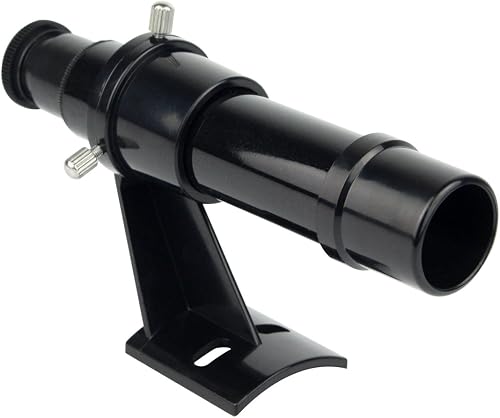 Best for a simple crosshair finderCheck it
- 8
 Check it
SVBONY SV208 Finder Scope 8x50 Finderscope
Best for a wide illuminated view
Which Celestron telescope finder scope is best?
The Astromania StarPointer is the strongest general pick because it gives you a wide open sight picture without adding magnification. Optical finders are better when you need crosshairs, a wider star field or more help locating dimmer targets.
Our score weighs specs, features and buyer feedback against the needs of someone choosing a finder for a Celestron telescope. We checked the stated optical design, reticle, mounting format and likely observing role for each product.
| Product | Best for | Finder type | Reticle choices | Power | Our score |
|---|---|---|---|---|---|
| Astromania StarPointer Red Dot Finder Scope | quick target alignment | Non-magnifying red or green reflex sight | 4 patterns | Included CR2032 lithium button cell | 9.7 |
| SVBONY SV165 Guide Scope | astronomy camera guiding | 9.6 | |||
| Blue Marble NASA Lunar Telescope for Kids Ages | a child’s first lunar setup | 9.4 | |||
| Astromania Finder Scope Dovetail Base for SC | adding a finder shoe | 9.3 | |||
| SVBONY SV182 Finder Scope | comfortable right-angle viewing | 8.8 | |||
| Astromania 9x50 Finder Scope Right Angle Optical | faint-target star-hopping | 8.5 | |||
| SVBONY Finder Scope | a simple crosshair finder | 8.4 | |||
| SVBONY SV208 Finder Scope 8x50 Finderscope | a wide illuminated view | 8.1 |
Best Celestron telescope finder scope picks
These products cover quick red-dot aiming, optical star-hopping, camera guiding and mounting problems. The names and scores are ordered from the highest score to the lowest.
Astromania StarPointer Red Dot Finder Scope: Best for quick target alignment
- Large viewing window
- Four reticle patterns
- Five red or green brightness levels
- Vixen and Skywatcher dovetail format
The open viewing window and non-magnifying reticle make this a strong choice for quickly pointing a telescope at bright targets. Its bracket format should be checked against the finder shoe on your Celestron telescope.
Pros
- Large open viewing window
- Four reticle patterns
- Five brightness levels
Cons
- Non-magnifying view cannot show fainter guide stars
- Bracket fit needs checking
The Astromania StarPointer uses a non-magnifying reflex sight, so you look through its large viewing window while keeping both eyes open. A red or green LED pattern appears on the window after alignment.
Four reticle patterns let you choose a dot, a circle with a dot, crosshairs or crosshairs with a circle. Five brightness levels help you adjust the reticle for different sky conditions.
The finder uses horizontal and vertical fine-adjustment screws, with an attached hex wrench for alignment. Its dovetail bracket is designed for Vixen and Skywatcher formats, so check the shoe on your Celestron telescope before ordering.
The included CR2032 lithium button cell powers the reticle. A removable cover helps protect the lens from dust and moisture between observing sessions.
Choose this when you want the fastest way to point at bright targets. If you need magnification to see guide stars, choose an optical finder instead.
SVBONY SV165 Guide Scope: Best for astronomy camera guiding
- 30mm objective lens
- F4 optics
- 45mm back focus distance
- 1.25-inch and M42 interfaces
This compact guide scope is aimed at astronomy cameras and can also support visual use with a 1.25-inch eyepiece mount. It is a specialist choice rather than a simple visual finder.
Pros
- Wide field of view
- Nylon-tipped thumbscrews
- Supports compatible guiding cameras
Cons
- Some cameras need extra focusing accessories
- Does not focus with a dielectric mirror star diagonal
The SVBONY SV165 is a 30mm F4 mini guide scope with a 2.86-degree field of view. Its main role is supporting compatible astronomy cameras for auto-guiding, not replacing a basic red dot sight for casual visual use.
It has a 45mm back focus distance and manual focus adjustment. The 1.25-inch and M42 interfaces support compatible guiding cameras, including cameras from SVBONY, Orion, ZWO and QHY.
Fully multi-coated optics and double glass are intended to reduce reflections and keep the image clear. When used with an eyepiece, the image is inverted, which is normal for this design.
Nylon-tipped thumbscrews help hold the tube without scratching it. The scope supports most finder-shoe bases, but some camera models need extra accessories to reach focus.
Choose this for a Celestron setup that already has a compatible astronomy camera and needs a compact guide scope. For simple visual alignment, its camera-focused design adds complexity you may not need.
Blue Marble NASA Lunar Telescope for Kids Ages: Best for a child’s first lunar setup
- Finder scope
- Low-power and high-power eyepieces
- Tabletop tripod
- 90x magnification
This is a complete beginner telescope with a finder scope, not a replacement finder for a Celestron optical tube. It belongs here only for readers comparing a child-friendly lunar setup with an accessory upgrade.
Pros
- Includes a finder scope
- Includes two eyepieces
- Tabletop tripod included
Cons
- Not a standalone Celestron finder accessory
- Designed as a complete lunar telescope
The Blue Marble NASA Lunar Telescope is a complete beginner telescope for ages 8 and up, not a standalone finder accessory for a Celestron optical tube. It includes its own finder scope, tabletop tripod, low-power eyepiece and high-power eyepiece.
The 25mm objective lens and 90x magnification are aimed at lunar viewing. The finder helps a child locate the Moon before switching to a higher-power eyepiece for a closer view.
A smooth mounting system supports scanning across the lunar surface. The included lens dust cap helps cover the telescope when it is not in use, and the learning guide adds basic lunar information.
This pick makes sense only if you are comparing a full child-friendly telescope with an accessory upgrade. It does not solve a missing finder shoe or replace a finder designed for a Celestron telescope.
Astromania Finder Scope Dovetail Base for SC: Best for adding a finder shoe
- Anodized aluminum construction
- Fits tube diameters from 130 to 400mm
- Two knurled thumbscrews
- Synta-style dovetail design
This is a mounting base rather than an optical finder. It can help when your telescope needs a shoe for a compatible finder bracket, but measure the tube and mounting holes first.
Pros
- Wide stated tube diameter range
- Two locking thumbscrews
- Supports many finder bracket designs
Cons
- Does not include an optical finder
- Installation may require checking hole spacing
The Astromania dovetail base is the right type of product when the problem is missing or unsuitable mounting hardware, not poor target visibility. It is an anodized aluminum base for telescope tubes from 130 to 400mm in diameter.
Two large knurled thumbscrews hold the base against the tube. The design also includes elongated holes and a countersunk hole for screws up to M5, with hole centers spaced from 24 to 41mm.
Its Synta-style dovetail design fits many finder bracket patterns associated with Celestron, Orion, Sky-Watcher and Vixen. That does not remove the need to compare your tube shape, screw positions and finder bracket before installation.
The base can carry a small guide or CCD guider. It does not include an optical finder, so pair it with a compatible bracket and finder if your telescope lacks a usable shoe.
Choose this when your Celestron telescope needs a secure base for a finder. Choose a complete finder instead when the mounting shoe is already present.
SVBONY SV182 Finder Scope: Best for comfortable right-angle viewing
- 6x30 optical finder
- 90-degree right-angle design
- Correct-image prism
- 7.5-degree field of view
The 90-degree viewing angle reduces the need to bend your neck while the 6x30 optics show more than a non-magnifying dot. It is intended for visual observing and includes a bracket.
Pros
- Right-angle viewing
- Correct-image view
- Crosshair reticle
Cons
- Not recommended for external high-magnification eyepieces
- Visual finder rather than a camera guide scope
The SVBONY SV182 is a 6x30 right-angle optical finder with a 90-degree viewing angle. That layout lets you look down into the eyepiece instead of bending your neck behind a straight-through finder.
Its 30mm aperture gathers more light than a non-magnifying sight, while the 120mm focal length and crosshair reticle help place a target near the center. The 7.5-degree field of view gives you a broad area of sky to search.
A correct-image prism keeps the view in the usual orientation. Fully multi-coated lenses are used to improve light transmission, and manual focus lets you set the view for your eyes.
The SV182 includes a bracket. It is intended for visual observing and is not recommended with external high-magnification eyepieces.
Choose it when comfort and an upright view matter more than the instant simplicity of a red dot. It is also a practical step up for users who find a small straight-through finder hard to use.
Astromania 9x50 Finder Scope Right Angle Optical: Best for faint-target star-hopping
- 9x magnification
- 50mm objective lens
- 90-degree viewing angle
- Upright corrected image
The 50mm objective and 9x magnification give this optical finder more reach for locating brighter deep-sky objects. Its bracket is described as fitting Celestron and several other telescope brands, but verify your shoe style.
Pros
- Large 50mm objective
- Built-in crosshairs
- Rotating focus ring
Cons
- Heavier 1.1 lb body
- Needs more room than a red dot finder
The Astromania 9x50 is the strongest optical choice here for brighter deep-sky targets and star-hopping. Its 50mm objective and 9x magnification show more stars than a non-magnifying finder.
A 90-degree viewing angle keeps your head in a more natural position, especially when the telescope points high in the sky. The corrected upright image is easier to compare with a normal sky chart.
The built-in crosshairs help you center a target, while two adjustment screws and a spring support alignment with the main telescope. A rotating focus ring fine-tunes the view, and a rubber ring helps hold the focus position.
The aluminum body weighs 1.1 lb and includes protective dust caps. Its standard Synta-style dovetail bracket is described as compatible with Celestron, Sky-Watcher, Vixen, Orion and GSO systems, but compare the actual shoe before buying.
Choose it when you want optical reach and can balance the added weight on your telescope.
SVBONY Finder Scope: Best for a simple crosshair finder
- 5x24 magnification
- Crosshair reticle
- Three thumb screws
- Mounting bracket and dust caps
This 5x24 finder offers more help than a plain sight while keeping the optical tube small. Its curved two-hole bracket does not slide into a dovetail base, so check your Celestron mounting arrangement.
Pros
- Compact 5x24 optics
- Crosshair reticle
- Dust caps included
Cons
- Bracket is not a dovetail type
- Mounting holes need to match the telescope
The SVBONY 5x24 is a compact crosshair finder for users who want basic optical help without moving to a large 50mm tube. Its 5x magnification and 24mm objective provide a wider aid than a plain sight.
Three thumb screws support XY positioning for alignment. The crosshair reticle helps place the selected star or planet near the center of the main telescope's field.
The curved mounting bracket uses two holes and attaches with bolts or screws. It does not slide into a dovetail base, which is the key fit issue for a Celestron telescope.
Dust caps protect the finder when it is stored. The glossy black metallic tube keeps the design simple, while manual focus suits basic visual use.
Choose this if your telescope has the matching two-hole mounting arrangement. If your Celestron uses a dovetail finder shoe, a dovetail-mounted option will be easier to install.
SVBONY SV208 Finder Scope 8x50 Finderscope: Best for a wide illuminated view
- 8x50 optics
- 7.3-degree field of view
- Correct-image roof prism
- Adjustable red LED reticle illumination
The SV208 combines a 50mm objective with a wide 7.3-degree field of view and adjustable dark-field illumination. It suits users who want a larger optical view and an illuminated crosshair.
Pros
- Wide field of view
- Correct-image view
- Illuminated reticle
Cons
- Heavier 632g body
- Manual focus and alignment adjustments take more setup
The SVBONY SV208 combines 8x50 optics with a 7.3-degree field of view, giving you a broad search area and more light than a small 24mm or 30mm finder.
Its correct-image roof prism keeps the view upright and left-to-right correct. The glass reticle is designed for stability, while the red LED dark-field illumination helps show the crosshair in very dark conditions.
The objective lens has a focus control, and reticle parallax compensation helps place the target and crosshair on the same focal plane. The observation angle can also be adjusted.
This finder weighs 632g, so check the balance of a smaller Celestron telescope before adding it. The metal tube and fully multi-coated objective support its larger optical format, but setup takes more adjustment than a red dot sight.
Choose it when you want a wide illuminated optical view and your mount can handle the added weight.
Red dot or optical finder for a Celestron telescope?
A red dot finder is best for quick alignment, while an optical finder is better when you need magnification and crosshairs. The right choice depends on the targets you observe and how much setup you want.
A red dot finder keeps the sky view simple. You point the reticle at the target, then look through the main telescope.
It works well for the Moon, planets and bright stars, but it does not magnify the sky.
An optical finder shows more stars and can help with star-hopping. The 6x30 SV182 is a moderate option, while the 9x50 Astromania and 8x50 SV208 offer larger objectives and more light gathering.
Right-angle finders are easier on your neck when the telescope is aimed high. A straight-through finder can feel more direct, but the viewing position may be less comfortable.
For another red dot comparison, see our guide to the best red dot finder for telescope. For angled optical designs, read our guide to the best right angle finderscope.
How do you check finder scope compatibility?
You check compatibility by matching the finder bracket, shoe, tube mounting holes and available balance. A finder can be optically suitable but still fail to attach to your Celestron telescope.
Measure the finder shoe or bracket already on the tube. A Vixen or Synta-style dovetail is different from a curved two-hole bracket, and the Astromania base has its own stated tube diameter and hole-spacing range.
Also check weight. A 50mm optical finder adds more mass than a small red dot sight, which can affect balance on a compact mount.
If you need a solar observing accessory, read how to choose a solar finder for telescope. A solar finder is a separate aiming tool, and safe solar viewing still requires a proper solar filter designed for the telescope.
How should you align a finder scope?
You align a finder during the day on a distant fixed target, then refine the alignment at night with a bright star. The main telescope and finder should point at the same object before you rely on the finder.
Start with a low-power eyepiece in the main telescope. Center the target in the main view, then adjust the finder's screws or reticle until the target is centered there too.
For a red dot finder, adjust horizontal and vertical controls. For an optical finder, use the adjustment screws and focus controls until the crosshair and target are easy to see.
Recheck alignment after moving the telescope. A finder that shifts slightly can send the main telescope away from the intended target.
If you use a Seestar system rather than a traditional Celestron telescope, our guide explains whether you need a Seestar S50 solar finder.
How do you care for a telescope finder?
Keep the finder capped when it is not in use, store batteries separately when appropriate, and remove dust with a blower before cleaning any lens. Avoid touching optical surfaces with your fingers.
The Astromania StarPointer includes a removable cover, while the Blue Marble telescope includes a lens dust cap. Other finders should be protected with their supplied or correctly sized covers.
Do not force a bracket into a finder shoe. If the fit is loose or the screws do not line up, stop and confirm the mounting format before observing.
For broader accessory care, use a dedicated best telescope lens cleaning kit guide. Cleaning should be gentle because repeated rubbing can mark optical coatings.
Do Celestron telescopes need a finder scope?
Most manual Celestron telescopes benefit from a finder because the main optical view is narrower at higher magnification. A finder helps you point the tube before switching to a closer view.
A red dot sight is usually the simplest choice for bright targets. An optical finder helps more when you need to compare star patterns or search for objects that are not obvious to the naked eye.
Computerized Celestron mounts may need less manual aiming after alignment, but a finder can still help with initial positioning and alignment steps. Check your telescope's existing shoe before choosing an accessory.
For storage and protection after adding accessories, see our guide to the best Dobsonian telescope cover. The same planning habit applies to any telescope cover: account for the finder and other hardware before choosing a size.
Final verdict on the best Celestron telescope finder scope
The Astromania StarPointer is the best Celestron telescope finder scope for quick visual alignment, provided its dovetail format matches your telescope. Choose the SV182 for comfortable right-angle viewing, the Astromania 9x50 for optical star-hopping, and the SV165 when astronomy-camera guiding is the goal.
Choose the Astromania dovetail base when your main issue is missing mounting hardware. Pick the SVBONY 5x24 when your Celestron uses its two-hole bracket style, and choose the SV208 when you want a larger illuminated optical view and can manage its added weight.
What is the best Celestron telescope finder scope for beginners?
The Astromania StarPointer is the simplest beginner choice because it uses a non-magnifying viewing window and adjustable reticle. You point the dot or selected pattern at a target, then look through the main telescope.
Confirm that its Vixen or Skywatcher dovetail bracket matches your Celestron finder shoe.
Is a red dot finder better than a 6x30 finder?
A red dot finder is better for fast alignment on bright targets because it does not magnify the view. A 6x30 optical finder shows more stars and includes a crosshair, so it can help with star-hopping.
The SVBONY SV182 also adds a 90-degree viewing angle for more comfortable observing.
Can I use a 50mm finder on a Celestron telescope?
You can use a 50mm finder when its bracket matches the telescope and the mount can handle the added weight. The Astromania 9x50 and SVBONY SV208 both use 50mm objectives, but their bodies and mounting arrangements differ.
Check the finder shoe, balance and available clearance first.
Does a finder scope magnify the view?
Some finder scopes magnify, while red dot finders do not. The Astromania StarPointer is a non-magnifying reflex sight.
The SVBONY SV182 magnifies 6x, the SVBONY SV208 magnifies 8x and the Astromania optical finder magnifies 9x.
How do I know if a finder bracket fits my Celestron telescope?
Compare the bracket style, shoe profile, tube diameter and screw spacing. A dovetail finder does not automatically fit a curved two-hole bracket.
The Astromania mounting base covers tube diameters from 130 to 400mm, but its hole spacing and the telescope's mounting points still need to match.
Do I need a solar finder for a Celestron telescope?
You may want a solar finder for easier alignment during solar observing, but it does not replace a proper solar filter. Use only solar-viewing equipment designed for safe telescope use.
A regular red dot or optical finder should not be used to look directly at the Sun without suitable protection.
Our top 3 picks at a glance
-
1
Best for quick target alignment
Astromania StarPointer Red Dot Finder Scope
9.7/10 our score
See it on Amazon -
2
-
3
Best for a child’s first lunar setup
Blue Marble NASA Lunar Telescope for Kids Ages
9.4/10 our score
See it on Amazon


