7 Best Power Banks for the Seestar S50 (November 2026)
The best Seestar S50 power banks include the Anker Power Bank for compact observing kits, the UGREEN Nexode 20000mAh 45W Power Bank for most imaging sessions, and the Belkin 20000mAh 15W 3 Port Power Bank for simple multi-device charging.
On this page (7 sections)
- The best Seestar S50 power banks for different setups
- How we compared Seestar S50 power banks
- What capacity should you choose?
- Which ports and cables make setup easier?
- How should you use a power bank at the telescope?
- Are power banks suitable for every telescope setup?
- Best Seestar S50 power bank: the final choice
The best Seestar S50 power bank for most imaging sessions is the UGREEN Nexode 20000mAh 45W Power Bank.
It gives you 20,000mAh capacity, 45W output, 3 outputs and a built-in USB-C cable in one portable pack. That mix suits a small smart telescope used at a dark site.
The capacity sits in the middle range for this group. It offers a sensible balance rather than a specialist pick.
A smaller 10,000mAh option makes sense when your telescope case is already full. The Anker pack shows how much lighter a smaller battery can feel next to a 20,000mAh model.
That smaller size can matter when you carry a tripod, a phone, cables and other small items in the same bag. For remote observing, a larger 80,000mAh pack offers far more stored energy.
The KONFULON option is built for longer time away from a wall outlet, not for the lightest load. It also takes more space and weighs more than the middle-sized choices, so plan where it will sit during a session.
Before choosing a battery, check the cable you plan to use and confirm that its connector matches the power bank. A built-in cable can reduce loose items, while separate ports can suit people who already own the right cable.
Also think about how you will check the charge before you leave home. A percentage display is clear at a glance, while a simple LED indicator only tells you the status in a more general way.
Our guide to telescope parts and accessories also covers the small items that can affect a field setup. Small items matter outdoors because a missing adapter or a short cable can waste time after dark.
Set the power bank where the cable can reach without pulling on the telescope or catching on the tripod. Keep it dry and away from dew as much as your setup allows.
Recharge it before a planned session so you are not guessing about the remaining charge. If the telescope is the main device, connect it first and treat other charging as secondary.
That order helps you protect imaging time when output is shared across several connections. Capacity, output and ports should be read together rather than as separate numbers.
A pack can look strong on capacity but still be a poor fit if the cable length or port type is wrong. Check the Seestar S50 instructions and your own cable ends before you order.
Once those basics match, choose the size that fits your case and your typical session length.
Our picks at a glance
-
1

-
2
 Best for most imaging sessions
UGREEN Nexode 20000mAh 45W Power Bank
9.6/10 our score
See it on Amazon -
3
 Best for simple multi-device charging
Belkin 20000mAh 15W 3 Port Power Bank
9.4/10 our score
See it on Amazon
- 4
 Check it
EF ECOFLOW Rapid 20000mAh Power Bank
Best for fast charging and heat control - 5
 Best for premium multi-port chargingCheck it
- 6
 Best for a visible battery readingCheck it
- 7
 Check it
KONFULON 80000mAh High Capacity PD 30W Power
Best for extended remote sessions
The best Seestar S50 power banks for different setups
The UGREEN is the strongest all-around pick because it balances capacity, output and connection options. Anker is easier to pack, while KONFULON suits longer remote sessions where capacity matters most.
Anker Power Bank: Best for compact observing kits
- 10,000mAh capacity
- USB-C input and output
- USB-C and USB-A connectors
- 5.99 x 2.81 x 0.61 in
Anker keeps the pack slim and light for observing kits that need less bulk. Its USB-C port handles both charging and recharging.
Pros
- Slim 8.48 oz design
- USB-C input and output
- USB-C to USB-C cable included
Cons
- 10,000mAh is the smallest capacity here
- No digital battery percentage display
Anker is the smallest and lightest pick here. Its 10,000mAh capacity is suited to a compact observing kit where you want an external battery without adding much bulk.
The body measures 6.01 x 0.61 x 2.82 in and weighs 8.48 oz. That slim shape should be easier to place beside a telescope case, table or accessory pouch than the larger high-capacity options.
Its USB-C port supports both input and output. The pack also has a USB-A connector, so you can choose the port that matches your cable.
A USB-C to USB-C cable is included.
Anker lists a 5-hour battery charge time. The package also includes a welcome guide, an 18-month warranty and customer service.
Choose Anker when low weight and a slim body are more important than maximum imaging time. Its 10,000mAh capacity is half that of the 20,000mAh picks in this roundup, so it may be less suitable for a long night away from power.
UGREEN Nexode 20000mAh 45W Power Bank: Best for most imaging sessions
- 20,000mAh capacity
- 45W output
- Built-in 8.6-inch braided USB-C cable
- 3 outputs with LED display
UGREEN combines 20,000mAh capacity with 45W output and 3 ways to connect. The LED display shows the remaining battery percentage.
Pros
- 45W output
- Built-in braided USB-C cable
- Three devices can charge at once
Cons
- Heavier than Anker
- Thicker body for a small observing pouch
UGREEN is the best Seestar S50 power bank for most portable imaging sessions because it combines 20,000mAh capacity with 45W output. It also gives you 3 outputs: a built-in USB-C cable, a USB-C port and a USB-A port.
The built-in cable is 8.6 inches long and has a braided exterior. It supports both input and output, so you can use it to charge a device or recharge the power bank without carrying a separate USB-C cable.
An LED display shows the remaining battery percentage. That is useful when you want to check the pack before setting up rather than estimate the charge from a small indicator light.
The body measures 5.98 x 2.8 x 1.14 in in one listed dimension set, and its listed battery weight is 348g. It is thicker and heavier than Anker, but the extra capacity gives it a better fit for longer sessions.
Pick UGREEN if you want one cable built into the pack, 45W output and enough capacity for a full portable setup. Its 3 outputs also give you room to charge another device, although using several outputs shares the available power.
Belkin 20000mAh 15W 3 Port Power Bank: Best for simple multi-device charging
- 20,000mAh capacity
- USB-C and 2 USB-A ports
- 15W USB-C output
- LED status light
Belkin offers a straightforward 20,000mAh option with 3 ports and an LED status light. It suits a setup where extra USB-A ports matter more than high output.
Pros
- Three ports
- 20,000mAh capacity
- USB-A to USB-C cable included
Cons
- 15W USB-C maximum
- No exact percentage display
Belkin is a straightforward choice when you want 20,000mAh capacity and several common USB ports. Its BoostCharge pack has 1 USB-C port and 2 USB-A ports, with a USB-C output rated at 15W maximum.
The three-port layout can help when your observing kit includes the Seestar S50 plus a phone or another small device. Belkin also includes a 6-inch USB-A to USB-C cable.
An LED indicator light shows the power bank's status. That is simpler than a percentage display, but it still gives you a quick reminder to recharge before the next session.
The body measures 0.85 x 6.04 x 3 in in one listed dimension set and weighs 426g. It is a substantial 20,000mAh pack, so plan a protected place for it in your observing case.
Choose Belkin when USB-A ports and a simple layout matter more than 45W charging. The 15W USB-C maximum is lower than UGREEN, EF ECOFLOW, Mophie and Kuulaa.
EF ECOFLOW Rapid 20000mAh Power Bank: Best for fast charging and heat control
- 20,000mAh capacity
- 45W fast charging
- Built-in 0.82-ft USB-C cable
- Aluminum alloy body with digital display
EF ECOFLOW pairs 45W output with a digital display and an aluminum alloy body. Its built-in USB-C cable keeps the cable count low.
Pros
- 45W output
- Digital display
- Built-in USB-C cable
Cons
- The included cable is 0.82 ft
- The product data lists smartphone and pad compatibility
EF ECOFLOW combines 20,000mAh capacity with 45W maximum charging and a built-in USB-C cable. Its aluminum alloy body includes a digital display that shows the remaining power.
The built-in cable is 0.82 ft long and is designed to resist repeated bending. That shorter cable can keep a small setup tidy, but measure the distance between the power bank and telescope before relying on it.
The body measures 5.91 x 2.74 x 0.75 in and weighs 12.8 oz. Its aluminum alloy construction is described as helping with heat dissipation and resisting fingerprints.
EF ECOFLOW also lists a safety system with automotive-grade cells, 10 layers of protection and temperature detection. The product includes a bypass mode for direct pass-through charging.
Choose this pack if 45W output, a percentage display and an aluminum body fit your setup. The listed compatible devices are smartphones and pads, so make sure your Seestar S50 cable and power requirements match before ordering.
Mophie Powerstation Fast: Best for premium multi-port charging
- 20,000mAh capacity
- USB-C PD 45W output
- Three USB-C PD ports
- Anodized aluminum body
Mophie gives you 20,000mAh capacity, 45W USB-C PD output and 3 USB-C ports. The aluminum body has soft-touch silicone end caps.
Pros
- Three USB-C ports
- 45W output
- LED indicator lights
Cons
- Heavier 1 lb body
- No built-in cable
Mophie is the premium multi-port option in this group. Its 20,000mAh battery and 45W USB-C PD output are paired with 3 USB-C PD ports, allowing several USB-C devices to charge at the same time.
The body uses anodized aluminum with soft-touch silicone end caps. LED indicator lights show the remaining battery power, while the USB-C port can charge devices or recharge the power bank.
Mophie lists a 1 lb weight and dimensions of 3.27 x 1.02 x 4.98 in in one set of measurements. The body is heavier than Anker and has no built-in cable, so you need to bring the cable that fits your telescope setup.
The product data lists compatibility with a wide range of phones, tablets, game systems and other devices. That broad device list may help if the same battery will serve your observing gear and everyday electronics.
Pick Mophie if three USB-C ports and a metal body matter more than minimum weight. It is less convenient for a bare-bones telescope case because the cable is separate.
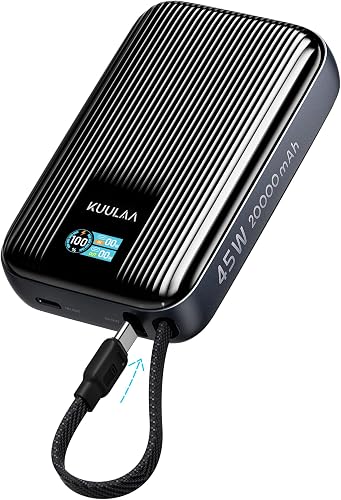
Kuulaa 45W Power Bank: Best for a visible battery reading
- 20,000mAh capacity
- 45W PD3.0 and PPS support
- Detachable built-in USB-C cable
- Digital display
Kuulaa combines 45W charging with a detachable built-in USB-C cable and a percentage display. Its 345g body remains compact for travel cases.
Pros
- Digital percentage display
- Detachable built-in cable
- 45W PD3.0 and PPS support
Cons
- Two ports
- Heavier than Anker
Kuulaa gives you 20,000mAh capacity, 45W PD3.0 and PPS support, a digital display and a detachable built-in USB-C cable. The percentage display makes it easy to see how much charge remains before an imaging session.
The cable is designed to detach and can also act as a carrying strap. That makes it easier to replace the cable or carry the power bank, while keeping the setup less dependent on a loose cable.
Kuulaa measures 11.4 x 7.2 x 3.0 cm and weighs 345g. It has 2 ports, so it offers fewer connection choices than Belkin, UGREEN or KONFULON.
The pack supports several charging protocols, including PD3.0, PPS, QC4+, QC3.0 and QC2.0. Those details matter most if the same battery will also charge compatible phones or other electronics.
Choose Kuulaa when a precise battery display and detachable built-in cable are useful. Its 2-port design is better for a focused setup than for charging many accessories at once.
KONFULON 80000mAh High Capacity PD 30W Power: Best for extended remote sessions
- 80,000mAh capacity
- PD 30W output
- 5 outputs
- LCD display and flashlight
KONFULON is the capacity pick, with 80,000mAh, 5 outputs and an LCD display. Its 6.2 x 3.4 x 2.9 in body is much larger than the other choices.
Pros
- Largest capacity here
- Five outputs
- LCD display and flashlight
Cons
- 30W maximum output
- Large body for a compact telescope setup
KONFULON is the capacity choice for extended remote sessions. Its 80,000mAh battery is far larger than every other option here, and its 5 outputs let you charge several devices at once.
The port layout includes 1 USB-C output and 4 USB outputs. It also lists PD 30W output, a 22.5W USB output and 2 USB-C input ports for recharging with a compatible charger.
An LCD display shows the remaining power percentage. A built-in flashlight and SOS function add another use for outdoor observing, especially when you are packing for a dark site.
The body measures 6.2 x 3.4 x 2.9 in. That is much larger than Anker and thicker than the 20,000mAh models, so it needs a stable place near the telescope rather than a small accessory pouch.
KONFULON lists a 13-hour battery charge time. Choose it when maximum stored capacity and multiple outputs matter more than weight, charging time or compact storage.
How we compared Seestar S50 power banks
We compared the power banks by the details that affect a portable imaging session: capacity, maximum output, connector type, number of ports, cable arrangement, size and battery status display.
A higher capacity can mean more stored energy, but it also usually means a larger pack. Anker's 10,000mAh body is the lightest option here, while KONFULON's 80,000mAh pack is the largest-capacity choice.
Output matters when you want to recharge devices quickly or power more than one device. UGREEN, EF ECOFLOW, Mophie and Kuulaa list 45W maximum output.
Belkin lists 15W USB-C output, and KONFULON lists PD 30W output.
We also looked at how easy each pack is to use in the dark. Digital displays on UGREEN, EF ECOFLOW and Kuulaa show a percentage, while Anker, Belkin and Mophie use simpler indicators.
KONFULON adds an LCD display and flashlight.
Our score weighs specs, features and buyer feedback against what you're shopping for.
What capacity should you choose?
Choose 10,000mAh for the lightest kit, 20,000mAh for a balanced setup and 80,000mAh when you need the longest possible time away from an outlet. Capacity alone does not tell you the exact runtime of a Seestar S50 session.
A 10,000mAh pack can reduce the weight of a small telescope case. The Anker Power Bank weighs 8.48 oz, which is much less than the 20,000mAh choices listed here.
The 20,000mAh group gives you more room for a full observing session and another device. UGREEN, Belkin, EF ECOFLOW, Mophie and Kuulaa all sit in this middle range, but their port layouts and output ratings differ.
KONFULON's 80,000mAh capacity is designed for long periods away from a wall outlet. Its larger body and 13-hour charge time make it better suited to planned remote use than quick grab-and-go observing.
If you also need power for dew control, a mount or other accessories, review our guide to the best telescope power supply before settling on a single battery bank.
Which ports and cables make setup easier?
A built-in USB-C cable reduces the number of loose accessories you need to pack, while multiple ports help when your phone and telescope need power at the same time. Your first check should be the cable connection required by the Seestar S50.
UGREEN includes an 8.6-inch braided USB-C cable. EF ECOFLOW includes a built-in 0.82-ft USB-C cable, and Kuulaa uses a detachable built-in USB-C cable.
Anker has USB-C and USB-A connectors, while Belkin has USB-C and 2 USB-A ports. Mophie provides 3 USB-C ports, and KONFULON provides 1 USB-C output plus 4 USB outputs.
Do not choose by port count alone. Confirm which port supplies the output you need, then keep the telescope cable separate from charging cables so setup stays easy to check in low light.
For larger telescope systems, the best telescope power distribution box guide explains when a dedicated distribution setup may make more sense than a single power bank.
How should you use a power bank at the telescope?
Keep the power bank protected from dew, direct moisture and accidental cable strain, then place it where the cable can reach without pulling on the telescope or tripod. Recharge the pack before each planned session.
A display can make this routine easier because UGREEN, EF ECOFLOW, Kuulaa and KONFULON show remaining power more clearly than a basic status light. If your pack uses an LED indicator, check it before leaving home.
Avoid letting a cable hang where it can catch on the mount or tripod. A short built-in cable may keep the setup tidy, while a longer separate cable may be better when the battery must sit on the ground.
If you run several devices at once, connect the Seestar S50 first and watch the battery indicator. Multi-port charging is useful, but the available output is shared across connected devices.
Dew can affect more than power planning. If moisture is a regular problem at your site, see our guide to a DIY telescope dew shield before your next session.
Are power banks suitable for every telescope setup?
Power banks are convenient for a USB-powered portable telescope, but they are not a universal replacement for every telescope power system.
Larger mounts, heaters and accessories may need different connectors, voltage or distribution.
A power bank is best seen as a portable source for compatible USB gear.
It is not automatically a substitute for a dedicated telescope battery or distribution system.
For a Celestron setup, compare the battery and adapter requirements in our guide to the Celestron NexStar 8SE power adapter.
A Seestar S50 setup should still be checked against its own instructions.
Different telescope systems can ask for different power arrangements, even when the battery size looks similar on paper.
A power bank also does not replace a dedicated telescope battery when you need several regulated outputs.
Our guide to the best Celestron telescope power supply covers a different type of observing setup.
That guide is useful when the goal is a more fixed system with separate outputs for multiple parts.
Do not assume that a high mAh number automatically makes a pack compatible.
Match the cable, connector and required power arrangement before you connect the telescope.
Also check the shape of the setup in the field, not just on a desk.
A cable that reaches at home may pull or catch when the tripod is set on uneven ground.
Keep the battery stable and protected from dew, and leave a little slack in the cable.
If the power needs are unclear, follow the telescope instructions first and treat the power bank as an accessory, not a workaround.
Best Seestar S50 power bank: the final choice
The UGREEN Nexode 20000mAh 45W Power Bank is the best Seestar S50 power bank for most users.
It balances 20,000mAh capacity, 45W output, 3 outputs and a built-in USB-C cable. That balance suits a standard portable imaging session without forcing a compromise on size or connections.
The built-in cable is 8.6 inches long and has a braided exterior. It supports input and output, so it can help with charging a device or recharging the pack.
The LED display shows the remaining battery percentage. That reading is handy before a session, when a quick check is easier than guessing from a small light.
Pick the Anker Power Bank if your priority is a slim, light pack. Its 10,000mAh capacity is the smallest in this group, but its body is easier to fit beside a compact case.
That choice suits short sessions, a light load and people who value low bulk. Choose KONFULON if you plan long remote sessions and can carry its larger 80,000mAh body.
It gives the most stored capacity in this group, plus 5 outputs, an LCD display and a flashlight. The trade-off is size, weight and a 13-hour battery charge time, so it needs planning rather than a last minute grab.
Belkin fits a simple multi-device kit with USB-A ports. Its 20,000mAh capacity, 3 ports and included cable suit a setup where common connectors matter more than high output.
The USB-C maximum is 15W, so it is less suited to buyers who want 45W charging. EF ECOFLOW and Kuulaa suit buyers who want 45W output with a digital display.
EF ECOFLOW adds an aluminum alloy body and a built-in 0.82 ft USB-C cable. Kuulaa adds a detachable built-in cable, percentage display and PD3.0 and PPS support.
Both are focused choices, but cable length, port count and body shape differ in daily use. Mophie is the better fit when three USB-C ports and an aluminum body matter more than minimum weight.
Its 20,000mAh battery, 45W USB-C PD output and LED indicators suit a kit built around USB-C devices. The body is heavier and there is no built-in cable, so bring the right cable and plan space in the case.
For most buyers, UGREEN remains the safest middle choice because it covers capacity, output and connection options in one pack. If you use older Celestron battery equipment, our guide to Celestron PowerTank battery replacement may help you compare repair and replacement planning.
That guide is most relevant when the question is about keeping older gear in service. For a Seestar S50, match the cable and connector first, then choose the capacity that fits your sessions.
Our top 3 picks at a glance
-
1
-
2
Best for most imaging sessions
UGREEN Nexode 20000mAh 45W Power Bank
9.6/10 our score
See it on Amazon -
3
Best for simple multi-device charging
Belkin 20000mAh 15W 3 Port Power Bank
9.4/10 our score
See it on Amazon
Frequently asked questions
What is the best Seestar S50 power bank?
The UGREEN Nexode 20000mAh 45W Power Bank is the best Seestar S50 power bank for most users in this group. It combines 20,000mAh capacity, 45W output, 3 outputs and a built-in USB-C cable.
Choose Anker when low weight matters more than capacity, or KONFULON when you need the largest battery here.
How large should a power bank be for the Seestar S50?
A 20,000mAh power bank is a practical middle choice for a portable imaging setup. It gives you more capacity than a 10,000mAh pack without the much larger body of the 80,000mAh KONFULON.
The right size also depends on your cable, other devices and how long you plan to stay away from an outlet.
Does a Seestar S50 power bank need USB-C?
Choose a power bank with the connector and output arrangement required by your Seestar S50 cable. USB-C options are common in this group, including packs with a USB-C port or built-in USB-C cable.
Check the telescope cable ends before buying.
A USB-A port alone may not match your cable without the correct adapter.
Is 45W too much for the Seestar S50?
A power bank's maximum output is not the same as the power a connected device must draw. The UGREEN, EF ECOFLOW, Mophie and Kuulaa packs list 45W maximum output, while the device and charging setup determine the actual draw.
Use a compatible cable and follow the Seestar S50 instructions.
Can one power bank run the telescope and other devices?
Yes, some power banks here have multiple outputs. UGREEN, Belkin and KONFULON list 3, 3 and 5 outputs respectively, while Mophie lists 3 USB-C ports.
Using several outputs divides the available power, so keep the telescope connected first when imaging time matters.


