6 Best Telescopes Under $400 (November 2026)
The best best telescope under 400 include the Celestron AstroMaster 70AZ Refractor Telescope for Moon for first-time Moon viewing, the Gskyer Telescope for travel and phone viewing, and the Koolpte Telescope for Adults & Beginner Astronomers for adult beginners on a budget.
On this page (8 sections)
- How we compared these telescopes under 400
- The best telescopes under 400, compared
- Which mount is easiest for a first telescope?
- Is 70mm, 80mm or 102mm the right aperture?
- What focal length should you choose?
- Should you get a phone adapter or a finderscope first?
- How should you set up and care for a new telescope?
- Our verdict on the best telescope under 400
The best telescope under 400 for most beginners is the Celestron AstroMaster 70AZ, with a 70mm fully coated refractor, 900mm focal length, 20mm and 10mm eyepieces and a StarPointer red dot finderscope. Our score weighs specs, features and buyer feedback against what you are shopping for.
A 400 cap does not force a bad choice. You can get a true 80mm refractor, a 102mm optical tube, or a compact travel scope with a phone adapter.
The key question is what you want to see first. The Moon rewards higher magnification and steady pointing.
Bright clusters and wide fields reward a shorter tube and a wider view.
If your budget can stretch a little later, our guide to the best telescope under 500 shows the next step up. For a wider look at higher limits, see best telescopes under 1000 and best telescopes under 5000.
Our picks at a glance
-
1
 Best for first-time Moon viewing
Celestron AstroMaster 70AZ Refractor Telescope for Moon
9.7/10 our score
See it on Amazon -
2
-
3
 Best for adult beginners on a budget
Koolpte Telescope for Adults & Beginner Astronomers
9.3/10 our score
See it on Amazon
- 4
 Best for kids and giftsCheck it
- 5
 Check it
Celestron PowerSeeker 80EQ Refractor Telescope for Moon
Best for learning an equatorial mount - 6
 Check it
SVBONY SV48P Telescope for Adults High Powered
Best for wide-field astrophotography
How we compared these telescopes under 400
We compared aperture, focal length, included eyepieces, finderscopes, mounts and included accessories for each model. We checked the specs for the Celestron AstroMaster 70AZ, Gskyer, both Koolpte models, Celestron PowerSeeker 80EQ and SVBONY SV48P.
We also looked for what is missing. A scope that needs a mount, a finder or a second eyepiece costs more in time and money than the headline purchase.
That is why the SVBONY SV48P scores lower here even though its 102mm aperture is the largest in the group.
We gave extra weight to complete kits. A telescope that includes a tripod, a finder and at least two eyepieces lets you observe on the first clear night.
That matters more for a first purchase than a headline magnification number.
We also separated travel scopes from home scopes. A short tube that fits in a carry bag suits campsite and backyard use.
A longer, heavier kit suits a fixed observing spot where you can take more time to set up.
If you want the simplest first telescope, the best budget friendly telescope list may be a better starting point. This guide focuses on models that stay under the 400 limit while giving you room to grow.
How the scoring reflects real use
The Celestron picks score higher for included finderscopes, longer focal lengths and clearer upgrade paths. The Gskyer and Koolpte picks score higher for portability, phone adapters and included cases.
The SVBONY scores for optics and focuser quality, but not for completeness. That balance reflects what a new buyer can actually use without buying more parts.
The best telescopes under 400, compared
The Celestron AstroMaster 70AZ and Gskyer lead on complete packages for beginners. The Koolpte 80mm model adds aperture.
The PowerSeeker 80EQ adds a 900mm focal length and an equatorial mount. The SVBONY SV48P adds aperture and a dual-speed focuser, but you bring the mount.
In practice, the choice comes down to three trade-offs. Aperture controls brightness.
Focal length controls magnification and field size. Included accessories control how soon you can observe.
A 900mm tube with a 10mm eyepiece gives a very different view from a 400mm tube with the same eyepiece. Neither is wrong.
The longer tube suits lunar detail. The shorter tube suits finding targets and scanning wide fields.
Celestron AstroMaster 70AZ Refractor Telescope for Moon: Best for first-time Moon viewing
- 70mm fully coated achromatic refractor
- 900mm focal length
- 20mm and 10mm eyepieces
- StarPointer red dot finderscope
- Alt-azimuth mount with panhandle
A complete beginner refractor with two eyepieces, an erect image diagonal and a red dot finderscope for fast target aiming.
Pros
- Two eyepieces included
- Red dot finderscope included
- Manual alt-azimuth mount is simple to point
Cons
- 70mm aperture gathers less light than 80mm and 102mm picks
- Manual mount means you move it by hand to follow objects
The AstroMaster 70AZ suits adults and kids who want a first telescope that works for the Moon, planets, bright star clusters and daytime land views. Its 70mm fully coated achromatic refractor gives bright, clear views, and the erect image diagonal keeps land views right side up.
With a 900mm focal length, the 20mm eyepiece gives 45x and the 10mm eyepiece gives 90x. That higher magnification suits lunar detail and planets better than the short 400mm Gskyer tube.
It also means the view is narrower, so finding a target takes a little more care.
The manual alt-azimuth mount with panhandle lets you point up, down and side to side with simple controls. The StarPointer red dot finderscope helps you aim fast, and assembly needs no tools.
The adjustable full-height tripod suits adults and kids, standing or seated.
The trade-off is aperture. At 70mm, it gathers less light than the 80mm Koolpte and PowerSeeker picks and less than the 102mm SVBONY.
If you want the most complete beginner kit, this is the pick.
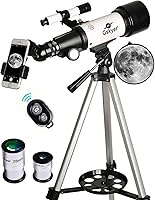
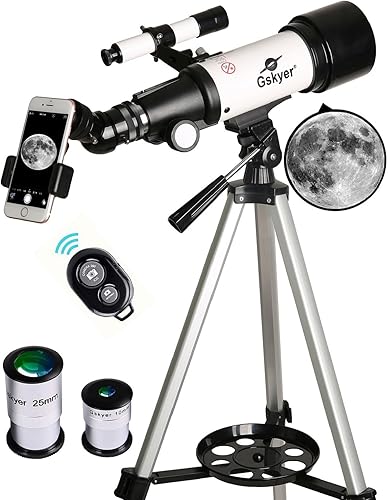
Gskyer Telescope: Best for travel and phone viewing
- 70mm aperture
- 400mm focal length
- 25mm and 10mm eyepieces with 3x Barlow lens
- 5x24 finder scope
- Phone adapter, wireless remote and carry bag
A compact 70mm refractor with a carry bag, phone adapter and wireless remote for travel and shared viewing.
Pros
- Carry bag included
- Phone adapter and wireless remote included
- Short 400mm tube is easy to pack
Cons
- Short focal length gives lower magnification than the 900mm Celestron picks
- Smaller aperture than 80mm and 102mm options
The Gskyer suits kids, beginners and travelers who want a light 70mm refractor that packs into a carry bag. Its 70mm aperture and 400mm focal length make a short, portable tube for Moon and planet viewing and for terrestrial targets.
It comes with 25mm and 10mm eyepieces for 16x and 40x, plus a 3x Barlow lens that triples the power of each eyepiece. That gives you a range from wide, easy views to closer views for the Moon.
A 5x24 finder scope with cross-hair lines helps you locate objects before you switch to the main eyepiece.
A phone adapter and wireless camera remote let you view through a phone screen and take celestial images. The adjustable aluminum tripod gives several viewing positions, and the telescope and tripod fit inside the carry bag.
Fully coated glass optics help protect your eyes and keep images clean.
The trade-off is reach. The 400mm focal length gives a wider field but less magnification than 900mm models.
Choose this for travel and phone viewing over maximum lunar detail.
Koolpte Telescope for Adults & Beginner Astronomers: Best for adult beginners on a budget
- 80mm aperture
- 600mm focal length
- 25mm and 10mm eyepieces with 3x Barlow lens
- 5x24 finder scope
- Phone adapter, wireless remote and carrying bag
An 80mm refractor with fully multi-coated optics, two eyepieces and a Barlow lens for stronger Moon and planet views than 70mm models.
Pros
- 80mm aperture gathers more light than 70mm
- Barlow lens triples eyepiece power
- Phone adapter and carrying bag included
Cons
- 600mm focal length is shorter than 900mm picks for high magnification
- No red dot finderscope named in the included items
The Koolpte 80mm model suits adults and beginner astronomers who want more light than a 70mm scope without leaving this price range. Its 80mm aperture and 600mm focal length capture more light for brighter Moon and planet views.
It includes 25mm and 10mm eyepieces for 24x and 60x, plus a 3x Barlow lens that can raise magnification to 72x and 180x. That range lets you start wide to find a target, then move closer for detail.
A 5x24 finder scope makes locating objects easier.
Fully multi-coated high transmission coatings help image brightness and clarity. A phone adapter, wireless remote and carrying bag support portable sessions and shared viewing on a phone.
The adjustable aluminum tripod suits home or travel use.
Setup needs no tools, and focusing is manual and quick. The trade-off is focal length.
At 600mm, it gives less magnification per eyepiece than the 900mm Celestron models, so the 70mm AstroMaster can still feel stronger on planets despite its smaller aperture.
Koolpte Telescope for Kids: Best for kids and gifts
- 70mm aperture
- 500mm focal length
- 25mm and 10mm eyepieces with 3x Barlow lens
- 5x24 finderscope
- Phone adapter, wireless remote and carrying case
A 70mm refractor built for kids and beginners, with a carrying case, phone adapter and wireless remote for family sessions.
Pros
- Carrying case included
- Phone adapter and wireless remote included
- Two eyepieces plus Barlow lens included
Cons
- 70mm aperture is smaller than the 80mm and 102mm picks
- 500mm focal length gives less reach than 900mm models
The Koolpte for Kids suits families buying a first telescope as a gift or for shared backyard sessions. Its 70mm aperture and 500mm focal length give a middle ground between the short Gskyer tube and the longer Celestron tubes.
It comes with 25mm and 10mm eyepieces plus a 3x Barlow lens that triples the power of each eyepiece. That pairing gives low power for finding the Moon and higher power for a closer look.
A 5x24 finderscope helps young users locate the Moon and bright targets.
A phone adapter, wireless remote and carrying case make it portable and help you take photos through a phone. The adjustable aluminum tripod lets kids and adults set a comfortable height.
The alt-azimuth mount keeps pointing simple, with no alignment step.
This model is aimed at building interest in astronomy and getting kids away from a screen. The trade-off is aperture.
At 70mm, it gathers less light than the 80mm Koolpte adult model and the 102mm SVBONY, so faint deep-sky views will be more limited.
Celestron PowerSeeker 80EQ Refractor Telescope for Moon: Best for learning an equatorial mount
- 80mm refractor
- 900mm focal length
- 20mm and 4mm eyepieces with 3x Barlow lens
- 5x24 finderscope
- Manual German equatorial mount with slow-motion altitude rod
An 80mm refractor on a manual German equatorial mount with slow-motion controls for smoother tracking by hand.
Pros
- 900mm focal length for higher magnification
- Slow-motion altitude rod aids tracking
- Accessory tray included
Cons
- Equatorial mount takes more learning than alt-azimuth
- Heavier at 16.4 pounds than the portable picks
The PowerSeeker 80EQ suits beginners who want to learn a manual German equatorial mount and track objects by hand. Its 80mm refractor and 900mm focal length give strong light gathering and high magnification for the Moon, planets, distant stars and the Orion Nebula.
It includes 20mm and 4mm eyepieces plus a 3x Barlow lens that triples the power of each. The 20mm eyepiece suits finding and focusing, while the 4mm eyepiece gives a very close view for planets.
A 5x24 finderscope helps you find targets before you switch to a higher power eyepiece.
The manual German equatorial mount has a slow-motion altitude rod for smoother pointing and tracking as objects drift across the sky. An accessory tray holds eyepieces, and the tripod is included.
Included astronomy software with 36,000 celestial objects and printable sky maps helps you plan sessions.
The trade-off is learning curve and weight. At 16.4 pounds, it is heavier than travel picks, and an equatorial mount takes more practice than an alt-azimuth mount.
Choose it if you want to learn tracking.
SVBONY SV48P Telescope for Adults High Powered: Best for wide-field astrophotography
- 102mm f/6.5 achromatic refractor
- Fully multi-coated optics
- 2.5-inch dual-speed focuser
- 360-degree rotatable design
- Tube rings with 210mm dovetail plate
A 102mm optical tube with a dual-speed focuser and tube rings, made for wide-field views and photography with a mount you supply.
Pros
- Largest aperture in this group at 102mm
- Dual-speed focuser for fine focus
- Tube rings and dovetail plate included
Cons
- No mount or tripod included
- No finderscope included
The SVBONY SV48P suits adults who already own or plan to buy a mount and want a large-aperture tube for wide-field work. Its 102mm f/6.5 achromatic refractor has fully multi-coated optics and a short focal ratio for a larger field of view.
A 2.5-inch dual-speed focuser lets you focus fast to a rough point, then fine-tune for clarity. The 360-degree rotatable design helps you set the camera or eyepiece angle for photography.
Tube rings and a 210mm dovetail plate add stability on a mount.
At about 663mm focal length from the f/6.5 ratio, it collects more light and gives brighter images for nebulae and wide-angle celestial photos. Fully multi-coated and anti-reflective coatings help reduce reflection and improve brightness, clarity and contrast.
The trade-off is key for buyers. No mount, tripod or finderscope is included.
You need those parts, plus an eyepiece or camera, before you can observe. For a complete first telescope, the Celestron and Gskyer picks are better value.
| Product | Best for | Aperture | Focal length | Mount | Our score |
|---|---|---|---|---|---|
| Celestron AstroMaster 70AZ Refractor Telescope for Moon | first-time Moon viewing | 70mm | 900mm | Altazimuth | 9.7 |
| Gskyer Telescope | travel and phone viewing | 70mm | 400mm | Altazimuth | 9.7 |
| Koolpte Telescope for Adults & Beginner Astronomers | adult beginners on a budget | 80mm | 600mm | Altazimuth | 9.3 |
| Koolpte Telescope for Kids | kids and gifts | 70mm | 500mm | Altazimuth | 9.3 |
| Celestron PowerSeeker 80EQ Refractor Telescope for Moon | learning an equatorial mount | 80mm | 900mm | Manual German equatorial | 8.7 |
| SVBONY SV48P Telescope for Adults High Powered | wide-field astrophotography | 102mm | No mount included | 8.5 |
Which mount is easiest for a first telescope?
An alt-azimuth mount is easiest for beginners. You move the telescope up and down and side to side with a panhandle or by hand, which matches how you point at land targets.
The AstroMaster 70AZ, Gskyer and both Koolpte models use alt-azimuth mounts. That makes them simple for Moon viewing, where you can point, focus and adjust without learning polar alignment.
Alt-azimuth pointing is intuitive on the first night. You see a bright target, move the tube toward it, and adjust focus.
That speed helps beginners stay engaged.
When an equatorial mount helps
A manual German equatorial mount helps you follow an object as it drifts across the sky. The PowerSeeker 80EQ uses slow-motion controls to move smoothly in altitude, which can make tracking feel more controlled.
Equatorial mounts align with the rotation of the sky. That alignment makes long, slow movements feel more natural once you learn the controls.
When you need to supply your own mount
The SVBONY SV48P has no mount. If you choose it, budget time to pick a mount that fits its tube rings and dovetail plate.
That extra step is part of the real cost of this pick.
A mount for a 102mm tube must hold the tube steady. A weak mount will shake the view and make focusing harder, even with good optics.
Is 70mm, 80mm or 102mm the right aperture?
Pick 80mm for the best balance of light and portability in this group. It gathers more light than 70mm for brighter Moon and planet views, without the size of the 102mm SVBONY tube.
70mm models are lighter and simpler. The AstroMaster 70AZ, Gskyer and Koolpte for Kids all use 70mm, which is enough for the Moon, bright planets and star clusters.
The difference between 70mm and 80mm is modest but noticeable on planets. The extra light makes the view brighter at the same magnification.
What aperture means in daily use
Aperture is the diameter of the main lens. More aperture means more light reaches your eye, so faint stars look brighter and planet detail is easier to see.
Aperture also affects resolution. A larger lens can show finer detail when the air is steady and the magnification is right.
Why the largest aperture is not always the best buy
The SVBONY SV48P has 102mm, but it has no mount or finder. A smaller complete kit can give you more usable views on your first night than a larger tube that needs extra parts.
Photography changes that balance. A larger aperture and a fast focal ratio help wide-field photos, but only if you have a stable mount and a camera.
What focal length should you choose?
Choose 900mm if you want higher magnification for the Moon and planets. The AstroMaster 70AZ and PowerSeeker 80EQ both use 900mm, so their eyepieces give stronger views than short tubes.
Choose 400mm to 600mm if you want a wider field for finding targets and for wide-field photography. The Gskyer uses 400mm, the Koolpte for Kids uses 500mm, and the Koolpte adult model uses 600mm.
Longer focal lengths narrow the field. That narrowing is useful for lunar detail, but it makes a beginner finder scope more important.
How eyepieces and Barlow lenses change the view
Magnification comes from focal length divided by eyepiece size. A Barlow lens triples the power of the eyepiece you use with it, which is why the Gskyer and Koolpte models reach higher magnification on paper.
A 900mm tube with a 20mm eyepiece gives 45x. A 400mm tube with a 25mm eyepiece gives 16x.
The same eyepiece does not give the same view on different tubes.
Why more magnification is not always better
High magnification makes the view dimmer and harder to steady. Start with a lower power eyepiece to find the target and focus, then switch to a higher power eyepiece or Barlow lens for a closer look.
Atmospheric shimmer also limits useful magnification. On many nights, a moderate power gives a clearer view than the highest power available.
Should you get a phone adapter or a finderscope first?
Get a finderscope first if you want to find stars and planets quickly. A finder helps you aim the main tube at a target you can see with the naked eye.
The AstroMaster 70AZ uses a StarPointer red dot finderscope. The Gskyer, Koolpte models and PowerSeeker use 5x24 finderscopes.
The SVBONY SV48P has finderscope dovetail slots but no finderscope included.
A red dot finder shows a target in a wide field. A small telescopic finder shows a narrower field.
Both help, but they feel different in use.
When a phone adapter is worth it
A phone adapter helps you share views with family and try simple phone photos. The Gskyer and Koolpte models include a phone adapter and wireless remote, which makes them strong picks for gifts and travel.
Phone photos work best on the Moon and bright planets. They are a shared viewing tool first and a photography tool second at this level.
What to do if your pick has neither
The SV48P needs a finder and an eyepiece or camera from you. Add those parts before your first session, or choose a complete kit instead.
Check the included items list before you buy. A missing finder or eyepiece can delay your first session by weeks.
How should you set up and care for a new telescope?
Set up on firm, level ground and let the telescope reach outdoor temperature before you observe. That simple step helps focus and reduces shimmer from temperature differences.
Assemble the tripod first, then the mount, then the optical tube. Add the finderscope and a low power eyepiece, point at a bright target, and focus slowly until the image is sharp.
Allow at least a short wait after moving a telescope from indoors to outdoors. Cold air and warm optics can make focus shift during that period.
How to find your first target
Use the finderscope to center a bright object, then look through the main eyepiece. Start with the Moon, which is bright and easy to find, and learn how focus and magnification change the view.
Move the telescope in small steps. Large movements make it easy to lose a target at higher magnification.
How to store it between sessions
Keep lenses clean and covered, store eyepieces in a case or tray, and keep the telescope in a dry place. The Gskyer and Koolpte models include a bag or case that helps with storage and travel.
Never point a telescope at the sun. Direct sunlight can cause serious eye injury and damage the optics.
Our verdict on the best telescope under 400
Pick the Celestron AstroMaster 70AZ if you want the most complete first telescope. Its 70mm lens, 900mm focal length, two eyepieces and red dot finderscope cover the Moon, planets and bright clusters with no extra parts to buy.
Pick the Gskyer if travel and phone viewing matter most. Pick the Koolpte 80mm model if you want more aperture for adult beginner viewing.
Pick the PowerSeeker 80EQ if you want to learn an equatorial mount with slow-motion controls.
Pick the Koolpte for Kids for a gift-ready kit with a case, phone adapter and remote. Pick the SVBONY SV48P only if you already have a mount and plan wide-field photography.
For most families, the decision is between a complete home kit and a complete travel kit. The AstroMaster suits a fixed backyard spot.
The Gskyer suits trips and shared phone viewing.
For the next step up in budget, read our best telescope under 500 guide. If you are comparing a much higher limit, see best telescopes under 1000 and best telescopes under 5000.
Our top 3 picks at a glance
-
1
Best for first-time Moon viewing
Celestron AstroMaster 70AZ Refractor Telescope for Moon
9.7/10 our score
See it on Amazon -
2
-
3
Best for adult beginners on a budget
Koolpte Telescope for Adults & Beginner Astronomers
9.3/10 our score
See it on Amazon
Frequently asked questions
What is the best telescope under 400 for a beginner?
The Celestron AstroMaster 70AZ is the best telescope under 400 for most beginners. Its 70mm refractor, 900mm focal length, two eyepieces and StarPointer finderscope cover Moon viewing, planets and bright star clusters without extra purchases.
Is 70mm or 80mm better for a first telescope?
80mm gathers more light, so it shows fainter stars and brighter planet views than 70mm. The trade-off is size and weight.
Choose 70mm for a lighter, simpler first scope and 80mm if you want more light for the Moon and planets.
Do I need a phone adapter on my first telescope?
A phone adapter helps you share views and try simple photos, but it is not needed for visual observing. The Gskyer and Koolpte picks include one, while the Celestron picks focus on eyepieces and finderscopes for direct viewing.
What does focal length mean on these telescopes?
Focal length affects magnification with each eyepiece. A 900mm tube gives higher magnification with the same eyepiece than a 400mm tube.
Shorter tubes give a wider field, which helps for locating targets and wide-field photography.
Can I use the SVBONY SV48P right out of the box?
No. The SV48P is an optical tube with no mount, tripod or finderscope included.
You need a compatible mount, an eyepiece or camera, and a finder to use it for visual observing or photography.