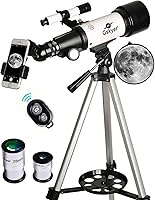
Celestron PowerSeeker 114EQ Telescope Review: Worth It? (November 2026)
The Celestron PowerSeeker 114EQ suits beginners who want a 114 mm reflector and a manual equatorial mount for viewing the Moon and planets. Its mount takes practice to use, so compare it with simpler altazimuth options if you want a more direct start.
On this page (8 sections)
- What does the Celestron PowerSeeker 114EQ include?
- How does the equatorial mount affect beginner use?
- What can you see with the PowerSeeker 114EQ?
- Is the included 4 mm eyepiece and Barlow useful?
- How does it compare with the PowerSeeker 70EQ?
- What are the main alternatives to this reflector?
- Who should choose the Celestron PowerSeeker 114EQ?
- Is the Celestron PowerSeeker 114EQ worth considering?
The Celestron PowerSeeker 114EQ is a 114 mm reflector for beginners who want to learn a manual equatorial mount. Its included eyepieces and slow-motion control give you a broad starting package, while the mount asks for more setup than a simple up-down, left-right design.
Choose it if you want to explore the Moon and planets and are ready to practice aiming and tracking. If ease of pointing matters more than aperture, compare it with a refractor on an altazimuth mount.
What does the Celestron PowerSeeker 114EQ include?
The PowerSeeker 114EQ includes a 114 mm Newtonian reflector, manual German equatorial mount, tripod, two eyepieces and a 3x Barlow lens. It also includes a 5x24 finderscope and an accessory tray.
Celestron PowerSeeker 114EQ Reflector Telescope for Backyard: Best for learning equatorial tracking

- 114 mm Newtonian reflector
- Manual German equatorial mount
- 20 mm and 4 mm eyepieces
- 3x Barlow lens
A 114 mm reflector package with a manual equatorial mount and two eyepieces. It fits a beginner who wants to learn slow-motion tracking while observing the Moon and planets.
Pros
- 114 mm reflector aperture
- Slow-motion control for tracking
- Includes two eyepieces and a 3x Barlow lens
- Compact and portable design
Cons
- Equatorial mount setup has a learning curve
- The included 4 mm eyepiece and Barlow create very high magnification that may be hard to use steadily
Its 900 mm focal length and 114 mm aperture are the core specifications to weigh against the mount and included accessories. The 20 mm eyepiece is the sensible first choice for finding a target; try the 4 mm after you have centered it and the image is steady.
The Barlow lens triples the magnification of an eyepiece. That can make focusing and tracking more demanding, so treat it as an option to explore under steady conditions rather than a promise of a better view.
How does the equatorial mount affect beginner use?
The manual German equatorial mount can follow an object across the sky with a slow-motion control, but learning its orientation adds a step before observing. Unlike an altazimuth mount, it is not always intuitive to move in the same direction the target appears to drift.
Take time to identify the mount's axes and controls in daylight. Follow the Celestron instructions for assembly and alignment, and practice with a distant stationary object without pointing near the Sun.
Once set up, the slow-motion rod lets you make small tracking adjustments as an object drifts through the field. This is useful at higher magnification, where a target crosses the view more quickly.
What can you see with the PowerSeeker 114EQ?
The 114 mm reflector is intended for lunar and planetary observing, along with brighter deep-sky targets such as the Orion Nebula. Celestron also describes views of Saturn's rings and Jupiter's Galilean moons.
Start with the Moon, which is bright and easy to locate. Use the 20 mm eyepiece first, focus carefully, then switch to the 4 mm eyepiece if the mount and sky conditions give a stable view.
A telescope's magnification does not determine image quality on its own. Atmospheric steadiness, focus, collimation and the mount's stability all affect how much detail you can see.
Never point a telescope at the Sun, even through a filter that is not designed and installed for solar viewing. Keep the telescope capped and away from direct sunlight when it is not in use.
Is the included 4 mm eyepiece and Barlow useful?
The 4 mm eyepiece and 3x Barlow offer high magnification combinations, but they may be difficult for a new observer to use well. High power narrows the view and makes small shakes or tracking errors more noticeable.
Begin with the 20 mm eyepiece to locate and center an object. Move up in magnification only when the target is focused and holding steady in the view.
Don't assume that using both the 4 mm eyepiece and Barlow is the best way to observe. If the image becomes dim or blurry, return to a lower-power eyepiece and refocus.
How does it compare with the PowerSeeker 70EQ?
The PowerSeeker 114EQ has a larger 114 mm reflector aperture, while the 70EQ is a smaller telescope in the same product family. Both use equatorial mounts, so the 70EQ does not remove the need to learn that style of tracking.
Compare the Celestron PowerSeeker 70EQ telescope review if you want to weigh the smaller model against the 114EQ. Pick based on the aperture, portability and package details that matter for your observing spot.
For a simpler mount, the Celestron Travel Scope 80 review is another comparison point. Its refractor design and travel focus make it a different fit from a Newtonian reflector on an equatorial mount.
What are the main alternatives to this reflector?
The PowerSeeker 114EQ is one option among reflectors for astronomy and beginner telescopes. Consider how you plan to aim, where you will observe and whether you want a larger aperture or a lighter travel setup.
The best reflector telescopes for astronomy guide helps compare reflector designs. For a more advanced aperture step within Celestron's range, see the Celestron Omni XLT 150 telescope review.
A child-focused Moon scope has a different goal and setup. The GeoSafari Omega reflector telescope review is another compact reflector to compare, while the best reflector telescope for beginners guide can help sort options by ease of use.
Who should choose the Celestron PowerSeeker 114EQ?
Choose the PowerSeeker 114EQ if you want a 114 mm reflector with an equatorial mount and included eyepieces and are willing to learn its controls. It is a better match for planned backyard sessions than for someone who wants to set up instantly and point in any direction.
Consider another design if you expect very simple setup, frequent travel, or mostly daytime terrestrial viewing. The mount and reflector format shape the experience as much as the aperture does.
Is the Celestron PowerSeeker 114EQ worth considering?
The Celestron PowerSeeker 114EQ is worth considering when aperture and learning equatorial tracking are priorities. Its 114 mm reflector and slow-motion rod form a useful beginner package, but its high-magnification accessories call for patience and steady conditions.
Pick the PowerSeeker 114EQ if you want to learn a manual equatorial mount; pick an altazimuth refractor if straightforward pointing is your main goal. For a child-first lunar setup, choose a scope designed around tabletop use and Moon viewing.
Frequently asked questions
Is the Celestron PowerSeeker 114EQ good for beginners?
The PowerSeeker 114EQ can suit a beginner who wants a 114 mm reflector and is willing to learn an equatorial mount. Its slow-motion rod helps track objects, but setup and orientation take practice.
If you want simpler point-and-look movement, consider an altazimuth telescope instead.
What can you see with the PowerSeeker 114EQ?
Celestron describes the 114EQ as suitable for the Moon, planets, distant stars and objects such as the Orion Nebula. The included 20 mm and 4 mm eyepieces give different views, while observing conditions and steady focusing affect what you can make out.
What eyepieces come with the Celestron PowerSeeker 114EQ?
The package includes 20 mm and 4 mm eyepieces plus a 3x Barlow lens. The Barlow increases magnification, but higher magnification also makes the view harder to keep steady and can dim the image, so start with the 20 mm eyepiece.
Is the PowerSeeker 114EQ easy to set up?
The PowerSeeker includes a tripod, accessory tray and manual German equatorial mount, but a beginner should allow time to understand the mount's orientation and controls. Practice aiming at a distant daytime target without looking at the Sun, then start a night session with the Moon.