GeoSafari Omega Reflector Telescope Review: Worth It? (October 2026)
The GeoSafari Omega suits beginners focused on the Moon and first planetary views, with a 76 mm mirror, 700 mm focal length and several eyepieces. Its advertised magnification range reaches high numbers, but steady, useful views depend on observing conditions and setup.
On this page (7 sections)
- What does the GeoSafari Omega offer?
- How easy is the Omega for a beginner?
- Does 350x magnification make the Omega powerful?
- How does the Omega compare with other reflector telescopes?
- What should you know about the tripod and portability?
- Is the GeoSafari Omega worth considering?
- Who should choose the GeoSafari Omega?
The GeoSafari Omega is a beginner reflector for first lunar and planetary observations, with a 76 mm primary mirror, 700 mm focal length and multiple eyepieces. Its altazimuth mount may suit a new observer, while its small aperture and advertised maximum magnification call for realistic expectations.
What does the GeoSafari Omega offer?
The Omega pairs a 76 mm mirror and 700 mm focal length with a 5 x 24 mm finder scope, eyepieces, a 2x Barlow lens and an adjustable aluminum tripod. That combination gives a beginner several ways to learn pointing and magnification.
The product description says the telescope has 4 eyepieces, while its feature specifications say it includes 3 interchangeable glass eyepieces. It describes a 35x to 175x range from the eyepieces, while another feature says the 2x Barlow lens can provide up to 350x magnification.
Educational Insights GeoSafari Omega Reflector Telescope: Best for first lunar viewing
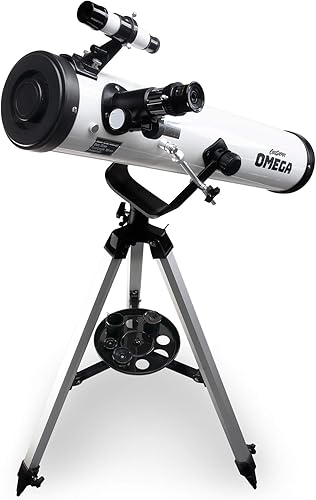
- 76 mm primary mirror
- 700 mm focal length
- Altazimuth mount
- 4 eyepieces and 2x Barlow lens
A beginner oriented telescope with a 76 mm mirror, 700 mm focal length, several eyepieces, a Barlow lens and an adjustable tripod. Its feature set fits learning the sky and starting with the Moon.
Pros
- 76 mm primary mirror
- 700 mm focal length
- Multiple eyepieces and 2x Barlow lens
- Adjustable tripod and accessory tray
Cons
- Small aperture limits light gathering compared with larger reflectors
- High magnification claims do not ensure clear views
The magnification figures describe combinations of the optics, not a promise that every setting will show a clear image. Begin with lower power, find and focus on the target, then increase magnification only while the view stays sharp.
What is the 76 mm mirror suited to?
A 76 mm aperture makes the Moon an approachable first target, with the product description highlighting lunar craters and ridges. Bright planets are also sensible early targets, but expect small images and modest detail.
Observing conditions, focus and telescope steadiness all affect what you can make out. Compare the Omega with other best reflector telescopes for astronomy if you expect to move beyond the Moon and brightest objects.
How easy is the Omega for a beginner?
The Omega's altazimuth mount moves up and down and side to side, which is straightforward for a first telescope. It includes an optical finder scope to help aim the main tube toward a target.
The product information describes the finder as both an optical finder scope and a reflex finder. Check the finder type with Educational Insights if that distinction matters to your aiming method.
An altazimuth mount does not follow a target automatically. As the sky appears to move, you will need to nudge the telescope to keep the object centered.
The adjustable aluminum tripod and accessory tray provide a basic stand and a place for accessories. Set the tripod on firm ground and keep the eyepiece you are using within reach.
If choosing a first scope is your main concern, our guide to the best reflector telescope for beginners compares beginner-friendly options and trade-offs.
Does 350x magnification make the Omega powerful?
The Omega's advertised maximum of 350x should not be treated as an everyday magnification. Aperture, optical quality, air movement and mount stability all affect whether a high-power view remains sharp.
The product description gives a 35x to 175x range from its eyepieces, while a feature bullet says the 2x Barlow lens can reach 350x. That does not mean the telescope can deliver crisp detail at the top end.
Start with the eyepiece that gives the widest, easiest view. Once the target is centered and focused, try more power in small steps, and return to lower power if the image grows dim, blurry or difficult to hold.
For a beginner, a steady view of the Moon at moderate power is more useful than a large, soft image. Learning to focus and track an object is part of using any manual telescope.
How does the Omega compare with other reflector telescopes?
The Omega favors a simpler beginner setup, while the alternatives below offer larger apertures and equatorial mounts. More aperture gathers more light, while mount design and weight affect how approachable a telescope feels.
The Celestron Omni XLT 150 is another step up in aperture and scope size. Read our Omni XLT 150 telescope review if you're comparing a beginner instrument with a larger Newtonian reflector.
For more options in the same design family, see our guide to the best Newtonian reflector telescope.
| Telescope | Aperture | Focal length | Mount |
|---|---|---|---|
| Educational Insights GeoSafari Omega | 76 mm | 700 mm | Altazimuth |
| Celestron PowerSeeker 127EQ | 127 mm | 1000 mm | Manual German equatorial |
| Gskyer 130EQ | 130 mm | 650 mm | Equatorial |
The Omega suits a beginner who prefers simple up-down and side-to-side motion. The larger Celestron and Gskyer models offer more aperture, but their equatorial mounts require a different setup and tracking approach.
What should you know about the tripod and portability?
The Omega includes an adjustable aluminum tripod and accessory tray. Its listed item weight is 4.86 kg, so consider that weight when deciding how far you may need to carry it.
The product dimensions are 29 in deep, 9.2 in wide and 10.4 in high. The description doesn't say how the telescope packs, so check the dimensions against your storage space before deciding where to keep it.
Set the tripod on solid ground and avoid touching the tube while viewing, so the image can settle after focusing or an adjustment.
Educational Insights describes this telescope as suitable for children ages 5 and up, while the age range in its specifications is 8+. Consider adult guidance when children use it.
Is the GeoSafari Omega worth considering?
Consider the Omega if your priority is a first telescope for the Moon, bright planets and learning basic observing. Its 76 mm mirror, eyepieces, finder scope and altazimuth mount cover the core parts of a starter setup.
Choose a larger reflector if you want more light gathering and are ready for a different mount. The Celestron PowerSeeker 127EQ and Gskyer 130EQ have larger apertures and equatorial mounts.
Compare the SVBONY SV520 telescope review if you're also weighing a different telescope style. A refractor or reflector telescope comparison can help clarify which optical design fits your priorities.
A manual visual telescope is a different tool from the best computer controlled telescope with camera. For a smart telescope comparison, see Seestar S30 Pro vs S30.
Who should choose the GeoSafari Omega?
The Omega fits someone who wants a first reflector and a way to learn the sky. Its 76 mm mirror and altazimuth mount suit a simple route into lunar observing, while the included eyepieces let you experiment with magnification.
Pick the Omega if simplicity matters most and you are comfortable with limited aperture. Choose the Celestron or Gskyer if you want a larger mirror and are ready to learn an equatorial mount; compare their apertures and setup needs before deciding.
Frequently asked questions
Is the GeoSafari Omega good for viewing the Moon?
The Omega is a reasonable beginner choice for lunar viewing, with a 76 mm mirror, 700 mm focal length and multiple eyepieces. The Moon is a bright, rewarding first target, and the included 2x Barlow lens can change the magnification.
Start with a lower-power eyepiece to find and center the Moon.
Can the GeoSafari Omega show planets?
The Omega can be used to look at bright planets, though its 76 mm aperture sets a limit on fine detail. Choose a calm night, let the telescope adjust to outdoor conditions, and begin at low power.
A large advertised maximum magnification does not guarantee a sharp view.
What mount does the GeoSafari Omega use?
The GeoSafari Omega has an altazimuth mount, which moves up and down and side to side. That simple movement suits learning to point at the Moon and bright objects.
It does not track the sky automatically, so you will need to make small adjustments as an object drifts.
How does the Omega compare with a 127 mm reflector?
The Celestron PowerSeeker 127EQ has a 127 mm aperture, while the Omega has a 76 mm mirror. The larger aperture can gather more light, but the Celestron's German equatorial mount adds a learning step.
Choose based on whether you value a simpler first setup or more aperture.