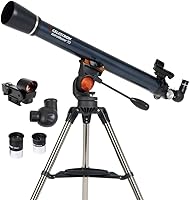
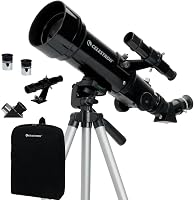
Best 90mm Refractor Telescopes: Top 9 Picks (October 2026)
The best 90mm refractor telescopes include the Dianfan Telescope for an all-around starter kit, the MEEZAA Telescope for a multi-coated 800 mm setup, and the Gskyer Telescope 600x90mm AZ Astronomical Refractor Telescope for a shorter focal length.
On this page (5 sections)
The best 90mm refractor telescope for most beginners is the Dianfan Telescope, an 800 mm kit with a 90 mm objective, two eyepieces, a 3× Barlow lens and carry bag. If you want a longer focal length, consider the Hawkko; if lunar accessories matter most, the HUGERSTAR includes a Moon filter and phase guide.
A 90 mm refractor telescope is a practical middle ground for lunar and bright-planet observing. For a broader target comparison, see telescopes for planets and galaxies.
Each pick here has a 90 mm objective, but focal length, mount controls and included accessories change what the kit is best suited to do.
For a broader view of adult refractors, see our guide to the best refractor telescope for adults. To compare how a larger objective changes the trade-offs, read how to choose a 150mm refractor telescope.
Our picks at a glance
-
1

-
2

-
3
 Best for a shorter focal length
Gskyer Telescope 600x90mm AZ Astronomical Refractor Telescope
9.2/10 our score
See it on Amazon
- 4
 Check it
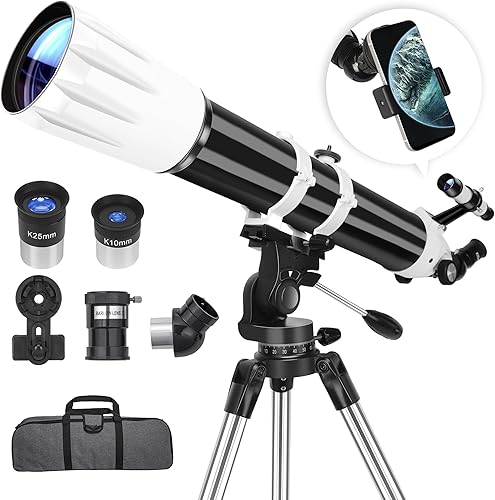
Hawkko 90mm Aperture 900mm Telescope for Adults
Best for a 900 mm focal length - 5
 Best for phone capture controlsCheck it
- 6
 Best for an optical tube upgrade pathCheck it
- 7
 Check it
Koolpte 90mm Aperture Refractor Telescope with Fine-Tracking
Best for fine manual tracking - 8
 Check it
HUGERSTAR Telescope for Adults & Kids
Best for Moon-focused family sessions - 9
 Check it
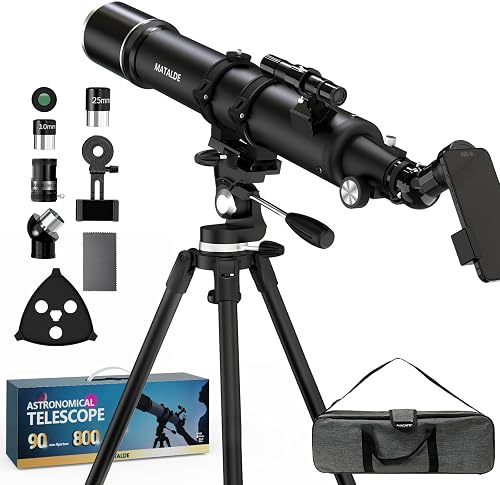
Matalde 90mm Aperture Telescope 800mm Focal Length
Best for an iron tripod
How we chose a 90mm refractor telescope
The best 90mm refractor telescope for lunar and planetary viewing should pair a suitable focal length with a usable mount and a clear starter set of accessories. We compared aperture, focal length, eyepiece options, mount details and included gear, giving more weight to complete kits aimed at visual observing.
Aperture is only one part of the decision. Our guide to why telescope aperture matters explains light gathering, while the best 80mm refractor telescopes show what you give up or gain by stepping down in objective size.
Our score weighs specs and features against what shoppers seeking a 90 mm refractor need.
| Product | Best for | Aperture | Focal length | Included accessories | Our score |
|---|---|---|---|---|---|
| Dianfan Telescope | an all-around starter kit | 90 mm | 800 mm | Two eyepieces, 3× Barlow lens, phone adapter, carry bag | 9.7 |
| MEEZAA Telescope | a multi-coated 800 mm setup | 90 mm | 800 mm | Two eyepieces, 3× Barlow lens, phone adapter, carry bag | 9.6 |
| Gskyer Telescope 600x90mm AZ Astronomical Refractor Telescope | a shorter focal length | 90 mm | 600 mm | Three eyepieces, 3× Barlow lens, 6×30 finderscope, erecting prism | 9.2 |
| Hawkko 90mm Aperture 900mm Telescope for Adults | a 900 mm focal length | 90 mm | 900 mm | Two eyepieces, 3× Barlow lens, phone adapter, carry bag | 9.0 |
| Koolpte Telescope for Adults | phone capture controls | 90 mm | 901 mm | Digital eyepiece, phone adapter, wireless remote | 8.9 |
| SVBONY SV48P Telescope | an optical tube upgrade path | 90 mm | 500 mm | Optical tube only | 8.6 |
| Koolpte 90mm Aperture Refractor Telescope with Fine-Tracking | fine manual tracking | 90 mm | 800 mm | Two eyepieces, 3× Barlow lens, phone adapter | 8.3 |
| HUGERSTAR Telescope for Adults & Kids | Moon-focused family sessions | 90 mm | 600 mm | Moon filter, Moon phase guide, two eyepieces, 3× Barlow lens | 8.1 |
| Matalde 90mm Aperture Telescope 800mm Focal Length | an iron tripod | 90 mm | 800 mm | Two eyepieces, 3× Barlow lens, finderscope, phone adapter | 7.9 |
Which 90mm refractor telescope fits your observing style?
The Dianfan is the strongest all-around kit here, while the remaining choices stand out for a specific focal length, mount control or lunar accessory. Match the product to the way you plan to observe before comparing magnification claims.
Dianfan Telescope: Best for an all-around starter kit
- 90 mm aperture
- 800 mm focal length
- Two eyepieces and 3× Barlow lens
- Phone adapter and carry bag
The 800 mm focal length and 90 mm objective are paired with two eyepieces and a 3× Barlow lens. A stainless steel tripod, phone adapter and carry bag round out the kit.
Pros
- Fully coated 90 mm objective
- Stainless steel tripod and carry bag
- 45° zenith mirror for upright terrestrial views
Cons
- Maximum stated magnification depends on viewing conditions
- Manual focusing
Dianfan balances a 90 mm fully coated objective with an 800 mm focal length, a useful pairing for starting with the Moon and bright planets. The kit includes two eyepieces and a 3× Barlow lens, with a stated 32×–240× range.
The stainless steel tripod, carry bag and phone adapter make it a complete package for backyard observing or taking the setup elsewhere. A 45° zenith mirror gives upright, correctly oriented views for daytime targets, too.
Dianfan describes assembly as taking about 15 minutes and includes instructions. Use a flat surface, begin with the lower-power eyepiece and leave the highest magnification for nights when the view stays sharp.
Buy it for a complete 800 mm starter setup with a bag and phone adapter. Its 240× upper figure is a kit calculation, so the clearest lunar views may come at lower power.
MEEZAA Telescope: Best for a multi-coated 800 mm setup
- 90 mm aperture
- 800 mm focal length
- Fully multi-coated optics
- Stainless steel tripod and carry bag
This 90 mm, 800 mm refractor combines fully multi-coated optics with two eyepieces and a 3× Barlow lens. Its kit includes an adjustable stainless steel tripod and phone adapter.
Pros
- Fully multi-coated optical glass
- Adjustable tripod
- Phone adapter and carry bag
Cons
- Manual focusing
- High magnification is sensitive to seeing conditions
MEEZAA is a close alternative if fully multi-coated optics and an 800 mm focal length are priorities. Its 90 mm objective comes with two eyepieces, a 3× Barlow lens, a stainless steel tripod and a carry bag.
The kit's stated 32×–240× range comes from those eyepieces and the Barlow combination. For lunar viewing, start at 32× to locate the target, then increase magnification only if the Moon's edge and surface details remain crisp.
A phone adapter supports basic photos and videos through the eyepiece. The tripod adjusts from 28 to 46 in, which gives some flexibility in viewing height.
Choose MEEZAA if you want a multi-coated 90 mm kit with phone capture accessories. As with the other high-power kits, the advertised upper range depends on focus and atmospheric steadiness.
Gskyer Telescope 600x90mm AZ Astronomical Refractor Telescope: Best for a shorter focal length
- 90 mm aperture
- 600 mm focal length
- Three eyepieces
- Adjustable aluminum tripod
The 600 mm focal length is shorter than the 800 mm and 900 mm kits here. Three eyepieces, a finderscope and an erecting prism give this refractor a broad accessory set.
Pros
- Three eyepieces included
- Adjustable tripod
- Erecting prism for terrestrial viewing
Cons
- Aluminum tripod rather than stainless steel
- Maximum magnification is not a guarantee of a sharp view
Gskyer uses a 600 mm focal length, shorter than the 800 mm and 900 mm options above. That makes it the choice to consider if you want a shorter refractor tube and a kit with three replaceable eyepieces.
Its listed eyepiece powers are 24×, 60× and 120×, with a 3× Barlow lens also included. The package adds a 6×30 finderscope, an erecting prism and an adjustable aluminum tripod.
The included prism supports terrestrial viewing, while the three eyepieces give you several starting points for the Moon. Compare the setup as a whole, since this kit's supplied tripod material differs from the stainless steel tripods in several other picks.
Pick Gskyer for its shorter focal length and three eyepieces. If you mainly want to inspect lunar detail at higher image scale, compare it with the longer 800 mm and 900 mm refractors.
Hawkko 90mm Aperture 900mm Telescope for Adults: Best for a 900 mm focal length
- 90 mm aperture
- 900 mm focal length
- Two eyepieces and 3× Barlow lens
- Phone adapter and carry bag
The Hawkko pairs a 90 mm objective with a 900 mm focal length and a stainless steel AZ tripod. It also includes two eyepieces, a Barlow lens, phone adapter and carry bag.
Pros
- 900 mm focal length
- Multi-coated optics
- Stainless steel AZ tripod
Cons
- The 36×–270× range includes powers that may be limited by conditions
- Manual focusing
Hawkko pairs a 90 mm aperture with a 900 mm focal length, the longest among the complete kits in this roundup. Its stated magnification range is 36×–270× using two eyepieces and a 3× Barlow lens.
The kit includes a stainless steel AZ tripod, finder, zenith mirror, accessory tray, phone adapter and carry bag. The tripod height adjusts from 28 to 46 in, and the mount is described as supporting 360° rotation.
That longer focal length can give more magnification with the same eyepiece than a shorter tube. It does not assure sharper detail, so begin at low power and let the image quality guide your eyepiece choice.
Choose Hawkko if a 900 mm focal length is your priority. Its included phone adapter and carry bag make the package more travel-ready than a bare optical tube.
Koolpte Telescope for Adults: Best for phone capture controls
- 90 mm aperture
- 901 mm focal length
- Vertisteel AZ mount
- Phone adapter and wireless remote
This 90 mm refractor has a 901 mm focal length and a Vertisteel AZ mount. A phone adapter and wireless remote support taking images without touching the phone during capture.
Pros
- Phone adapter and wireless remote
- Fully multi-coated optics
- Vertisteel AZ mount
Cons
- Some accessory details are less specific
- No focal-length or eyepiece-based magnification range given
Koolpte's 90 mm refractor has a 901 mm focal length and a Vertisteel AZ mount. It stands out for its phone adapter and wireless remote, which let you trigger phone images without touching the phone during capture.
The kit also includes a digital eyepiece and an aluminum tripod. The available specifications do not give an eyepiece-based magnification range, so compare the included optics and accessories with the more fully described 800 mm and 900 mm kits.
At 2.07 kg, the stated weight is lighter than some complete packages listed here. If portability is a deciding factor, consider the full dimensions and what you need to carry along with the telescope.
Pick this Koolpte for phone capture controls and a long focal length. Buyers who want a clearly stated set of eyepieces and magnification options may prefer another complete kit.
SVBONY SV48P Telescope: Best for an optical tube upgrade path
- 90 mm aperture
- 500 mm focal length
- 1:10 dual-speed focuser
- Accepts 1.25 in and 2 in accessories
The SV48P is an optical tube assembly with a 500 mm focal length, a dual-speed focuser and 1.25 in and 2 in accessory compatibility. Plan separately for a mount and eyepieces.
Pros
- Dual-speed focuser with 1:10 adjustment
- Rotating focuser
- Works with 1.25 in and 2 in accessories
Cons
- No mount or eyepieces included
- No finderscope
The SVBONY SV48P is an optical tube assembly, not a complete telescope kit. For a review of another SVBONY refractor, see the SVBONY SV520 telescope review.
Its 90 mm aperture and 500 mm focal length are paired with a 1:10 dual-speed focuser and a rotating focuser assembly.
It accepts 1.25 in and 2 in accessories, giving you room to build a system around compatible eyepieces and a mount. The package does not include a finderscope, mount or eyepieces, so budget time to choose those separately.
The shorter focal length favors a wider view with a given eyepiece than a longer refractor. That can suit larger targets, while close lunar views call for suitable eyepieces and careful focusing.
Choose the SV48P if you already plan to assemble a telescope system. For a ready-to-observe kit with tripod and eyepieces, choose one of the complete packages above.
Koolpte 90mm Aperture Refractor Telescope with Fine-Tracking: Best for fine manual tracking
- 90 mm aperture
- 800 mm focal length
- Slow-motion tracking knobs
- Two eyepieces and 3× Barlow lens
The Vertisteel AZ mount offers coarse positioning and slow-motion knobs for centering and tracking. The kit has an 800 mm optical tube, two eyepieces and a 3× Barlow lens.
Pros
- Fine-tracking knobs on the AZ mount
- 90 mm aperture and 800 mm focal length
- Phone adapter included
Cons
- 240× is a calculated option, not a promise of a sharp view
- Manual focusing
This Koolpte kit combines an 800 mm tube with a fine-tracking AZ mount. The mount uses broad positioning for quick aiming, then slow-motion knobs for more precise centering and tracking.
Two eyepieces and a 3× Barlow lens provide calculated options of 32×, 80×, 96× and 240×. The product guidance recommends beginning with the 25 mm eyepiece and increasing power only while the image remains sharp.
A phone adapter, finder, diagonal mirror, adjustable tripod and accessory tray are also included. The finer controls may be useful when you're trying to keep the Moon in view while making small adjustments.
Pick it for slow-motion tracking controls on a complete 800 mm kit. The 240× figure is calculated, so observing conditions should decide whether that setting is useful.
HUGERSTAR Telescope for Adults & Kids: Best for Moon-focused family sessions
- 90 mm aperture
- 600 mm focal length
- Moon filter and Moon phase guide
- Carry bag and phone adapter
The 600 mm refractor comes with a Moon filter and Moon phase guide, making lunar observing the focus of its beginner kit. It also includes a phone adapter and carry bag.
Pros
- Moon filter included
- Moon phase guide included
- Adjustable tripod and carry bag
Cons
- Maximum stated power may exceed what conditions support
- Manual focusing
HUGERSTAR is a 600 mm kit with a Moon filter and Moon phase guide. Those lunar accessories give it a specific focus within a crowded field of 90 mm refractors.
The kit includes 25 mm and 10 mm eyepieces, a 3× Barlow lens and a 5×24 finder. Its stated magnification range is 24×–180×, and the aluminum tripod adjusts from 22.04 to 47.63 in.
A carry bag supports storage and travel, while the phone adapter can hold a smartphone at the eyepiece. The Moon filter is meant to reduce lunar glare; follow the instructions for its use and never point a telescope at the Sun without a proper solar filter.
Choose HUGERSTAR for its Moon-focused extras and adjustable tripod. Its 600 mm focal length is shorter than the 800 mm and 900 mm picks, so compare the image scale you want as well as the accessory set.
Matalde 90mm Aperture Telescope 800mm Focal Length: Best for an iron tripod
- 90 mm aperture
- 800 mm focal length
- Adjustable iron tripod
- Two eyepieces and 3× Barlow lens
The Matalde 800 mm refractor is supplied with an adjustable iron tripod, two eyepieces and a 3× Barlow lens. Its kit also includes a finderscope and phone adapter.
Pros
- Iron tripod
- Two eyepieces and 3× Barlow lens
- Finderscope and phone adapter included
Cons
- Tripod adjustment range is 26–46 in
- Manual focusing
Matalde pairs a 90 mm objective with an 800 mm focal length and an adjustable iron tripod. It includes two eyepieces, a 3× Barlow lens, a finderscope, a zenith diagonal and a phone adapter.
The stated 32×–240× range follows from the eyepieces and Barlow combination. The tripod adjusts from 26 to 46 in, and the package is described as an alt-azimuth system with horizontal and vertical movement.
Its accessories cover the basics for lunar observing and simple phone capture. The product information does not specify lens coatings, so buyers who prioritize that detail may prefer one of the kits with coatings clearly described.
Pick Matalde if you want an iron tripod and an 800 mm focal length. Compare the stated tripod height with your observing position and storage space before deciding.
What should you compare in a 90mm aperture telescope?
For a 90mm aperture telescope, compare focal length, eyepieces and mount controls along with the objective diameter. Those details affect how easy it is to frame a target, change magnification and keep an object centered.
How does focal length affect lunar viewing?
Focal length and eyepiece focal length determine magnification: divide the telescope focal length by the eyepiece focal length. For example, an 800 mm telescope with a 25 mm eyepiece gives 32× before adding a Barlow lens.
Longer focal lengths give higher magnification with the same eyepiece, while shorter ones provide a wider view. For broad context on refractor designs, compare our guide to the best achromatic refractor telescope.
Does a 90mm telescope need a 3× Barlow lens?
A 3× Barlow lens can raise magnification by tripling the eyepiece's effective power. It is an accessory for changing image scale, not a way to add detail the telescope or sky cannot resolve.
Start with the lowest-power eyepiece to find and center the Moon. Increase power gradually, and return to a lower setting if the view dims or becomes soft.
What mount features help with planets?
An alt-azimuth mount moves up, down, left and right, which is simple for manual aiming. Slow-motion knobs, such as those on the fine-tracking Koolpte, make smaller corrections easier as a target drifts across the view.
A steady tripod matters at higher magnifications because small shakes become more visible. Place the legs on flat ground and check that joints are secure before observing.
How do you get clearer lunar and planetary views?
Clear, steady air and a stable setup help a 90 mm refractor show more detail. Let the telescope settle outdoors, use low power first and avoid nights when wind or atmospheric turbulence makes the image shimmer.
The Moon is a forgiving first target because it is bright and easy to locate. For planets, wait until they are well above the horizon and use a higher-power eyepiece only when the image stays focused.
City lights can hide faint objects, though they do not prevent lunar observing. For brighter, more contrasty views of the Moon and planets, focus on clear skies and steady air.
Which 90mm refractor should you choose?
Choose the Dianfan for a complete 800 mm starter kit with a carry bag, or the Hawkko if you want the longest focal length among the full packages here. Pick the HUGERSTAR for lunar accessories, the fine-tracking Koolpte for slow-motion controls, or the SVBONY if you want to build around an optical tube.
The best 90mm refractor telescope for you is the one whose mount and accessories fit your observing plans. Start with the Moon, use modest magnification, and move to higher power only when the view remains sharp.
Our top 3 picks at a glance
-
1
-
2
-
3
Best for a shorter focal length
Gskyer Telescope 600x90mm AZ Astronomical Refractor Telescope
9.2/10 our score
See it on Amazon
Frequently asked questions
What can you see with a 90mm refractor telescope?
A 90 mm refractor can show lunar craters and seas, along with bright planets when the sky is steady. The Moon is a practical first target because it is bright and easy to locate.
Aperture gathers light, but seeing conditions and the mount also affect how much detail remains clear.
Is a 90mm aperture telescope good for beginners?
Yes. A 90 mm aperture telescope can be a useful beginner size when the kit includes a stable mount, a finder and straightforward eyepieces.
Compare the complete setup and carrying needs as well as the objective size.
Our guide to what telescope aperture is good for beginners explains how aperture affects target choice.
Does higher magnification show more detail?
Not by itself. Magnification enlarges the view, but a blurry image does not gain detail, and atmospheric turbulence can limit useful power.
Start with the lowest-power eyepiece, focus carefully, then increase power only while the image stays sharp.
A Barlow lens adds magnification, but it cannot improve the atmosphere.
What does focal length change on a refractor?
Focal length helps determine magnification with a given eyepiece: divide the telescope's focal length by the eyepiece focal length. A longer focal length gives more magnification with the same eyepiece, while a shorter one gives a wider view.
The eyepiece and observing conditions still matter.
Can I take Moon photos through a 90mm telescope?
Many complete kits here include a phone adapter, which can hold a smartphone over the eyepiece for basic lunar photos. Keep the phone aligned and begin at low power.
A phone adapter is a convenient starting point, but it does not turn a visual telescope into a dedicated astrophotography system.