Celestron PowerSeeker 70EQ Telescope Review: Worth It? (November 2026)
The Celestron PowerSeeker 70EQ is a capable beginner refractor for Moon and planet viewing, with a 70mm aperture, 700mm focal length and manual German equatorial mount. Choose it when smooth tracking matters more than the simplest possible setup.
On this page (10 sections)
- Celestron PowerSeeker 70EQ review: the short answer
- What stands out about the PowerSeeker 70EQ?
- How does the 70mm refractor perform for beginner targets?
- Is the equatorial mount easy to use?
- PowerSeeker 70EQ specifications at a glance
- Celestron PowerSeeker 70EQ versus two alternatives
- Which telescope should you choose?
- How to set up the PowerSeeker 70EQ
- Care and safety for new observers
- Final verdict on the Celestron PowerSeeker 70EQ
The Celestron PowerSeeker 70EQ is a strong beginner refractor for Moon and planet viewing when you want a manual equatorial mount. Its 70mm aperture and 700mm focal length favor a traditional telescope experience, while the slow-motion altitude rod helps you follow objects after setup.
The main trade-off is simplicity. An equatorial mount can track the sky smoothly, but a beginner may find an altazimuth mount easier to understand at first.
Celestron PowerSeeker 70EQ review: the short answer
The Celestron PowerSeeker 70EQ is best for families and new observers who want a 70mm refractor with guided manual movement. It includes a finderscope, 20mm and 4mm eyepieces, a 3x Barlow lens and astronomy software with 36,000 celestial objects and printable sky maps.
The 700mm focal length gives this refractor a different feel from a short travel scope. It is more focused on controlled viewing than on keeping the entire setup as small as possible.
For another adult-focused option, compare the best refractor telescope for adults before choosing a mount style.
What stands out about the PowerSeeker 70EQ?
The manual German equatorial mount is the defining feature. Its slow-motion altitude rod lets you make small adjustments while following an object across the night sky.
That control system can be useful for Moon and planet sessions because the target can stay in view while you make gradual corrections. It also gives beginners a chance to learn how equatorial mounts move.
The refractor optical design is straightforward for a first telescope. The 70mm objective gathers enough light for the Moon, planets, distant stars and the Orion Nebula, according to Celestron's product information.
The telescope has a 700mm focal length and a 0.74-degree field of view. Those numbers describe a narrower, more focused view than a short 400mm travel refractor.
What comes with the Celestron PowerSeeker 70EQ?
The package includes a 20mm eyepiece, a 4mm eyepiece, a finderscope and a 3x Barlow lens. The Barlow lens triples the magnification of each included eyepiece.
The 20mm eyepiece is the sensible starting point for finding and centering an object. The 4mm eyepiece gives a much stronger view, so careful focus and steady control become more important.
The included astronomy software works on a Mac, PC or laptop. It provides information on 36,000 celestial objects and printable sky maps for planning an observing session.
The telescope also includes a tripod and accessory tray. Keep the eyepieces and Barlow lens together so you are not searching for small parts in the dark.
How does the 70mm refractor perform for beginner targets?
The 70mm aperture is well suited to bright beginner targets, especially the Moon and planets. It can also show distant stars and the Orion Nebula when observing conditions and location cooperate.
The Moon is the easiest first target because its bright surface and craters are simple to locate. Start with the 20mm eyepiece, focus carefully, then try the 4mm eyepiece if the view remains steady.
Planet viewing depends on alignment, focus and atmospheric steadiness. A telescope's aperture does not guarantee a sharp view on every night, so give the optics time to reach outdoor temperature and avoid observing through a closed window.
The product information describes views of Saturn's rings and Jupiter's Galilean moons. These targets are good reasons to learn the slow-motion control instead of relying only on large movements.
For a broader comparison of optical designs, our guide to the best achromatic refractor telescope explains where a classic refractor fits.
Is the equatorial mount easy to use?
The equatorial mount is useful once you understand its movement, but it may take longer to learn than an altazimuth mount. The PowerSeeker 70EQ is therefore a better fit for a beginner who wants to learn tracking rather than only point and look.
Begin by placing the tripod on firm ground and making the setup stable. Use the finderscope to locate a bright target, then switch to the 20mm eyepiece for a wider view.
After centering the object, use the slow-motion altitude rod for small corrections. Avoid making large movements with the fine control, since that makes it harder to keep the target centered.
A manual mount does not follow a target automatically. You will still need to make adjustments as the object appears to drift across the sky.
The SVBONY SV520 telescope review is useful if you are comparing this learning-focused setup with another beginner telescope.
PowerSeeker 70EQ specifications at a glance
The core specifications show why this telescope favors focused Moon and planet viewing over ultra-wide travel observing.
| Detail | Celestron PowerSeeker 70EQ |
|---|---|
| Optical design | Refractor |
| Aperture | 70mm |
| Focal length | 700mm (28 in) |
| Mount | Manual German equatorial |
| Focus | Manual |
| Field of view | 0.74 degrees |
| Eyepieces | 20mm and 4mm |
| Barlow lens | 3x |
| Finderscope | Included |
| Coating | Fully coated |
| Item weight | 13.9 lb |
| Item dimensions | 40 x 40 x 55 in |
| Compatible device | Laptop |
| Model | PowerSeeker 70EQ Telescope |
The dimensions describe the item rather than the clear floor space needed around it. Check where the tripod legs will stand and where you will place the accessory tray before an evening session.
The 13.9 lb weight is manageable for many backyard setups, but carrying a tripod, optical tube and accessories through a dark yard still takes planning. Keep the route clear and use both hands when moving the equipment.
Celestron PowerSeeker 70EQ versus two alternatives
The PowerSeeker 70EQ is the better match when you want a 70mm refractor with a 700mm focal length and equatorial tracking. The two alternatives change the priority: one is lighter and simpler to carry, while the other offers a larger reflector aperture.
Celestron PowerSeeker 70EQ Refractor Telescope for Family: Best for learning equatorial tracking

- 70mm refractor
- 700mm focal length
- Manual German equatorial mount
- 20mm and 4mm eyepieces
- 3x Barlow lens
A family-friendly refractor with a 70mm objective, slow-motion altitude rod and included eyepieces, finderscope and 3x Barlow lens.
Pros
- Long 700mm focal length
- Slow-motion altitude control
- Includes 20mm and 4mm eyepieces
- Compact and portable design
Cons
- Manual mount needs an adjustment period
- The 4mm eyepiece produces a narrow viewing experience
The Celestron PowerSeeker 70EQ combines a 70mm refractor with a manual German equatorial mount. Its 20mm and 4mm eyepieces, 3x Barlow lens, finderscope and astronomy software make it a complete learning setup for family stargazing.
The 700mm focal length supports focused views of bright celestial targets. The slow-motion altitude rod is the reason to choose it over a simpler altazimuth design, especially if you want to practice following objects across the sky.
Its 13.9 lb weight is reasonable for backyard use and planned trips. The telescope is compact and portable, but the equatorial mount still deserves careful setup on firm ground.
Gskyer Telescope: Best for lightweight travel
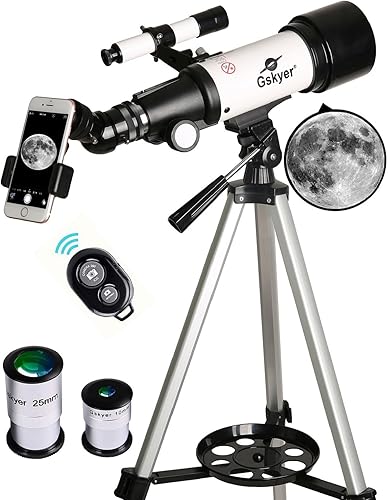
- 70mm aperture
- 400mm focal length
- Altazimuth mount
- Smartphone adapter
- Wireless camera remote
A lighter 70mm refractor with a 400mm focal length, adjustable aluminum tripod, carry bag, smartphone adapter and wireless camera remote.
Pros
- 5.7 lb item weight
- Carry bag included
- Simple altazimuth mount
- Smartphone adapter and wireless remote
Cons
- Shorter focal length than the PowerSeeker 70EQ
- Manual focus still requires careful adjustment
The Gskyer Telescope uses a 70mm aperture and a shorter 400mm focal length. Its altazimuth mount is more direct for beginners who want simple up, down and side-to-side movement.
At 5.7 lb, it is much lighter than the PowerSeeker 70EQ. The adjustable aluminum tripod and carry bag support travel, while the smartphone adapter and wireless camera remote make screen-based viewing part of the setup.
This model is the better fit for portability and quick outdoor use. Choose the Celestron instead if the longer focal length and equatorial tracking matter more than a low carry weight.
Celestron PowerSeeker 127EQ Reflector Telescope for Home: Best for a larger reflector aperture

- 127mm Newtonian reflector
- 1000mm focal length
- Manual German equatorial mount
- 20mm and 4mm eyepieces
- 3x Barlow lens
A larger-aperture reflector with the same style of manual equatorial tracking and a 1000mm focal length.
Pros
- Larger 127mm aperture
- 1000mm focal length
- Slow-motion control knobs
- Includes 20mm and 4mm eyepieces
Cons
- Reflector design needs different care from a refractor
- The longer optical setup may suit home use better than quick trips
The Celestron PowerSeeker 127EQ uses a 127mm Newtonian reflector and 1000mm focal length. Its larger aperture is the main reason to consider it over the 70mm refractor.
It also has a manual German equatorial mount, slow-motion controls, 20mm and 4mm eyepieces and a 3x Barlow lens. That makes the control style familiar to someone already considering the PowerSeeker 70EQ.
The reflector design changes the care and setup experience compared with a refractor. Pick it when the larger aperture is your main goal, and pick the 70EQ when a simpler refractor design better matches your first telescope plans.
Which telescope should you choose?
Choose the PowerSeeker 70EQ if you want a 70mm refractor, 700mm focal length and manual equatorial tracking. It is the most direct choice for learning how to make small adjustments while observing the Moon and planets.
Choose the Gskyer if weight, a carry bag and a smartphone adapter matter most. Its 70mm aperture is the same size, but its 400mm focal length and altazimuth mount create a different observing experience.
Choose the PowerSeeker 127EQ if a 127mm reflector aperture is more important than the simpler refractor design. Its 1000mm focal length and equatorial mount suit a buyer who wants a larger home astronomy setup.
The best refractor telescope for the money gives you another way to compare refractors by use case and features.
How to set up the PowerSeeker 70EQ
Set the tripod on stable ground and arrange the telescope so the controls are easy to reach. Keep the 20mm eyepiece installed while you locate the first target.
Use the finderscope for initial aiming, then look through the main eyepiece. Turn the manual focus control slowly until the object becomes clear.
Once the target is centered, use the slow-motion altitude rod for small corrections. If the image is blurred or shaking, wait for the telescope to settle before changing eyepieces.
Start each session with a bright target. The Moon is easier to locate than a faint deep-sky object, and it gives you a clear way to learn the mount's movement.
Care and safety for new observers
Store the telescope and accessories in a dry place, and protect the objective lens from dust when it is not in use. Avoid sudden temperature changes that can cause moisture to form on the optics.
Never aim the telescope at the Sun without a proper, purpose-built solar filter securely fitted for the telescope. NASA's solar viewing safety guidance explains why ordinary eyepieces and improvised filters are unsafe.
Use the lowest magnification first, then increase power only when the target is centered and the air is steady. More magnification does not automatically produce more detail.
Final verdict on the Celestron PowerSeeker 70EQ
The Celestron PowerSeeker 70EQ is a good beginner choice when equatorial tracking is part of the goal. Its 70mm refractor, 700mm focal length, included eyepieces and slow-motion altitude rod support structured Moon and planet sessions.
Pick the Gskyer for lighter travel and simpler altazimuth movement. Pick the PowerSeeker 127EQ for a larger reflector aperture.
If you want the classic refractor learning path, the 70EQ remains the most balanced choice of the three.
Frequently asked questions
Is the Celestron PowerSeeker 70EQ good for beginners?
The Celestron PowerSeeker 70EQ suits beginners who want a 70mm refractor with a manual German equatorial mount. Its 700mm focal length, finderscope, 20mm and 4mm eyepieces and 3x Barlow lens give you several ways to learn basic Moon and planet viewing.
What can you see with the Celestron PowerSeeker 70EQ?
The 70mm refractor is designed for views of the Moon's craters, planets, distant stars and the Orion Nebula. Celestron also describes views of Saturn's rings and Jupiter's Galilean moons.
Atmospheric conditions, focus and observing location affect what you can see.
Does the PowerSeeker 70EQ have an equatorial mount?
Yes. The Celestron PowerSeeker 70EQ uses a manual German equatorial mount with a slow-motion altitude rod.
After you learn the mount's movement, that control can help you follow objects as they appear to drift across the sky.
Is the PowerSeeker 70EQ portable?
The PowerSeeker 70EQ weighs 13.9 lb and is described as compact, lightweight and portable. It is intended for backyard use, campsites and dark-sky observing sites, but you should still plan how to carry the telescope, tripod and accessories together.