5 Best Smart Telescope for Astrophotography (November 2026)
The best smart telescopes for astrophotography include the DWARFLAB Dwarf Mini Smart Telescope for lightweight deep-sky imaging, the Celestron StarSense Explorer LT 114AZ Newtonian Smartphone for guided telescope viewing, and the ZWO Seestar S30 Pro Smart Telescope for simple urban deep-sky imaging.
On this page (6 sections)
The best smart telescope for astrophotography is the DWARFLAB Dwarf Mini Smart Telescope because it combines app control, Auto GOTO, EQ mode, built-in filters, and exposures up to 90 seconds in a 1.85 lb body. Choose Celestron Origin for a larger home observatory, Seestar S30 Pro for deep-sky simplicity, or StarSense Explorer for smartphone-guided viewing through a traditional reflector.
Smart telescopes automate several jobs that normally require separate astronomy equipment. They can help find targets, track them, capture images, stack frames, and process the result through an app.
We compared the listed optics, mounts, imaging tools, exposure support, software features, portability, and stated use cases. Our score weighs specs, features, and buyer feedback against what you're shopping for.
If you are still learning how these systems differ, start with this smart telescope comparison. Beginners can also compare these picks with our guide to the best smart telescope for beginners.
Our picks at a glance
-
1
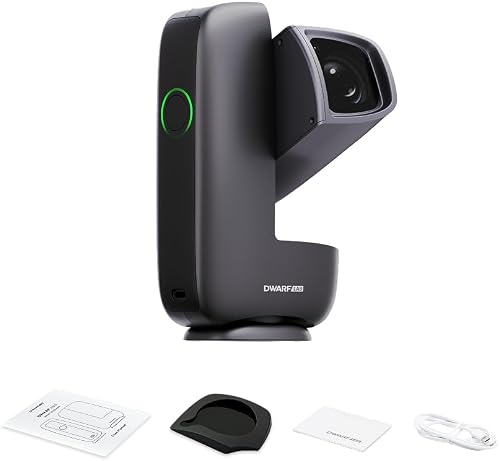 Best for lightweight deep-sky imaging
DWARFLAB Dwarf Mini Smart Telescope
9.5/10 our score
See it on Amazon -
2
 Best for guided telescope viewing
Celestron StarSense Explorer LT 114AZ Newtonian Smartphone
9.5/10 our score
See it on Amazon -
3
 Best for simple urban deep-sky imaging
ZWO Seestar S30 Pro Smart Telescope
9.3/10 our score
See it on Amazon
- 4
 Check it
DWARFLAB Dwarf 3 Smart Telescope
Best for astronomy and daytime imaging - 5
 Best for a permanent backyard setupCheck it
Which smart telescope is best for astrophotography?
The Dwarf Mini is the strongest all-around pick for portable astrophotography, while Celestron Origin is the more capable home-based option. Seestar S30 Pro and Dwarf 3 suit people who want automated imaging without a large telescope setup.
The key difference is how much of the process each model automates. Integrated smart telescopes combine a telescope, camera, mount, wireless control, and processing tools.
The StarSense Explorer LT 114AZ uses a different approach: your smartphone guides you to targets, but the telescope has a manual mount and manual focus.
How we chose these smart astrophotography telescopes
We looked first at target finding and tracking because those features affect how quickly you can begin imaging. Auto GOTO and automatic tracking reduce the need to find objects by hand, while EQ modes can support longer exposures.
We also compared aperture, focal length, field of view, exposure support, and processing. A wider field can help with large nebulae and sky landscapes, while a larger aperture can collect more light through the optical system.
Portability matters for anyone who travels to darker skies. The Dwarf Mini weighs 1.85 lb, the Dwarf 3 weighs 3 lb, and the Seestar S30 Pro weighs 3.64 lb.
Celestron Origin weighs 42 lb, so it fits a very different use case.
For general setup basics, read How to Use a Telescope for Beginners: A Beginner’s Guide. The guide covers the habits that matter for any telescope, including choosing a clear location, allowing time for setup, and protecting the equipment between sessions.
| Product | Best for | Weight | Focal length | Mount | Our score |
|---|---|---|---|---|---|
| DWARFLAB Dwarf Mini Smart Telescope | lightweight deep-sky imaging | 1.85 lb | 150 mm | Altazimuth and equatorial | 9.5 |
| Celestron StarSense Explorer LT 114AZ Newtonian Smartphone | guided telescope viewing | 1000 mm | Manual altazimuth | 9.5 | |
| ZWO Seestar S30 Pro Smart Telescope | simple urban deep-sky imaging | 3.64 lb | 160 mm | 9.3 | |
| DWARFLAB Dwarf 3 Smart Telescope | astronomy and daytime imaging | 3 lb | Altazimuth | 9.1 | |
| Celestron | a permanent backyard setup | 42 lb | 8.9 |
The best smart telescopes for astrophotography
Each model below solves a different imaging problem. The Dwarf Mini leads for portability and exposure control, while the other picks trade travel size, optical design, or automation for a more specific role.
DWARFLAB Dwarf Mini Smart Telescope: Best for lightweight deep-sky imaging
- 1.85 lb weight
- Auto GOTO and 360° pivot
- EQ mode
- Up to 90-second exposures
The Dwarf Mini combines automated targeting, app control, EQ mode, and long exposures in a 1.85 lb body.
Pros
- Very light
- 90-second exposure support
- Built-in light pollution filters
Cons
- 30 mm objective lens
- Smallest body in the group
The DWARFLAB Dwarf Mini Smart Telescope is the best smart telescope for astrophotography when you want to carry the system to a campsite, hiking area, or dark-sky location. Its stated weight is 1.85 lb, and its dimensions are 2.39 in deep by 3.95 in wide by 7.23 in high.
The DWARFLAB app provides an interactive star map and target selection. Auto GOTO helps point the telescope, while its 360° pivot allows full rotation around the sky.
Its 150 mm focal length, 30 mm objective lens, and 2.45-degree field of view suit wide views of star clusters, nebulae, and night-sky scenes. The Sony IMX662 sensor is listed with a 1/2.8-inch format and 2.9μm pixels.
The strongest imaging feature is EQ mode with single-frame exposures up to 90 seconds. Built-in dark, astro, and duo-band filter options support different imaging needs, and smart cloud processing can enhance raw data through the app.
The Dwarf Mini uses a battery power source and includes a filter, USB-C to USB-C charging cable, and cleaning cloth. Pick it when a compact system and longer exposures matter more than a large aperture.
Celestron StarSense Explorer LT 114AZ Newtonian Smartphone: Best for guided telescope viewing
- 114 mm Newtonian reflector
- Smartphone sky recognition
- 25 mm and 10 mm eyepieces
- Manual altazimuth mount
This Celestron uses a smartphone for sky guidance while keeping a traditional optical telescope and eyepieces.
Pros
- Largest stated aperture among the compact picks
- Two eyepieces included
- StarSense smartphone guidance
Cons
- Manual tracking
- Not an integrated automated imaging system
The Celestron StarSense Explorer LT 114AZ Newtonian Smartphone is best for people who want smartphone guidance with a traditional optical telescope. It uses a 114 mm Newtonian reflector with a 1000 mm focal length and high-reflectivity coatings.
StarSense technology analyzes star patterns overhead to calculate the telescope’s position. The app then shows arrows toward selected targets and creates a list based on your location and time.
This model is not an integrated automated astrophotography system. Its manual altazimuth mount uses altitude slow-motion adjustment with a sliding rod, and focusing is manual.
The optical tube is designed for views of the Moon, planets such as Jupiter and Saturn, and deep-sky objects such as the Orion Nebula and Andromeda Galaxy. The 2.04-degree field of view is narrower than the Dwarf Mini and Seestar S30 Pro.
The package includes 25 mm and 10 mm eyepieces, a 2x Barlow lens, a preassembled mount and tripod, an optical tube, and a StarPointer finderscope. Choose it if guided observing is more important than automatic image capture and stacking.
For another traditional telescope option, compare it with the Celestron PowerSeeker 70EQ telescope review.
ZWO Seestar S30 Pro Smart Telescope: Best for simple urban deep-sky imaging
- App control
- Auto tracking and GOTO
- 4K dual camera
- Built-in light pollution filters
The Seestar S30 Pro is designed for app-controlled deep-sky imaging, automatic tracking, and one-tap processing.
Pros
- Auto tracking
- Wide 4.6-degree field of view
- Automatic mosaic stitching
Cons
- Designed for deep-sky objects, not planetary observation
- Keep it stationary during deep-sky imaging
The ZWO Seestar S30 Pro Smart Telescope is a strong choice for simple deep-sky astrophotography, especially when you want app control and a wide field. It weighs 3.64 lb and has a 160 mm focal length, 30 mm objective lens, and 4.6-degree field of view.
The Seestar S30 Pro uses automatic GOTO targeting and tracking. Its app can capture deep-sky objects, the Moon, the Sun, the Milky Way, and star trails, while automatic mosaic stitching can create wider images.
Its dual-camera system supports 4K-quality imaging, and AI processing can reduce noise and improve image quality. Built-in light pollution filters are intended to help with imaging in bright urban areas.
The mount is alt-azimuth with support for equatorial mode. During deep-sky imaging, the system should remain stationary for stable and accurate tracking.
One important limit is its target focus. The Seestar S30 Pro is designed for deep-sky objects and is not intended for planetary observation.
Choose it for nebulae, galaxies, star fields, and wide night landscapes rather than a planet-focused setup.
It includes a tripod, filter, Type-C cable, quick start guide, safety instructions, and astronomy-themed sticker. It works with smartphones and tablets.
DWARFLAB Dwarf 3 Smart Telescope: Best for astronomy and daytime imaging
- 3 lb portable design
- Dual imaging system
- 4K auto-tracking
- Cloud-powered processing
The Dwarf 3 adds a dual-camera system and daytime imaging uses to an app-controlled astrophotography setup.
Pros
- Portable
- Wide-angle and telephoto imaging
- Automatic processing
Cons
- Altazimuth mount
- More weight than the Dwarf Mini
The DWARFLAB Dwarf 3 Smart Telescope suits buyers who want astrophotography plus daytime imaging. Its 3 lb design fits in a standard backpack, and the system uses a dedicated app for automatic setup and processing.
The Dwarf 3 has a dual imaging system. Its telephoto lens is intended for wildlife, landscapes, and deep-space objects, while its wide-angle camera handles the Milky Way and star trails.
The system provides 4K auto-tracking for stars, planets, and wildlife. Its wide-angle camera supports a 90-second shutter, giving it a useful role for broad night-sky scenes.
Cloud-powered processing can enhance photos through one touch in the DWARFLAB app. The Dwarf 3 also supports EQ mode, although its listed mount is altazimuth.
The 35 mm objective lens and compact body make it easier to carry than a large home observatory. The trade-off is that it does not provide the 6-inch optical aperture found on Celestron Origin.
The Dwarf 3 includes a carrying bag, magnetic filters, filter pouch, wipe cloth, and USB-C cable. Choose it when one device needs to cover astronomy, landscapes, wildlife, and panorama imaging.
For a similar compact system with a different design, see our DWARFLAB Draco smart telescope review.
Celestron: Best for a permanent backyard setup
- 6-inch RASA optical design
- Fully automated GoTo mount
- AI-powered real-time stacking
- iOS and Android app
Celestron Origin is a larger home observatory that automates setup, focusing, alignment, targeting, and real-time image stacking.
Pros
- Largest aperture here
- Fast f/2.2 optical system
- Automated initialization
Cons
- 42 lb weight
- Designed for home use rather than travel
Celestron Origin is the best smart telescope here for a permanent backyard setup. It weighs 42 lb and uses a 6-inch RASA optical design with a fast f/2.2 focal ratio.
The larger aperture and fast optical system are intended to produce bright, clear images with less exposure time. Its 1.02-degree field of view is narrower than the Seestar S30 Pro, so it suits a more focused home observatory workflow.
Origin automates setup after assembly. StarSense scans the sky, focuses the telescope, and aligns the system, while the GoTo mount moves to the selected target.
Its app works with iOS and Android devices. Built-in AI algorithms stack and process each frame in real time, and the system delivers views to a phone or tablet.
The size is the main trade-off. This is not the pick for carrying in a backpack or taking on a casual trip.
It makes more sense when you have a stable place to assemble and use a 42 lb telescope system.
Choose Celestron Origin when automated home imaging and aperture matter more than travel weight. Its 24.5-inch optical tube length also makes storage planning important.
What matters most in a smart telescope for astrophotography?
Is automated tracking important for a smart telescope for astrophotography?
Automated tracking is important when you want the telescope to keep a target centered while capturing several frames. The Dwarf Mini, Seestar S30 Pro, Dwarf 3, and Celestron Origin all include automated tracking or GoTo features, while the StarSense Explorer LT 114AZ uses manual tracking.
Longer exposures place more demands on tracking. The Dwarf Mini supports single-frame exposures up to 90 seconds, and the Seestar S30 Pro includes EQ mode.
Always use a stable surface and follow the model’s setup instructions.
How much aperture do you need?
Aperture affects the optical system’s ability to collect light and resolve detail, but it is not the only factor in a smart imaging system. Software processing, sensor design, exposure support, tracking, and the target itself also shape the result.
The compact smart telescopes here use objective lenses from 30 mm to 35 mm. Celestron StarSense Explorer has a 114 mm reflector, and Celestron Origin uses a 6-inch optical design.
A larger telescope usually needs more space and planning. A smaller system can be easier to carry to darker skies, where lower light pollution may help the image.
Is a wide field of view useful?
A wide field of view helps when you want large nebulae, star fields, Milky Way scenes, or landscape elements in the frame. The Seestar S30 Pro has a 4.6-degree field of view, while the Dwarf Mini has a 2.45-degree field of view.
A narrower field can help frame smaller targets more tightly. Celestron Origin has a 1.02-degree field of view, and the StarSense Explorer LT 114AZ has a 2.04-degree field of view.
Match the field of view to the objects you plan to capture. Large targets need room around them, while smaller targets benefit from a tighter composition.
Should you choose EQ mode or an altazimuth mount?
EQ mode can help with longer-exposure imaging by aligning the tracking movement with the apparent motion of the sky. The Dwarf Mini and Seestar S30 Pro list EQ mode, while the Dwarf 3 lists EQ mode with an altazimuth mount.
Altazimuth systems can be simpler for general observing and short imaging sessions. The Celestron StarSense Explorer LT 114AZ uses a manual altazimuth mount, and Celestron Origin uses a GoTo mount.
The best mount depends on the balance between ease of setup, exposure length, and how much control you want over the imaging session.
Do you need a separate camera?
The integrated smart telescope models in this roundup are designed around built-in imaging systems. The Dwarf Mini uses a Sony IMX662 sensor, Seestar S30 Pro includes dual cameras, Dwarf 3 uses a dual imaging system, and Celestron Origin includes a Sony IMX178 color CMOS sensor.
The StarSense Explorer LT 114AZ is different. It is a traditional Newtonian telescope with smartphone sky guidance, so its included smartphone dock helps you find targets rather than turning the telescope into a fully integrated automated camera system.
Choose an integrated model if you want capture and processing in one workflow. Choose StarSense Explorer if guided visual observing is the main goal.
How should you set up a smart telescope?
Start with a stable, open location that gives the telescope a clear view of the sky. Avoid placing the system where trees, walls, or roof edges block the target as it moves.
Charge the included battery before an imaging session and install the control app before you leave for a dark location. Keep the device stationary during deep-sky imaging when the model instructions call for it.
Light pollution filters can help with urban imaging, but they do not remove every source of sky glow. The Dwarf Mini and Seestar S30 Pro include filter features, while Dwarf 3 includes magnetic filters.
Use the shortest practical setup for your first session. Begin with a bright target, confirm that the app connects, check focus, and then move to longer exposures or automated stacking.
Which smart telescope should you choose?
Choose the DWARFLAB Dwarf Mini if you want the lightest system with Auto GOTO, EQ mode, built-in filters, and exposures up to 90 seconds.
Choose the Celestron StarSense Explorer LT 114AZ if you want smartphone-guided target finding through a traditional 114 mm Newtonian reflector.
Choose the ZWO Seestar S30 Pro for app-controlled deep-sky imaging, automatic mosaic stitching, and a wide field of view. Choose the DWARFLAB Dwarf 3 if you also want daytime wildlife, landscape, and panorama imaging.
Choose Celestron Origin when you want a larger automated home observatory with a 6-inch RASA system and real-time processing. For a smaller budget and traditional telescope options, compare our guide to the best telescope under 100 dollars.
Travelers may also prefer a portable 70mm telescope with backpack.
Our top 3 picks at a glance
-
1
Best for lightweight deep-sky imaging
DWARFLAB Dwarf Mini Smart Telescope
9.5/10 our score
See it on Amazon -
2
Best for guided telescope viewing
Celestron StarSense Explorer LT 114AZ Newtonian Smartphone
9.5/10 our score
See it on Amazon -
3
Best for simple urban deep-sky imaging
ZWO Seestar S30 Pro Smart Telescope
9.3/10 our score
See it on Amazon
Frequently asked questions
What is the best smart telescope for astrophotography?
The DWARFLAB Dwarf Mini Smart Telescope is the best smart telescope for astrophotography in this group if you want low weight, automated targeting, EQ mode, and exposures up to 90 seconds. Choose Celestron Origin when a larger backyard system matters more than portability.
Are smart telescopes good for astrophotography?
Yes. Smart telescopes combine automated targeting, tracking, app control, image capture, and processing.
That reduces the setup work found in traditional astrophotography.
The right choice still depends on your target, available space, exposure needs, portability, and whether you want planetary or deep-sky images.
Which smart telescope is best for beginners?
The best beginner choice depends on the type of experience you want. The Dwarf Mini and Seestar S30 Pro offer app control, automated targeting, and image processing.
The Celestron StarSense Explorer LT 114AZ gives beginners guided sky finding with a traditional telescope and eyepieces.
Can smart telescopes photograph planets?
Some smart telescopes can capture planets, but deep-sky imaging is the main strength of several models here. The Seestar S30 Pro is designed for deep-sky objects and is not intended for planetary observation.
For planetary choices, see our guide to what is the best smart telescope for planets.
Do smart telescopes need a phone?
Most integrated smart telescopes in this roundup use a smartphone or tablet for control, targeting, viewing, or processing. The Dwarf 3 also lists compatibility with a laptop and personal computer.
The Celestron StarSense Explorer LT 114AZ uses a smartphone for sky guidance.


