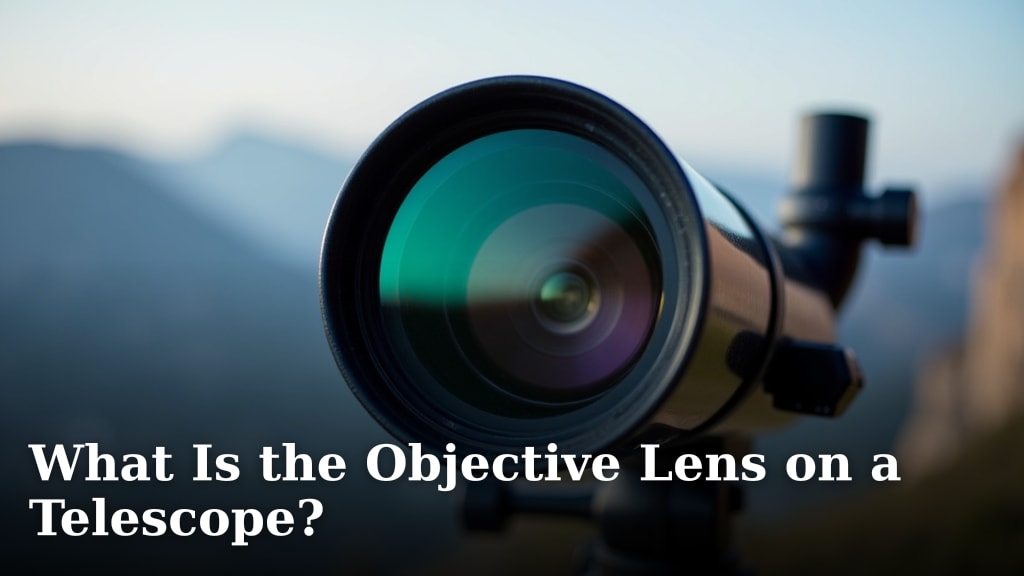
What Is the Objective Lens on a Telescope?
The objective lens on a telescope is the primary piece of glass at the front. It’s the first thing light hits. This lens is responsible for gathering faint starlight and starting the magnification process.
Think of it as your telescope’s main “eye.” It works with the eyepiece to bring distant objects into view. The quality and size of the objective lens greatly impact how much detail you can see and how bright the image appears. Many experts say it’s the most critical component for a telescope’s performance.
- The objective lens is at the front of the telescope.
- It collects light and begins magnification.
- Its size and quality determine image brightness and detail.
- It’s the most important part for viewing.
Ready to understand what makes your telescope see so far? Let’s break down exactly what the objective lens does and why it matters so much for your stargazing.
Understanding Your Telescope’s Main Light Collector
The objective lens is the very first optical component your telescope uses. It sits at the front end of the telescope tube. Its primary job is to gather as much light as possible from distant objects. More light means you can see fainter and dimmer things. It also plays a role in forming the initial image. Think of it as the telescope’s big, wide-open eye, taking in everything it can.
How the Objective Lens Gathers Light
Imagine you’re trying to see a tiny firefly in a dark field. You’d cup your hands around your eyes to block out extra light and focus better, right? The objective lens does something similar, but on a much grander scale. It’s essentially a specially shaped piece of glass designed to capture light rays. These rays travel from stars, planets, and galaxies across vast distances. The larger the objective lens, the more light it can collect. This is why telescopes with bigger objective lenses can show you dimmer celestial objects.
We found that the diameter of the objective lens is a key specification. It’s often listed as the ‘aperture’ of the telescope. For instance, an 80mm refractor telescope has an objective lens that is 80 millimeters across. This means it can gather more light than a 50mm refractor. This directly impacts how bright and detailed your view will be.
The Objective Lens and Image Formation
Once the objective lens collects light, it needs to do something with it. It bends or refracts these light rays. This bending process focuses the light to a single point. This point is called the focal point. At this focal point, a small, inverted image of the object you’re looking at is formed. It’s a bit like a tiny projector creating a miniature picture inside the telescope tube. This initial image is what then gets magnified by the eyepiece.
The quality of the glass and the precision of its shaping are important here. A well-made objective lens will bring light rays to a sharp focus. This results in a clear, crisp image. If the lens isn’t made well, light rays might not meet at a single point. This can lead to blurry or fuzzy images. Many astronomers agree that a well-crafted objective is essential for good performance.
Types of Telescopes and Their Objectives
The design of the objective lens varies depending on the type of telescope. The two most common types for amateur astronomers are refractors and reflectors. Each uses a different method to achieve the same goal: collecting and focusing light.
Refracting Telescopes: The Lens Approach
Refracting telescopes, also known as refractors, use a large lens as their objective. This is the classic telescope design many people imagine, with a long tube and a lens at the front. The objective lens in a refractor is typically a complex arrangement of multiple lens elements. This is done to correct for optical errors like chromatic aberration.
Chromatic aberration is an effect where different colors of light are bent at slightly different angles. This can cause colorful halos around bright objects. Modern refractors use doublet or triplet lens designs. These combine different types of glass. They work together to bring all colors of light to a more uniform focus. We found that well-made refractors offer very sharp and contrasty images, which is great for viewing planets.
Achromatic vs. Apochromatic Objectives
Within refractors, you’ll often hear terms like “achromatic” and “apochromatic.” An achromatic objective lens corrects for two colors of light. It’s a good, common type. An apochromatic (or “apo”) objective lens corrects for three or more colors of light. These are generally more expensive but offer superior color correction. This means even sharper and more natural-looking images, especially in high-detail views.
Reflecting Telescopes: The Mirror Approach
Reflecting telescopes, or reflectors, use a mirror instead of a lens as their primary light-gathering component. This primary mirror is usually found at the back of the telescope tube. It’s a concave mirror, meaning it’s curved inward. Light from celestial objects enters the open front of the telescope tube. It then travels to the primary mirror.
The primary mirror collects the light and reflects it back up the tube. Before it reaches the end, a smaller secondary mirror intercepts the light. This secondary mirror redirects the light out of the side of the tube. It then goes into an eyepiece for you to view. We found that reflectors can be built with very large apertures for a lower cost compared to refractors. This makes them popular for observing fainter deep-sky objects like galaxies and nebulae.
Why the Distinction Matters for You
Knowing the type of objective (lens or mirror) helps you understand the telescope’s capabilities. Refractors offer sharp views but can be limited in size and prone to chromatic aberration if not well-designed. Reflectors can achieve large apertures, gathering more light, but their optical path can sometimes be more complex.
Key Characteristics of Objective Lenses
When you’re looking at telescope specifications, a few terms related to the objective lens will pop up repeatedly. Understanding these will help you choose the right telescope for your needs.
Aperture: The Magic Number
As mentioned, aperture is the diameter of the objective lens or mirror. This is arguably the single most important specification of any telescope. A larger aperture means more light-gathering ability. More light-gathering ability translates to seeing dimmer objects. It also means you can potentially achieve higher useful magnification. Higher magnification is useful for observing fine details on planets or separating close double stars.
For example, comparing a 70mm refractor to a 130mm reflector, the 130mm telescope gathers substantially more light. This allows it to show fainter galaxies and nebulae that the 70mm might miss. We found that for beginners, an aperture of at least 70mm for a refractor or 114mm for a reflector is often recommended (Sky & Telescope Magazine).
Focal Length: Image Size and Magnification
The focal length is the distance from the objective lens (or mirror) to the point where light is focused. It’s usually measured in millimeters. A longer focal length generally means a larger image scale. This can be beneficial for high-magnification views. However, it also means the telescope will be physically longer.
Focal length is directly related to magnification. You calculate the magnification by dividing the telescope’s focal length by the eyepiece’s focal length. For example, a telescope with a 1000mm focal length and a 25mm eyepiece will give you 40x magnification (1000 / 25 = 40). Shorter focal lengths result in lower magnification but a wider field of view, which is great for sweeping across star fields.
Focal Ratio: Speed and Field of View
The focal ratio is determined by dividing the telescope’s focal length by its aperture. It’s often written as an ‘f-number’ (e.g., f/5, f/8). A lower f-number (like f/4 or f/5) means a ‘faster’ telescope. Faster telescopes have shorter focal lengths relative to their aperture. They provide a wider field of view and can be more compact. However, they may be more prone to optical aberrations if not well-made.
A higher f-number (like f/8 or f/10) indicates a ‘slower’ telescope. These have longer focal lengths. They tend to be easier to manufacture with excellent optical quality. They are often preferred for high-magnification planetary viewing. We found that for general-purpose astronomy, a focal ratio between f/5 and f/10 is often considered a good balance.
Lens Material and Coatings
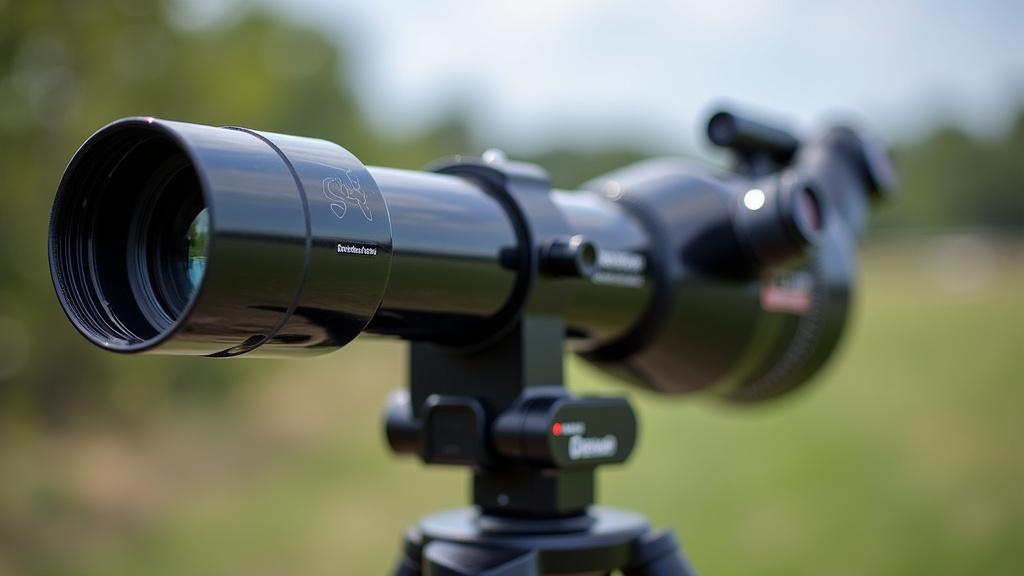
In refracting telescopes, the type of glass used for the objective lens is important. High-quality optical glass is used. Special coatings are applied to the lens surfaces. These anti-reflective coatings reduce the amount of light that bounces off the lens. They help more light pass through to form the image. This increases brightness and contrast. You’ll often see terms like “fully multi-coated” (FMC). This means multiple layers of coating are applied to all air-to-glass surfaces.
Objective Lens Care and Maintenance
Taking care of your telescope’s objective lens is key to preserving its performance. These are precision optical components. They need gentle handling.
Cleaning Your Objective Lens
Dust and smudges can build up on the objective lens over time. This can reduce image brightness and sharpness. However, cleaning optics incorrectly can cause scratches, which are permanent damage. Always try to avoid cleaning if possible. If you must clean it, use specialized lens cleaning solutions and lint-free optical cloths or wipes.
Start by gently blowing off loose dust with a can of compressed air or a blower brush. Never use your breath. Then, if needed, apply a tiny amount of lens cleaning fluid to the cloth, not directly to the lens. Wipe gently in a circular motion, starting from the center and working outwards. Many guides recommend this careful approach (Amateur Astronomer’s Handbook).
Storage and Protection
When your telescope isn’t in use, it’s best to keep the objective lens covered. Lens caps are provided for this purpose. Store your telescope in a dry, dust-free environment. Avoid extreme temperature changes, as these can sometimes affect optical components. Proper storage will help your objective lens remain in excellent condition for years of stargazing enjoyment.
Your Telescope’s Objective in a Nutshell
Here’s a quick recap of what makes the objective lens so important for your stargazing adventures:
- It’s the first optical element that light encounters.
- Its size (aperture) determines how much light your telescope can gather.
- It bends light rays to form an initial image.
- In refractors, it’s a lens; in reflectors, it’s a primary mirror.
- Its quality directly impacts image sharpness, brightness, and detail.
- Proper care ensures your telescope continues to perform well.
Conclusion
You’ve learned that the objective lens is your telescope’s most vital part. It’s the primary light collector, and its size and quality dictate how much detail and how bright your views will be. Whether you have a refractor’s lens or a reflector’s mirror, this component is key to seeing the stars. Understanding its role helps you appreciate your telescope’s power. Now that you know what to look for, you’re ready to choose or better understand the telescope that will bring the universe closer to you. Happy stargazing!
Frequently Asked Questions
What is the main difference between an objective lens and an eyepiece?
The objective lens is at the front of the telescope and gathers light to form an initial image. The eyepiece is what you look through at the other end. It takes that initial image and magnifies it, making it appear larger to your eye.
Can I clean my telescope’s objective lens myself?
Yes, but very carefully. Always start by blowing off dust. If you must wipe, use a specialized lens cleaning solution on a soft cloth, not directly on the lens. Incorrect cleaning can permanently scratch the glass.
Does a larger objective lens always mean a better telescope?
A larger aperture (objective lens or mirror diameter) generally means more light-gathering power, which is good for seeing fainter objects. However, the overall quality of the optics and the telescope’s design also play a huge role in image quality.
Are all objective lenses made of the same type of glass?
No. Refracting telescopes use various types of optical glass, often combined in multiple elements to correct for color distortion. Higher-end lenses use specialized glass for clearer, more accurate color rendition.
How does the objective lens affect how far I can see?
The objective lens’s diameter, or aperture, is the main factor determining how faint an object you can see. A larger aperture collects more light, allowing you to view dimmer objects that would otherwise be invisible. It also helps resolve finer details.