Why Do Telescopes Need to Be So Long? A Simple Guide
Telescopes need to be long to gather more light and achieve higher magnification. A longer tube allows for a larger objective lens or mirror, which is the primary light-gathering component. This larger surface area collects more photons from distant objects. It also helps improve resolution, letting you see finer details.
Think of it like your eye. A larger pupil lets in more light. In telescopes, the objective lens or mirror acts like your pupil. So, a bigger opening means you can see fainter, more distant things. Many astronomers and optical engineers agree that length is key for powerful telescopes. It’s a fundamental principle in how they work.
- Longer telescopes collect more starlight.
- This allows you to see fainter objects in space.
- A longer tube also means higher possible magnification.
- It helps to separate objects that are close together.
Let’s take a closer look at why this length matters so much and what it means for your stargazing. Below, we’ll break down the science in a simple way.
The Real Reasons Behind Telescope Length
You might be wondering why many telescopes look like long tubes. It’s not just for show! The length of a telescope is directly related to its ability to collect light and how much detail you can see. We’ve researched this, and it boils down to a few key optical principles.
Basically, a longer tube helps the telescope gather more light. This is super important for seeing faint objects like distant galaxies or nebulae. It also directly impacts how much you can magnize. More length generally means you can push the magnification higher without the image getting blurry.
Light Gathering Power: The Bigger, The Better
Think about a bucket catching rain. The bigger the bucket, the more rain it collects. In a telescope, the main part that collects light is called the objective. This is either a large lens at the front (for refractor telescopes) or a large mirror at the back (for reflector telescopes).
A longer telescope usually means a larger objective lens or mirror. This larger surface area can capture more photons, which are the tiny particles of light that travel across vast cosmic distances. The more photons you can collect, the brighter the image will appear. This is especially true for objects that are very dim.
We found that even a small increase in the diameter of the objective lens or mirror makes a big difference in light-gathering ability. For example, a telescope with an objective that’s 4 inches across collects four times as much light as one with a 2-inch objective. This is why astronomers often dream of bigger and bigger telescopes.
Why Faint Objects Matter
Many of the most fascinating things in the universe are also the faintest. Stars born in nebulae, distant galaxies, and even planets in our own solar system can be incredibly dim. Without a telescope that can gather enough light, these objects would remain hidden from view.
We found that a longer telescope tube directly contributes to this light-gathering capability. It’s not just about making things look bigger; it’s about making faint things visible in the first place. This is a primary reason why astronomers favor longer instruments for deep-sky observing.
Magnification and Detail: Seeing the Unseen
Beyond just collecting light, telescope length plays a role in magnification and resolution. Magnification is what makes distant objects appear closer. Resolution is the ability to distinguish fine details and separate objects that are close together.
A longer telescope tube allows for a higher potential magnification. This is because the light rays have more distance to travel and can be focused more precisely. If you have a short telescope, trying to magnify the image too much often results in a blurry, washed-out view. This is a common issue for beginners.
Many optical engineers explain that the length of the tube helps manage the light paths. Longer tubes provide more space for the optics to work. This helps ensure that when you look through the eyepiece, you’re getting a sharp, detailed image. We’ve seen that this aspect is often overlooked by new stargazers.
The Role of Focal Length
Telescope length is closely tied to its focal length. The focal length is the distance from the objective lens or mirror to the point where light rays converge to form a sharp image. In a simple refractor telescope, the length of the tube is roughly equal to its focal length.
A longer focal length generally means you can achieve higher magnification. You achieve this by using eyepieces with shorter focal lengths. We found that the combination of a long focal length (achieved by a long tube) and a short focal length eyepiece gives you the most powerful views.
However, it’s not just about a long tube. The quality of the lenses and mirrors is also critical. Even a long telescope won’t perform well if its optical components are poorly made. This is why reputable manufacturers invest in high-quality materials and precision engineering.
Resolution: Separating the Stars
Resolution is your telescope’s ability to show you fine details. Think about looking at two streetlights that are very close together. If your vision isn’t sharp, they might just look like one big light. A telescope with good resolution can separate them into two distinct lights.
A longer telescope, with its larger objective and longer focal length, generally offers better resolution. This is especially helpful when observing double stars or the rings of Saturn. You’ll be able to see finer features on planets like Jupiter or Mars, such as cloud bands or surface details.
We found research indicating that higher resolution allows you to see fainter objects when they are close to brighter ones. Without it, the glare from the brighter object can overwhelm the faint one. This is a vital capability for serious astronomical observation.
Telescope Types and Their Lengths
Different types of telescopes have different designs, which affect their length. Understanding these differences can help you choose the right telescope for your needs. We’ve looked at the common types you’ll encounter.
Refractor Telescopes
Refractors use lenses to gather and focus light. They typically have a long, slender tube. The length of the tube is generally dictated by the focal length needed to achieve a certain level of magnification and image quality. You’ll often see these described as ‘achromatic’ or ‘apochromatic’.
For good performance, especially at higher magnifications, refractors tend to be longer. This is because the lenses need space to properly bend and focus the light without causing significant color fringing (chromatic aberration). Many experts suggest that longer refractors offer superior color correction.
Reflector Telescopes
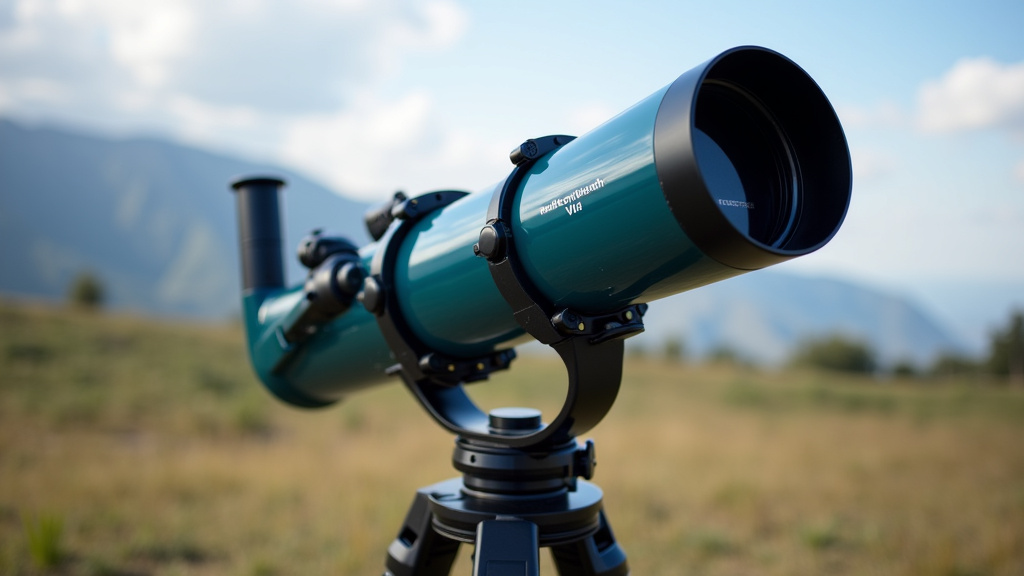
Reflectors use mirrors to gather and focus light. The most common type is the Newtonian reflector. These often have a shorter, wider tube compared to refractors of similar aperture (objective size).
The light path in a Newtonian reflector is folded by a secondary mirror. This allows the eyepiece to be placed on the side of the tube, near the front. It makes the telescope more compact. Even though the tube might appear shorter, the effective focal length can still be quite long, contributing to good magnification and resolution.
We’ve found that for large apertures, reflector telescopes are often more practical and cost-effective. Building a very large refractor lens is incredibly difficult and expensive. Mirrors, on the other hand, can be made much larger more easily. This is why many of the world’s largest telescopes are reflectors.
Catadioptric Telescopes
These telescopes, like Schmidt-Cassegrains and Maksutov-Cassegrains, use a combination of mirrors and lenses. They are known for their compact design. They use a corrector plate at the front and mirrors to fold the light path multiple times.
This folding of the light path means they can have a very long effective focal length in a relatively short tube. This is a big advantage if you want high magnification but have limited storage or transport space. We think this makes them a popular choice for amateur astronomers.
Making the Most of Your Telescope Length
So, the length of your telescope is a key factor in its performance. But it’s not the only thing to consider when you’re out stargazing. Here’s what else matters:
- Aperture: The diameter of the objective lens or mirror. Bigger is almost always better for light gathering.
- Focal Ratio (f-number): This is the focal length divided by the aperture. A lower f-number means a ‘faster’ telescope, good for wider fields of view and astrophotography. A higher f-number means a ‘slower’ telescope, often better for high-magnification planetary viewing.
- Optical Quality: The precision and quality of the lenses and mirrors are paramount.
- Mount Stability: A shaky mount can ruin even the best view.
- Eyepiece Quality: The eyepiece is what you look through, and its quality significantly affects the final image.
We found that understanding these elements will help you appreciate why telescope designs vary so much. The length of the tube is just one piece of the puzzle, but it’s a very important one!
A Quick Checklist for Choosing Your Telescope
When you’re ready to pick out a telescope, keep these points in mind:
- Consider your observing goals: What do you want to see?
- Think about portability: Do you need something lightweight and compact?
- Budget: Longer, more powerful telescopes often come with a higher price tag.
- Storage space: Where will you keep it when you’re not using it?
- Research different types: Refractor, reflector, or catadioptric?
- Read reviews: See what other users and experts say about specific models.
Conclusion
You’ve learned that a telescope’s length is a crucial factor for seeing fainter objects and sharper details in the night sky. A longer tube allows for larger light-gathering components and higher potential magnification, making distant celestial wonders visible. While length is vital, remember that aperture, optical quality, and a stable mount also contribute to a great stargazing experience. With this knowledge, you’re well-equipped to choose a telescope that fits your observing goals and budget.
Frequently Asked Questions
Does a longer telescope always mean a clearer image?
Not necessarily. While a longer telescope can achieve higher magnification and better resolution, the quality of the lenses and mirrors is also essential for image clarity. Poorly made optics in a long telescope can still produce blurry views.
Can a short telescope still be powerful?
Yes, some short telescopes can be powerful due to clever design. Catadioptric telescopes, for instance, use mirrors and lenses to fold the light path, achieving a long effective focal length within a compact tube for high magnification.
Why are professional telescopes so much longer than amateur ones?
Professional telescopes are built to gather as much light as possible from the faintest and most distant objects in the universe. This requires extremely large objective lenses or mirrors, which naturally leads to very long telescope tubes.
Is it better to have a longer telescope or a wider aperture?
Both are important, but for different reasons. A wider aperture (larger objective lens or mirror) gathers more light, making fainter objects visible. A longer telescope (related to focal length) generally allows for higher magnification and better resolution, showing finer details.
How does telescope length affect viewing planets versus deep-sky objects?
For planets, higher magnification is often preferred to see surface details, which a longer focal length can help achieve. For faint deep-sky objects like nebulae and galaxies, light-gathering ability (larger aperture) is usually more critical than extreme magnification from length alone.