5 Best Maksutov Cassegrain Telescopes (November 2026)
The best Maksutov Cassegrain telescopes include the Celestron NexStar 4SE Maksutov-Cassegrain GoTo Telescope for guided lunar and planetary observing, the Celestron NexStar 6SE Schmidt-Cassegrain Telescope for more light and deeper targets, and the Sky-Watcher Skymax 102mm Maksutov-Cassegrain for a manual optical tube.
On this page (5 sections)
The best Maksutov Cassegrain telescope for most beginners is the Celestron NexStar 4SE, because its compact 4 in optics pair with automated GoTo tracking and SkyAlign. That mix suits people who want clear Moon and planet views without learning to find targets first.
Maksutov-Cassegrain telescopes suit observers who want a long focal length in a short tube. The folded optical path makes the package easier to store and carry than a long refractor of similar reach.
That design is especially useful for the Moon, planets and distant daytime subjects. High contrast helps small details stand out once the target is centered.
The trade-off is field of view. A long focal length gives a narrower view, so very wide star fields are less suited to this style.
Choose the Sky-Watcher Skymax 102 for a manual optical tube if you already own a suitable mount and prefer to aim it yourself.
Choose the SARBLUE Mak60 for travel. Its small tube and tabletop setup fit tight storage spaces and short observing sessions.
Choose the SARBLUE Mak70 for slow-motion tripod control if you want finer aiming without a computerized mount.
Budget and carrying space matter as much as lens size. A telescope you can set up quickly is more likely to be used on clear nights.
For beginners, automated locating removes a common barrier. The mount finds the target while you focus on patience and letting the view settle.
For experienced manual observers, a bare optical tube can be a cleaner choice. You control the mount, eyepieces and accessories to match your habits.
Daytime use also needs thought. Distant landmarks and wildlife can fill the time between clear nights, but sun viewing needs a proper filter.
The right pick depends on that mix of targets and routine. Guided convenience, manual control and portability point to different models here.
Our picks at a glance
-
1
 Best for guided lunar and planetary observing
Celestron NexStar 4SE Maksutov-Cassegrain GoTo Telescope
9.6/10 our score
See it on Amazon -
2
 Best for more light and deeper targets
Celestron NexStar 6SE Schmidt-Cassegrain Telescope
9.5/10 our score
See it on Amazon -
3
 Best for a manual optical tube
Sky-Watcher Skymax 102mm Maksutov-Cassegrain
8.1/10 our score
See it on Amazon
- 4
 Check it
SARBLUE Maksutov-Cassegrain Telescope for Adults Kids Astronomy
Best for compact beginner travel - 5
 Check it
SARBLUE Maksutov-Cassegrain Telescope
Best for slow-motion tripod control
The best Maksutov Cassegrain telescopes for different observers
The Celestron NexStar 4SE is the strongest overall match for guided observing, while the Skymax 102 gives manual users a larger Maksutov optical tube. The SARBLUE models make more sense when compact size, simple setup or included tripod control matters most.
Celestron NexStar 4SE Maksutov-Cassegrain GoTo Telescope: Best for guided lunar and planetary observing
- 4 in Maksutov-Cassegrain optics
- Computerized GoTo mount
- 40,000+ object database
- SkyAlign technology
- Built-in wedge
Compact optics and an automated mount make this the easiest all-around choice for finding and tracking Moon and planet targets.
Pros
- Computerized GoTo mount
- SkyAlign setup
- Built-in wedge
Cons
- Manual focus
- Heavier than the tabletop travel picks
The Celestron NexStar 4SE Maksutov-Cassegrain GoTo Telescope is the best fit if you want the telescope to help locate and follow targets. Its 4 in Maksutov-Cassegrain optics have a 1325mm focal length, a combination aimed at sharp lunar and planetary views in a compact format.
The computerized mount uses a NexStar+ hand control and a database of more than 40,000 objects. SkyAlign lets you center 3 bright stars or planets so the system can calculate its position and align the mount.
The built-in wedge supports polar alignment for entry-level long-exposure imaging. The package also includes a 25mm eyepiece, accessory tray, StarPointer red dot finderscope, tripod and single fork arm mount.
Choose this model when target finding and tracking matter more than the lightest possible setup. For a closer look at the larger Maksutov option from the same brand family, see our Sky-Watcher 180mm Maksutov review.
Celestron NexStar 6SE Schmidt-Cassegrain Telescope: Best for more light and deeper targets
- 6 in Schmidt-Cassegrain optics
- Computerized GoTo mount
- 40,000+ object database
- SkyAlign technology
- StarBright XLT coating
The 6 in aperture gathers more light than the smaller picks, while the computerized mount keeps target finding simple.
Pros
- Largest aperture here
- GoTo tracking
- Useful for lunar, planetary and deep-sky viewing
Cons
- Heavier setup
- Not a Maksutov-Cassegrain design
The Celestron NexStar 6SE Schmidt-Cassegrain Telescope is the best choice here when you want more aperture and are open to a different Cassegrain design. Its 6 in optics gather more light than the 4 in NexStar 4SE, with a 1500mm focal length for lunar, planetary and deep-sky observing.
Its computerized Altitude-Azimuth mount can select, locate and track targets from a database of more than 40,000 objects. SkyAlign keeps the alignment process simple by using 3 bright stars or planets.
This telescope includes a 25mm eyepiece, star diagonal, StarPointer red dot finderscope, tripod and NexStar+ hand control. Its StarBright XLT coating is part of the optical setup.
Pick the 6SE if seeing galaxies, globular clusters and nebulae matters alongside detailed Moon and planet views. It is not a Maksutov-Cassegrain, so choose it for aperture and target range rather than strict adherence to the Mak design.
Our Celestron NexStar 8SE review covers the larger Celestron family.
Sky-Watcher Skymax 102mm Maksutov-Cassegrain: Best for a manual optical tube
- 102mm aperture
- 1300mm focal length
- Fully baffled tube
- Vixen-style dovetail
- 10mm and 25mm eyepieces
This optical tube emphasizes high-contrast lunar and planetary views and gives you flexible mounting through its Vixen-style dovetail.
Pros
- 102mm aperture
- Fully baffled tube
- Carrying bag included
Cons
- Requires a separate suitable mount
- Manual focus
The Sky-Watcher Skymax 102mm Maksutov-Cassegrain is the best manual optical tube in this group. Its 102mm objective and 1300mm focal length favor high-contrast lunar and planetary observing while keeping the tube smaller than a comparable long-tube telescope.
A fully baffled tube helps limit stray light, and the primary mirror has a stated 94% reflectivity coating. The Vixen-style dovetail gives you a common mounting connection, while a 1/4-20 tripod thread sits under each dovetail bar.
The package includes 10mm and 25mm 1.25 in eyepieces, a red-dot finder, a 90-degree star diagonal and a padded carrying bag. You still need to match the optical tube with a suitable mount before observing.
Choose the Skymax 102 if you prefer selecting and tracking targets yourself. Its 102mm aperture is larger than the SARBLUE models here, but the setup does not include an automated GoTo mount.
For a smaller version, compare our Sky-Watcher Skymax 102 review.
SARBLUE Maksutov-Cassegrain Telescope for Adults Kids Astronomy: Best for compact beginner travel
- 60mm objective lens
- 750mm focal length
- 20cm optical tube
- Tabletop tripod
- Phone adapter
The compact Mak60 combines a short tube with a tabletop tripod and phone adapter for simple Moon, planet and daytime viewing.
Pros
- Very compact tube
- Tabletop tripod included
- Educational detachable lid
Cons
- Smallest aperture here
- Manual focus
The SARBLUE Maksutov-Cassegrain Telescope for Adults Kids Astronomy is the best fit for compact beginner travel. Its 60mm objective, 750mm focal length and 20cm tube create a small package for Moon, planet and daytime viewing.
That short tube is a real help when cupboard space is tight. A compact telescope is easier to lift out for a quick look at the Moon, then put away again.
The included 20mm eyepiece provides 37.5x magnification. It gives a close view of bright targets without needing extra eyepieces to get started.
A tabletop tripod, phone adapter and erect-image diagonal are included. The setup is aimed at simple observing without a separate full-size mount.
The tabletop format suits a deck, balcony or sturdy table. It also keeps the whole kit light enough for a car trip to a darker spot.
The detachable lid exposes the internal construction for an educational look at how the telescope is arranged. It can spark curiosity about folded optics in a way a closed tube cannot.
Keep fingers away from the mirrors and avoid letting dust enter the tube. That care matters because fingerprints and dust can spoil the clean views the design is meant to give.
The fully multi-coated optics help cut down on reflections. In daily use, that means crisper daytime views and cleaner contrast on bright night targets.
Choose the Mak60 when storage space and portability matter more than aperture. It suits a first telescope for a child or adult who wants to learn the basics.
Its 60mm objective gives less light-gathering capacity than the 70mm, 102mm and 4 in options. It is best for bright targets and beginner use, such as the Moon and the brighter planets.
Do not expect wide deep-sky views from a small, long-focus tube. The strength here is simple, portable access to sharp bright-target views.
Set it up on a level surface and focus slowly. Small movements are normal at this magnification, so patience with the tabletop tripod pays off.
SARBLUE Maksutov-Cassegrain Telescope: Best for slow-motion tripod control
- 70mm objective lens
- 1000mm focal length
- Slow-motion gimbal tripod
- Adjustable tripod
- Phone adapter
The Mak70 adds slow-motion control to a compact telescope, making small aiming adjustments easier during lunar and planetary viewing.
Pros
- Slow-motion gimbal control
- Adjustable tripod
- Two eyepieces included
Cons
- Manual focus
- Less aperture than the 102mm and 4 in picks
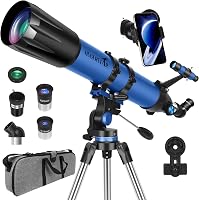
The SARBLUE Maksutov-Cassegrain Telescope is the best compact option when you want slow-motion tripod control. Its 70mm objective and 1000mm focal length fit inside a 210mm tube, so you get long focus without a long transport case.
That folded design makes a practical difference on travel nights. You can carry a telescope with real reach while keeping the case size manageable.
The gimbal mount combines quick movement with slow-motion adjustment. Use the quick move to get near the target, then use the fine control to centre it.
That helps with smaller aiming changes as the Moon or a planet moves through the field. It is a calmer way to work than nudging a basic tripod head by hand.
The adjustable tripod extends from 23 in to 56 in. That range lets you work seated on a low stool or standing at full height.
The soft-touch fine knobs on the gimbal head give more control when you keep a bright target in a narrow field. They are worth noting if patience matters more than speed.
The package includes a 20mm eyepiece for 50x magnification. That is a sensible starting point for the Moon and daytime subjects.
A 10mm photographic eyepiece brings 100x magnification. It suits closer work on planets and lunar detail once the target is already centred.
A phone adapter with 1.5x Barlow lens is also included. It gives a simple way to try basic phone pictures of bright targets.
A 5x24 finderscope helps with initial aiming. Lining it up in daylight makes night use far less frustrating.
Choose the Mak70 when tripod control matters more than automated locating. It suits readers who enjoy learning the sky while still getting fine aiming help.
It gives more objective diameter than the Mak60, but less aperture than the Skymax 102 and Celestron 4SE. That middle ground suits bright targets and early deep-sky curiosity.
Care is simple but steady. Keep dust off the optics, store it dry and tighten the tripod before you start.
How we compared these Maksutov Cassegrain telescopes
Our score weighs optical specifications, mount features, included equipment and fit for this search, along with buyer feedback on everyday use. We checked aperture, focal length, mounting style and setup features for compact lunar and planetary observing.
That focus matters because Maksutov-Cassegrain designs are chosen for a specific job. They put a long focal length into a short tube, which helps with the Moon and planets.
Aperture affects how much light the telescope can gather and how much detail it can resolve. A larger objective can show finer detail and fainter contrast in bright targets.
The 4 in NexStar 4SE and 102mm Skymax 102 sit above the 60mm and 70mm SARBLUE models here. That gap shows up most on lunar detail and planetary bands.
Focal length also matters in daily use. A long focal length makes higher magnification easier to reach with an eyepiece.
The cost is a narrower view. That trade-off suits the Moon and planets, while wide open clusters may be easier with a shorter focal length.
Focal ratio and eyepiece choice change the feel of the view. A longer system needs steadier focus and more patience as you raise magnification.
Mount design changes the experience just as much as the optical tube. The NexStar models automate locating and tracking, while the Skymax 102 uses a manual mounting connection.
The SARBLUE models focus on portable tripod setups. Their simple mounts suit bright targets and short sessions, though tracking needs more hand work.
Included equipment also shapes value. Eyepieces, finders, diagonals and tripods decide whether a scope is ready on the first night.
We also weighed how a setup fits real spaces. A compact tube helps, but a wobbly mount or awkward height can undo that gain.
Care and storage entered the comparison too. Fewer loose parts and a tidy case make regular use more likely.
In short, aperture, focal length and mount need to be read together. The best pick is the one whose trade-offs match your targets and routine.
What should you look for in a Maksutov Cassegrain telescope?
Start with aperture and mount, then check focal length, included eyepieces and how you plan to carry the telescope. A compact tube is useful only if the mount remains steady and the setup fits your observing space.
Aperture sets the light available for detail. A larger objective helps with lunar contrast and planetary detail, though it can add weight.
Mount choice sets how you find and follow targets. A computerized mount reduces learning time, while a manual mount gives you direct control.
Focal length shapes magnification and field of view. A long focal length suits the Moon and planets, but a narrower view can be harder for beginners.
Eyepieces decide the view you get on the night. Check which sizes are included, and whether the finder helps you aim before you raise power.
For guided observing, the Celestron NexStar 4SE is the clearest match. Its GoTo mount and SkyAlign system reduce the work of locating targets.
That suits readers who want to spend time looking, not searching. It also helps when you are still learning star names and sky patterns.
If you want more light and accept the Schmidt-Cassegrain design, the 6SE is the stronger aperture choice. It suits readers who plan to look beyond bright targets.
For a manual setup, the Skymax 102 provides a 102mm objective, long focal length and Vixen-style dovetail. That common dovetail gives flexibility with many mounts.
Confirm the mount connection and stability before buying an optical tube alone. A good tube on a weak mount will frustrate even experienced users.
For travel, compare the complete package rather than tube length only. Total weight, tripod height and case size matter on the road.
The SARBLUE Mak60 includes a tabletop tripod for short sessions and very tight storage. The Mak70 includes an adjustable tripod with slow-motion gimbal control for finer aiming without automation.
Think about wind, light pollution and a flat surface at your site too. Look at warranty and support as part of the package, since clear help matters when a beginner meets a setup problem at night.
Finally, match the telescope to your first targets. Bright Moon and planet views need a different setup than wide star fields or faint deep-sky work.
How do you set up and care for a Maksutov telescope?
Set the telescope on a stable surface, attach the optical tube and mount, fit the finderscope, and begin with the lower-power eyepiece. For a GoTo model, follow the alignment process before asking the mount to locate targets.
Level the tripod first and tighten the legs before you mount the tube. A firm base cuts vibration and makes focusing feel calmer.
Fit the finderscope in daylight if you can. Align it with the main view, then check it again at night on a bright target.
Start with the lowest power eyepiece in the box. A wider view makes finding and focusing much easier.
For a GoTo model, complete the alignment steps before you send it to a target. Rushing can leave the mount pointing near the target but not on it.
Allow your eyes to adjust to the dark and give the setup a few minutes to settle after it stops moving or vibrating.
Higher magnification makes focusing and tracking more demanding, so move up gradually after the target is centred. Small focus turns are enough at high power.
Use slow, light touches on the focus knob. The image can shift if you press too hard or lean on the tube.
Keep the corrector plate and mirrors free from fingerprints and dust. Hold eyepieces by their rims and keep caps on when they are not in use.
The SARBLUE Mak60 instructions specifically warn against touching the mirrors, and the same care suits any compound telescope. A clean optical path gives the high contrast these designs promise.
Store the telescope dry and covered. Damp storage can invite dust and fungus, which are far harder to fix than a quick clean of the outside.
Before a session, check batteries, cables and hand controls on computerized mounts. A flat battery at the wrong moment ends a good night fast.
Use a proper solar filter designed for the telescope if you observe the Sun. Never point an unfiltered telescope at the Sun, because concentrated sunlight can cause serious eye injury.
Daytime viewing needs the same steady setup. Distant subjects can shimmer in heat, so patience and lower power often give the clearest view.
End each session by capping the tube and eyepieces. That small habit protects the optics and keeps the next setup quick.
Which telescope should you choose?
Pick the Celestron NexStar 4SE if you want the best blend of compact Maksutov optics, automated locating and lunar or planetary use. It suits beginners who want help finding targets from the first night.
Pick the Skymax 102 if you want a larger manual Maksutov optical tube and already have a suitable mount.
Choose the SARBLUE Mak60 for the smallest beginner travel setup. Its short tube and tabletop tripod suit tight storage and simple bright-target viewing.
Choose the SARBLUE Mak70 if slow-motion tripod adjustments matter more. The gimbal control helps you centre small, moving targets with finer moves.
If you want more light for deep-sky targets and do not require a Maksutov design, the Celestron NexStar 6SE is the stronger alternative. Its larger aperture suits galaxies and clusters as well as Moon and planet views.
Match your choice to your likely routine. Nightly quick looks, travel and guided sessions all point to different setups.
Think about space before you buy. A telescope that fits your hall, car and observing spot will be used more often.
Think about skill too. Automated locating can help a new observer, while manual control can suit someone who wants to learn the sky.
For computerized Celestron options with larger apertures, our Celestron NexStar Evolution 8 review is a useful next comparison. Read it if your budget and storage can stretch further, since a larger aperture also adds size and handling.
If you stay with this group, focus on aperture, mount and included kit. Those three decide most of your first year of viewing.
Start with the Moon and bright planets. They give clear feedback on focus, stability and whether the setup suits your habits.
Then widen your targets slowly. Whichever model you pick, set it up in daylight first, since that practise makes the first dark evening far smoother.
Our top 3 picks at a glance
-
1
Best for guided lunar and planetary observing
Celestron NexStar 4SE Maksutov-Cassegrain GoTo Telescope
9.6/10 our score
See it on Amazon -
2
Best for more light and deeper targets
Celestron NexStar 6SE Schmidt-Cassegrain Telescope
9.5/10 our score
See it on Amazon -
3
Best for a manual optical tube
Sky-Watcher Skymax 102mm Maksutov-Cassegrain
8.1/10 our score
See it on Amazon
Frequently asked questions
What is the best Maksutov Cassegrain telescope for beginners?
The Celestron NexStar 4SE is the strongest beginner choice here because it combines 4 in Maksutov-Cassegrain optics with a computerized GoTo mount and SkyAlign. The SARBLUE Mak60 is easier to carry and simpler for basic Moon and planet viewing, but it has a smaller 60mm aperture and no automated mount.
Are Maksutov Cassegrain telescopes good for planets?
Yes. Maksutov-Cassegrain telescopes use compact tubes with long focal lengths, a useful combination for detailed lunar and planetary observing.
The Skymax 102 has a 1300mm focal length, while the SARBLUE Mak70 folds a 1000mm focal length into a 210mm tube.
What is the difference between a Maksutov and Schmidt-Cassegrain telescope?
Both designs use folded optical paths to keep the tube compact. A Maksutov-Cassegrain is often chosen for sharp lunar and planetary views, while the Celestron NexStar 6SE here uses a Schmidt-Cassegrain design and gives you a larger 6 in aperture for more light.
Do Maksutov Cassegrain telescopes need a GoTo mount?
No. A GoTo mount helps you find and track targets automatically, but a manual mount can work well for the Moon and bright planets.
The Sky-Watcher Skymax 102 uses a Vixen-style dovetail, while the Celestron NexStar 4SE includes a computerized Altitude-Azimuth mount.