9 Best Telescopes for Galaxy Astrophotography (November 2026)
The best galaxy astrophotography telescopes include the Gskyer Telescope for kids learning galaxies, the DWARFLAB Dwarf Mini Smart Telescope for beginners photographing galaxies, and the HUGERSTAR Telescope for visual galaxy viewing on a range.
On this page (9 sections)
- Our top picks for photographing galaxies, from wide fields to tight crops
- Side by side: focal length, aperture and tracking for galaxy imaging
- How we compared these galaxy astrophotography telescopes
- What focal length do you need for small distant galaxies?
- Do you need a smart telescope for galaxy photos?
- Can you see galaxies with a home telescope?
- Which mount tracks galaxies best for long exposures?
- How much aperture helps faint galaxy detail?
- Verdict: best galaxy astrophotography telescope picks for your sky
The best galaxy astrophotography telescope for most beginners is the DWARFLAB Dwarf Mini Smart Telescope, because its auto GOTO, EQ mode and 90 second exposures remove much of the setup work. The best galaxy astrophotography telescope for small distant galaxies is different, and that is where longer focal length and larger aperture matter.
Galaxies are small, faint and spread over a wide range of sizes. Andromeda fills a wide field, while many spiral galaxies need a long focal length to show arms and dust lanes.
Our score weighs specs, features and buyer feedback against what you're shopping for.
Start with the galaxy you want to photograph first. That target sets focal length, field of view and image scale.
Then choose a mount that can track long enough to collect light.
If you are new to astrophotography, our best telescope for astrophotography guide explains the wider setup. Our best beginner telescope for astrophotography picks suit a first scope, and our best portable telescope for astrophotography picks suit travel to dark skies.
Our picks at a glance
-
1
-
2
 Best for beginners photographing galaxies
DWARFLAB Dwarf Mini Smart Telescope
9.5/10 our score
See it on Amazon -
3

- 4
 Check it
Celestron AstroMaster 130EQ Telescope for Deep-Sky Beginners
Best for manual equatorial deep sky learning - 5
 Check it
ZWO Seestar S30 Pro Smart Telescope
Best for one tap galaxy capture - 6
 Check it
Celestron NexStar 8SE Computerized Telescope
Best for larger aperture galaxy imaging - 7
 Check it
Gskyer 130EQ Professional Astronomical Reflector Telescope
Best for brighter galaxies with an equatorial mount - 8
 Check it
DWARFLAB Dwarf 3 Smart Telescope
Best for portable dual camera galaxy shots - 9
 Best for an existing telescope camera add onCheck it
Our top picks for photographing galaxies, from wide fields to tight crops
We compared aperture, focal length, mount type and tracking help across these 9 scopes. Smart scopes win on ease, while larger reflectors and the 8 inch Schmidt Cassegrain win on reach for small galaxies.
Gskyer Telescope: Best for kids learning galaxies
- 70mm aperture
- 400mm focal length
- Altazimuth mount
- Phone adapter and wireless remote
A short 400mm refractor with a phone adapter is a gentle first step for bright galaxies and the Moon. It is best for learning framing before longer exposures.
Pros
- Short focal length suits wide galaxy fields
- Carry bag and adjustable tripod aid travel
- Phone adapter and wireless remote included
Cons
- Manual focus and altazimuth mount limit long tracking
- Small aperture gathers less light than 130mm and 8 inch picks
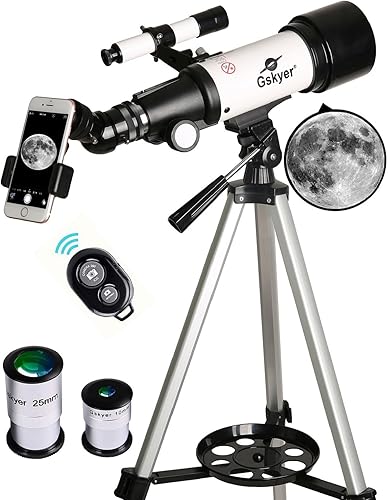
The Gskyer Telescope suits kids and beginners who want to learn where galaxies sit in the sky before they invest in longer exposures. Its 70mm aperture and 400mm focal length give a wide, forgiving field for bright galaxies, star clusters and the Moon.
You get two eyepieces and a 3x Barlow lens, plus a 5x24 finder scope with cross hair lines. That finder helps you place a galaxy in the field, then you can switch eyepieces to frame it tighter for visual viewing.
A phone adapter and wireless camera remote let you try smartphone photos. At 5.7 pounds with a carry bag and adjustable aluminum tripod, the tube and tripod pack away for travel and storage.
The fully coated optics and BAK4 prism support clean views of bright targets. Manual focus means you will spend time at the focus wheel, especially as the image cools outdoors.
Trade off: the short focal length keeps big galaxies in view, yet tiny galaxies stay small. Choose it to learn, travel and share photos, not for detailed galaxy imaging.
DWARFLAB Dwarf Mini Smart Telescope: Best for beginners photographing galaxies
- 150mm focal length
- 30mm objective lens
- Auto GOTO and EQ mode
- 90 second exposures
A 1.85 lb smart scope that finds and tracks deep sky targets by app. Its wide field suits large galaxies and galaxy groups from dark or bright skies.
Pros
- Auto GOTO and 360 degree pivot
- EQ mode with 90 second exposures
- Light pollution filter included
Cons
- Short focal length gives small image scale for tiny galaxies
- Small lens gathers less light than larger telescopes
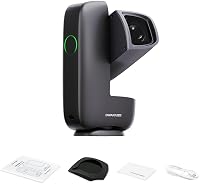
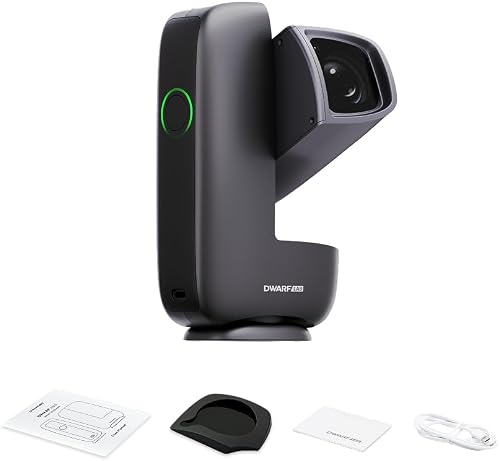
The DWARFLAB Dwarf Mini Smart Telescope suits beginners who want a galaxy photo with minimal setup. It weighs 1.85 lb and finds targets by app, so you can go from unboxing to a first shot in about 3 minutes, as DWARFLAB says.
Its 150mm focal length and 2.45 degree field of view suit large galaxies, groups and the Milky Way. Auto GOTO and 360 degree pivot place the target, and EQ mode supports single frame exposures up to 90 seconds.
A Sony IMX662 sensor, built in light pollution filter and smart cloud processing help cut city glow and boost faint detail. The sensor is listed as a 1/2.8 inch format with 2.9 micrometer pixels and 2MP RAW output.
The box includes a filter, USB-C cable and cleaning cloth, and the scope fits in a backpack or large pocket. That size makes dark sky trips and camping use simple for a first smart scope.
Trade off: the small 30mm lens gathers less light than a 130mm reflector or 8 inch scope. Tiny galaxies will look small at this image scale, so use it for wide fields and easy nights.
HUGERSTAR Telescope: Best for visual galaxy viewing on a range
- 90mm aperture
- 800mm focal length
- 10mm and 25mm eyepieces
- 3x Barlow lens
An 800mm refractor that frames small galaxies at higher image scale. It suits visual work and phone photos more than long tracked exposures.
Pros
- Longer focal length for smaller galaxies
- Adjustable stainless steel tripod
- Phone adapter and moon filter included
Cons
- Altazimuth mount is not ideal for long exposures
- Manual focus needs practice for sharp galaxy images
The HUGERSTAR Telescope suits adults who want visual galaxy viewing with more image scale than a short 400mm refractor. Its 90mm aperture and 800mm focal length frame smaller galaxies tighter and show detail at higher magnification.
Two eyepieces at 10mm and 25mm, plus a 3x Barlow lens, give a stated range of 32x to 240x. A 5x24 finder scope helps you find faint patches, and the moon filter reduces glare for lunar work.
The stainless steel tripod adjusts from 28.7 to 46.4 inches and has an accessory tray. A phone adapter lets you try smartphone photos, and a carry bag helps with travel and storage.
The 80 centimeter optical tube is longer than the 400mm refractor, so it needs a stable surface and room to swing. Manual focus is simple, but sharp galaxy images need patience with the focus wheel.
Trade off: the altazimuth mount and manual focus limit long tracked exposures. Choose it for visual galaxy hunting and phone photos, and step up to an equatorial or smart scope for deep sky stacks.
Celestron AstroMaster 130EQ Telescope for Deep-Sky Beginners: Best for manual equatorial deep sky learning
- 130mm Newtonian reflector
- 650mm focal length
- German equatorial mount
- 20mm and 10mm eyepieces
A 130mm reflector on an equatorial mount that gathers more light for faint galaxies. Slow motion controls help you follow targets by hand.
Pros
- Larger aperture for faint deep sky objects
- Equatorial mount with slow motion controls
- StarPointer finderscope included
Cons
- No automatic tracking for long exposures
- Manual controls demand patience and practice
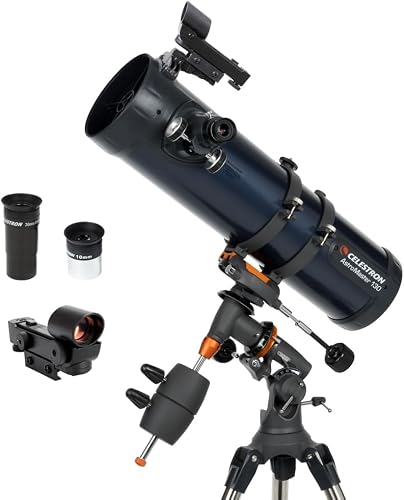
The Celestron AstroMaster 130EQ Telescope for Deep-Sky Beginners suits buyers who want a real equatorial mount and larger aperture at a starter level. Its 130mm Newtonian reflector at 650mm focal length gathers more light for faint galaxies than 70mm and 90mm refractors.
Slow motion control knobs on the German equatorial mount let you nudge right ascension and declination to center a galaxy and follow it by hand. That manual skill becomes useful if you later add tracking.
You get a 20mm eyepiece with an erect image corrector, a 10mm eyepiece and a StarPointer red dot finderscope. Celestron says the 20mm eyepiece gives 33x and the 10mm gives 65x.
The aluminum and SiO2 coatings are meant to boost brightness and contrast for deep sky targets. The adjustable tripod suits adults or kids, standing or seated, and assembly is listed as no tools required.
Trade off: there is no automatic tracking, so long galaxy exposures need skill and a suitable camera setup. At 17 lb assembled, it is portable enough for a backyard or dark site trip.
ZWO Seestar S30 Pro Smart Telescope: Best for one tap galaxy capture
- 160mm focal length
- 30mm objective lens
- Dual camera 4K imaging
- Auto tracking and EQ mode support
A 3.64 lb app controlled scope with automatic targeting and tracking. It captures deep sky objects, the Milky Way and galaxies in a wide field.
Pros
- Automatic GOTO targeting and tracking
- Built in light pollution filters
- Portable travel friendly design
Cons
- Short focal length suits wide fields more than tiny galaxies
- Keep stationary during deep sky imaging for stable tracking
The ZWO Seestar S30 Pro Smart Telescope suits beginners who want one tap astrophotography without learning star hopping. It weighs 3.64 lb and uses automatic GOTO targeting and tracking to find and follow celestial objects.
Its 160mm focal length and 4.6 degree field of view suit wide nightscapes, the Milky Way and large galaxies. Dual camera 4K imaging gives higher resolution, and built in light pollution filters help in urban skies.
Apochromatic optics reduce color distortion for sharper stars and higher contrast, as ZWO says. AI imaging reduces noise and balances sky and foreground in one tap.
The mount is altazimuth with equatorial mode support, plus auto focus and manual focus. Anti dew protection and long session imaging support help with all night sessions.
Trade off: this short focal length gives small image scale, so distant galaxies will not fill the frame. ZWO also notes it is designed for deep sky objects and not intended for planetary observation.
Celestron NexStar 8SE Computerized Telescope: Best for larger aperture galaxy imaging
- 8 inch Schmidt Cassegrain optics
- 2032mm focal length
- Computerized GoTo mount
- 40,000 plus object database
An 8 inch computerized scope that reaches small, distant galaxies at long focal length. SkyAlign and GoTo tracking remove much star hopping.
Pros
- Large aperture gathers light for faint galaxies
- Fully automated GoTo mount with tracking
- SkyAlign alignment in minutes
Cons
- Long focal length narrows the field for large galaxies
- Heavier and larger than smart portable picks
The Celestron NexStar 8SE Computerized Telescope suits intermediate users ready for larger aperture and tighter galaxy framing. Its 8 inch Schmidt Cassegrain optics at 2032mm focal length reach small, distant galaxies that short smart scopes show as tiny smudges.
The fully automated GoTo mount selects from a 40,000 plus object database and tracks the target. SkyAlign aligns the mount by centering any three bright stars or planets, even if you do not know their names.
The NexStar+ hand control, 25mm eyepiece, star diagonal and StarPointer finderscope are included. Celestron says the scope is visual and astroimaging ready, and compatible with Celestron accessories for wireless control and location accuracy.
The StarBright XLT coating and 0.57 arc second Dawes limit point to a scope built for fine planetary and deep sky detail. A single fork arm mount and tripod keep the package portable for its aperture class.
Trade off: the long focal length narrows the field, so large galaxies and groups need a focal reducer or a shorter scope. Weight and size also exceed the portable smart picks above.
Gskyer 130EQ Professional Astronomical Reflector Telescope: Best for brighter galaxies with an equatorial mount
- 5.1 inch aperture
- 650mm focal length
- German equatorial mount
- Three eyepieces and 3x Barlow lens
A 130mm reflector with a German equatorial mount and a short 24 inch tube. It suits brighter galaxies, nebulas and star clusters for beginners.
Pros
- 130mm aperture for deep sky light gathering
- German equatorial mount for sky tracking
- Wireless remote for phone photography
Cons
- Manual focus and manual tracking limit long exposures
- 30.1 lb weight is less portable than smart scopes
The Gskyer 130EQ Professional Astronomical Reflector Telescope suits beginners and advanced users who want a 130mm reflector with an equatorial mount. Its 5.1 inch aperture and 650mm focal length suit brighter galaxies, nebulas and star clusters.
The German equatorial mount helps track celestial objects as they move across the sky. A short 24 inch optical tube and fast f/5 focal ratio make the setup easier to handle than a long tube of similar aperture.
The package includes 3 eyepieces, a 3x Barlow lens, a finderscope and an adjustable tripod. A Bluetooth wireless remote pairs with iPhone or Android devices for photos and videos without an app download, as Gskyer says.
The toothless focusing base is meant to make focus changes smooth for beginners and advanced users. Maximum magnification is listed at 307x, which suits detailed lunar and planetary views as well as brighter deep sky targets.
Trade off: at 30.1 lb, it is less portable than the smart scopes. Manual focus and manual tracking also limit long exposures, so pick it for visual deep sky work and learning equatorial handling.
DWARFLAB Dwarf 3 Smart Telescope: Best for portable dual camera galaxy shots
- 35mm objective lens
- Dual lens design
- 4K auto tracking
- AZ and EQ modes
A 3 lb smart telescope with telephoto and wide angle lenses for galaxies and the Milky Way. Cloud processing in the app cuts PC work.
Pros
- Dual imaging system for day and night
- Auto GOTO and EQ mode
- Carrying bag and magnetic filter included
Cons
- Small lens and wide framing limit detail on tiny galaxies
- Cloud processing needs an internet connection
The DWARFLAB Dwarf 3 Smart Telescope suits travelers who want one portable device for galaxies, the Milky Way and wide nightscapes. It weighs 3 lb and fits in a standard backpack, according to DWARFLAB.
A dual lens design pairs a telephoto lens for wildlife, landscapes and deep space objects with a wide angle lens for the Milky Way and star trails. That split helps you locate a target with the wide lens, then frame deep sky objects with the telephoto lens.
App control, auto GOTO, 4K auto tracking and AZ and EQ modes reduce setup work. Cloud powered processing in the DWARFLAB app enhances photos without a PC, as DWARFLAB says.
The 35mm objective lens and auto focus keep the system simple, with a carrying bag, magnetic filter, filter pouch and USB-C cable in the box. DWARFLAB lists a 2 minute start for astrophotography, which suits spontaneous trips.
Trade off: the 35mm objective lens gathers less light than 130mm and 8 inch telescopes. Small distant galaxies will show limited detail, so choose this for portability, wide fields and easy sharing.
SVBONY SV105 Telescope Camera: Best for an existing telescope camera add on
- 1.25 inch IMX307 CMOS color camera
- 1920 x 1080 at 30 frames per second
- USB plug and play
- M28.5x0.6 thread for filters
A compact eyepiece camera that turns a compatible telescope into an imaging setup. It suits the Moon and planets first, and brighter deep sky targets with care.
Pros
- Plug and play USB connection
- Direct focus reduces light loss
- Sharpcap and AstroDMx capture support
Cons
- No autofocus, focus by hand on screen
- No mount or tracking, depends on your telescope
The SVBONY SV105 Telescope Camera suits owners who already have a telescope and want a low cost camera add on. It is a 1.25 inch IMX307 CMOS color eyepiece camera that connects by USB and transfers a live view to a laptop or PC.
It works best with telescopes from 400mm to 800mm focal length, a range that covers the Gskyer 70mm, HUGERSTAR 90mm and the 650mm reflectors in this guide. That makes focal length choice matter before you buy the camera.
The camera records up to 30 frames per second at 1920 x 1080 and supports Sharpcap Capture on Windows, AstroDMx Capture on Linux and USB Camera on Android. Its M28.5x0.6 thread lets it work with telescope filters.
Dark light compensation in the image processor is meant to improve clarity in low light. The all metal aluminum body helps with heat dissipation, and direct focus reduces light loss compared with some WiFi options.
Trade off: it has no mount, tracking or autofocus. You focus by hand while watching the screen, and galaxy work depends on your telescope mount and tracking.
It suits the Moon and planets first.
Side by side: focal length, aperture and tracking for galaxy imaging
Use this table to match a scope to the size of the galaxies you want to photograph. Short focal lengths cover large targets, while long focal lengths give small galaxies more image scale.
| Product | Best for | Aperture | Focal length | Mount | Our score |
|---|---|---|---|---|---|
| Gskyer Telescope | kids learning galaxies | 70mm | 400mm | Altazimuth Mount | 9.7 |
| DWARFLAB Dwarf Mini Smart Telescope | beginners photographing galaxies | 30mm | 150mm | Altazimuth and Equatorial Mount | 9.5 |
| HUGERSTAR Telescope | visual galaxy viewing on a range | 90mm | 800mm | Altazimuth Mount | 9.4 |
| Celestron AstroMaster 130EQ Telescope for Deep-Sky Beginners | manual equatorial deep sky learning | 130mm | 650mm | Equatorial Mount | 9.3 |
| ZWO Seestar S30 Pro Smart Telescope | one tap galaxy capture | 30mm | 160mm | Altazimuth Mount | 9.3 |
| Celestron NexStar 8SE Computerized Telescope | larger aperture galaxy imaging | 8 inch | 2032mm | Computerized Altitude-Azimuth Single Fork Arm Mount | 9.3 |
| Gskyer 130EQ Professional Astronomical Reflector Telescope | brighter galaxies with an equatorial mount | 5.1 inch | 650mm | Equatorial Mount | 9.2 |
| DWARFLAB Dwarf 3 Smart Telescope | portable dual camera galaxy shots | 35mm | 35mm objective lens | Altazimuth Mount | 9.1 |
| SVBONY SV105 Telescope Camera | an existing telescope camera add on | 31.75mm | 400mm to 800mm works best | Fixed Mount | 8.2 |
How we compared these galaxy astrophotography telescopes
We checked specs for aperture, focal length, mount type and tracking help, then matched each scope to fitting galaxy sizes. A 150mm smart scope and a 2032mm Schmidt Cassegrain solve opposite problems.
We also weighed setup skill, portability and processing help. Smart scopes handle targeting, tracking and stacking in an app.
Traditional scopes ask you to find, focus and track targets yourself.
Buyer patterns in the data guided our badges, but we did not add specs that are not in the product data. Scores rise for scopes that fit the keyword searcher, with ease for beginners and reach for small galaxies.
How aperture and focal length work together
Aperture controls how much light a scope collects from a faint galaxy. Focal length controls how large that galaxy looks in the frame.
A small lens at long focal length can still gather little light. A large lens at short focal length can gather more light but show a wide field.
That split explains why this guide mixes 30mm smart lenses with 130mm reflectors and an 8 inch scope. Each group serves a different galaxy size.
What focal length do you need for small distant galaxies?
Long focal length is the direct answer for small distant galaxies. A 2032mm scope gives far more image scale than a 150mm smart scope, so spiral arms and dust lanes can fill more of the frame.
A 650mm reflector sits in the middle of this group. It frames medium galaxies well and keeps more field than the 8SE.
A 800mm refractor also works for tighter visual views.
Short focal lengths near 150mm to 400mm suit large galaxies such as Andromeda and galaxy groups. They also tolerate tracking errors better in short exposures.
Short focal length: 150mm to 400mm
Short focal lengths cover wide fields and large galaxies with ease. The Dwarf Mini at 150mm, the Seestar S30 Pro at 160mm and the Gskyer 70mm at 400mm all fit this group.
These scopes forgive small tracking errors in short exposures. They also show more stars around a galaxy, which helps with context and composition.
Long focal length: 650mm to 2032mm
Long focal lengths give small galaxies larger image scale for detail. The NexStar 8SE at 2032mm is the extreme pick in this guide for distant targets.
The two 650mm reflectors and the 800mm HUGERSTAR refractor offer a middle path. They frame smaller spirals tighter than smart scopes without narrowing the field as much as the 8SE.
Do you need a smart telescope for galaxy photos?
A smart telescope is the easiest path for beginners who want galaxy photos fast. Auto GOTO, tracking, stacking and processing remove the hardest setup steps.
The Dwarf Mini, Seestar S30 Pro and Dwarf 3 all use app control and automatic tracking. Their short focal lengths suit large galaxies, clusters and wide fields.
Traditional telescopes give you more aperture and focal length choice. You gain reach for small galaxies, but you also handle finding, focusing and tracking yourself.
Smart scopes for wide fields and easy nights
Smart scopes suit buyers who value a short setup and simple sharing. The Dwarf Mini supports 90 second exposures in EQ mode, while the Dwarf 3 adds a dual lens design.
The Seestar S30 Pro adds dual camera 4K imaging and built in light pollution filters. All three weigh under 4 lb, so travel to a dark site is simple.
Traditional scopes for aperture and image scale
Traditional scopes suit buyers who want larger optics and longer focal lengths. The AstroMaster 130EQ and Gskyer 130EQ both pair 130mm aperture with 650mm focal length.
The NexStar 8SE adds 8 inch aperture and computerized GoTo tracking. That mix suits small distant galaxies that smart scopes show as small points of light.
Can you see galaxies with a home telescope?
Yes, you can see bright galaxies with a home telescope, and our guide to Can You See Galaxies With a Home Telescope? explains what to expect at the eyepiece. Visual galaxies look faint and gray, even in larger scopes.
Photography reveals more color and detail because long exposures collect light over time. That is why tracking and a stable mount matter so much for galaxy images.
Aperture helps you see fainter galaxies visually. Focal length helps you frame them at a useful size for photos.
Visual viewing vs camera imaging
Visual viewing suits galaxy hunting with eyepieces and a finder. The HUGERSTAR 90mm and the two 130mm reflectors give useful image scale for this work.
Camera imaging suits galaxy detail with long exposures and stacking. Smart scopes automate that process, while traditional scopes need a camera, tracking and more setup skill.
Which mount tracks galaxies best for long exposures?
An equatorial mount is the best choice for long galaxy exposures. It tracks along Earth rotation, so stars stay round and galaxies stay in place as exposures grow.
The AstroMaster 130EQ and Gskyer 130EQ use German equatorial mounts with manual controls. You still need skill, but the mount moves the right way for sky tracking.
Smart scopes in EQ mode offer an easier route. The Dwarf Mini and Dwarf 3 support EQ mode with automatic tracking and exposure control.
Altazimuth mounts and short exposures
Altazimuth mounts move in altitude and azimuth, which can cause field rotation in long exposures. They work well for visual use, short exposures and phone photos.
The Gskyer 70mm, HUGERSTAR 90mm and SV105 camera setup all fit short exposure or visual work. Keep exposures short, or step up to EQ mode for deeper stacks.
GoTo mounts and finding faint targets
GoTo mounts find faint galaxies without star hopping. The NexStar 8SE uses a 40,000 plus object database and SkyAlign alignment.
Smart scopes also use auto GOTO by app. That help matters for faint galaxies, because a small error can place the target outside a narrow field.
How much aperture helps faint galaxy detail?
More aperture collects more light from faint galaxies. An 8 inch scope gathers far more light than a 30mm smart lens or a 70mm refractor.
A 130mm reflector is a strong middle ground in this guide. It gathers more light than 70mm and 90mm refractors, while staying easier to carry than an 8 inch scope.
Aperture does not replace focal length. A large scope at a short focal length still gives a wide field, while a small scope at a long focal length still gathers little light.
Aperture for faint detail
Use aperture to judge how faint a galaxy can appear in your images. The NexStar 8SE and the two 130mm reflectors lead this group for light gathering.
Smart scopes trade aperture for portability and automation. Their small lenses still capture bright galaxies well in wide fields.
Image scale for galaxy size
Use focal length to judge how large a galaxy appears in the frame. The 2032mm 8SE gives the largest image scale, followed by the 800mm and 650mm scopes.
Crop sensor size, binning and cropping in software can change the final framing in practice. We did not add those details here, because they depend on your camera choice.
Verdict: best galaxy astrophotography telescope picks for your sky
The best galaxy astrophotography telescope for most beginners is the DWARFLAB Dwarf Mini Smart Telescope, because it targets, tracks and processes galaxies with the least setup. Choose the ZWO Seestar S30 Pro for one tap 4K capture, or the Dwarf 3 for dual lens wide fields.
Choose the Celestron NexStar 8SE if you want the best reach for small distant galaxies in this group. Its 8 inch aperture and 2032mm focal length give detail that short smart scopes cannot match.
Choose the Celestron AstroMaster 130EQ or Gskyer 130EQ for a manual equatorial start with 130mm aperture. Choose the SVBONY SV105 only if you already own a suitable telescope, and read our best 8 inch telescope for astrophotography guide before you step up to 8 inch scopes.
Our top 3 picks at a glance
-
1
-
2
Best for beginners photographing galaxies
DWARFLAB Dwarf Mini Smart Telescope
9.5/10 our score
See it on Amazon -
3
Frequently asked questions
What focal length is best for galaxy astrophotography?
Short focal lengths near 150mm to 400mm suit large galaxies and groups with a wide field. Longer focal lengths near 650mm to 2032mm suit small, distant galaxies and tighter crops.
Choose by the size of your target galaxies, not by magnification alone.
Can you photograph galaxies with a smart telescope?
Yes. Smart telescopes track, stack and process deep sky images from an app.
They work best for bright and large galaxies in a wide field.
Small distant galaxies need longer focal length and more aperture from a traditional telescope.
Do you need an equatorial mount for galaxies?
An equatorial mount tracks the sky with the rotation of Earth. That helps keep stars round in long exposures.
Altazimuth mounts can work for short exposures, visual viewing and phone photos, but field rotation becomes a limit as exposures grow.
What aperture do you need for faint galaxies?
Larger aperture gathers more light from faint galaxies. A 130mm reflector gathers more than 70mm to 90mm refractors, and an 8 inch scope gathers more again.
Aperture helps faint detail, while focal length sets image scale.