8 Best Telescopes for Teenagers (October 2026)
The best telescopes for teenagers include the Gskyer Telescope for travel and lunar viewing, the MEEZAA Telescope for brighter refractor views, and the Koolpte Telescope for Adults for a simple 80 mm kit.
On this page (4 sections)
The best telescope for most teenagers is the Celestron StarSense Explorer LT 114AZ Newtonian Smartphone, thanks to phone-guided target finding and a 114 mm reflector. The Gskyer is a portable refractor for a simpler start with the Moon and planets.
Teenagers may be ready for a capable telescope, but it helps to match the setup to their interests. For age-specific choices, see telescopes for ages 10–15.
Compare aperture, how the mount moves, storage and whether the teen wants an app to help locate targets.
For family context, read How Do I Pick a Telescope for My Kid? What to Know and [What Age Is a Telescope Good For?
Explained](/what-age-is-a-telescope-good-for/). Those guides help match a telescope to the young observer's patience and interests.
Our picks at a glance
-
1
-
2

-
3

- 4
 Check it
Celestron StarSense Explorer LT 114AZ Newtonian Smartphone
Best for guided sky finding - 5
 Check it
Blue Marble NASA Lunar Telescope for Kids Ages
Best for Moon-first beginners - 6
 Check it
Koolpte Telescope for Adults & Beginner Astronomers
Best for portable 80 mm viewing - 7
 Check it
EACONN Telescopes for Adults Astronomy
Best for carrying in a backpack - 8
 Check it
MEEZAA Telescope for Adults & Kids
Best for a family kit with a backpack
Which telescope is best for teenagers with different interests?
The best telescope for teenagers depends on their observing goals and comfort with the setup. These eight picks range from a Moon-focused starter kit to a larger reflector with phone-guided target finding.
Celestron StarSense Explorer LT 114AZ Newtonian Smartphone: Best for guided sky finding
- 114 mm Newtonian reflector
- Phone app sky recognition
- Manual altazimuth mount with slow motion adjustment
- Two eyepieces
Phone-guided sky finding and a 114 mm reflector make this a strong fit for a teen exploring beyond the Moon. The manual mount still requires aiming and tracking.
Pros
- Largest aperture in this roundup
- App guides you to targets based on time and location
- Slow motion adjustment helps with aiming
Cons
- Phone must be compatible with the app
- Reflector requires more care than a sealed refractor
The Celestron stands out for its 114 mm Newtonian reflector and StarSense phone guidance. Dock a compatible phone, open the app and follow its arrows toward suggested targets for the current time and location.
Its manual altazimuth mount has a slow motion adjustment rod for small aiming changes. The teen still needs to learn how to keep a target in view, but the app can reduce the guesswork of finding it.
This is the top pick for a teen curious about more than the Moon, including bright planets and some deep-sky objects. Its reflector design and phone setup call for care as the teen learns to use it.
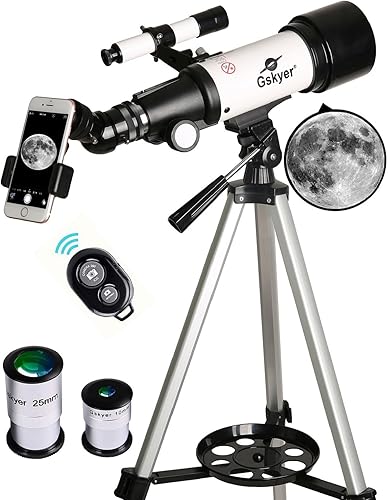
Gskyer Telescope: Best for travel and lunar viewing
- 70 mm aperture
- 400 mm focal length
- Phone adapter and wireless remote
- Adjustable tripod and carry bag
A compact refractor kit with a carry bag, adjustable tripod and phone adapter. Its 70 mm aperture and shorter focal length fit a teen who wants straightforward Moon and planet viewing.
Pros
- Carry bag included
- Phone adapter and wireless remote included
- Adjustable tripod
Cons
- Smaller aperture than the other main astronomy picks
- A 3x Barlow can make aiming and focusing more demanding
The Gskyer is a portable 70 mm refractor with a 400 mm focal length, adjustable tripod and carry bag. Its included 25 mm and 10 mm eyepieces cover lower and higher magnifications, and a 3x Barlow can increase magnification further.
A finder scope helps locate targets, but it takes practice to point a telescope accurately. The phone adapter and wireless remote offer a way to capture views, though smartphone pictures through an eyepiece can take patience to align.
This is a practical option for a teen who wants a telescope that can travel to a darker yard or campsite. Its smaller aperture may be less suited to a teen seeking brighter views than the larger options here.
MEEZAA Telescope: Best for brighter refractor views
- 90 mm aperture
- 800 mm focal length
- Two eyepieces and 3x Barlow
- Tripod, phone adapter and carry bag
The 90 mm aperture is the largest among these refractors, and the longer focal length suits a teen interested in lunar and planetary observing. A tripod, phone adapter and carry bag round out the kit.
Pros
- Largest aperture among the refractors here
- Two eyepieces and Barlow included
- Carry bag and phone adapter
Cons
- Longer tube and tripod take more room
- More magnification is not always useful in unsteady air
MEEZAA's 90 mm refractor has the largest aperture among the refractors in this roundup. Its 800 mm focal length, two eyepieces and 3x Barlow give a teen options for viewing the Moon and other bright targets.
The package includes an adjustable tripod, phone adapter and carry bag. A longer tube and tripod take more storage space than a compact kit, so consider where the telescope will go between sessions.
Choose it for a teen interested in lunar and planetary observing who is ready to learn focusing and aiming. Magnification alone doesn't guarantee a sharp view, especially when the air is moving or the tripod is unsteady.
Koolpte Telescope for Adults: Best for a simple 80 mm kit
- 80 mm aperture
- 600 mm focal length
- Two eyepieces and 3x Barlow
- Phone adapter, remote and carry bag
This 80 mm refractor pairs two eyepieces with a Barlow, finder scope and phone accessories. It fits a teen who wants a general-purpose kit with a mid-size aperture.
Pros
- 80 mm aperture
- Phone adapter and wireless remote included
- Carry bag included
Cons
- Product name is aimed at adults, though its features suit beginner use
- The eyepieces and Barlow may take practice to aim
This Koolpte 80 mm refractor pairs its 600 mm focal length with two eyepieces, a 3x Barlow and a 5x24 finder scope. Its altazimuth mount moves up, down and side to side, a straightforward layout for learning to aim.
The phone adapter, wireless remote and carry bag suit a teen who likes taking gear outdoors or trying basic phone photos. Aligning a phone with an eyepiece can take practice.
Consider it when a mid-size refractor feels like a better fit than a smaller starter scope. Give the teen time to practice with the finder and focus before expecting easy views of faint targets.
Blue Marble NASA Lunar Telescope for Kids Ages: Best for Moon-first beginners
- Designed around lunar viewing
- Finder scope
- Low- and high-power eyepieces
- Tabletop tripod
A Moon-focused telescope with a finder scope, two eyepieces and tabletop tripod. It can suit a younger teen who wants a simple introduction to lunar observing.
Pros
- Moon-centered use is easy to understand
- Finder scope included
- Learning guide included
Cons
- Tabletop tripod limits viewing positions
- Less suited to a teen seeking broader astronomy targets
The Blue Marble NASA Lunar Telescope is designed around observing the Moon. Its finder scope helps locate the lunar target, while the low- and high-power eyepieces provide two viewing options.
The tabletop tripod and smooth mount keep the setup focused on lunar sessions. A teen interested in planets, clusters and other targets may prefer a general-purpose telescope.
Choose it for a younger teenager who wants an uncomplicated first look at lunar craters, perhaps alongside a parent. The included learning guide gives the first sessions a clear subject to explore.
Koolpte Telescope for Adults & Beginner Astronomers: Best for portable 80 mm viewing
- 80 mm aperture
- 600 mm focal length
- Two eyepieces and 3x Barlow
- Phone adapter, remote and carry bag
This 80 mm refractor includes a phone adapter, wireless remote and carry bag for sessions away from home. It offers a similar feature set to the other Koolpte 80 mm option.
Pros
- Portable accessories included
- Two eyepieces and Barlow included
- 80 mm aperture
Cons
- Overlaps closely with the other Koolpte 80 mm pick
- Manual aiming takes practice
This Koolpte model has the same core 80 mm aperture and 600 mm focal length as the other Koolpte pick. Its two eyepieces, Barlow, phone adapter, wireless remote and carry bag make it another portable beginner kit.
The overlapping specifications mean the teen's needs may matter more than small differences in product naming. Consider the accessories and available storage space when choosing between the two.
It's a reasonable match for a teen who wants to carry a refractor between home and outdoor observing spots. Manual focus and aiming take practice, even when setup is described as tool-free.
EACONN Telescopes for Adults Astronomy: Best for carrying in a backpack
- 80 mm aperture
- 600 mm focal length
- 30x–66x stated magnification
- Backpack and phone adapter
The 80 mm refractor comes with an adjustable tripod, phone adapter and backpack. Its finder scope and 30x–66x magnification suit a teen learning to locate brighter targets.
Pros
- Backpack included
- Finder scope has crosshair
- Adjustable tripod
Cons
- Two eyepieces offer fewer viewing options than some kits here
- Check that the backpack and tripod suit the teen's transport needs
EACONN pairs an 80 mm aperture and 600 mm focal length with a backpack and adjustable tripod. Its K20 mm and K9 mm eyepieces provide magnifications of 30x and 66x, and the 5x24 finder scope has crosshairs.
The phone adapter has positions for the two eyepieces, which can help align a phone for photos. A backpack can help organize transport, though the teen should be able to carry the packed gear comfortably.
Pick it for a beginner who wants a portable refractor and will use the backpack. The two eyepieces offer fewer viewing options than some kits, so consider whether they suit the teen's goals.
MEEZAA Telescope for Adults & Kids: Best for a family kit with a backpack
- 80 mm aperture
- 500 mm focal length
- Two eyepieces and 3x Barlow
- Phone adapter, waterproof backpack and adjustable tripod
This 80 mm refractor includes an adjustable tripod, backpack, phone adapter and eyepieces. The shorter focal length and family-oriented kit may appeal to a teen sharing the telescope at home.
Pros
- Backpack and phone adapter included
- Tripod adjusts across a broad height range
- Two eyepieces and Barlow included
Cons
- More accessories to organize
- A phone adapter does not make deep-sky photography simple
MEEZAA's 80 mm refractor has a 500 mm focal length and comes with two eyepieces, a 3x Barlow and a 5x24 finder scope. Its tripod adjusts from 16.92 to 44.48 inches for different observing positions.
A waterproof backpack and phone adapter make this a travel kit for family use. The included stickers may appeal to younger users, while the telescope gives a teen a manual setup to learn.
Choose it when the telescope will be shared across ages or taken on trips. A phone adapter holds a phone in position, but it doesn't replace a dedicated astronomy camera for deep-sky photography.
How should you choose a telescope for a teenager?
Match the telescope to the teen's main targets, ability to carry the setup and interest in learning the controls. Aperture, mount, finder and included accessories matter more than a high maximum magnification claim.
For Moon and planet viewing, a refractor such as the Gskyer, Koolpte or MEEZAA options offers a familiar optical design and included eyepieces. For a larger aperture and app-assisted target finding, the Celestron reflector is a step toward exploring a wider range of objects.
A teenager's age doesn't reveal how much setup they'll enjoy. If you're choosing for a younger sibling too, compare the best telescope for toddlers and best telescope for an 8 year old to see how simpler, age-focused choices differ.
What should the best telescope for teens include?
The best telescope for teens should include a usable mount, a finder and eyepieces that support a few practical magnifications. A phone adapter is optional; a phone-guided app can be more useful for locating targets than a camera accessory.
Check that the tripod can be set to a comfortable height and that the teen can carry the packed kit. A carry bag or backpack can help keep small pieces together, but it doesn't make a telescope light.
How much aperture does a teenager need?
Aperture is the diameter of the telescope's main lens or mirror, and larger apertures can collect more light. The Celestron's 114 mm reflector has the largest aperture in this group, while the refractors range from 70 mm to 90 mm.
More aperture can reveal more, but a larger telescope may take more space and care. For many teens, a smaller telescope they use often is more useful than a larger model that stays stored.
How can a teenager get started with astronomy?
A teenager can start by learning to focus on the Moon and use the finder before moving to harder targets. Choose a clear night, set the tripod on stable ground and begin with the lowest-power eyepiece.
Avoid looking through a window, since glass can distort the image. Let the telescope adjust to outdoor temperature, and never aim it at or near the Sun.
The Moon makes an easy first target because it's bright and straightforward to locate. After that, try bright planets when they're visible, then use a star map or the Celestron app to find other targets.
Which telescope should you choose for a teenager?
Choose the Celestron StarSense Explorer LT 114AZ Newtonian Smartphone if guided sky finding and a larger aperture matter most. Pick the Gskyer for a portable refractor, or the MEEZAA Telescope for a larger-aperture refractor with a carry bag.
The right choice is the one the teenager can set up, aim and enjoy using repeatedly. For more age-specific context, start with [What Age Is a Telescope Good For?
Explained](/what-age-is-a-telescope-good-for/).
Our top 3 picks at a glance
-
1
-
2
-
3
Frequently asked questions
What is a good telescope for a teenager?
A good telescope for a teenager has enough aperture for useful views, a mount they can aim, and a setup they can manage. The Celestron StarSense Explorer LT 114AZ Newtonian Smartphone adds phone-guided target finding, while an 80 mm refractor offers a simpler optical tube and included accessories.
Choose around the teen's interest and willingness to learn, not the biggest magnification number.
Can a teenager use a telescope alone?
Many teenagers can set up and use a beginner telescope with practice, but age alone doesn't determine readiness. Consider the tube, tripod height, manual steps and whether an adult can help with the first setup.
Never point any telescope at the Sun.
Direct sunlight through optics can cause permanent eye injury.
Is a refractor or reflector better for a teenager?
A refractor can be a straightforward choice because its optical tube is sealed, while a reflector can offer a larger aperture but needs more care. In this group, the Celestron 114 mm reflector has the largest aperture, and the refractors include portability-focused accessories.
Pick based on the teen's interests, storage space and comfort with setup.
What can a beginner telescope show a teenager?
A beginner telescope can show the Moon's craters and, with suitable conditions and aiming, bright planets and star clusters. What you see depends on aperture, sky conditions, target position and magnification.
A telescope won't show colorful, detailed views like long-exposure space photographs.
Start with the Moon, then learn to find brighter targets.