7 Best Telescopes Under 250 (November 2026)
The best telescopes under 250 include the Celestron Travel Scope 70mm Beginner Portable Telescope for travel and first setups, the Gskyer Telescope for phone photos and Barlow reach, and the CELTICBIRD Telescope for Adults High Powered for Moon contrast and 80mm light.
On this page (10 sections)
- How the best telescopes under 250 were compared
- The best telescopes under 250, pick by pick
- Best telescopes under 250 side by side
- How these were compared
- What aperture and focal length mean for beginners
- Which mount and tripod should you expect under 250
- What eyepieces and Barlow lenses do in daily use
- Can you take phone photos with these telescopes
- Are these scopes good for kids, travel and gifts
- Verdict: best telescopes under 250
The best telescopes under 250 for most beginners are the Celestron Travel Scope 70mm and the Gskyer 70mm, because both give you a real 70mm aperture, a 400mm focal length and a mount you can learn in one evening.
If you want more light, step up to an 80mm, 600mm model.
If you want the simplest kids Moon scope, the Blue Marble pick is the focused choice.
Our score weighs specs, features and buyer feedback against what you are shopping for.
We compared aperture, focal length, included eyepieces, finderscopes, mounts, tripods and travel gear across these seven picks.
We looked for models that can show the Moon well, frame bright planets, and still pack away without a fight.
Our picks at a glance
-
1
 Best for travel and first setups
Celestron Travel Scope 70mm Beginner Portable Telescope
9.7/10 our score
See it on Amazon -
2
-
3
 Best for Moon contrast and 80mm light
CELTICBIRD Telescope for Adults High Powered
9.5/10 our score
See it on Amazon
- 4
 Check it
Blue Marble NASA Lunar Telescope for Kids Ages
Best for young Moon watchers - 5
 Check it
EACONN Telescopes for Adults Astronomy
Best for 80mm travel with a scale gimbal - 6
 Check it
ToyerBee Telescope for Adults & Kids
Best for wide 15x to 150x zoom range - 7
 Best for simple 20x to 32x viewingCheck it
How the best telescopes under 250 were compared
Aperture came first, then focal length and mount type.
A 70mm lens gathers less light than 80mm, but it is lighter and easier to carry.
A 600mm focal length gives a narrower, more detailed view than 300mm or 400mm, yet it also makes aiming and tracking more demanding.
We also checked what is in the box.
Two eyepieces matter because a low-power eyepiece helps you find an object and a higher-power eyepiece helps you inspect it.
A finderscope matters for the same reason.
A phone adapter matters only if you plan to take photos, and a backpack matters only if you plan to travel.
The best telescopes under 250, pick by pick
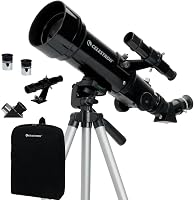
Celestron Travel Scope 70mm Beginner Portable Telescope: Best for travel and first setups
- 70mm aperture
- 400mm focal length
- 20mm and 10mm eyepieces
- 5x24 finderscope
- 45 degree erect image diagonal
- Full-height tripod
- Padded backpack included
- Starry Night Basic Edition software
A lightweight 70mm refractor with a backpack, two eyepieces and a finderscope for quick Moon, planet and daytime viewing.
Pros
- Backpack for storage and travel
- No-tool setup with full-height tripod
- Two eyepieces for wide and close views
Cons
- 70mm aperture limits faint deep-sky detail
- Shorter 400mm focal length than the 80mm picks
The Celestron Travel Scope 70mm suits a beginner who wants a scope that goes from closet to backyard in minutes.
Its 70mm aperture and 400mm focal length hit a useful middle ground for the Moon, bright planets and daytime scenery.
You get 20mm and 10mm eyepieces, a 5x24 finderscope and a 45 degree erect image diagonal.
That diagonal helps for ground viewing because it turns the image upright and lets you look down into the eyepiece at a more comfortable angle.
The full-height tripod and padded backpack are the practical win here.
Everything packs into one bag, and Celestron states that no tools are needed for setup.
The included Starry Night Basic Edition software also helps you plan what to look for.
Trade-off: an 80mm model will gather more light for faint targets.
If travel ease and beginner setup matter more than maximum brightness, this is the cleaner choice.
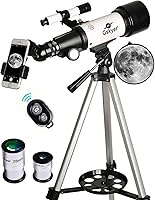
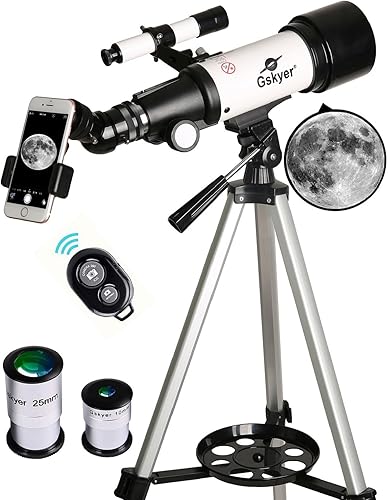
Gskyer Telescope: Best for phone photos and Barlow reach
- 70mm aperture
- 400mm focal length
- 25mm and 10mm eyepieces
- 3x Barlow lens
- 5x24 finderscope
- Adjustable aluminum tripod
- Carry bag
- Phone adapter and wireless camera remote
A 70mm refractor with a 3x Barlow, phone adapter and wireless remote for higher magnification and simple phone imaging.
Pros
- 3x Barlow triples eyepiece power
- Phone adapter and wireless remote included
- Adjustable tripod and carry bag
Cons
- Same 70mm aperture as the Celestron
- Highest Barlow power can feel unsteady in wind
The Gskyer Telescope suits a beginner who wants more magnification options and phone imaging in one kit.
Its 70mm aperture and 400mm focal length match the Celestron on paper, but the accessory list leans more toward close-up viewing and photos.
You get 25mm and 10mm eyepieces plus a 3x Barlow lens.
The Barlow triples the power of each eyepiece, so one eyepiece can serve two jobs.
A 5x24 finderscope with crosshair lines helps you center the Moon before you switch to higher power.
The phone adapter and wireless camera remote are the hook.
You can frame on your phone and trigger shots without touching the tripod as much.
An adjustable aluminum tripod and carry bag keep the kit portable.
Trade-off: the highest Barlow combinations can feel shaky if the tripod is on soft ground.
Start with the lower eyepiece power and move up only when the view is steady.
CELTICBIRD Telescope for Adults High Powered: Best for Moon contrast and 80mm light
- 80mm aperture
- 600mm focal length
- 20mm and 9mm eyepieces
- 30x and 66x magnification
- 5x24 finderscope
- Moon filter
- Adjustable tripod 17.7 to 52 in
- Backpack and phone adapter
An 80mm, 600mm refractor with a Moon filter, backpack and phone adapter for brighter Lunar views and steady planet framing.
Pros
- Larger 80mm aperture than most picks
- Moon filter reduces glare and boosts contrast
- Tall adjustable tripod for adults and kids
Cons
- Longer 60cm tube is less compact
- Moon filter helps the Moon, not faint galaxies
The CELTICBIRD Telescope for Adults High Powered suits a Moon-first buyer who wants a larger lens without leaving the budget class.
Its 80mm aperture and 600mm focal length gather more light than the 70mm picks and give a longer view for craters and planets.
The kit includes 20mm and 9mm eyepieces for 30x and 66x magnification, plus a 5x24 finderscope.
A Moon filter is included, and CELTICBIRD says it transmits only 13 percent of incoming light.
That lower light level can reduce glare and improve contrast on a bright lunar surface.
The adjustable tripod runs from 17.7 to 52 inches, so adults and kids can share it without stacking books under the legs.
A backpack and upgraded phone adapter keep accessories together for travel and phone photos.
Trade-off: the 60cm optical tube is longer and less compact than the 400mm models.
If you need the smallest pack, a 70mm scope will be easier to carry.
Blue Marble NASA Lunar Telescope for Kids Ages: Best for young Moon watchers
- Finder scope
- Low-power and high-power eyepieces
- Tabletop tripod
- Equatorial mount
- Lens dust cap
- Learning guide
- 90x magnification
A simple NASA-branded Lunar scope for ages 8 and up, built around finding the Moon and zooming in with two eyepieces.
Pros
- Simple for kids and parents together
- Finder scope helps locate the Moon
- Learning guide included
Cons
- Small objective lens limits brightness
- Tabletop tripod is less flexible than a full tripod
The Blue Marble NASA Lunar Telescope for Kids Ages suits a child aged 8 and up who has one clear goal: see the Moon up close.
It is a focused Lunar scope, not a general-purpose star telescope.
That focus is its strength for a young beginner.
The kit includes a finder scope, low-power and high-power eyepieces, a tabletop tripod and a lens dust cap.
Blue Marble lists 90x magnification.
In practice, the finder scope helps a child locate the Moon first, then the eyepieces help zoom in for a closer view.
The smooth mount system is meant to make scanning the lunar surface easier.
A learning guide is also included, which helps turn a short viewing session into a lesson about lunar features.
Trade-off: this is the smallest-feeling pick here, with a tabletop tripod and a narrow objective lens diameter of 25.
For a child who mainly wants the Moon, that simplicity can be a plus.
For an adult who wants planets and deep-sky targets, choose a 70mm or 80mm refractor instead.
EACONN Telescopes for Adults Astronomy: Best for 80mm travel with a scale gimbal
- 80mm aperture
- 600mm focal length
- K20mm and K9mm eyepieces
- 30x to 66x magnification
- 5x24 finderscope with crosshair
- Phone adapter
- Adjustable tripod
- Backpack
An 80mm, 600mm travel refractor with a scaled rough adjustment gimbal, phone adapter and backpack for backyard and road use.
Pros
- 80mm aperture with 600mm focal length
- Scaled gimbal helps repeatable pointing
- Backpack and phone adapter included
Cons
- Overlaps closely with the CELTICBIRD 80mm pick
- No Moon filter stated for this model
The EACONN Telescopes for Adults Astronomy suits a traveler who wants 80mm light with a more deliberate pointing system.
Its 80mm aperture and 600mm focal length match the CELTICBIRD on core optics, while the mount hardware points toward repeatable aiming.
EACONN describes a rough adjustment and positioning gimbal with a scale.
That scale can help you return to a similar altitude and azimuth after you move the scope, which is useful when you are learning the sky from a backyard or campsite.
You get K20mm and K9mm eyepieces for 30x to 66x magnification, a 5x24 finderscope with a crosshair and a phone adapter.
The adapter has end positions prepared for the K20 and K9 eyepieces, so you can match the eyepiece lettering before you attach your phone.
A backpack and adjustable tripod keep the kit portable.
EACONN positions this as a gift for beginners and kids aged 8 to 12, as well as adults.
Trade-off: it overlaps heavily with the CELTICBIRD 80mm model.
Choose CELTICBIRD if the Moon filter and taller tripod range matter more.
Choose this EACONN if the scaled gimbal and eyepiece-matched phone adapter sound more useful.
ToyerBee Telescope for Adults & Kids: Best for wide 15x to 150x zoom range
- 70mm aperture
- 300mm focal length
- 20mm and 6mm eyepieces
- 3x Barlow lens
- 15x to 150x magnification
- 5x24 finderscope
- Phone adapter and wireless camera remote
- Star chart
A light 70mm refractor with a 3x Barlow for a wide stated zoom range, plus phone adapter, wireless remote and star chart.
Pros
- Widest stated magnification range here
- Lightweight at 3.5 lb
- Star chart helps learn the night sky
Cons
- 300mm focal length is shorter than 400mm and 600mm picks
- High 150x power needs steady air and a steady tripod
The ToyerBee Telescope for Adults & Kids suits a buyer who likes a wide zoom range and a light kit.
Its 70mm aperture and 300mm focal length give a wider starting view than the 400mm and 600mm models, while the Barlow adds reach.
ToyerBee lists 15x to 150x magnification using 20mm and 6mm eyepieces plus a 3x Barlow lens.
That range is useful in theory: low power for finding and framing, high power for the Moon and bright planets.
In real use, the top end will depend on air steadiness and tripod stability.
The kit includes a 5x24 finderscope, a phone adapter, a wireless camera remote and a star chart.
The star chart is a small but real help for a beginner learning constellations and bright planets.
At 3.5 pounds, this is one of the lighter full kits here.
That helps for camping and road trips.
Trade-off: the shorter 300mm focal length means less native reach than a 600mm tube.
If your main target is the Moon in close detail, the 80mm, 600mm picks have the stronger optical starting point.
EACONN Telescopes: Best for simple 20x to 32x viewing
- 70mm aperture
- 400mm focal length
- 12.5mm and 20mm eyepieces
- 20x to 32x magnification
- 5x24 finderscope with crosshairs
- Adjustable aluminum tripod 12 to 38 in
- Custom phone adapter
- Altazimuth mount
A straightforward 70mm, 400mm refractor with two eyepieces, a crosshair finderscope and a phone adapter for easy first views.
Pros
- Low 20x to 32x range is easy for beginners
- Crosshair finderscope helps aim
- Tripod adjusts from 12 to 38 in
Cons
- No Barlow or backpack stated
- Lower top magnification than several rivals
The EACONN Telescopes suits a beginner who wants simple, low-power viewing without extra accessories to manage.
Its 70mm aperture and 400mm focal length are a proven starter pairing for the Moon, planets and landscape viewing.
You get 12.5mm and 20mm eyepieces for 20x to 32x magnification.
That modest range is easy to use because the view stays wider and less sensitive to small movements.
A 5x24 finderscope with crosshairs helps you aim before you switch eyepieces.
The adjustable aluminum tripod runs from 12 to 38 inches.
That range works for a seated child, a standing adult or a quick backyard setup.
A custom phone adapter lets you try phone photos without buying a separate mount.
Trade-off: there is no Barlow, backpack or Moon filter stated for this kit.
If you want a complete travel bundle, the Celestron or CELTICBIRD will feel more finished.
If you want a simple first scope, this one is easy to learn.
Best telescopes under 250 side by side
| Product | Best for | Aperture | Focal length | Mount | Our score |
|---|---|---|---|---|---|
| Celestron Travel Scope 70mm Beginner Portable Telescope | travel and first setups | 70mm | 400mm | Altazimuth | 9.7 |
| Gskyer Telescope | phone photos and Barlow reach | 70mm | 400mm | Altazimuth | 9.7 |
| CELTICBIRD Telescope for Adults High Powered | Moon contrast and 80mm light | 80mm | 600mm | Altazimuth | 9.5 |
| Blue Marble NASA Lunar Telescope for Kids Ages | young Moon watchers | 25mm objective lens diameter | Equatorial | 9.4 | |
| EACONN Telescopes for Adults Astronomy | 80mm travel with a scale gimbal | 80mm | 600mm | Altazimuth | 9.1 |
| ToyerBee Telescope for Adults & Kids | wide 15x to 150x zoom range | 70mm | 300mm | 9.1 | |
| EACONN Telescopes | simple 20x to 32x viewing | 70mm | 400mm | Altazimuth | 8.3 |
For a quick read, the 80mm models lead on light gathering, the 70mm models lead on portability, and the Blue Marble leads on kid-focused simplicity.
The Gskyer and ToyerBee lead on magnification options and phone gear.
The Celestron leads on a clean travel bundle with software.
How these were compared
We compared the seven kits by aperture, focal length, mount, eyepieces, finderscope, tripod and included travel or photo gear.
We also weighed how a beginner would actually use each scope: finding the Moon, framing a planet, packing the kit and setting it up again.
We did not treat maximum magnification as the main goal.
A scope that is hard to aim or hard to keep steady will frustrate a new user faster than a modest scope that is easy to set up.
That is why two eyepieces, a finderscope and a usable tripod matter so much at this budget.
If you are torn between two similar 70mm models, look at the box contents.
A backpack, Barlow lens, phone adapter or software can change daily use more than a small spec difference.
If you are torn between 70mm and 80mm, think about where you will observe.
A darker site rewards the larger aperture more than a bright backyard does.
What aperture and focal length mean for beginners
Aperture is the diameter of the main lens, and it controls how much light the scope gathers.
An 80mm lens has about 31 percent more light-gathering area than a 70mm lens, based on the lens diameter alone.
That extra light helps the Moon and planets look brighter and helps faint stars show up a little better.
Focal length controls the view size.
A 600mm focal length gives a narrower field than 400mm at the same eyepiece power.
That means more detail on the Moon, but also a smaller target to find and track.
70mm models for lighter travel
The Celestron, Gskyer, ToyerBee and second EACONN use 70mm apertures.
They are easier to carry and often easier to set up on a small tripod.
For a first scope, that ease can matter more than a small gain in brightness.
80mm models for brighter Moon and planet views
The CELTICBIRD and the first EACONN use 80mm apertures with 600mm focal lengths.
They are better suited to Lunar detail and planet framing.
They also need a steadier tripod because the longer tube magnifies small movements more.
Which mount and tripod should you expect under 250
Most picks here use an altazimuth mount, which moves up-down and left-right.
That motion is intuitive for a beginner because it matches how you point at a building or a tree.
You push the tube where you want it to go, then use the focuser to sharpen the image.
The Blue Marble user-facing pick uses an equatorial mount.
That mount type is common for astronomy because it is designed to follow the sky's rotation.
For a simple kids Moon scope, the key point is that the mount should move smoothly enough to scan the lunar surface.
Tripod height and stability
A tripod that can reach your eye height will be more comfortable than a short tabletop tripod for most adults.
The CELTICBIRD tripod adjusts to 52 inches, while the second EACONN adjusts from 12 to 38 inches.
The Celestron uses a full-height tripod for standing use.
Why a finderscope matters
A finderscope is a small pointing scope that shows a wider view than the main eyepiece.
Most picks here include a 5x24 finderscope.
Use it to center the Moon or a bright planet, then look through the main eyepiece.
That two-step process saves a lot of hunting.
What eyepieces and Barlow lenses do in daily use
Eyepieces change magnification and field of view.
A longer eyepiece, such as 20mm or 25mm, gives lower power and a wider view.
A shorter eyepiece, such as 9mm, 10mm or 6mm, gives higher power and a closer view.
A Barlow lens sits between the eyepiece and the telescope and multiplies the power.
The Gskyer and ToyerBee include a 3x Barlow, so each eyepiece can be used at two power levels.
That is handy, but the highest combinations are the most sensitive to shake.
Starting power for the Moon
Start with the lowest-power eyepiece, center the Moon, then move to a higher eyepiece.
The Moon is bright and large, so it does not need the highest power to look good.
Low power also helps you see more craters across the surface at once.
Starting power for planets
Planets such as Jupiter and Saturn are small, so higher power helps.
Still, start low, center the planet, then increase power in small steps.
If the planet looks fuzzy or wobbly, the air or the tripod may be the limit rather than the eyepiece.
Can you take phone photos with these telescopes
Yes, but phone photos are a bonus, not the main job.
Several kits include a phone adapter, and the Gskyer and ToyerBee include a wireless camera remote.
The Moon, bright planets and daytime scenery are the most realistic phone targets.
Phone imaging works best when the tripod is steady and the target is bright.
Align the phone camera with the eyepiece, adjust focus, then take several shots and keep the sharpest one.
A wireless remote helps because it reduces shaking from pressing the phone screen.
What to expect from phone photos
Expect a bright Moon disk, a small planet image or a decent daytime landscape.
Do not expect detailed galaxy photos from a budget refractor and a phone.
If astrophotography is your main goal, treat the phone adapter as a way to experiment rather than a reason to choose a scope by itself.
Are these scopes good for kids, travel and gifts
Yes, if you match the scope to the child and the trip.
The Blue Marble scope is aimed at ages 8 and up and focuses on the Moon.
The Celestron and CELTICBIRD include backpacks, which helps for camping and road trips.
The ToyerBee includes a star chart, which helps a child learn the sky beyond the Moon.
For a gift, check the tripod height and the kit weight before you choose.
A scope that is too tall, too heavy or too fiddly will sit in a closet.
A scope that packs into a bag and sets up without tools is more likely to be used every week.
If you want a broader upgrade path later, our guide to the best budget friendly telescope can help you compare entry-level options by use case.
If your budget can stretch later, the best telescope under 1000 guide shows what changes at a higher tier.
For a larger jump, the best telescope under 5000 guide covers premium scopes, and the best telescope under 500 guide sits between this budget and the 1000 tier.
Verdict: best telescopes under 250
Buy the Celestron Travel Scope 70mm if you want the simplest travel-ready first scope.
Buy the Gskyer if you want a Barlow and phone gear in the box.
Buy the CELTICBIRD or the EACONN 80mm model if you want more light for the Moon and planets.
Buy the Blue Marble if the buyer is a young kid and the Moon is the main target.
For most beginners shopping the best telescopes under 250, start with a 70mm or 80mm refractor, two eyepieces and a finderscope.
That combination will teach you the sky faster than a high-magnification kit that is hard to aim.
Pick the bundle that fits your storage, your tripod needs and your observing site, and you will use it far more often.
Our top 3 picks at a glance
-
1
Best for travel and first setups
Celestron Travel Scope 70mm Beginner Portable Telescope
9.7/10 our score
See it on Amazon -
2
-
3
Best for Moon contrast and 80mm light
CELTICBIRD Telescope for Adults High Powered
9.5/10 our score
See it on Amazon
Frequently asked questions
What is the best telescope under 250 for a beginner?
For most beginners, the Celestron Travel Scope 70mm or the Gskyer 70mm is the safest start. Both use a 70mm aperture and 400mm focal length on an altazimuth mount.
Pick the Celestron for the backpack and software, or the Gskyer for the Barlow and phone adapter.
Is 70mm or 80mm better under 250?
An 80mm aperture gathers more light than 70mm, so the CELTICBIRD and the first EACONN 80mm model can show a brighter Moon and planets. The trade-off is a longer 600mm tube and a less compact carry.
A 70mm scope is lighter and often easier to set up.
Can these telescopes take phone photos?
Several picks include a phone adapter, and the Gskyer and ToyerBee also include a wireless camera remote. Phone photos work best with the Moon, bright planets and daytime scenery.
Keep expectations modest for faint stars and galaxies at this budget.
What magnification do beginners need?
Most beginners are happiest starting near 20x to 40x for wide views, then moving higher for the Moon and planets. The picks here span 15x to 150x depending on eyepiece and Barlow use.
Higher power makes the view smaller and more sensitive to shake and air movement.