9 Best Refractor Telescopes for Visual Astronomy (November 2026)
The best refractor telescopes for visual astronomy include the Dianfan Telescope for beginners starting visual astronomy, the MEEZAA Telescope for a complete accessory kit, and the Celestron StarSense Explorer LT 80AZ Smartphone Guided for phone guided finding.
On this page (8 sections)
- Best refractor telescopes for visual astronomy compared side by side
- How we compared these refractor telescopes for visual use
- What aperture and focal length mean at the eyepiece
- What magnification range should you expect
- Do you need phone guided finding or a finder scope
- What should be in the box for a first refractor
- How should you set up and care for a refractor
- Verdict: which refractor telescope for visual astronomy should you buy
The best refractor telescope for visual astronomy for most beginners is the Dianfan Telescope, because its 90mm aperture and 800mm focal length give bright eyepiece views with a complete tripod and carry kit. If finding targets is your main worry, the Celestron StarSense models point you with your phone instead.
A refractor suits visual astronomy because the lens tube is closed, setup is direct, and there is no mirror to align. You look through an eyepiece at the Moon, planets, open clusters and bright nebulae, rather than building a camera based imaging rig.
Our score weighs specs, features and buyer feedback against what a visual observer needs at the eyepiece. Aperture, focal length, included eyepieces, finder, mount, portability and kit completeness all count.
Start with Is a Refractor Good for a Beginner? What to Know if this is your first telescope.
That guide explains the trade offs before you compare these nine models.
Our picks at a glance
-
1

-
2

-
3
 Best for phone guided finding
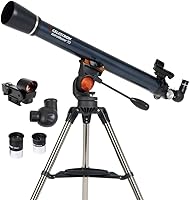
Celestron StarSense Explorer LT 80AZ Smartphone Guided
9.6/10 our score
See it on Amazon
- 4
 Check it
Celestron StarSense Explorer DX 102AZ App-Enabled Refractor
Best for larger phone guided aperture - 5
 Check it
Askar 71F Flat-Field Telescope
Best for a portable optical tube - 6
 Check it
Gskyer Telescope 600x90mm AZ Astronomical Refractor Telescope
Best for multiple eyepiece options - 7
 Check it
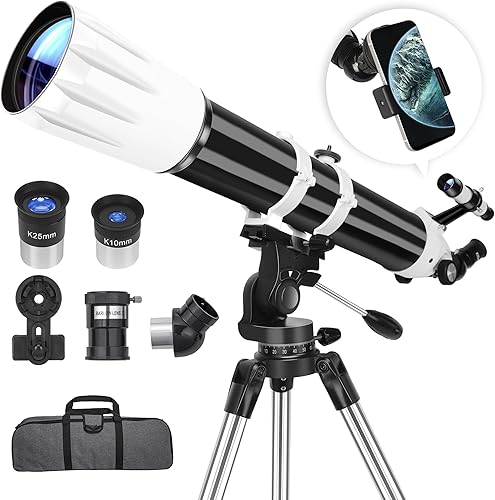
Hawkko 90mm Aperture 900mm Telescope for Adults
Best for long focal length planetary views - 8
 Check it
EACONN Telescopes for Adults Astronomy
Best for compact travel viewing - 9
 Check it
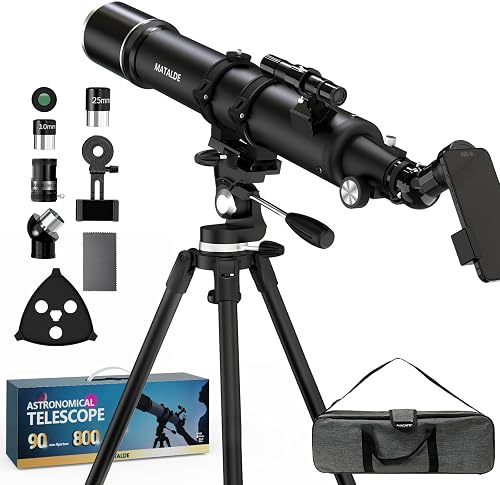
Matalde 90mm Aperture Telescope 800mm Focal Length
Best for a ready to use alt azimuth kit
Best refractor telescopes for visual astronomy compared side by side
The Dianfan and MEEZAA lead on complete 90mm kits, the Celestron pair lead on guided finding, and the Askar suits owners who already have a mount. The rest trade portability, focal length or eyepiece choice.
Read the product notes below by the job you want the telescope to do first. Some are built for wide, easy scanning, some for close lunar detail, and one is an optical tube that expects you to bring the mount yourself.
Dianfan Telescope: Best for beginners starting visual astronomy
- 90mm aperture
- 800mm focal length
- 32x to 240x magnification
- Two eyepieces and 3x Barlow lens
- Stainless steel tripod, carry bag and phone adapter
A 90mm by 800mm refractor with a full beginner kit for Moon, planet and daytime viewing.
Pros
- Large 90mm aperture for its class
- Complete kit with bag and phone adapter
- 45 degree zenith mirror for upright views
Cons
- Manual focus only
- Heavier than the Askar OTA alone
The Dianfan suits a first time visual observer who wants one box with the tube, tripod, eyepieces and a way to carry it all. Its 90mm aperture and 800mm focal length put it in the sweet spot for Moon and planet viewing without becoming unwieldy.
You get two eyepieces and a 3x Barlow lens for 32x to 240x magnification. That range lets you start wide on clusters and move up to lunar craters when the air is steady.
The 45 degree zenith mirror gives upright, correctly oriented images, which also helps for daytime landscapes and wildlife. A stainless steel tripod and carry bag make backyard to field trips simpler.
The fully coated 90mm objective and 1.29 arc second Dawes limit support sharp split views and contrast on bright targets. The manual altazimuth mount and smooth focusing help beginners learn the sky by hand.
The trade off is manual focus and a 4.7kg package, so it is not the lightest travel option here. For a beginner who values a complete kit over app guidance, it is the strongest overall pick.
MEEZAA Telescope: Best for a complete accessory kit
- 90mm aperture
- 800mm focal length f/8.88
- 10mm and 25mm eyepieces plus 3x Barlow lens
- Adjustable stainless steel tripod 28 to 46 inches
- Carry bag, phone adapter and accessory tray
A 90mm refractor with named eyepieces, a Barlow lens and a tray for organized backyard sessions.
Pros
- Eyepiece sizes stated clearly
- Tripod height range stated
- Fully multi-coated optics
Cons
- Manual focus only
- Same 800mm class as several rivals
The MEEZAA suits an adult beginner who wants the eyepiece sizes and tripod height stated up front. Its 90mm aperture and 800mm f/8.88 focal length closely mirror the Dianfan, so the choice comes down to kit layout and details.
It includes 10mm and 25mm eyepieces plus a 3x Barlow lens for 32x to 240x magnification. The 25mm eyepiece gives the wide view for scanning, while the 10mm and Barlow reach lunar detail.
The adjustable stainless steel tripod extends from 28 to 46 inches. An accessory tray and carry bag help keep eyepieces organized at the telescope.
The fully multi coated glass, straight through finderscope and zenith mirror make target acquisition and comfortable viewing straightforward in a backyard. The paper manual is aimed at first assembly, with most users reported to finish in about 10 minutes.
The trade off is that it shares the same manual focus and 800mm class as close rivals. Pick MEEZAA if the tray, stated eyepiece sizes and tripod range matter to you.
Celestron StarSense Explorer LT 80AZ Smartphone Guided: Best for phone guided finding
- 80mm refractor
- 400mm focal length
- StarSense Explorer phone dock and app navigation
- 25mm and 10mm eyepieces plus 2x Barlow lens
- StarPointer red dot finderscope
An 80mm refractor built around phone app sky recognition and on screen arrows to targets.
Pros
- App guided target finding
- Preassembled mount and tripod
- 2 year US warranty from Celestron
Cons
- Smaller 80mm aperture than 90mm picks
- Requires a compatible smartphone
The Celestron StarSense Explorer LT 80AZ suits a beginner who fears getting lost in the sky. Its 80mm refractor with 400mm focal length is smaller than the 90mm picks, but the phone guided system changes the experience.
You dock your phone, launch the StarSense Explorer app, and follow on screen arrows to stars, planets, nebulae and more. The app builds a list of targets for your time and location.
It includes 25mm and 10mm eyepieces, a 2x Barlow lens, an erect image diagonal and a StarPointer red dot finderscope. The manual altazimuth mount has altitude slow motion adjustment.
The 400mm focal length gives a forgiving wide field, which helps when you are still learning to center objects after the app points you there. The preassembled mount and tripod reduce first night setup friction.
The trade off is the smaller 80mm aperture and a need for a compatible smartphone. Pick it if guided finding matters more than maximum light gathering.
Celestron StarSense Explorer DX 102AZ App-Enabled Refractor: Best for larger phone guided aperture
- 102mm refractor
- 650mm focal length
- StarSense Explorer phone dock and app navigation
- 25mm and 10mm eyepieces
- StarPointer finderscope and erect image diagonal
A 102mm app guided refractor with dual axis slow motion controls for easier target centering.
Pros
- Largest aperture among app guided picks
- Dual axis slow motion controls
- 2 year US warranty from Celestron
Cons
- 14.2 pounds, heavier than the 80AZ
- Requires a compatible smartphone
The Celestron StarSense Explorer DX 102AZ suits a beginner who wants app guidance with more aperture. Its 102mm refractor and 650mm focal length gather more light than the 80AZ for brighter Moon and planet views.
The same StarSense Explorer app uses sky recognition to point the telescope. Dual axis slow motion controls help you center a target once the bullseye turns green.
It includes 25mm and 10mm eyepieces, an erect image diagonal, a StarPointer finderscope and a preassembled mount and tripod. Celestron includes a 2 year US warranty.
The 650mm focal length sits between the short 400mm LT model and the long 800mm kits. That middle ground suits the Moon and planets while keeping the field wider than a 900mm tube.
The trade off is weight at 14.2 pounds and a higher price class than basic 90mm kits. Pick it if you want guided finding plus the largest aperture in the Celestron pair.
Askar 71F Flat-Field Telescope: Best for a portable optical tube
- 71mm aperture
- 493.9mm focal length f/6.9
- Quadruplet air spaced APO with ED glass
- 230mm Vixen dovetail plate
- 2.5kg tube weight
A 71mm flat field OTA for visual observation that needs its own mount and eyepieces.
Pros
- Light 2.5kg tube
- ED glass APO design
- Self flattened design
Cons
- OTA only, mount and eyepieces not included
- Smallest aperture in this group
The Askar 71F suits a visual observer who already owns a suitable mount or plans to build a small portable system. Its 71mm aperture at f/6.9 with 493.9mm focal length is the shortest focal length here.
The quadruplet air spaced APO design includes ED glass to reduce chromatic aberration. The self flattened design also suits photography, but for visual use the key benefit is a compact, quality lens tube.
The tube weighs only 2.5kg and the package with tube rings and dovetail plate is about 3kg. That makes it far easier to carry than a full kit on a tripod.
The dual speed 2.4 inch focuser, 360 degree rotator and 230mm Vixen dovetail plate show this is aimed at users who will choose their own mount and eyepieces. The matte interior and CNC barrel help control stray light.
The trade off is clear: it is an optical tube assembly, so you supply the mount, tripod and eyepieces. Pick it only if you already have that gear or want to choose it yourself.
Gskyer Telescope 600x90mm AZ Astronomical Refractor Telescope: Best for multiple eyepiece options
- 90mm aperture
- 600mm focal length f/6.7
- 24x, 60x and 120x eyepieces plus 3x Barlow lens
- 6x30 finderscope
- Adjustable aluminum tripod 31.5 to 49 inches
A 90mm by 600mm refractor with three eyepieces for a wider range of viewing magnifications.
Pros
- Three eyepieces included
- 6x30 finderscope
- Astronomy software included
Cons
- Aluminum tripod rather than stainless steel
- Heavier package at 17.5 pounds
The Gskyer 600x90mm suits a visual observer who wants more eyepiece choices in the box. Its 90mm aperture and 600mm f/6.7 focal length give a shorter tube than 800mm and 900mm rivals.
It comes with three eyepieces for 24x, 60x and 120x, plus a 3x Barlow lens that triples each eyepiece. That step between magnifications helps you find the best view for the Moon or a planet on a given night.
The package includes a 6x30 finderscope, a 48 degree erecting BAK7 prism and astronomy software. The aluminum tripod adjusts from about 31.5 to 49 inches.
The 25mm, 10mm and 5mm eyepiece set covers wide scanning through close planetary work without needing an immediate extra purchase. The fully coated optics and hook dovetail plate keep the tube simple to operate for a novice.
The trade off is an aluminum tripod and a 17.5 pound package. Pick it if three eyepieces and a shorter focal length matter more than a stainless steel tripod.
Hawkko 90mm Aperture 900mm Telescope for Adults: Best for long focal length planetary views
- 90mm aperture
- 900mm focal length
- 36x to 270x magnification
- 25mm and 10mm eyepieces plus 3x Barlow lens
- Stainless steel AZ tripod 28 to 46 inches
A 90mm by 900mm refractor with the longest focal length in this group for higher magnification.
Pros
- 900mm focal length for planets and Moon
- Complete kit with finder and tray
- Phone adapter included
Cons
- Longer tube is less portable
- Higher magnification can show empty views in poor air
The Hawkko 90mm by 900mm suits a visual observer focused on the Moon and planets. Its 900mm focal length is the longest in this group, so it reaches higher magnification with a given eyepiece.
It offers 36x to 270x magnification with 25mm and 10mm eyepieces and a 3x Barlow lens. The 90mm aperture with full multi layer coating aims for bright, sharp lunar views.
The stainless steel AZ tripod adjusts from 28 to 46 inches and supports 360 degree rotation. The kit includes a finder scope, zenith mirror, accessory tray, carry bag and phone adapter.
The 1.29 arc second Dawes limit and 90cm optical tube reflect a design tuned for high power lunar work. The longer focal ratio also helps separate double stars and tighten planetary detail on steady nights.
The trade off is a longer 90cm tube that is less portable than 600mm models. Pick it if planetary magnification matters more than easy travel.
EACONN Telescopes for Adults Astronomy: Best for compact travel viewing
- 80mm aperture
- 600mm focal length
- 30x to 66x magnifications
- K20mm and K9mm eyepieces
- Backpack, tripod and phone adapter
A compact 80mm by 600mm travel refractor with a backpack for portable family viewing.
Pros
- Backpack for travel
- 5x24 finder scope with crosshair
- 2 year warranty
Cons
- Lower stated magnification range
- Smaller aperture than 90mm picks
The EACONN suits a family or traveler who needs a refractor that packs away easily. Its 80mm aperture and 600mm focal length give a compact tube for Moon, planet and daytime viewing.
It offers 30x to 66x magnification with K20mm and K9mm eyepieces. That is a modest range, but it keeps the view wide and forgiving for beginners and younger observers.
The kit includes a 5x24 finder scope with crosshair, a backpack, an adjustable tripod and a customized phone adapter. EACONN lists a 2 year warranty.
The rough adjustment gimbal with scale helps set altitude and azimuth, and the fully multi coated green optics glass aims to improve light transmission. The backpack format makes car trips and campsite use easier than a hard case alone.
The trade off is lower magnification and a smaller aperture than the 90mm picks. Pick it if portability and a backpack matter more than reaching high power.
Matalde 90mm Aperture Telescope 800mm Focal Length: Best for a ready to use alt azimuth kit
- 90mm aperture
- 800mm focal length f/8.8
- 32x to 240x magnification
- 10mm and 25mm eyepieces plus 3x Barlow lens
- Adjustable iron tripod 26 to 46 inches
A 90mm by 800mm refractor with a zenith diagonal, finderscope and phone adapter in one kit.
Pros
- 48 degree zenith diagonal
- 5x24 finderscope
- Two year warranty
Cons
- Iron tripod rather than stainless steel
- Fewer buyer reports than established picks
The Matalde 90mm by 800mm suits a beginner who wants a ready to use alt azimuth kit at a budget level. Its 90mm aperture and 800mm f/8.8 focal length match the core specs of the top picks.
It gives 32x to 240x magnification with 10mm and 25mm eyepieces and a 3x Barlow lens. The 48 degree zenith diagonal and 5x24 finderscope help you find and view targets comfortably.
The iron tripod extends from 26 to 46 inches, and the alt azimuth mount moves 360 degrees horizontally and 90 degrees vertically. A phone adapter is included for sharing views.
The straight through finderscope and complete tube assembly mean you can start observing without sourcing a finder or diagonal separately. The two year warranty adds cover for a first purchase.
The trade off is an iron tripod and a smaller buyer track record than the brands above it. Pick it if the complete stated kit matters and you accept that trade off.
How we compared these refractor telescopes for visual use
We compared aperture, focal length, magnification range, eyepieces, finder, mount, tripod material, weight and included accessories. We also checked what each model does not include, because an optical tube only needs very different extras than a complete kit.
For visual astronomy, aperture decides brightness and resolution, while focal length decides magnification with each eyepiece. A 90mm aperture is a practical step up from 80mm for faint clusters and nebulae.
Our score weighs specs, features and buyer feedback against what you're shopping for. A complete kit with a tripod, finder and two eyepieces scores higher for a first buyer than a bare tube with finer optics.
We also separated daytime capable kits from night only thinking. A zenith mirror or erect image diagonal matters for landscapes, wildlife and cityscapes, and several kits here include one for that reason.
If you want the wider context, our best refractor telescope for adults guide breaks down which adult buyers benefit from which designs. That page helps you decide before you focus on these nine.
| Product | Best for | Aperture | Focal length | Mount | Our score |
|---|---|---|---|---|---|
| Dianfan Telescope | beginners starting visual astronomy | 90mm | 800mm | Altazimuth | 9.7 |
| MEEZAA Telescope | a complete accessory kit | 90mm | 800mm | Altazimuth | 9.6 |
| Celestron StarSense Explorer LT 80AZ Smartphone Guided | phone guided finding | 80mm | 400mm | Altazimuth | 9.6 |
| Celestron StarSense Explorer DX 102AZ App-Enabled Refractor | larger phone guided aperture | 102mm | 650mm | Altazimuth | 9.4 |
| Askar 71F Flat-Field Telescope | a portable optical tube | 71mm | 493.9mm | Altazimuth | 9.2 |
| Gskyer Telescope 600x90mm AZ Astronomical Refractor Telescope | multiple eyepiece options | 90mm | 600mm | Altazimuth | 9.2 |
| Hawkko 90mm Aperture 900mm Telescope for Adults | long focal length planetary views | 90mm | 900mm | Altazimuth | 9.0 |
| EACONN Telescopes for Adults Astronomy | compact travel viewing | 80mm | 600mm | Altazimuth | 8.7 |
| Matalde 90mm Aperture Telescope 800mm Focal Length | a ready to use alt azimuth kit | 90mm | 800mm | Altazimuth | 7.9 |
What aperture and focal length mean at the eyepiece
Aperture is the diameter of the front lens, and more aperture gathers more light. That means brighter views of nebulae and star clusters, plus finer detail on the Moon and planets.
Focal length decides how much magnification you get with each eyepiece. Longer focal lengths reach higher power, but they also narrow the view and make finding targets harder.
At the eyepiece, aperture also affects how much detail you can split on double stars. A larger lens resolves closer pairs, while a smaller lens keeps the image brighter per unit of magnification.
Choosing between 80mm, 90mm and 102mm
An 80mm refractor, like the Celestron LT 80AZ and EACONN, is light and forgiving. It suits a first telescope, a young observer, or a travel setup.
A 90mm refractor is the most common sweet spot in this group. The Dianfan, MEEZAA, Gskyer, Hawkko and Matalde all sit here, with enough light for planets and bright deep sky objects.
A 102mm refractor, like the Celestron DX 102AZ, gives the most light here. It is the better choice if you will use it often from a fixed backyard spot.
Choosing between 400mm and 900mm focal length
A 400mm to 600mm focal length gives a wider view that is easier for finding targets and scanning clusters. The Celestron LT 80AZ and Gskyer sit in this range.
An 800mm to 900mm focal length gives higher magnification for the Moon and planets. The Dianfan, MEEZAA, Hawkko and Matalde sit here.
What magnification range should you expect
Magnification is focal length divided by eyepiece focal length, and a Barlow lens multiplies that result. A 3x Barlow triples the power of any eyepiece you use with it.
Most kits here start near 24x to 36x and reach 240x to 270x with the Barlow. That spread covers wide scanning, moderate planet views and close lunar detail.
Exit pupil size links aperture and magnification to image brightness at the eye. Lower magnification gives a larger exit pupil and a brighter, easier view, which is why starting low is often best for faint objects.
When high magnification helps and when it does not
High magnification helps on steady nights for lunar craters, Saturn's rings and Jupiter's bands. The Hawkko at 270x and the Dianfan at 240x suit that use.
High magnification gives a dim, shaky view when the air is unsteady or the target is faint. Start with the lowest power eyepiece, then step up slowly.
Filters can also help at the eyepiece for the Moon and planets. Our guide to filters used in astronomy explains which types change the view and which ones you can skip at first.
Do you need phone guided finding or a finder scope
Phone guided finding removes the hardest first step, which is pointing the telescope at a target you cannot see. The Celestron StarSense app draws arrows on your phone screen and tells you when the target is centered.
A finder scope is the traditional tool. A red dot finder like the StarPointer, or a straight through finder like the 6x30 on the Gskyer, helps you aim the main tube.
A finder scope also teaches you the sky over time. You learn constellations, the path of planets and where bright clusters sit relative to naked eye stars.
Which finding method suits you
Pick app guided finding if you are new to the sky and want a list of targets for tonight. The Celestron pair build that list from your time and location.
Pick a finder scope if you prefer learning the sky yourself. You will find the Moon and bright planets quickly, and star clusters will get easier with practice.
If you are a student, our best telescope for astronomy students page covers the same choice from a classroom angle.
What should be in the box for a first refractor
A complete first kit should include the tube, an alt azimuth mount, a tripod, at least two eyepieces and a finder. A zenith mirror or diagonal makes viewing angles far more comfortable.
A carry bag and accessory tray help more than most buyers expect. Eyepieces are small and easy to lose in the dark, so a tray that stays with the tripod keeps them safe.
Check the eyepiece sizes, not just the count. A 25mm or 20mm eyepiece gives the wide view you will use most often, while a 10mm or 9mm eyepiece plus Barlow gives the close view for the Moon.
OTA only versus a complete kit
The Askar 71F is an OTA only, so you supply the mount, tripod and eyepieces. That suits an owner upgrading a mount, not a first buyer.
Every other model here is a complete kit. Our best refractor telescope for the money page helps you judge which complete kit gives the most per pound spent.
Our best 100mm refractor telescope page also helps if you are deciding between the 102mm Celestron and the 90mm kits.
How should you set up and care for a refractor
Set the tripod on firm, level ground and tighten every knob before you attach the tube. A wobbling tripod ruins high magnification views more than any lens flaw.
Let the telescope sit outside for 20 to 30 minutes before you observe. That lets the lens reach outdoor temperature so focus stays steady through the session.
Align the tripod so one leg points toward your main viewing direction. That stance improves stability when the tube is high and you are leaning in to the eyepiece.
Store the tube in its bag with the lens cap on. Keep eyepieces in their case, and never touch lens surfaces with your fingers or clean them unless you see moisture or dust that blocks the view.
Choose calm, clear nights away from city lights for the best visual results. Light pollution washes out faint nebulae and galaxies, while wind shakes the tube and blurs planets.
Verdict: which refractor telescope for visual astronomy should you buy
Pick the Dianfan Telescope if you want the best all round complete kit for a beginner. Its 90mm aperture, 800mm focal length and 32x to 240x range cover most visual targets.
Pick the Celestron StarSense Explorer DX 102AZ if phone guided finding and a larger 102mm aperture matter most. Pick the Askar 71F only if you already own a mount and want a light 71mm OTA.
Pick the Gskyer 600x90mm if three eyepieces matter, the Hawkko 90mm by 900mm if long focal length planet views matter, and the EACONN if a backpack for travel matters. Our best refractor telescope for adults guide is the next step if this is a gift or a shared family scope.
Our top 3 picks at a glance
-
1
-
2
-
3
Best for phone guided finding
Celestron StarSense Explorer LT 80AZ Smartphone Guided
9.6/10 our score
See it on Amazon