6 Best Achromatic Refractor Telescopes (November 2026)
The best achromatic refractor telescopes include the Celestron AstroMaster 70AZ Refractor Telescope for Moon for first-time backyard viewing, the Celestron StarSense Explorer LT 80AZ Smartphone Guided for guided celestial navigation, and the ToyerBee Telescope for Adults & Kids for portable family use.
On this page (8 sections)
- The best achromatic refractor telescopes for different buyers
- How the best achromatic refractor telescope picks compare
- What aperture and focal length should you choose?
- How much does chromatic aberration matter?
- Should you buy a complete kit or an OTA only?
- Which mount and finder help you find targets?
- What else should you check before you buy?
- Verdict: which achromatic refractor should you buy?
The best achromatic refractor telescope for most beginners is the Celestron AstroMaster 70AZ, because its 70mm achromatic lens, 900mm focal length and full tripod kit work right away. The StarSense Explorer LT 80AZ is better if you want phone guidance to find targets.
The SVBONY SV503 is better if your goal is camera imaging rather than simple visual viewing.
An achromatic refractor uses two lens elements to focus two colors of light together. That design cuts the rainbow fringe you get from a single lens, especially on the Moon and bright stars.
It is not perfect, so bright objects at high magnification can still show a thin color edge.
If you want the basics first, read What Is an Achromatic Telescope? A Simple Guide.
It explains the lens design, the limits and why aperture and focal ratio both matter.
Our score weighs specs, features and buyer feedback against what you are shopping for. We compared aperture, focal length, glass type, mounts, included accessories and how easy each set is to use on night one.
We also checked which models are complete kits and which are OTA only.
Our picks at a glance
-
1
 Best for first-time backyard viewing
Celestron AstroMaster 70AZ Refractor Telescope for Moon
9.7/10 our score
See it on Amazon -
2
 Best for guided celestial navigation
Celestron StarSense Explorer LT 80AZ Smartphone Guided
9.6/10 our score
See it on Amazon -
3

- 4
 Check it
Hawkko 90mm Aperture 900mm Telescope for Adults
Best for high magnification on a budget - 5
 Check it
SVBONY SV503 Upgraded ED Refractor Telescope
Best for deep-sky imaging - 6
 Best achromatic OTA for camera ownersCheck it
The best achromatic refractor telescopes for different buyers
The Celestron AstroMaster 70AZ leads for a complete beginner kit. The StarSense model leads for guided finding.
The SVBONY models lead for owners who already have a mount or a camera.
Small differences in focal length change the job each scope does best. A 900mm tube spreads light over a larger image scale for planets.
A 300mm to 500mm tube keeps the field wide for clusters, nebulae and for learning the sky.
Those trade offs explain why the highest scoring scope is not the largest aperture. A complete kit with a stable tripod and the right eyepieces beats an OTA only tube for a first night.
Aperture still matters, but only when the mount and accessories let you use it.
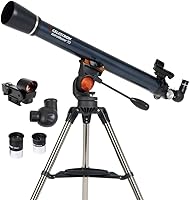
Celestron AstroMaster 70AZ Refractor Telescope for Moon: Best for first-time backyard viewing
- 70mm fully coated achromatic refractor
- 900mm focal length
- 20mm and 10mm eyepieces
- StarPointer red dot finderscope
- Alt-azimuth mount with tripod
A complete beginner set with a long focal length for the Moon and planets, plus day viewing land objects.
Pros
- Complete kit out of the box
- Simple manual alt-azimuth controls
- Right-side-up image for land viewing
Cons
- 70mm aperture limits faint deep-sky detail
- Long tube needs space to carry and store
This suits a first-time buyer who wants a full set without shopping for a tripod or eyepieces. The 70mm fully coated achromatic lens gives bright views of the Moon, Jupiter, Saturn and bright star clusters.
The 900mm focal length gives 45x with the 20mm eyepiece and 90x with the 10mm eyepiece, so planets get a useful size without forcing you to add a Barlow lens on day one.
The manual alt-azimuth mount with a panhandle is simple to learn. You point it up, down and side to side, which suits visual use where you nudge the tube to follow a target.
The adjustable tripod works for adults and kids standing or seated, and the erect image diagonal gives a right-side-up view for land viewing.
The Dawes limit of 1.66 arcsec and the 900mm focal length show why this scope is tuned for lunar and planetary work at moderate magnification. Fully coated optics help transmission through both eyepieces.
Manual focus is simple, but at 90x small focus moves change the image quickly, so short test moves work best.
The trade-off is aperture. At 70mm it gathers less light than the 80mm and 90mm models here, so faint galaxies will look dimmer.
Its long 900mm tube also needs more room to carry and store than a short 300mm or 400mm scope.
Celestron StarSense Explorer LT 80AZ Smartphone Guided: Best for guided celestial navigation
- 80mm refractor
- 400mm focal length
- StarSense Explorer phone dock
- 25mm and 10mm eyepieces
- 2x Barlow lens
Phone sky recognition helps beginners find targets, while the 80mm lens gives a brighter view than 70mm models.
Pros
- On-screen arrows for finding targets
- 80mm aperture gathers more light
- Includes Barlow lens and accessory tray
Cons
- Shorter focal length gives lower planetary magnification
- Phone guidance needs a compatible smartphone
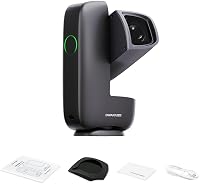
This suits a buyer who worries about getting lost in the sky. The StarSense Explorer phone dock uses sky recognition to analyze star patterns and guide you with on-screen arrows.
The app builds a list of targets for your time and location, so you can pick a planet or cluster and follow the arrows until the bullseye turns green.
The 80mm refractor with high-reflectivity coatings gives sharp views of the Moon, Jupiter, Saturn and bright deep-sky objects such as the Orion Nebula and Andromeda Galaxy. The kit includes 25mm and 10mm eyepieces, a 2x Barlow lens, an erect image diagonal, a red dot finderscope and a full-height tripod.
Altitude slow motion adjustment on the sliding rod helps you make fine moves once the target is centered. That matters because manual altazimuth mounts need small corrections as the sky moves.
The 400mm focal length keeps magnification low, so targets stay in view longer during those corrections.
The trade-off is focal length. At 400mm it gives a wider field for finding targets and viewing clusters, but planets will look smaller than in a 900mm scope.
If your main goal is close planetary detail, a longer focal length will suit you better than phone guidance.
ToyerBee Telescope for Adults & Kids: Best for portable family use
- 70mm aperture
- 300mm focal length
- 20mm and 6mm eyepieces
- 3X Barlow lens
- Phone adapter and tripod
A light 3.5 lb package made for travel, camping and family stargazing with phone photo support.
Pros
- Very light for travel
- Phone adapter and camera remote included
- Quick setup with no tools required
Cons
- Short focal length limits planetary detail
- Smaller feature set than full Celestron kits
This suits families, campers and gift buyers who need a light scope that packs fast. At 3.5 lb, it is the lightest model in this group and fits travel and road trips.
The 70mm aperture and fully multi-coated glass suit the Moon, bright stars and daytime views of wildlife and mountains.
The 300mm focal length gives a wide view that is forgiving for beginners. You get 20mm and 6mm eyepieces plus a 3X Barlow lens, with magnification from 15x to 150x.
A 5x24 finderscope, phone adapter and wireless camera remote help you find targets and take photos without shake.
The compact size and no tools setup suit short sessions. A child can use it for a few minutes outdoors without a long assembly sequence.
The star chart in the kit gives a starting point for learning constellations, while the phone adapter helps share a view with family.
The trade-off is optical reach. A short focal length gives less planetary detail than the 900mm Celestron and Hawkko models.
It is a strong choice for easy family use, but serious Moon and planet viewers will want a longer tube for more magnification.
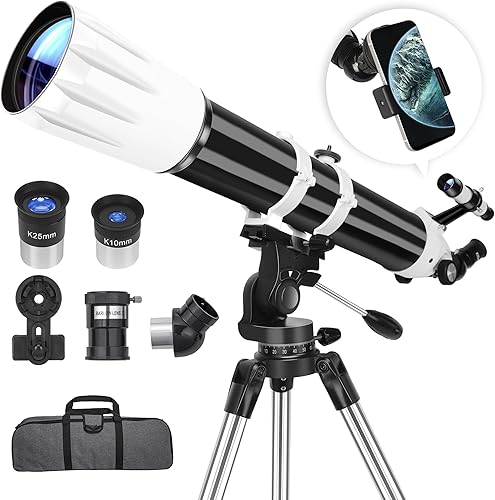
Hawkko 90mm Aperture 900mm Telescope for Adults: Best for high magnification on a budget
- 90mm aperture
- 900mm focal length
- 25mm and 10mm eyepieces
- 3X Barlow lens
- Stainless steel AZ tripod
A 90mm f/10 refractor with a long focal length and a full accessory kit for Moon and planet viewing.
Pros
- Largest aperture in the beginner group
- 900mm focal length for planets
- Carry bag and phone adapter included
Cons
- Long tube is less portable than short models
- High magnification can make tracking harder
This suits an adult beginner who wants more aperture and more magnification than a 70mm kit. The 90mm aperture and 900mm focal length give a longer reach for the Moon and planets, with magnification from 36x to 270x using the included eyepieces and 3X Barlow lens.
The fully multi-layer coating improves light transmission for clearer and brighter images. The stainless steel AZ tripod adjusts from 28 to 46 inches and supports smooth 360-degree rotation.
The kit includes a finderscope, zenith mirror, 25mm and 10mm eyepieces, a phone adapter, an accessory tray and a carry bag.
The 90mm aperture and Dawes limit of 1.29 arcsec help explain the high magnification range. At 270x the image will be dimmer and more affected by air movement, so the lower powers often give the best first views.
The 900mm focal length is f/10, which gives a relaxed focus position compared with very fast scopes.
The trade-off is size and handling. A 90cm tube is less portable than the ToyerBee, and high magnification makes tracking harder on a manual mount.
Buy it for backyard power and completeness, not for the lightest travel setup.
SVBONY SV503 Upgraded ED Refractor Telescope: Best for deep-sky imaging
- 80mm F7 ED refractor
- 560mm focal length
- 0.8X field flattener
- 2-inch dual-speed focuser
- S-FPL51 ED glass
An ED optical tube built for camera use, with a field flattener for sharper stars from center to edge.
Pros
- ED glass reduces chromatic aberration
- Field flattener for edge-to-edge stars
- Lightweight 2.5kg OTA for portable mounts
Cons
- OTA only, no tripod or eyepiece kit
- Best suited to imaging rather than simple visual use
This suits an imaging buyer who already has or plans to buy a suitable mount and camera. It is an 80mm F7 ED refractor with S-FPL51 ED glass that reduces chromatic aberration for purer stars and cleaner highlights.
The 560mm focal length suits large galaxies and nebulae.
The kit includes the SV193 0.8X field flattener, which reduces exposure times and keeps stars sharp from center to edge. The 2-inch dual-speed focuser gives 1:10 micro-adjustment for precise focus.
At 2.5kg, the OTA is light for portable mounts and outdoor imaging.
Fully multi-coated optics and the field flattener work together for full frame clarity. That combination is aimed at camera sensors, not at an eyepiece alone, so visual users should read the kit list carefully.
The 560mm focal length with the reducer gives a faster system for shorter exposures.
The trade-off is that it is an OTA only. It has no tripod, no finderscope and no eyepiece kit for simple visual use.
Choose it for deep-sky astrophotography, not as a first complete telescope for a child or a casual viewer.
SVBONY SV48P Telescope: Best achromatic OTA for camera owners
- 90mm aperture
- 500mm focal length
- Achromatic glass
- 2-inch 1:10 dual-speed focuser
- 360-degree rotation
A 90mm achromatic OTA with a wide field and rotating focuser for visual astronomy and astrophotography.
Pros
- 90mm aperture with wide field
- Rotating focuser for camera framing
- Compatible with 1.25 and 2 inch accessories
Cons
- OTA only, mount and accessories sold separately
- Achromatic design shows more color fringe than ED glass
This suits a visual observer or camera owner who wants a wider field than the 900mm models. The 90mm aperture and 500mm focal length gather more light than a 70mm scope and give a wide view for the Moon, nebulae and star clusters.
The achromatic glass and fully multi-layer coated green lenses help maximize light transmission and reduce false color.
The 2-inch rotatable dual-speed focuser with a 1:10 gear ratio gives smooth focus control. The focuser rotates 360 degrees, which helps with photographic composition and visual observation.
The metal interface and dovetail plate help with stable mounting.
The 500mm focal length is about f/5.5, so eyepieces give lower magnification and a brighter exit pupil than a 900mm tube. That helps for large deep sky objects and for framing with a camera.
The 2 to 1.25 inch adapters match common eyepiece and Barlow sizes, which makes adding accessories simpler.
The trade-off is that it is an OTA only, so you need a compatible mount and eyepieces or camera gear. As an achromat, it will show more color fringe on bright targets than the ED SV503.
Buy it for field of view and upgrade paths, not for the lowest color error.
How the best achromatic refractor telescope picks compare
| Model | Aperture | Focal length | Best use |
|---|---|---|---|
| Celestron AstroMaster 70AZ | 70mm | 900mm | Complete beginner kit |
| Celestron StarSense LT 80AZ | 80mm | 400mm | Guided target finding |
| ToyerBee 70mm | 70mm | 300mm | Travel and family use |
| Hawkko 90mm | 90mm | 900mm | High magnification |
| SVBONY SV503 80ED | 80mm | 560mm | Deep-sky imaging |
| SVBONY SV48P | 90mm | 500mm | Wide-field OTA |
| Product | Best for | Aperture | Focal length | Mount | Our score |
|---|---|---|---|---|---|
| Celestron AstroMaster 70AZ Refractor Telescope for Moon | first-time backyard viewing | 70mm | 900mm | Altazimuth | 9.7 |
| Celestron StarSense Explorer LT 80AZ Smartphone Guided | guided celestial navigation | 80mm | 400mm | Altazimuth | 9.6 |
| ToyerBee Telescope for Adults & Kids | portable family use | 70mm | 300mm | Tripod | 9.1 |
| Hawkko 90mm Aperture 900mm Telescope for Adults | high magnification on a budget | 90mm | 900mm | Altazimuth | 9.0 |
| SVBONY SV503 Upgraded ED Refractor Telescope | deep-sky imaging | 80mm | 560mm | Fixed mount OTA | 8.6 |
| SVBONY SV48P Telescope | achromatic OTA for camera owners | 90mm | 500mm | Altazimuth and equatorial compatible | 8.6 |
Aperture controls how much light the lens gathers. More light means brighter views of faint objects and finer detail on the Moon.
Focal length controls magnification with a given eyepiece. A long focal length makes planets larger, while a short focal length gives a wider field for clusters and finding targets.
Glass type controls color error. Achromatic glass improves on a single lens, and ED glass improves again for imaging and bright stars.
Mount type controls how easy it is to point and track. A manual alt-azimuth mount is simple for visual use, while imaging buyers need a mount that can hold an OTA steady for exposures.
We ranked complete kits above OTA-only models for beginners because a kit works on the first night. We ranked the SVBONY models lower for first-time buyers because they need extra gear.
That order changes if you already own a mount, eyepieces or a camera.
How focal ratio ties the specs together
Focal ratio is focal length divided by aperture. A 900mm tube with a 70mm lens is about f/12.9, while a 500mm tube with a 90mm lens is about f/5.5.
The slower ratio gives higher magnification with the same eyepiece. The faster ratio gives a brighter, wider image.
That is why two scopes with similar aperture can feel very different. The longer tube is harder to track at high power.
The shorter tube is easier to find targets with, but planets look smaller. Choose the ratio for the targets you will view most.
What aperture and focal length should you choose?
A 70mm to 90mm aperture covers the Moon, planets and bright clusters well as a first scope. Larger apertures show fainter deep-sky detail, but they add weight and need a stronger mount.
For a first achromatic refractor, choose the aperture you will carry outside often.
Focal length matters just as much. A 900mm tube gives strong planetary magnification with standard eyepieces.
A 300mm to 500mm tube gives a wide field that is easier for finding targets and viewing large clusters. Our guide to the best refractor telescope for adults breaks down those choices for adult buyers.
Short focal length for wide views
Short tubes such as 300mm and 400mm are forgiving. You find targets faster, and small pointing errors matter less.
This suits travel, families and guided scopes where finding objects is the hardest part.
Long focal length for planets
Long tubes such as 900mm give larger views of the Moon and planets. They also make tracking more sensitive, so a stable tripod and smooth mount controls help.
Buy a long tube if planets are your main target.
How much does chromatic aberration matter?
Chromatic aberration is color fringing around bright stars and planets. Achromatic glass reduces it by focusing two colors together.
ED glass reduces it more, which is why imaging scopes use ED or apochromatic glass.
At low magnification, most buyers will not notice much fringe. At high magnification, a bright planet or star can show a blue or purple edge.
If you plan close planet viewing, check the glass type and focal ratio before you choose only on aperture.
For most beginners, an achromat is a fair balance of cost and performance. Our explainer on what is an achromatic telescope covers the lens design in more detail.
If you move to imaging later, ED glass is worth the upgrade.
Should you buy a complete kit or an OTA only?
A complete kit includes a tripod, mount, eyepieces and a finderscope. You can use it the first night with no extra shopping.
That is why the Celestron, ToyerBee and Hawkko models rank high for beginners.
An OTA only is just the optical tube. It suits buyers who already own a mount, eyepieces or a camera.
The SVBONY SV503 and SV48P fall in this group. Check mount compatibility, dovetail size and focuser size before you buy an OTA.
If you are unsure whether a refractor suits you at all, read is a refractor good for a beginner. It covers setup, storage and eyepiece basics that matter for a first purchase.
Which mount and finder help you find targets?
A manual alt-azimuth mount is the easiest to learn. You move the tube up, down and side to side.
It suits visual viewing where you nudge the scope to keep a target in view. A panhandle or slow-motion control helps at high magnification.
A finderscope helps you aim the main tube. A red dot finderscope is simple for wide-field targets.
A straight finderscope gives a magnified view for fainter objects. Phone guidance, such as the StarSense system, helps even more if you do not know the sky yet.
If you want a guided option with a full review, see our celestron astrofi 90 wi-fi refractor review. Compare its finding system and kit contents with the StarSense model here before you choose.
What else should you check before you buy?
Check the included eyepieces, diagonal and finderscope. A kit with one eyepiece may force you to buy more gear right away.
Check the tripod height, especially if adults and kids will share the scope.
Check weight and tube length for storage. A 900mm tube needs more space than a 300mm tube.
Check day viewing too, since several models here include an erect image diagonal for land viewing. Our best telescopes for land viewing guide explains diagonals and image orientation.
If you want more aperture, compare our picks with a 150mm refractor telescope guide and the best 100mm refractor telescope roundup. Those larger sizes gather more light, but they also need a stronger mount and more storage space.
If budget is your main concern, read the best refractor telescope for the money guide. It helps you decide when a basic achromat is enough and when ED glass or a larger aperture is worth it.
Verdict: which achromatic refractor should you buy?
Pick the Celestron AstroMaster 70AZ if you want the best complete beginner kit. Pick the StarSense Explorer LT 80AZ if finding targets is your biggest worry.
Pick the ToyerBee if you need a light travel scope for family use.
Pick the Hawkko 90mm if you want more aperture and magnification in a full kit. Pick the SVBONY SV503 if you plan deep-sky imaging with a camera.
Pick the SVBONY SV48P if you want a wide-field 90mm OTA and already have a mount.
Our score weighs specs, features and buyer feedback against what you are shopping for. Start with the job you need done: first visual use, guided finding, travel, high magnification or imaging.
Then choose the aperture, focal length and glass type that fit that job.
Our top 3 picks at a glance
-
1
Best for first-time backyard viewing
Celestron AstroMaster 70AZ Refractor Telescope for Moon
9.7/10 our score
See it on Amazon -
2
Best for guided celestial navigation
Celestron StarSense Explorer LT 80AZ Smartphone Guided
9.6/10 our score
See it on Amazon -
3
Frequently asked questions
What is an achromatic refractor telescope?
An achromatic refractor uses two lens elements to bring two colors of light to a common focus. That cuts color fringing compared with a single lens.
It does not remove color completely, so bright stars and planets can still show a faint fringe at high power.
Is a refractor good for a beginner?
Yes, a refractor is often simple to set up and use. The tube is sealed, the focus is easy to learn and the view needs little alignment.
Our guide on whether a refractor suits a beginner explains setup, storage and eyepiece choices in plain terms.
What aperture should a beginner choose?
A 70mm to 90mm aperture is a practical start for the Moon, planets and bright clusters. Larger apertures gather more light for faint objects, but they also add weight and cost.
Match aperture to the mount and tripod you can carry outside often.
Does chromatic aberration matter at high magnification?
Yes, color fringing shows more on bright targets at high power. Achromatic glass reduces it, and ED glass reduces it further.
If you plan close planet viewing or imaging, check the glass type before you choose only on aperture.