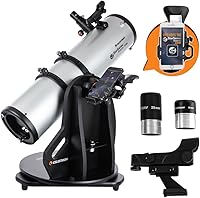
Where Is the Focal Point of a Reflector Telescope?
The focal point of a reflector telescope is where light reflected by the primary mirror converges near the focuser. An eyepiece or camera must sit at that point to produce a sharp image.
On this page (8 sections)
- Where is the focal point of a reflector telescope?
- How does light reach the focal point?
- What is the difference between focal point and focal length?
- How do you find the focal point with an eyepiece?
- Can a reflector telescope focus a camera?
- Can mirror experiments show where light converges?
- Why does a reflector need accurate mirror alignment?
- What should you remember about the focal point?
The focal point of a reflector telescope is where light reflected by the primary mirror converges near the focuser. An eyepiece or camera must sit at that point to form a sharp image.
In a Newtonian reflector, the large primary mirror at the bottom of the tube gathers light from a distant object. The mirror sends that light forward toward the smaller secondary mirror, which redirects it through the side of the tube and into the focuser.
Where is the focal point of a reflector telescope?
The focal point of a reflector telescope is usually outside the main tube, beside the secondary mirror and behind the focuser. You may also hear this location called the focal plane, because the image comes into focus across a small plane rather than at only one mathematical dot.
The primary mirror controls where the light converges. A longer focal length places the focal point farther from the primary mirror, while a shorter focal length brings it closer.
The secondary mirror does not create the telescope's main focal length. It changes the direction of the light so you can reach the focal plane from the side of a Newtonian tube.
A what is a reflecting telescope guide explains how the primary and secondary mirrors work together before the light reaches your eye.
How does light reach the focal point?
Light follows a two-mirror path in a Newtonian reflector. The primary mirror gathers and reflects the light, while the secondary mirror sends the converging beam toward the focuser.
The primary mirror has a curved reflecting surface. Incoming light from a distant star or planet arrives in nearly parallel rays, and the curve brings those rays toward a common region in front of the mirror.
The secondary mirror is mounted at an angle near the front of the tube. It intercepts the beam before it reaches the primary mirror's direct focal point, then redirects the beam outward through the focuser.
The eyepiece sits in the focuser and magnifies the image formed at the focal plane. Moving the focuser changes the eyepiece's distance from that plane until the view becomes sharp.
What is the difference between focal point and focal length?
Focal length is a measurement, while the focal point is the location where the reflected light converges. On a reflector telescope, focal length is measured from the primary mirror to the point where parallel rays would meet.
For example, a mirror with a 900 mm focal length is designed to bring parallel light to a convergence point about 900 mm from the mirror's reference position. The secondary mirror redirects that light, so the usable focal point appears near the focuser instead.
Focal length affects the telescope's viewing behavior. With the same eyepiece, a longer focal length produces more magnification than a shorter focal length.
Use the guide to what focal length means on a telescope when comparing magnification, field of view, and eyepiece choices.
How does the Skyoptikst mirror relate to the focal point?
The Skyoptikst Diameter 114 mm Focal Length 900mm has a 114 mm diameter and 900 mm focal length, so it suits a Newtonian reflector design that uses a longer light path.
Its stated focal ratio is F8, calculated from the 114 mm diameter and 900 mm focal length. That relationship helps explain why the mirror sends light toward a focal region farther along the tube than a shorter-focal-length mirror of the same diameter.
The mirror uses enhanced aluminum and a protective coating, with a stated reflectance of 92% across 400–950 nm. The set includes a primary mirror, a 25 mm secondary mirror, and a packing box.
How do you find the focal point with an eyepiece?
Use the focuser to move the eyepiece toward or away from the focal plane until a distant object becomes sharp. Start with a bright, stationary target during daylight, but never point the telescope near the Sun.
Insert the eyepiece fully and secure it. Aim at a distant building, tree, or other object, then turn the focus knob slowly in one direction.
If the image becomes sharper, continue with small adjustments. If it becomes blurrier, turn the knob the other way until fine detail appears.
A star does not look like a disk through most amateur telescopes, so use the smallest visible point of light as a focus reference. Atmospheric movement can make stars shimmer, which is different from a focus problem.
If no position produces a sharp image, check that the focuser is not locked, the eyepiece is seated correctly, and the secondary mirror is aligned. A reflector may also need collimation if the mirror angles are not correct.
Can a reflector telescope focus a camera?
A camera can focus when its sensor reaches the telescope's focal plane. The camera must sit at the correct distance from the focuser, and the telescope must have enough inward or outward focus travel for that setup.
A camera sensor replaces the eyepiece as the surface that records the focused image. The image is sharp only when the sensor lies at the focal plane.
A flip mirror can help when you need to center and focus an object before sending the light to a camera. The how to build a telescope guide covers the basic optical layout, while a build your own telescope guide can help you think through mirror placement and tube dimensions.
Which accessory helps find focus for a camera?
The Astromania Telescope Flip Mirror for 1.25 Eyepiece has a movable mirror that redirects light 90 degrees upward or lets it pass through toward a camera.
Its helical focuser accepts a standard 1.25 in eyepiece, and its camera side has a T-2 thread. The design lets an object appear in the eyepiece while the camera remains in the light path, helping you center the target before imaging.
The accessory uses manual focus. It suits a reflector owner who needs a repeatable way to check position and focus between visual viewing and camera work.
Can mirror experiments show where light converges?
Concave mirrors can demonstrate convergence by bringing reflected light toward a focal region. The mirror's curve and focal length determine where that region appears.
A classroom mirror set can help you compare different focal lengths without changing the basic idea. Convex mirrors spread reflected rays outward, while concave mirrors bring them toward a convergence point.
Which mirror set helps demonstrate focal points?
The United Scientific™ MCVSET Glass Mirror, Set of 6 includes 3 convex and 3 concave glass spherical mirrors, each with a 50 mm diameter.
The concave mirrors have focal lengths of 50 mm, 100 mm, and 200 mm. The convex mirrors have focal lengths of -50 mm, -100 mm, and -200 mm.
This set suits learners who want to see how mirror curvature changes the direction of reflected light. It is an optics teaching aid, not a replacement for a telescope's primary mirror.
Use care with any glass mirror. Keep the reflecting surfaces clean and avoid touching them during experiments, because fingerprints can make the reflected image harder to inspect.
Why does a reflector need accurate mirror alignment?
A reflector needs the primary and secondary mirrors aimed along the same optical path. If either mirror is tilted too far, light may not converge correctly at the focuser.
This adjustment is called collimation. It does not change the mirror's stated focal length, but it changes whether the telescope delivers the converging beam to the correct place.
Poor alignment can produce soft stars, uneven focus, or views that change as you move your eye. Check alignment when the image stays blurry after careful focuser adjustments.
The secondary mirror also needs to sit in the correct position under the focuser. Its job is to intercept the primary mirror's beam and send it out through the side of the tube.
Reflectors can offer strong light gathering for their size, but they also have trade-offs. Read about the disadvantages of reflecting telescopes before choosing this design.
What should you remember about the focal point?
The focal point of a reflector telescope is the convergence area created by the primary mirror, redirected through the secondary mirror and reached through the focuser. Focal length tells you how far the primary mirror brings parallel light toward convergence.
Pick a longer-focal-length mirror when you want the optical behavior associated with more magnification from the same eyepiece. Pick a flip mirror when camera focusing and target centering are part of your setup.
For a simple optics demonstration, the United Scientific set shows how different mirror curves change convergence. For a Newtonian build, the Skyoptikst mirror provides a 114 mm diameter and 900 mm focal length to work around.
Frequently asked questions
Where is the focal point of a reflector telescope?
The focal point is near the upper part of a Newtonian reflector, outside the main tube beside the secondary mirror and focuser. The primary mirror reflects incoming light toward the secondary mirror, which redirects the converging light through the focuser.
The exact position depends on the mirror's focal length and the telescope's design.
How do you find the focal point on a reflector telescope?
Insert an eyepiece into the focuser and aim at a distant object during daylight, without looking near the Sun. Turn the focus knob slowly until the object becomes sharp.
The image forms when the eyepiece reaches the focal plane created by the primary mirror.
Is the focal point the same as the focal length?
No. Focal length is the distance from the primary mirror to the point where parallel light converges.
The focal point is the actual convergence location.
In a Newtonian reflector, the secondary mirror changes the direction of the light, so the focal point sits outside the tube near the focuser.