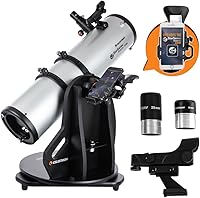
How to Build a Telescope
To build a working telescope, pair an objective lens or primary mirror with an eyepiece, hold the optics in a stable tube, and align them so light reaches focus. A reflector also needs a secondary mirror to direct the image to the eyepiece.
On this page (7 sections)
To build a working telescope, pair an objective lens or primary mirror with an eyepiece, hold the optics at the right spacing, and align them so light reaches focus. A reflector also needs a secondary mirror to direct the image to the eyepiece.
The build starts with an optical design, not a tube. Choose optics with a known focal length, then select a tube, focuser, and mount that can hold them in position without flexing.
What parts do you need to build a telescope?
A working telescope needs an objective lens or primary mirror, an eyepiece, a tube or frame, and a stable mount. A Newtonian reflector also needs a small secondary mirror and a way to hold and adjust both mirrors.
The objective gathers light and forms an image. The eyepiece magnifies that image for your eye, while the focuser shifts the eyepiece to bring it into sharp focus.
For a reflector design, learn what a reflecting telescope is before choosing parts. A Newtonian uses a primary mirror at the back of the tube and a diagonal secondary mirror near the front.
The tube keeps dust and stray light away from the optical path. It also needs to hold each part firmly at the correct distance, with an opening wide enough to avoid clipping the light cone.
Which telescope design should you build?
A refractor uses lenses, while a reflector uses mirrors. For a first build, choose the design that matches the optics you can obtain and the alignment work you can manage.
A refractor places the objective lens at the front and the eyepiece at the back. Its optics follow a straight path, which can make assembly easier, but a large objective lens can be costly and heavy.
A Newtonian reflector folds the light path with a secondary mirror. Read how a Newtonian telescope works to see why that mirror sits at an angle and sends light to a side focuser.
Reflectors need periodic collimation, which means adjusting the mirrors so their optical axes line up. They can also have an open tube that collects dust, so consider the disadvantages of reflecting telescopes before building one.
Do telescopes use concave or convex lenses?
Many refractors use a convex objective lens to gather and focus light, paired with an eyepiece that magnifies the image. The exact lens shapes depend on the optical design, so check whether telescopes use concave or convex lenses before buying glass.
A reflector instead uses a curved primary mirror to focus light. The mirror’s curve and focal length must suit the tube and eyepiece spacing; a flat mirror or decorative mirror won't do the job.
Learn where the reflector's focal point forms before setting the spacing.
How do you choose the optics and tube?
Choose optics with a stated aperture and focal length, then size the tube and focuser around their light path. The tube must allow the complete light cone to reach the eyepiece without hitting its walls or hardware.
A primary mirror’s aperture is its diameter. A larger aperture gathers more light, while focal length affects the tube length and the magnification an eyepiece can provide.
The Skyoptikst primary mirror has a 114 mm aperture and 900 mm focal length, with a 35 mm major-axis secondary mirror.
Use the design’s optical dimensions to place the secondary and focuser. Don’t assume a mirror will fit a tube just because the tube is long enough; confirm its inside diameter and room for the mirror cell, spider, and focuser.
The eyepiece’s focal length also matters. Magnification is the telescope’s focal length divided by the eyepiece’s focal length, but a higher number alone does not guarantee a sharper image.
Can a classroom mirror set supply telescope optics?
A classroom mirror set can help you see how concave and convex surfaces behave, but it isn't a substitute for a matched astronomical objective. The United Scientific™ set includes six 50 mm glass spherical mirrors with several positive and negative focal lengths.
Use this set for demonstrations or early experiments with focal points. Its spherical mirrors and varied focal lengths don't mean any one mirror is suited to a telescope design, so don't build around them without checking the optical requirements.
How do you assemble a Newtonian reflector?
A Newtonian reflector places the primary mirror at the back, the secondary mirror near the front, and the focuser beside the tube. Assemble the holders so each optic stays secure and can be adjusted without stressing the glass.
- Attach the primary mirror to a cell at the back of the tube.
- Install the secondary mirror on a spider near the open end.
- Mount the focuser opposite the secondary mirror.
- Place the secondary at 45 degrees to redirect light toward the focuser.
- Fit an eyepiece and check that the focuser can reach focus.
The primary mirror cell should support the mirror evenly. Avoid clamping its edges tightly, since pressure can distort the optical surface.
Keep the spider thin and centered so it blocks as little light as practical. The secondary mirror must be large enough to send the image to the focuser, but an unnecessarily large one can block more incoming light.
For a step-by-step reflector project, see how to build your own telescope. Before cutting a tube, use a plan that gives the mirror spacing, secondary position, focuser height, and tube diameter.
How do you align the mirrors?
Align the mirrors by centering the secondary under the focuser, tilting it to face the primary, then adjusting the primary until the reflections line up. Use the collimation steps designed for your telescope rather than guessing from a blurry view.
Check that the secondary appears centered when viewed through the focuser. Then adjust its tilt so you can see the primary mirror’s full reflection, including its center mark if the design uses one.
Finally, adjust the primary mirror’s tilt until the optical axis returns through the middle of the focuser. Small changes can matter, so make adjustments gradually and check the view after each one.
How do you focus and test a homemade telescope?
Point the telescope at a distant object in daylight and move the focuser slowly until its edges look sharp. Keep the Sun out of the telescope, even when using a filter, because concentrated sunlight can cause serious eye injury.
Start with the longest-focal-length eyepiece you have, which usually gives lower magnification and a wider view. Once the image is centered and focused, try another eyepiece if the view remains clear.
A flip mirror can send light to either an eyepiece or a camera. The Astromania Telescope Flip Mirror for 1.25 Eyepiece has a movable mirror that directs light upward to an eyepiece or through to a camera.
This accessory suits a build with a compatible 1.25 in focuser or adapter and a camera with the right T-thread connection. It adds another component to align, so a basic visual telescope doesn't need one.
For observing, learn how to use a telescope for beginners. Begin with the Moon or a distant land target, and make sure the mount holds the tube steady while you focus.
What can go wrong when you build a telescope?
A homemade telescope often struggles because its optics are misaligned, the tube flexes, or the eyepiece cannot reach focus. Check those points before changing mirrors or buying additional parts.
If focus never becomes sharp, verify the distance between the objective and eyepiece. A tube can be too long or too short for the optical focal length, and the focuser may need more inward or outward travel.
If the image looks dim or uneven, check for a blocked light path, a dirty surface, or a secondary mirror that is out of position. Clean optics only with methods suited to coated optical glass.
A shaky mount can make a well-aligned telescope seem unusable at higher magnification. Keep the tube balanced and secure, and compare your design with fork-mounted telescope options to understand how a mount supports tracking and stability.
Resolution depends mainly on aperture and optical quality, not magnification alone. Read about the resolving power of a telescope before expecting fine planetary detail from a small or poorly aligned build.
Is building a telescope worth it?
Build a telescope if you want to learn how optics, spacing, alignment, and mounting work together. Choose a refractor for a straight optical path, or a Newtonian reflector if you're ready to position and collimate two mirrors.
Before buying parts, get a design with measured optical distances and a mount suited to the tube’s weight. If you want to observe soon, compare that effort with a complete telescope; if you want the learning experience, start with a plan and assemble one part at a time.
Frequently asked questions
What parts do you need to build a telescope?
A basic telescope needs an objective lens or primary mirror, an eyepiece, a tube or frame to hold the optics at the right spacing, and a stable mount. A Newtonian reflector also uses a small secondary mirror to redirect light to the side of the tube.
You may need a focuser and alignment tools.
Is it easier to build a refractor or reflector telescope?
A simple refractor can be easier to assemble because its objective lens and eyepiece sit in a straight line. A Newtonian reflector can use a larger primary mirror, but it needs a secondary mirror, a holder, careful alignment, and access to the eyepiece near the tube’s front.
The best choice depends on your optics and tools.
Can you make a telescope with two mirrors?
Yes. A reflecting telescope uses a primary mirror to collect and focus light, while a secondary mirror redirects that light toward the eyepiece or a camera.
The mirror shape, spacing, and alignment must match the design; two household mirrors won't form a useful astronomical telescope.
How do you align a homemade telescope?
Center the secondary mirror under the focuser, then tilt it so it directs the primary mirror’s reflection into the eyepiece. Adjust the primary mirror until its optical axis points back through the center of the focuser.
Follow the mirror maker’s or telescope design’s instructions, and check alignment again after moving the tube.