Which Telescope Brands Have the Best Optics?
Telescope brands with best optics win on aperture, coating quality and focal length, not on magnification claims. A 6-inch or 8-inch Schmidt-Cassegrain with StarBright XLT coating will show more than a smaller scope with higher stated power.
On this page (11 sections)
- What makes telescope optics good in plain terms?
- How aperture changes what you see at the eyepiece
- Why coatings matter more than most buyers think
- How focal length and field of view shape your view
- Schmidt-Cassegrain versus reflector optics for quality
- What the three Celestron models show about brand optics
- How mounts and finders affect optical quality in use
- How to compare brands without getting fooled by magnification
- Which brand optics suit planets, Moon and deep sky
- Care, collimation and honest trade-offs between these scopes
- Final verdict on telescope brands with best optics
Telescope brands with best optics deliver more usable light to your eye, and that comes from aperture, coating and focal length working together. Magnification alone does not make optics better, because extra power with a small lens only spreads the same light thinner.
We compared the specs, features and buyer patterns for the models below against what you will actually see at the eyepiece. Our score weighs specs, features and buyer feedback against what you are shopping for.
If you want the wider brand question first, see what is the best telescope brand and then use this guide to judge the optics behind each name.
What makes telescope optics good in plain terms?
Good optics start with aperture, the diameter of the main lens or mirror. A larger aperture gathers more light, so faint galaxies look brighter and lunar detail looks sharper.
The NexStar 6SE has a 6-inch aperture, and the NexStar 8SE has an 8-inch aperture. The PowerSeeker 127EQ has a 127mm aperture, or about 5 inches.
Coating is the next factor. Celestron uses StarBright XLT coating on both NexStar models to help the optics transmit more light.
Focal length controls the size of the image. The 6SE is 1500mm, the 8SE is 2032mm, and the PowerSeeker 127EQ is 1000mm.
You should judge a brand by how it combines those three numbers, not by a single headline claim. A long focal length with a small aperture can give high power but a dim image.
Rule: choose aperture first, then coating, then focal length for your target.
How aperture changes what you see at the eyepiece
Aperture decides how much light the telescope collects from the sky. More light means you can see fainter stars and more structure in deep sky objects.
With the 6SE, Celestron says you can see fine lunar details, cloud bands on Jupiter, and deep sky objects like galaxies and globular clusters. That claim follows from its 6-inch Schmidt-Cassegrain design.
With the 8SE, the larger 8-inch aperture gathers even more light for the same kinds of targets. Its exit pupil is 4.06mm with the included 25mm eyepiece, compared with 2.5mm on the 6SE.
The PowerSeeker 127EQ uses a 127mm Newtonian reflector with glass mirrors coated with aluminum and SiO₂. Celestron says it can show planets, the Moon's craters, distant stars, and the Orion Nebula.
Aperture also affects resolution. The Dawes limit listed for the 6SE is 0.77 arc seconds, for the 8SE it is 0.57 arc seconds, and for the PowerSeeker it is 0.91 arc seconds.
Smaller numbers mean finer detail is possible under good seeing. That is why the 8SE leads on paper for planets and double stars.
Rule: pick the largest aperture you will actually carry and set up.
Why coatings matter more than most buyers think
Coatings reduce light lost at each glass and mirror surface. Without good coatings, some of the light you collected never reaches your eye.
Celestron lists StarBright XLT as the coating on the NexStar 6SE and NexStar 8SE. That coating works across the corrector plate and mirrors in a Schmidt-Cassegrain design.
The PowerSeeker 127EQ uses glass mirrors coated with aluminum and SiO₂. That is a standard reflector coating for a primary mirror, and the design has fewer reflective surfaces than a folded Schmidt-Cassegrain.
In practice, coatings help most on faint deep sky targets. A galaxy that is barely visible in a poorly coated small scope can look clearer when more light passes through.
Coatings also help with contrast on the Moon and planets. Higher contrast makes cloud bands and surface features easier to separate.
You cannot judge coating quality from a brand name alone. Look for the named coating system and the surface it covers.
Rule: prefer a named coating system over a vague claim of high quality.
How focal length and field of view shape your view
Focal length sets the image scale, while eyepiece choice sets your magnification. Longer focal lengths give larger images of planets, and shorter focal lengths give a wider field for star clusters and nebulae.
The 6SE has a 1500mm focal length and a field of view of 1.7 degrees. The 8SE has a 2032mm focal length and a field of view of 0.75 degrees with its included setup.
The PowerSeeker 127EQ has a 1000mm focal length and a field of view of 2.5 degrees. That wider field makes it easier to frame large objects and find targets.
A Schmidt-Cassegrain folds a long focal length into a short tube. That is why the 6SE and 8SE stay portable despite their long focal lengths.
If you mostly watch the Moon and planets, a longer focal length helps you fill the eyepiece. If you mostly tour star clusters and nebulae, a shorter focal length and wider field help you fit the target.
Rule: match focal length to your main target, planets need longer and wide deep sky needs shorter.
Schmidt-Cassegrain versus reflector optics for quality
Schmidt-Cassegrain telescopes use a corrector plate and a folded mirror system to make a long focal length in a short tube. Reflectors use a single primary mirror and a small secondary mirror to send light to the eyepiece.
The NexStar 6SE and 8SE are Schmidt-Cassegrain models with a fully computerized GoTo mount. Their compact form makes them easy to store and move.
The PowerSeeker 127EQ is a Newtonian reflector on a manual German Equatorial mount. Its design keeps the optical path simpler and the weight lower at 13 pounds.
Reflector optics often give strong aperture per pound. Schmidt-Cassegrain optics give a versatile focal ratio and a compact tube for the same aperture.
Optical quality is not decided by type alone. Aperture, coating, collimation and focal length matter more than the label on the tube.
For a deeper look at one brand's range, see our guide to the best celestron telescope models and how their designs differ.
Rule: choose Schmidt-Cassegrain for compact versatility and reflector for simple aperture value.
What the three Celestron models show about brand optics
Celestron NexStar 6SE: balanced optics for stepping up
The NexStar 6SE pairs 6-inch Schmidt-Cassegrain optics with StarBright XLT coating and a 1500mm focal length. Celestron positions it for intermediate users ready to step up from manual scopes.
It includes a 25mm eyepiece, star diagonal, StarPointer red dot finderscope, accessory tray and NexStar+ hand control. The mount is a computerized altitude-azimuth single fork arm.
The 6SE weighs 21 pounds and measures 32 x 34 x 52 inches. That size fits most backyards and car trunks, but it is not a one-hand carry.
SkyAlign technology lets you center any three bright stars or planets to align the mount in minutes. The hand control then gives access to a 40,000+ object database.
This model suits buyers who want GoTo convenience without moving to the largest tube here. It is the middle path on aperture, focal length and portability.
Rule: choose the 6SE if you want computerized ease with solid 6-inch optics.
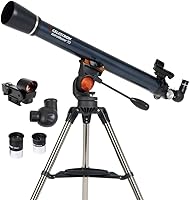
Celestron PowerSeeker 127EQ: simple reflector optics for learning
The PowerSeeker 127EQ has a 127mm Newtonian reflector with a 1000mm focal length. It includes 20mm and 4mm eyepieces plus a 3x Barlow lens that triples the power of each.
Its manual German Equatorial mount has slow-motion controls on an altitude rod. That manual setup teaches you the sky, but it requires you to find and track targets yourself.
The scope weighs 13 pounds and measures 33 x 33 x 54 inches. It is the lightest and most portable option in this group.
Its exit pupil is 5.08mm with the included eyepiece setup, and its field of view is 2.5 degrees. Those numbers suit wide views and easy framing for beginners.
This model suits families and learners who want bright Moon and planet views without automation. You trade GoTo and larger aperture for lower weight and simpler use.
Rule: choose the PowerSeeker if you want to learn the sky with simple reflector optics.
Celestron NexStar 8SE: larger aperture for finer detail
The NexStar 8SE has 8-inch Schmidt-Cassegrain optics with StarBright XLT coating and a 2032mm focal length. It shares the computerized GoTo system and 40,000+ object database with the 6SE.
It includes the same core extras: 25mm eyepiece, star diagonal, StarPointer finderscope, accessory tray and NexStar+ hand control. The mount is a computerized altitude-azimuth single fork arm.
The 8SE weighs 10.88 kg, or about 24 pounds, and measures 32 x 34 x 52 inches. The tube is larger, but the overall footprint stays familiar.
Its Dawes limit of 0.57 arc seconds signals finer resolution than the 6SE on paper. That helps with close double stars and planetary detail under steady seeing.
This model suits buyers who plan to keep one scope for years and want more aperture for deep sky. You get more light gathering, but you also carry more weight.
Rule: choose the 8SE if aperture and fine detail matter most to you.
How mounts and finders affect optical quality in use
Optics only perform as well as the mount lets them. A wobbly mount makes even good lenses look shaky at high power.
The NexStar models use computerized altitude-azimuth mounts that slew to a target and track it. That tracking keeps the image steady while you observe at higher magnification.
The PowerSeeker uses a manual German Equatorial mount with slow-motion controls. It can track smoothly, but you must adjust it by hand as the sky moves.
Finders help you land on target before you look through the main optics. The NexStar models use a StarPointer red dot finderscope, and the PowerSeeker includes a finderscope.
StarPointer red dot finders are simple to align and use for bright targets. They do not magnify, so they work best as a pointing aid, not as a viewing scope.
A brand with good optics should also give you a mount that holds the tube steady. Check mount type and weight capacity before you judge the lens alone.
Rule: a steady mount and a good finder protect your optical quality every night.
How to compare brands without getting fooled by magnification
Magnification lists are the easiest number to inflate. A brand can claim high power by pairing a long focal length with a short eyepiece, even when the image is dim.
Compare aperture in inches or millimeters first. Then compare focal length, coating name and Dawes limit where available.
Also compare the included eyepieces. The PowerSeeker includes 20mm and 4mm eyepieces with a 3x Barlow, while the NexStar models include a 25mm eyepiece.
That difference changes your starting magnification. With the 6SE at 1500mm and a 25mm eyepiece, you start near 60x.
With the 8SE at 2032mm and a 25mm eyepiece, you start near 81x.
Higher starting power is not always better. Too much power on a small aperture gives a faint, shaky image.
If you are weighing one brand against the field, read is celestron a good brand for context on support, warranty and range.
Rule: ignore magnification claims and compare aperture, focal length and included eyepieces.
Which brand optics suit planets, Moon and deep sky
Planets need resolution and steady tracking. The 8SE with its 2032mm focal length and 0.57 arc second Dawes limit has the strongest paper specs for that work.
The Moon rewards aperture and contrast. Celestron says both NexStar models reveal fine lunar details, and the larger 8-inch aperture should show more at the same power.
Deep sky objects reward light gathering above all. The 8SE and 6SE both list galaxies and globular clusters as targets, with the 8SE gathering more light per view.
The PowerSeeker 127EQ suits the Moon, planets and bright deep sky objects like the Orion Nebula. Its 1000mm focal length and 2.5 degree field make framing easier for new observers.
Your sky quality changes the ranking. Under bright city lights, a larger aperture helps wash out less faint detail, but no scope fixes a poor sky.
Rule: pick aperture for deep sky, focal length and resolution for planets, and simplicity for learning.
Care, collimation and honest trade-offs between these scopes
Good optics need care to stay good. Dust on lenses and mirrors cuts contrast, and a knocked reflector mirror can lose alignment.
Keep lens caps on the tubes when they are not in use. Store the scopes in a dry place and let them cool to outdoor temperature before you observe.
Reflectors can need collimation, which means aligning the mirrors so light goes to the eyepiece centered. Schmidt-Cassegrain models also benefit from careful handling, but their sealed tube design helps protect the optics.
The PowerSeeker is lighter at 13 pounds but fully manual. The 6SE is 21 pounds with GoTo ease.
The 8SE is the heaviest at about 24 pounds but gives the most aperture.
All three include a 2-year warranty from Celestron, which is based in California since 1960. Warranty support matters because optics and mounts both need service over time.
History also shapes brand choices. If you are comparing legacy names, see what happened to meade telescopes before you rule a brand in or out.
Rule: buy the optics you will maintain, store and carry every clear night.
Final verdict on telescope brands with best optics
Telescope brands with best optics earn that label with large aperture, named coatings and focal lengths matched to your targets. On those specs, an 8-inch Schmidt-Cassegrain leads, a 6-inch Schmidt-Cassegrain is the balanced pick, and a 127mm reflector is the simple learner.
Pick the NexStar 8SE if you want the finest detail and the most light for deep sky. Pick the NexStar 6SE if you want GoTo ease in a slightly lighter tube.
Pick the PowerSeeker 127EQ if you want portable manual views and a lower learning curve.
Next, check the mount, finder and included eyepieces for each model. Those parts decide whether the optics get a fair chance on your first night out.
Frequently asked questions
Which telescope brand has the best optics for beginners?
Celestron is a strong starting point because its PowerSeeker 127EQ gives a 127mm reflector with a 1000mm focal length for bright Moon and planet views. Optical quality still depends on aperture and coatings, so compare those specs across brands before you decide.
Are Schmidt-Cassegrain optics better than reflector optics?
Schmidt-Cassegrain optics are compact and versatile for planets and deep sky, while reflectors often give more aperture for the money. The NexStar 6SE and 8SE use Schmidt-Cassegrain designs in a portable form, and the PowerSeeker 127EQ uses a 127mm Newtonian reflector.
What does StarBright XLT coating do?
Celestron says StarBright XLT is its coating system on the NexStar 6SE and 8SE optics. Coatings help the mirrors and corrector pass more light to your eye, which supports brighter views of faint objects when the sky is dark.
Is a larger aperture always better?
A larger aperture gathers more light and shows finer detail, but it also adds size and weight. The 8SE has an 8-inch aperture compared with 6 inches on the 6SE, while the PowerSeeker 127EQ is lighter at 13 pounds for easier transport.