What Should Kids Know About Telescopes?
A telescope gathers light and helps you see faraway objects more clearly. Its main parts collect or reflect light, bring it to focus, and let your eye look at the image.
On this page (11 sections)
- What are the main telescope facts for kids?
- How does a telescope gather light?
- What does the eyepiece do?
- What do the finder and mount do?
- Why do stars look like tiny points?
- How can kids use a telescope safely?
- What can a child learn with a telescope?
- Can a simple spyglass help kids explore?
- What can kids see with a beginner telescope?
- Is a digital microscope also a telescope?
- What should kids remember about telescopes?
A telescope gathers light and helps you see faraway objects more clearly. Its lens or mirror collects light, the eyepiece brings the image to your eye, and the mount helps keep the view steady.
These telescope facts for kids explain the main parts and what they do in plain language. A telescope can make the Moon's craters easier to see, but it cannot make every star look like a bright picture in a book.
What are the main telescope facts for kids?
The main fact is that a telescope collects light from a distant object and focuses it into an image. It helps your eye notice details that are hard to see without an instrument.
The Moon is a good first target because it's bright and has visible craters and dark plains. Stars usually remain tiny points of light, even through a telescope, because they are extremely far away.
A telescope also needs a steady place to rest. Small shakes move the image, so a mount and tripod help you aim and look without holding the tube in your hands.
How does a telescope gather light?
A telescope gathers light with a lens, a mirror, or both. The light enters the front of the telescope, travels through the tube, and is brought together at a focus.
In a refracting telescope, glass lenses bend light toward a focus. In a reflecting telescope, a curved mirror gathers and reflects light to another part of the tube.
A telescope's opening is called its aperture. A larger opening can gather more light, which can help you see fainter objects, though the sky and steadiness also affect the view.
What does the eyepiece do?
The eyepiece magnifies the focused image so you can see it through the telescope. It's the small lens assembly you look into.
Eyepieces often have different focal lengths. A lower-power eyepiece usually gives a wider view, which can make it easier to find the Moon or another target; a higher-power one gives a closer view but can be harder to keep steady.
Start with the widest view and focus slowly. If the image looks blurry, turn the focus control a little at a time until the edges become clearer.
What do the finder and mount do?
A finder helps you aim the telescope at a target, while the mount supports and moves the tube. The finder has a wider view than the main telescope, so it can help you point in the right direction.
A tripod can wobble if it's on soft ground or bumped during viewing. Set it on firm, level ground, and use gentle movements when aiming.
Some beginner kits include a finderscope, tripod, and eyepieces together. The Celestron Travel Scope 80mm Telescope Kit includes a 5x24 finderscope, full-height tripod, and 20mm and 10mm eyepieces.
Why do stars look like tiny points?
Stars look like tiny points because they are much farther away than the Moon and planets. A telescope can gather more of their light, but most stars still appear as points rather than disks.
The Moon looks different because it's close enough for a telescope to show its surface features. Planets can appear as small disks, but the amount of detail depends on the telescope, the target's position, and how steady the air is.
A dark sky helps you spot more stars. Give your eyes time to adjust, and avoid shining bright lights toward the telescope while you observe.
How can kids use a telescope safely?
Kids should use a telescope with an adult nearby and never point it at the Sun. Looking at the Sun through a telescope or finder can seriously injure your eyes.
Regular sunglasses do not make solar viewing safe. Solar observing requires a proper filter designed for the telescope, installed and checked according to its instructions by an adult.
At night, set up away from roads, stairs, and other trip hazards. Take turns at the eyepiece, and keep the tripod where people won't bump it.
What can a child learn with a telescope?
A child can learn how the Moon changes shape during the month, how planets differ from stars, and how a finder helps aim. Keeping a simple observing notebook can help you remember what you saw and when.
Start with one target and give yourself time to focus. Draw the Moon's craters or note whether a bright planet looked like a point or a small disk.
For a first telescope, the best telescope kit for kids can help you compare beginner options. If you're choosing a scope for a particular child, read how to pick a telescope for your kid and what makes a good telescope for a child.
Can a simple spyglass help kids explore?
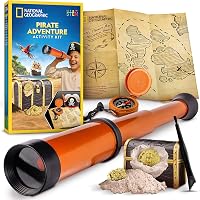
A spyglass can help kids learn about aiming and looking at distant scenery, but it is not the same as a telescope kit for astronomy. It can be a playful way to practice looking through an optical tube during daytime exploring.
The Blue Marble National Geographic Pirate Telescope Adventure Activity includes a working spyglass, compass, treasure map, craft materials, and a learning guide. Its activities focus on pirate play, navigation, and discovery.
A homemade model can show how a tube and lenses fit together, though it may not work like an astronomy telescope.
What can kids see with a beginner telescope?
A beginner telescope can show the Moon, bright planets, and daytime scenery, depending on the telescope and conditions. The Moon is often a satisfying first target because it's bright and easy to locate.
The Celestron Travel Scope 80mm is a refractor with an 80mm aperture and fully coated glass lenses. It comes with a 20mm eyepiece for wider views and a 10mm eyepiece for closer views, along with a smartphone adapter and backpack.
Use the lower-power eyepiece first, then try the other one if the target stays clear. If the view shakes, wait for the tripod to settle and avoid touching it while looking.
Is a digital microscope also a telescope?
A digital microscope is mainly for looking at small nearby objects, though some handheld models also offer a low-power landscape view. It can add variety to a young observer's exploration, but it doesn't replace a telescope made for the night sky.
The BMDSAE 2-in-1 Digital Microscope for Kid Handheld combines microscope viewing with 10x landscape observing. It has a screen, LED lights, and photo and video capture features.
Choose it for close-up curiosity about small objects, not for studying the Moon or planets through a standard telescope. Keep its role clear so a child knows which tool is meant for nearby details and which is meant for distant sky targets.
What should kids remember about telescopes?
Remember that telescopes gather light, eyepieces magnify an image, and mounts help keep the view steady. A telescope can reveal details on nearby sky objects, but distant stars still look like points.
Choose a real beginner telescope if your goal is the Moon and planets. Choose a spyglass or digital microscope for daytime play and close-up exploration, and always keep telescope safety in mind around the Sun.
Frequently asked questions
What does a telescope do for kids?
A telescope gathers light from faraway objects and brings it to a focus so your eye can see more detail. It can show the Moon's craters, star clusters, and other bright sky targets, but it won't make every object look large or colorful.
What you can see depends on the telescope, eyepiece, sky, and observing conditions.
What are the main parts of a telescope?
Most beginner telescopes have an opening with a lens or mirror, a tube, an eyepiece, a focusing control, and a mount or tripod. The lens or mirror gathers light, the eyepiece magnifies the focused image, and the mount holds the telescope steady.
Some models also have a finder to help aim.
Can kids look at the Sun through a telescope?
Never look at the Sun through a telescope or its finder unless the telescope has a proper solar filter made for that instrument and it is installed over the front opening as directed. Regular sunglasses are not safe for this.
An adult should handle solar observing, and children should follow the filter maker's instructions.
Does more magnification always make a telescope better?
No. Higher magnification makes the view larger, but it also makes the image dimmer and harder to keep steady.
A clear, stable view at modest magnification is often more useful for a young observer.
Start with the eyepiece that gives the widest view, then try more magnification when the target is bright and steady.