Alt-Azimuth vs Equatorial Mount: Which Should You Choose? (November 2026)
Pick an alt-azimuth mount for quick visual viewing and an equatorial mount for steady tracking. In this altazimuth mount vs equatorial mount comparison, your setup time, telescope weight and how long you plan to observe decide the winner.
On this page (10 sections)
- The quick verdict: altazimuth mount vs equatorial mount
- Side by side: how the two designs move
- Setup time: which mount gets you observing faster?
- Tracking the sky: where equatorial mounts pull ahead
- Weight and payload: do not push the limit
- Visual use: why alt-azimuth mounts suit beginners
- Astrophotography: why equatorial mounts matter more there
- Portability: which mount is easier to carry out?
- Who should buy which mount?
- The verdict: altazimuth vs equatorial mount
Pick an alt-azimuth mount for quick visual viewing and an equatorial mount for steady tracking. In this altazimuth mount vs equatorial mount comparison, your setup time, telescope weight and how long you plan to observe decide the winner.
An alt-azimuth mount moves up and down and left and right. That motion matches how you look around during a short session on the Moon or bright planets.
An equatorial mount moves along one axis aligned with Earth's rotation. That motion lets you follow a star or planet with slow, steady adjustments as it crosses the sky.
Our score weighs specs, features and buyer feedback against what you are shopping for. We have compared the specs below to show where each design fits.

The quick verdict: altazimuth mount vs equatorial mount
Choose alt-azimuth for ease and equatorial for tracking. Your observing style should decide, not which mount looks more advanced.
For 20 to 30 minutes moving between a few targets, alt-azimuth keeps things simple. You level the tripod, find the object and use slow motion controls to keep it in view.
For an hour or more on one object, equatorial gives smoother tracking. One axis follows the sky, so you make fewer corrections while you observe or take photos.
The products show both paths. The SVBONY SV225 is a light alt-azimuth mount for visual use.
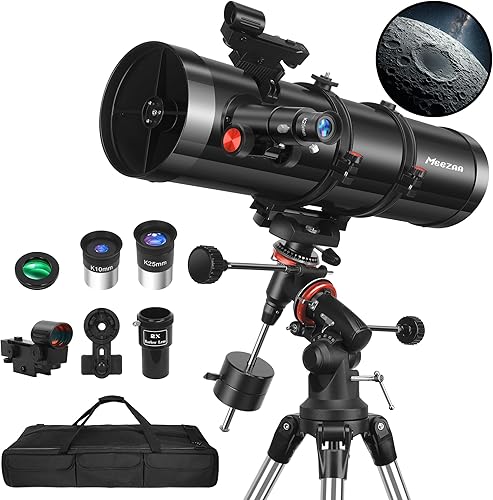
The MEEZAA Telescope includes a German Equatorial Mount for beginners learning tracking.
The box contents differ too. The SV225 ships as a mount head with fine tuning levers, dovetail lock knobs, locking screws, an Allen wrench and a metal handle.
The MEEZAA package includes tube, mount, tripod, eyepieces, Barlow lens, finderscope, moon filter, phone adapter and carry bag.
Our telescope mount types guide explains each design before you choose.
Side by side: how the two designs move
Alt-azimuth moves in altitude and azimuth, while equatorial moves in right ascension and declination. Those axis names explain why the mounts feel different once you start to track.
An alt-azimuth mount has a vertical axis and a horizontal axis. You tilt the tube up or down for altitude, then swing it left or right for azimuth.
An equatorial mount tilts one axis to match Earth's axis. That axis is often called the polar axis or right ascension axis.
When an equatorial mount is aligned, a slow turn on the polar axis follows the sky. The other axis then makes small corrections in declination.
| Point to compare | Alt-azimuth mount | Equatorial mount |
|---|---|---|
| Main motion | Up, down, left and right | Along Earth's rotation, plus declination |
| Setup | Level tripod and start | Level tripod, then polar align |
| Best use | Short visual sessions | Longer tracking and photos |
| Field rotation | Yes, as an object moves | No, when aligned well |
| Learning curve | Low for most beginners | Higher at first |
A dovetail plate can change how a tube sits on either mount. The SVBONY SV219 Telescope Dovetail Plate helps you balance a tube so the mount moves more smoothly.
Why balance matters on both designs
Balance changes how hard the slow motion controls work. A tube that sits too far forward or back can make one axis feel heavy, even when the total weight is within the limit.
The SV219 is a 210 mm plate, machined from aluminum alloy with a black anodized finish. Its continuous groove lets you slide the mounting bolts to the spacing your tube needs.
That sliding range matters more on a light alt-azimuth mount, where a small offset can show up as drift or stiffness. On an equatorial mount, the same plate helps you set the tube so the polar axis turns without fighting gravity.
Setup time: which mount gets you observing faster?
An alt-azimuth mount usually wins on setup time. You level the tripod, attach the tube and begin pointing at targets within minutes.
An equatorial mount needs polar alignment before it can track well. You set the latitude, point the polar axis toward the celestial pole and check the alignment with a finderscope or a polar scope.
That extra work can put off a beginner on a cold night. It also frustrates a casual observer who only wants to see the Moon for a short time.
The SVBONY SV225 Alt-Azimuth Mount fits the fast path. It weighs 2.34 kg and has a CNC hollow structure, so it is easy to carry out for a light session.
The MEEZAA Telescope takes the slower path. Its German Equatorial Mount has precision dials and slow motion control knobs, and those controls help you learn tracking as you observe.
Setup also includes learning the controls. The SV225 comes with an English manual, which helps a new user understand the structure and installation steps before going outside.
The MEEZAA package includes instructions and is described as needing no tools for assembly.
Our full telescope mounts guide walks through tripod leveling, saddle checks and first alignment steps.
Tracking the sky: where equatorial mounts pull ahead
An equatorial mount tracks with one main motion, which makes long observations calmer. You turn the right ascension axis slowly and the object stays near the center of the field.
An alt-azimuth mount needs both axes as an object moves. You adjust altitude and azimuth together, and the field slowly rotates during the session.
That rotation matters for photos, where even a short exposure can show moving stars as the field turns.
For visual viewing, rotation matters less. You can nudge the tube with fine controls and keep a planet or cluster in view without much effort.
The SV225 has variable speed gear and slow motion controls on both axes. SVBONY says those controls help you follow the Moon and planets smoothly.
The MEEZAA German Equatorial Mount also has slow motion controls for manual tracking. That lets a beginner practice following objects before buying a motor or controller.
Tracking quality also depends on the locks. SVBONY notes the locks on each SV225 axis work well and the slow motions are smooth, making it easier to zero in and keep an object from drifting out of the eyepiece.
Our best telescope mounts and tripods page compares models for longer tracking sessions.
Weight and payload: do not push the limit
Stay well below the stated load limit for steadier views. Extra weight from eyepieces, cameras and cables can make slow motion controls feel stiff.
SVBONY states a 10 kg load capacity for the SV225, but recommends a maximum load of 7 to 8 kg. SVBONY also recommends using only the micro-adjustment lever when the load is heavy.
That advice is worth following. A mount that feels firm with a light tube will shake more when you touch the focuser or add a heavy diagonal.
The K&F CONCEPT Fluid Head shows the same principle at a smaller scale. It has a safe working load of 11 lb or 5 kg, and it weighs 484 g.
You should not treat that fluid head as an astronomical tracking mount. It suits light pan and tilt work with binoculars, cameras or a light telescope.
Check payload before you buy a tube. A mount and tripod that work with a small refractor may struggle with a long reflector.
The SV225 uses a UNC 3/8-16 thread that is compatible with most Celestron, Skywatcher and Orion astronomical OTAs. That wide thread fit helps you match the mount to a tube you already own, provided the total load stays in the recommended range.
The play in the fine adjustment lever
SVBONY notes that it is normal for the fine adjustment lever to have some play. If there is no play, the lever will feel very heavy to move.
That detail affects how you judge a mount in use. A small amount of play can feel like looseness, yet in this design it is part of keeping the fine control usable.
When the load is heavy, SVBONY recommends using only the micro adjustment lever rather than pushing both controls. That approach protects stability and keeps the motion smoother.
The Celestron NexStar 8SE tripod guide shows how tripod choice affects stability for a specific alt-azimuth setup.
Visual use: why alt-azimuth mounts suit beginners
Alt-azimuth mounts match the way most people look at the sky. You point up to see a high object and swing sideways to follow it across the sky.
That direct motion helps beginners learn the sky without first learning polar alignment. You can find an object, view it and move to the next target in seconds.
The SV225 has fine adjustment shift and a variable speed gear. Those features let you make small moves without pushing the whole tube.
Its adjustment range is also wide. SVBONY lists 360 degree adjustment and -60 to +60 degree altitude adjustment for visual observation.
The mount also suits surface observation. You can tilt the tube toward the Moon, planets or daytime landscapes without changing the mount type.
For a beginner, that range covers most of a session. You can start low near the horizon, follow an object as it climbs, then move to another target without rethinking the mount setup.
Stability helps at high magnification. The SV225 is described as holding the telescope steady, with locks on each axis that work well for visual use.
A best altazimuth telescope mount shortlist can help you compare light models built for this kind of use.
Astrophotography: why equatorial mounts matter more there
An equatorial mount keeps the field steady for longer exposures. That steadiness is the main reason photo users choose an equatorial design.
With an alt-azimuth mount, the field rotates as the sky moves. A camera sees that rotation as trails that grow with exposure time.
With an equatorial mount, the camera rotates with the sky when the polar axis is aligned. Stars stay in place while you use longer exposures.
The MEEZAA Telescope is aimed at visual astronomy, not full astrophotography. Still, its German Equatorial Mount teaches the same tracking motion used by larger equatorial models.
If photos are a future goal, plan for a mount with enough payload and a stable tripod. Our Celestron Advanced VX Equatorial Mount review covers a model built for heavier loads.
Brand choice also matters for motors, controllers and spare parts. Our celestron vs meade mounts comparison helps you weigh those ecosystems before you commit.
Weather and site choice affect photo results as much as the mount. Clear skies, calm air, low humidity and minimal light pollution give the steadiest view.
Those conditions also help visual observers see fainter detail on the Moon and planets.
Portability: which mount is easier to carry out?
A light alt-azimuth mount is easier to carry and store. The SV225 weighs 2.34 kg, so it fits in a small space and moves out to the yard without much effort.
An equatorial mount and tripod usually weigh more as a set. The mount head, tripod legs and counterweight add bulk to carry in separate trips.
The MEEZAA Telescope includes a stainless steel tripod with adjustable height. Its parts fit into a carry bag, which helps with storage after a session.
Still, a complete equatorial telescope takes more room than a small alt-azimuth mount in a closet or car boot.
From a balcony or a dark site drive away, weight and size may matter more than tracking power. Choose the mount you will actually carry out each night.
The dimensions show the contrast. The SV225 measures about 13.26 by 11.11 by 5.6 inches.
The MEEZAA package measures about 35.43 by 13.97 by 9.64 inches.
That contrast explains the grab and go framing. SVBONY contrasts it with heavy and complex equatorial mounts for beginners or experienced users wanting light observation.
Our Celestron NexStar 8SE wedge guide explains when a wedge changes portability for some alt-azimuth setups.
Who should buy which mount?
Buy alt-azimuth for casual visual viewing and equatorial for longer tracking or photos. Your observing habits should drive the choice more than mount type alone.
Choose an alt-azimuth mount if you live in a small space or observe for short periods. Choose it also if you mainly look at the Moon, planets and bright clusters.
Choose an equatorial mount if you plan to observe one target for a long time. Choose it also if you want to learn astrophotography or use a heavier telescope.
The verdict: altazimuth vs equatorial mount
Pick alt-azimuth for speed and equatorial for tracking. In the altazimuth vs equatorial mount choice, the faster mount is not always the better mount.
If you want to observe tonight with minimal setup, start with an alt-azimuth mount. It suits short sessions, light telescopes and visual viewing.
If you want to follow objects for longer or prepare for photos, choose an equatorial mount. It rewards the extra setup with steadier tracking night after night.
Next, check payload and tripod stability before you buy either type. A lighter load on a firm mount will give you steadier views than a heavy load pushed to the limit.
Match the mount to the tube you own or plan to buy. The SV225 fits many astronomical OTAs through its 3/8-16 thread, while the MEEZAA package gives you a matched tube, equatorial mount and tripod in one set.
For a broader look before you decide, read our telescope mount types guide and compare models in best telescope mounts and tripods.
Frequently asked questions
Is an alt-azimuth mount easier to set up than an equatorial mount?
Yes, an alt-azimuth mount is usually easier because you level the tripod and point up, down, left and right. An equatorial mount needs polar alignment so one axis points toward the celestial pole.
That extra step pays off when you track an object for a long time.
Which mount is better for astrophotography?
An equatorial mount is usually better for astrophotography because it tracks along the sky's rotation and keeps the field stable. An alt-azimuth mount can work for short visual sessions, but field rotation becomes a problem as exposures get longer.
Sky-Watcher and Celestron equatorial models are common starting points.
Can I convert an alt-azimuth mount to an equatorial mount?
You can sometimes add a wedge to convert an alt-azimuth mount to equatorial use, but it depends on the model and load. Check the mount's thread and warranty first, and keep the total load within safe limits.
A dedicated equatorial mount is simpler if tracking is your main goal.
How much weight should I put on a mount?
Stay below the maker's safe working load and leave room for extra weight from eyepieces, cameras and cables. SVBONY recommends 7 to 8 kg for the SV225 even though its stated capacity is 10 kg.
A lighter load on the mount usually means steadier views and smoother motion.


