7 Best Smart Telescope Mounts (November 2026)
The best smart telescope mounts include the Gskyer Telescope for beginners who want a complete kit, the MOVE SHOOT MOVE tridaptor for phone imaging alignment, and the SVBONY SV225 Alt-Azimuth Mount for light grab-and-go viewing.
On this page (11 sections)
- Best smart telescope mounts for finding and tracking targets
- How the best smart telescope mounts compare side by side
- How we compared these mounts
- What does a smart telescope mount actually automate?
- Which mount type suits a beginner best smart telescope setup?
- How much payload do you need for a smart mount?
- What tripod should you pair with a smart telescope mount?
- Do you need an equatorial mount for a Seestar smart telescope?
- What finder and phone accessories help with a smart mount?
- How should you set up and care for a computerized mount?
- Verdict: which smart telescope mount should you buy?
The best smart telescope mount for most buyers is the Celestron Advanced VX Computerized German Equatorial Mount, because it combines computerized target finding with a 30 lb payload and sidereal tracking. A smart mount earns its place when it finds the object for you and keeps it centered while you observe or image.
This guide compares computerized mounts, manual alt-azimuth and equatorial mounts, and the small parts that make finding and phone imaging easier. Our score weighs specs, features and buyer feedback against what you are shopping for here.
If you are new to telescopes in general, start with How to Use a Telescope for Beginners: A Beginner’s Guide before you choose a mount. Understanding eyepieces, focus and alignment will help you judge any mount more clearly.
Our picks at a glance
-
1
-
2

-
3

- 4
 Check it
Astromania Finder Scope Mount Universal Dovetail Base
Best for adding a finder to a telescope - 5
 Best for a manual equatorial starter telescopeCheck it
- 6
 Check it
Celestron Advanced VX Computerized German Equatorial Mount
Best for computerized target finding and tracking - 7
 Check it
Celestron CG-4 Manual German Equatorial Mount
Best for manual equatorial tracking on a steel tripod
Best smart telescope mounts for finding and tracking targets
The Celestron Advanced VX leads for computerized use, while the SVBONY SV225 and Celestron CG-4 cover manual tracking at lower weights. The Gskyer and MEEZAA packages suit beginners who want a telescope and mount together.
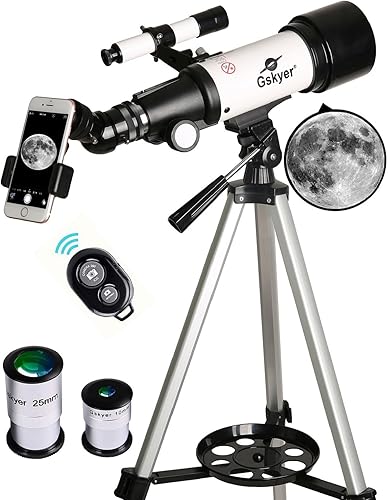
Gskyer Telescope: Best for beginners who want a complete kit
- 70mm aperture, 400mm focal length
- Altazimuth mount
- Wireless camera remote and smartphone adapter
- Adjustable aluminum alloy tripod and carry bag
A complete 70mm refractor package with an alt-azimuth mount, adjustable tripod, carry bag, phone adapter and wireless remote for beginners.
Pros
- Complete kit in one package
- Portable carry bag design
- Phone adapter and wireless remote included
Cons
- Manual focus
- Alt-azimuth mount is not computerized tracking
The Gskyer Telescope suits kids and beginners who want one box with a telescope, mount, tripod and carry bag. Its 70mm aperture and 400mm focal length give a wide, forgiving view for the Moon and brighter objects.
The alt-azimuth mount moves in intuitive up, down, left and right directions. That makes first use simple, and the adjustable aluminum alloy tripod lets you set a comfortable viewing height for seated or standing observers.
A 5x24 finder scope with cross-hair lines helps you point the main tube, and two eyepieces plus a 3x Barlow lens change magnification in steps. The smartphone adapter and wireless camera remote add a simple way to try phone photos without touching the scope.
Fully coated optics and a 40cm optical tube keep the package compact at 5.7 pounds overall. The trade-off is clear: this is a manual alt-azimuth setup, not a computerized tracking mount.
Choose it for easy starts and portability, not for long-exposure astrophotography.
MOVE SHOOT MOVE tridaptor: Best for phone imaging alignment
- 3-axis digiscoping phone mount
- All-metal build
- Bluetooth remote included
- Fits eyepieces 0.86 to 2.4 in
A tridaptor phone adapter with 3-axis alignment for lining a smartphone camera up with an eyepiece for digiscoping photos and video.
Pros
- Precise 3-axis alignment
- Rigid aluminum construction
- Bluetooth remote reduces shake
Cons
- Adapter only, not a telescope mount
- Not suitable for shorter eyepiece models
The MOVE SHOOT MOVE tridaptor suits anyone who wants to use a smartphone with a spotting scope, telescope, monocular or microscope eyepiece. It is a phone adapter, not a telescope mount, and that distinction matters when you shop for either role.
Its 3-axis design adjusts left and right, up and down, and forward and back. That forward and back Z-axis adjustment helps you reach the right eye relief and reduce dark edges in photos and video, which is where cheaper clamp adapters often struggle.
The all-metal build keeps the phone steady, and rubber pads protect the phone and eyepiece from scratches. An included Bluetooth remote lets you take a shot without tapping the phone and shaking the image, a small detail that improves sharpness for birds, wildlife and distant scenes.
It fits most iPhone and Android phones from 2.36 to 3.44 inches wide and eyepieces from 0.86 to 2.4 inches in outer diameter. Measure your eyepiece first, because shorter eyepiece models are not suitable.
Against the other picks, this adds imaging precision rather than tracking power.
SVBONY SV225 Alt-Azimuth Mount: Best for light grab-and-go viewing
- Alt-azimuth mount
- 10kg load-bearing capacity
- Fine adjustment and variable speed gear
- 2.34 kg hollow CNC structure
A lightweight alt-azimuth mount with slow-motion controls on both axes for smooth manual following of the Moon and planets.
Pros
- Lightweight portable design
- Slow-motion controls on both axes
- 360 degree adjustment
Cons
- Manual tracking, not computerized
- SVBONY recommends 7-8 kg maximum load
The SVBONY SV225 Alt-Azimuth Mount suits beginners and experienced observers who want a light grab-and-go mount for visual use. At 2.34 kg, its hollow CNC structure is easy to carry to a dark site or up a short flight of stairs.
It carries up to 10 kg in rated capacity, and SVBONY recommends staying at 7 to 8 kg for better stability. That honest margin is useful guidance for any alt-azimuth mount you compare, because vibration matters more than the headline number.
Slow-motion controls on both axes let you follow the Moon and planets smoothly after you find them. Fine adjustment levers help you zero in without large jumps in position, and the locks on each axis hold the telescope steady while you observe.
Altitude adjustment runs from -60 to +60 degrees, with 360 degree all-round adjustment for viewing in any direction. The UNC 3/8-16 thread fits many common optical tubes.
The trade-off against a computerized equatorial mount is that you still do the finding and the tracking yourself.
Astromania Finder Scope Mount Universal Dovetail Base: Best for adding a finder to a telescope
- Universal dovetail base
- Aluminum with two thumbscrew locks
- Includes two M5 screws
- Fits screw spacing 10.2 to 30.2mm
A finder scope dovetail base for mounting a red dot finder, reflex sight or laser pointer bracket to a compatible telescope tube.
Pros
- Quick thumbscrew locking
- Fits many common finder brackets
- Corrosion-resistant aluminum
Cons
- Finder base only, not a full mount
- Requires matching drilled holes on the tube
The Astromania Finder Scope Mount Universal Dovetail Base suits telescope owners who need a place to add a finder. It is a small dovetail base, not a complete mount, and it solves a specific aiming problem quickly.
You can use it for a red dot finder, reflex sight, laser pointer bracket or a backup finder scope alongside your main aiming device. Two large thumbscrew locks let you secure the bracket without extra tools, even with gloves on, and the larger friction surface helps you grip them in cold weather.
The base is die-cast aluminum with an anodizing process for corrosion resistance. It includes two M5 screws, and the drilled holes accept screws up to 5mm in diameter.
At 1.73 ounces, it adds almost no weight to the top of a tube.
Compatibility depends on center-to-center screw spacing from 10.2 to 30.2mm on your telescope tube. Measure before you order, because a finder base only helps if it fits your tube and your chosen finder bracket.
Compared with full mounts here, this is an accessory that improves every session.
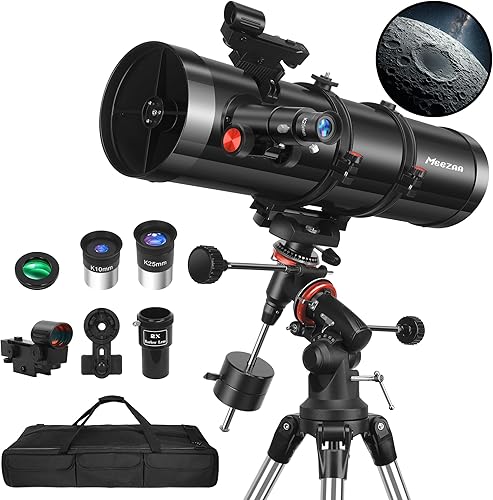
MEEZAA Telescope: Best for a manual equatorial starter telescope
- 150mm aperture, 650mm focal length
- German equatorial mount with slow-motion controls
- Stainless steel tripod and carry bag
- Phone adapter and moon filter
A 150mm Newtonian reflector on a German equatorial mount with manual slow-motion controls, a stainless steel tripod and a carry bag.
Pros
- Large 150mm aperture
- Manual equatorial tracking
- Complete accessory package
Cons
- Manual tracking, not computerized
- Largest package to transport
The MEEZAA Telescope suits adults and beginners who want a larger reflector on an equatorial mount. Its 150mm aperture and 650mm focal length gather more light than the smaller refractor in this guide, which helps faint objects and planetary detail.
The German equatorial mount has precision dials and slow-motion control knobs for smooth pointing and manual tracking. A red dot finderscope helps you aim, and a moon filter reduces glare during lunar viewing, so the bright Moon is easier to study comfortably.
Two eyepieces and a 2X Barlow lens give magnification from 26X to 130X. A stainless steel tripod with adjustable height and an accessory tray keep the setup steady and organized, and the tray keeps eyepieces off the ground.
All parts fit into a carry bag, and assembly needs no tools. The trade-off is that tracking is manual, so you will nudge the controls yourself as objects drift.
That teaches the sky well, but a computerized mount does that work for you.
Celestron Advanced VX Computerized German Equatorial Mount: Best for computerized target finding and tracking
- Computerized German equatorial mount
- 30 lb payload
- NexStar+ hand control with 40,000+ object database
- Sidereal, solar and lunar tracking rates
A computerized German equatorial mount with a 30 lb payload, stainless steel tripod and hand control for locating and tracking celestial objects.
Pros
- Computerized GoTo control
- High 30 lb payload
- Multiple tracking rates and alignment modes
Cons
- 47 lb total kit weight
- Requires alignment setup before use
The Celestron Advanced VX Computerized German Equatorial Mount suits observers who want the mount to find and track for them. Its NexStar+ hand control holds a database of more than 40,000 objects and offers multiple alignment procedures for locating targets.
It supports up to 30 lb of telescopes and accessories, which covers a wide range of setups. A 2-inch stainless steel tripod gives a stable platform and helps limit vibration at higher magnifications, a key benefit when you push magnification for planets.
Latitude adjustment runs from 7 to 77 degrees, so you can align it accurately at different locations. Tracking rates include sidereal, solar and lunar, with EQ North and EQ South modes, which cover stars, the Sun and the Moon without extra setup.
Celestron also lists All-Star Polar Alignment, SkyAlign, PPEC and the Celestron PWI software connection. The full kit weighs 47 lb, so portability takes planning.
For true computerized tracking, this is the strongest pick here.
Celestron CG-4 Manual German Equatorial Mount: Best for manual equatorial tracking on a steel tripod
- Manual German equatorial mount
- 20 lb weight capacity
- Stainless steel tripod, 33-47 in adjustable height
- Manual slow-motion controls on both axes
A manual German equatorial mount on a stainless steel tripod with slow-motion controls for fine adjustment and manual tracking.
Pros
- Heavy-duty steel tripod
- 20 lb capacity
- Smooth manual slow-motion controls
Cons
- Manual only, no computerized control
- Accepts motor drive separately
The Celestron CG-4 Manual German Equatorial Mount suits buyers who want equatorial tracking without computerized control. It supports up to 20 lb of optical equipment on a stainless steel tripod, a solid middle ground in this guide.
The tripod legs are 1.75 inches in diameter, which helps keep views steady during observation. Adjustable height from 33 to 47 inches suits seated and standing observers, and the center brace and accessory tray add stability and storage.
Manual slow-motion controls on both axes give fine adjustment for locating and tracking objects. Ball bearings in both axes help the mount move smoothly under load, so small corrections do not turn into jumps.
Celestron lists 7 lb and 4 lb counterweights, and the mount accepts a motor drive for powered tracking later. The trade-off is that it is manual out of the box.
Choose it if you want to learn equatorial setup at a lower level of complexity.
How the best smart telescope mounts compare side by side
The comparison table below puts payload, mount type and control style in one place. Use it to narrow the field before you read the buying advice.
| Product | Best for | Aperture | Focal Length | Mount | Our score |
|---|---|---|---|---|---|
| Gskyer Telescope | beginners who want a complete kit | 70mm | 400mm | Altazimuth Mount | 9.7 |
| MOVE SHOOT MOVE tridaptor | phone imaging alignment | 9.6 | |||
| SVBONY SV225 Alt-Azimuth Mount | light grab-and-go viewing | Altazimuth Mount | 9.5 | ||
| Astromania Finder Scope Mount Universal Dovetail Base | adding a finder to a telescope | 9.4 | |||
| MEEZAA Telescope | a manual equatorial starter telescope | 150mm | 650mm | Equatorial Mount | 9.4 |
| Celestron Advanced VX Computerized German Equatorial Mount | computerized target finding and tracking | German Equatorial Mount | 9.4 | ||
| Celestron CG-4 Manual German Equatorial Mount | manual equatorial tracking on a steel tripod | Equatorial Mount | 9.2 |
How we compared these mounts
We compared rated payload, mount type, control style, tripod design and portability for each option. We looked at what each mount includes, how it finds or tracks targets, and how much weight it can carry with margin.
We also checked finder options, phone adapters and slow-motion controls, because those parts shape daily use. A mount that finds an object quickly but shakes at high magnification will frustrate you more than a simpler mount that stays steady.
Our top pick favors computerized finding and tracking for the smart mount search. Manual mounts still earn places here because many readers want control, lower complexity or a complete telescope package.
We treated accessories such as the tridaptor and finder base on their own terms, since they support a mount rather than replacing one.
How to judge payload margin in practice
Payload margin is the gap between what a mount can carry and what you actually load on it. A mount rated for 30 lb will feel steadier with a 15 lb telescope than with a 28 lb imaging rig, because balance and vibration change with load.
Slow-motion controls and tripod leg diameter matter here too, since a stiff mount on flexible legs still shakes.
What does a smart telescope mount actually automate?
A smart telescope mount automates target finding and astronomical tracking. Computerized mounts slew to an object from a database, then follow it as Earth turns, so it stays centered in the eyepiece or camera frame.
Manual mounts do not automate either task. You find the object with a finder scope, then use slow-motion controls to keep it in view.
That process teaches you the sky, and it works well for visual observing.
Alt-azimuth mounts move on altitude and azimuth axes. Equatorial mounts align one axis with Earth's rotation, which makes tracking smoother for long views and imaging.
Our guide to Alt-Azimuth vs Equatorial Mount: Which Should You Choose? breaks down that choice in plain terms.
Automation also changes session length. When tracking holds an object for minutes instead of seconds, you can use higher magnification and switch eyepieces without losing the target.
That benefit grows with telescope size, because longer focal lengths drift faster in the view.
Which mount type suits a beginner best smart telescope setup?
A beginner who wants the mount to do the work should choose a computerized equatorial mount. The Celestron Advanced VX finds objects from its database and tracks them, which removes the hardest part of early observing.
A beginner who wants a simple complete telescope should consider the Gskyer package. Its alt-azimuth mount is intuitive, and the kit includes a tripod and carry bag.
You will learn pointing before you learn polar alignment.
A beginner who wants to learn equatorial tracking manually should look at the Celestron CG-4. Its slow-motion controls and steel tripod give a stable platform at a 20 lb capacity.
You can add a motor drive later if you want powered tracking.
How to Use a Telescope for Beginners: A Beginner’s Guide
Read How to Use a Telescope for Beginners: A Beginner’s Guide alongside this guide if this is your first telescope. It covers focus, eyepieces and basic alignment, so you can focus on mount choice here.
How much payload do you need for a smart mount?
Choose a mount rated well above your total load, not at its limit. Your total load includes the telescope tube, finder, camera, eyepiece and accessories.
A mount near its limit vibrates more.
The Advanced VX supports 30 lb, which suits heavier telescopes and imaging gear. The CG-4 supports 20 lb, which suits mid-size tubes.
The SV225 rates 10 kg, and SVBONY recommends 7 to 8 kg for stability.
That margin matters for tracking accuracy. A steadier mount holds a target centered longer and gives cleaner views at high magnification.
When in doubt, step up in capacity rather than saving weight at the cost of stability.
Balance matters as much as total weight. A telescope balanced on its mount moves with small nudges, while a front-heavy tube forces you to fight gravity on every adjustment.
Counterweights on equatorial mounts serve this purpose, so include them in your planning.
What tripod should you pair with a smart telescope mount?
A mount is only as steady as its tripod. Look for larger leg diameter, a center brace or accessory tray, and enough height range for your telescope and your chair.
The Advanced VX includes a 2-inch stainless steel tripod. The CG-4 includes a stainless steel tripod with 1.75-inch legs and 33 to 47 inch height adjustment.
Both designs prioritize stability over lightness.
If your mount does not include a tripod, compare options in our best tripod for smart telescope guide. That guide focuses on stability, height and carrying weight for smart telescope setups.
telescope mounts
For a complete overview of mount types, tripod materials and setup steps, read our telescope mounts buying guide. It explains how mount and tripod choices work together before you spend.
Do you need an equatorial mount for a Seestar smart telescope?
Some smart telescopes work best on a standard tripod, and some owners choose an equatorial mount to improve tracking for longer sessions. The right answer depends on your model and your goals.
For the Seestar S30 Pro, start with our best tripod for seestar s30 pro guide. It covers stability and height for that specific model, which matters more than generic mount advice.
For the Seestar S50, our equatorial mount for seestar s50 guide explains when an equatorial setup helps and what to check before you buy. Read it before adding a mount to a smart telescope that already tracks internally.
For the Seestar S30, our equatorial mount for seestar s30 guide covers model-specific fit and alignment. A mount that suits one smart telescope may not suit another, even within the same brand.
best telescope tracking mount
If your main goal is tracking accuracy, compare our best telescope tracking mount guide with this roundup. Tracking mounts focus on smooth sidereal follow and payload margin for longer views.
What finder and phone accessories help with a smart mount?
A finder scope helps you aim quickly, even on a computerized mount. The Astromania dovetail base adds a red dot finder or reflex sight to compatible tubes, and it locks with two thumbscrews.
Phone imaging needs a rigid adapter. The MOVE SHOOT MOVE tridaptor aligns a smartphone on 3 axes, and its Bluetooth remote reduces shake when you press the shutter.
Measure your eyepiece before you choose an adapter.
The Gskyer package includes a smartphone adapter and wireless camera remote, which makes it a simple starting point for phone photos. The MEEZAA package includes a phone adapter as well, so both kits support casual imaging.
These accessories work best when you treat them as part of a system. A finder helps you arrive at the target, slow-motion controls help you stay there, and a rigid phone adapter helps you record what you see.
How should you set up and care for a computerized mount?
Level the tripod, point the mount north, and set the latitude to your location before you align it. Computerized mounts track best when that first setup is patient and repeatable.
Use the mount's alignment routine each session, even if you observed from the same spot last week. Small changes in tripod position or tube balance can shift pointing accuracy.
Keep the mount dry, tighten knobs and locks regularly, and store counterweights and hand controls with the mount. Check that dovetail locks and thumbscrews hold firmly before you attach a telescope.
Temperature and dew also affect sessions at the eyepiece. Let optics reach outdoor temperature before you observe, and keep eyepieces capped when not in use to protect coatings from moisture.
Verdict: which smart telescope mount should you buy?
Pick the Celestron Advanced VX for computerized finding and tracking, the SVBONY SV225 for light manual alt-azimuth use, and the Gskyer for a complete beginner kit. Each choice matches a different way of observing, so choose by the job you want done.
If you want the mount to find targets and track them, the Advanced VX is the clear pick in this group. Its 30 lb payload and database make it the best smart telescope mount for imaging-ready setups.
If you want to learn the sky by hand, the CG-4 gives manual equatorial tracking on a steel tripod. If you want a simple package today, the Gskyer gives you a telescope, mount, tripod and bag in one order.
Next, check our telescope mounts guide to confirm tripod and mount fit for your telescope before you order.
Our top 3 picks at a glance
-
1
-
2
-
3
Frequently asked questions
What is a smart telescope mount?
A smart telescope mount automates target finding and astronomical tracking. Computerized mounts use a hand control or app to locate objects and follow them as Earth turns, so the target stays in view longer.
Is an alt-azimuth mount good for beginners?
Yes, alt-azimuth mounts move up and down and side to side, which feels natural at first. Manual slow-motion controls help you follow the Moon and planets, but long exposures usually need equatorial tracking.
What payload should I choose?
Choose a mount rated above your telescope, camera and accessories combined. Leave headroom, because a mount near its limit vibrates more and tracks less smoothly during long sessions.
Do I need a separate tripod?
Some mounts include a tripod and some do not. Check what is included, then compare the tripod material, leg diameter and height range with your telescope weight and viewing position.


