5 Best ED Refractor Telescopes (November 2026)
The best ED refractor telescopes include the SVBONY SV550 AP0 Telescope for color correction, the SVBONY SV503 Upgraded ED Refractor Telescope for deep-sky imaging, and the Celestron StarSense Explorer DX 102AZ App-Enabled Refractor for guided visual observing.
On this page (4 sections)
The best ED refractor telescopes reduce color fringing while keeping setup simple. That balance suits buyers who want cleaner color without a large or complicated system.
For imaging, the SVBONY SV503 and SV550 have the strongest low-dispersion designs here. They suit people who already plan to use a camera, a suitable mount, and careful focusing.
For visual beginners, Celestron offers easier complete setups, while the Bushnell is the simplest compact option. Those models suit quick viewing better than photographing faint deep sky targets.
ED means extra-low dispersion glass. That glass helps control red, green and blue light that can focus at slightly different points in a basic achromatic refractor.
In practice, that control can make bright stars look less fringed and help the Moon and planets appear with cleaner edges. The effect shows most clearly against a basic design without low dispersion glass.
ED alone does not fix performance. Aperture, focal length, lens coatings, focuser quality, and mount stability still change what you see.
A larger aperture gathers more light for faint objects. A shorter focal length gives a wider view of large clusters and nebula fields, while a longer focal length makes planetary detail easier to frame.
Focusing deserves close attention. A focuser that moves smoothly in small steps makes it easier to reach a sharp image and return to focus as temperature changes.
Mount format shapes daily use as much as the optics. A complete alt azimuth package can be ready for casual viewing in minutes, while an imaging optical tube usually needs a mount chosen for camera weight and tracking.
We compared optical design, aperture, focusing, mount format and included equipment. Our score weighs specs and buyer feedback against what you are shopping for.
Beginners often do best with a complete manual setup and included eyepieces. Imaging buyers should check camera compatibility, back focus, and adapter needs before ordering.
If your priority is photographing nebulae and galaxies, start with our guide to the best refractor telescope for astrophotography. For a broader look at one SVBONY choice, see SVBONY SV48P vs SV503.
Those guides help match focal length and sensor size before you commit to an optical tube. Lunar and planetary viewing rewards stable focus, while wide nebula imaging rewards a faster system and a flat field.
Our picks at a glance
-
1

-
2
 Best for deep-sky imaging
SVBONY SV503 Upgraded ED Refractor Telescope
8.6/10 our score
See it on Amazon -
3
 Best for guided visual observing
Celestron StarSense Explorer DX 102AZ App-Enabled Refractor
9.4/10 our score
See it on Amazon
- 4
 Check it
Celestron AstroMaster 70AZ Refractor Telescope for Moon
Best for simple beginner viewing - 5
 Check it
Bushnell Refractor 600x50mm Telescope
Best for compact basic viewing
Which ED refractor telescope is best overall?
The SVBONY SV503 is the best ED refractor telescope for deep-sky imaging, because its 80mm ED optical tube includes a 0.8X focal reducer and field flattener. That combination is designed to shorten exposure times and keep stars sharper toward the edge of the frame.
A faster system can collect usable signal in less time per exposure. That helps under bright skies or when you want more sub exposures during a limited clear window.
The field flattener addresses a different problem. Without correction, stars near the edge can stretch or swell, which can waste the corners of a large sensor even when the center looks fine.
The SV503 uses S-FPL51 ED glass in an 80mm F7 design. That glass helps reduce chromatic aberration, so bright stars and highlight areas can look cleaner in camera frames.
Its 2 inch dual speed focuser offers 1 to 10 micro adjustment. Small focus steps matter for imaging because a camera image can lose sharpness quickly when focus drifts between exposures.
The optical tube weighs 2.5kg, which keeps the load modest for a portable imaging setup. Lighter tubes are easier to balance and safer to carry between sessions.
The SV550 is the stronger choice when triplet APO correction is your main goal. It uses one S-FPL51 ED glass element and 2 correcting lenses, while the SV503 uses S-FPL51 ED glass in an 80mm F7 design.
That extra correction is aimed at color control across the spectrum. It can be valuable for buyers who notice blue edge fringing and want the most controlled star color from an 80mm class scope.
The SV550 also uses a 2.5 inch dual speed focuser and four internal light baffles. Those baffles are intended to cut stray light inside the tube and support contrast in deep sky frames.
Its 480mm focal length gives a wider field direction than the SV503 at 560mm before reduction. A wider field can suit large nebula targets, while a narrower field can suit smaller galaxies and tighter compositions.
For visual observing, the Celestron StarSense Explorer DX 102AZ offers the largest aperture in this group and adds smartphone guidance. Its manual alt azimuth mount keeps the physical controls familiar.
That larger 102mm aperture can gather more light for the Moon, planets, and bright deep sky objects. The phone dock and sky recognition help new users locate targets without learning star patterns first.
A complete visual package removes several buying steps. Eyepieces, diagonal, finderscope, tripod, and phone dock are included, so you can start observing without sourcing missing parts.
The trade off is purpose. The Celestron is not built around the same imaging corrections as the SVBONY scopes, so it suits guided visual astronomy more than camera focused deep sky work.
Choose based on your main use. Imaging buyers should study field size, camera adapters, and mount capacity, while visual buyers should weigh aperture, guidance, and ease of set up.
| Product | Best for | Optical design | Focal length | Focuser | Our score |
|---|---|---|---|---|---|
| SVBONY SV550 AP0 Telescope | color correction | 80mm F6 triplet APO | 480mm | 2.5-inch dual-speed, 1:10 | 9.0 |
| SVBONY SV503 Upgraded ED Refractor Telescope | deep-sky imaging | 80mm F7 ED refractor | 560mm | 8.6 | |
| Celestron StarSense Explorer DX 102AZ App-Enabled Refractor | guided visual observing | 650mm | 9.4 | ||
| Celestron AstroMaster 70AZ Refractor Telescope for Moon | simple beginner viewing | 900mm | 9.7 | ||
| Bushnell Refractor 600x50mm Telescope | compact basic viewing | 600mm | 8.0 |
The best ED refractor telescopes compared
1. SVBONY SV550 AP0 Telescope: Best for color correction
SVBONY SV550 AP0 Telescope: Best for color correction
- 80mm ED F6 triplet APO
- S-FPL51 low-dispersion ED glass
- 2.5-inch dual-speed focuser
- Four internal light baffles
The triplet APO design uses one S-FPL51 ED glass element and 2 correcting lenses to reduce chromatic aberration. Its manual fine focus and camera compatibility suit deep-sky imaging.
Pros
- Triplet APO optics
- Low-dispersion ED glass
- Internal light baffling
Cons
- OTA format needs a suitable setup
- No beginner-focused mount included
The SVBONY SV550 AP0 Telescope uses an 80mm F6 triplet apochromatic design. One S-FPL51 low-dispersion ED glass element works with 2 correcting lenses to address the blue-edge color problem associated with simpler single-ED designs.
Its 480mm focal length gives it a wide-field direction, while the 2.5-inch magnesium alloy dual-speed focuser offers 1:10 fine adjustment. That level of control matters when a camera needs precise focus.
The SV550 also has four internal light baffles across the focuser and lens-barrel walls. Those barriers are intended to reduce stray light and support contrast.
This is an optical tube rather than a beginner-ready complete telescope package. It is a better fit for an amateur astronomer or astrophotographer who already understands how the camera and support system must work together.
Choose the SV550 when color correction and camera use matter most. If you want a field flattener included for a faster imaging system, compare it with the SV503.
2. SVBONY SV503 Upgraded ED Refractor Telescope: Best for deep-sky imaging
SVBONY SV503 Upgraded ED Refractor Telescope: Best for deep-sky imaging
- 80mm F7 ED refractor
- 0.8X focal reducer and field flattener
- 2-inch dual-speed focuser
- 2.5kg optical tube
The SV503 combines S-FPL51 ED glass with a 0.8X field flattener for faster imaging and sharper stars toward the edge of the frame. Its 2.5kg OTA is suited to portable camera setups.
Pros
- Field flattener included
- Edge-to-edge imaging design
- Lightweight OTA
Cons
- No finderscope
- Fixed mount listed
The SVBONY SV503 Upgraded ED Refractor Telescope combines an 80mm F7 ED refractor with a 0.8X focal reducer and field flattener. The reducer makes the system faster and widens the field, while the flattener is designed to keep stars sharp from center to edge.
Its S-FPL51 ED glass helps reduce chromatic aberration around bright stars and highlights. The 2-inch dual-speed focuser adds 1:10 micro-adjustment for careful camera focus.
The optical tube weighs 2.5kg, which helps when you are planning a portable imaging setup. It has a 560mm focal length before the 0.8X reduction and a 46cm optical tube length.
There is no finderscope in the stated equipment, so plan target-finding around the imaging system and your wider setup. The product is camera-compatible and is aimed more at deep-sky imaging than casual first-telescope viewing.
Pick the SV503 when you want an ED refractor telescope with a field flattener included. For triplet correction, the SV550 is the more advanced optical design.
3. Celestron StarSense Explorer DX 102AZ App-Enabled Refractor: Best for guided visual observing
Celestron StarSense Explorer DX 102AZ App-Enabled Refractor: Best for guided visual observing
- 102mm refractor
- StarSense smartphone dock
- Manual alt-azimuth mount
- 25mm and 10mm eyepieces
This 102mm refractor pairs high-reflectivity coatings with smartphone-guided object finding. Its manual mount, eyepieces and phone dock make it a practical visual choice for beginners.
Pros
- Largest aperture here
- Smartphone sky recognition
- Dual-axis slow-motion controls
Cons
- Manual focus
- App use depends on a compatible smartphone
The Celestron StarSense Explorer DX 102AZ App-Enabled Refractor is the best visual pick for beginners who want help locating objects. Its StarSense Explorer app uses a smartphone dock and sky recognition to point you toward stars, planets, nebulae and galaxies.
The 102mm refractor has high-reflectivity coatings and a 650mm focal length. Celestron describes it for views of the Moon, Jupiter, Saturn, the Orion Nebula and the Andromeda Galaxy.
A manual alt-azimuth mount with dual-axis slow-motion controls lets you make small pointing adjustments. The package includes 25mm and 10mm eyepieces, an erect image diagonal, a StarPointer finderscope, a tripod and the StarSense phone dock.
The app works with modern smartphones, including Android 12 and later and iOS 18 and newer. Check your phone's operating system before choosing this model.
This is not an ED refractor telescope, but its larger aperture and guided setup make it a strong alternative for visual astronomy. For more complete visual comparisons, see the best apochromatic refractor telescope guide.
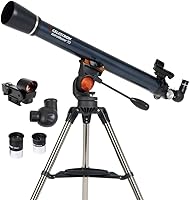
4. Celestron AstroMaster 70AZ Refractor Telescope for Moon: Best for simple beginner viewing
Celestron AstroMaster 70AZ Refractor Telescope for Moon: Best for simple beginner viewing
- 70mm fully coated achromatic optics
- Manual alt-azimuth mount
- 20mm and 10mm eyepieces
- Adjustable tripod
The AstroMaster 70AZ is a simple achromatic refractor for Moon, planet, star cluster and land viewing. Its preassembled tripod and included eyepieces keep setup straightforward.
Pros
- Simple manual controls
- Day and night viewing
- Quick no-tool setup
Cons
- Achromatic rather than ED optics
- Smaller aperture than the 102mm model
The Celestron AstroMaster 70AZ Refractor Telescope for Moon & Planet Viewing suits adults and kids who want a simple manual telescope. Its fully coated 70mm achromatic optics are designed for the Moon, planets, bright star clusters and daytime land viewing.
The manual alt-azimuth mount uses a panhandle to move up, down and side to side. Its adjustable tripod supports standing or seated use, and the setup requires only a few parts with no tools.
Celestron includes 20mm and 10mm eyepieces, an erect image 90-degree diagonal and a StarPointer red dot finderscope. The tripod and mount are preassembled, and the telescope also includes astronomy software for planning sessions.
The 900mm focal length favors a narrower view than the SV550's 480mm design. Since this is an achromatic refractor, it does not offer the low-dispersion correction of the ED models above.
Choose it when quick setup and simple Moon viewing matter more than astrophotography. Our guide to [Is a Refractor Good for a Beginner?
What to Know](/is-a-refractor-good-for-a-beginner/) explains why this telescope type can suit a first-time observer.
5. Bushnell Refractor 600x50mm Telescope: Best for compact basic viewing
Bushnell Refractor 600x50mm Telescope: Best for compact basic viewing
- 50mm objective lens
- 600mm focal length
- Multi-coated optics
- Manual alt-azimuth mount
The Bushnell is a basic 50mm refractor with multi-coated optics and a 600mm focal length. It fits buyers who want a compact starting point for general telescope viewing.
Pros
- Small 50mm format
- Multi-coated optics
- Manual controls
Cons
- Smallest aperture here
- Not an ED optical design
The Bushnell Refractor 600x50mm Telescope is the most basic option in this comparison. It uses a 50mm objective lens, 600mm focal length and multi-coated optics in a manual alt-azimuth format.
That format keeps the controls plain and familiar. You point the tube up, down, and side to side by hand, then fine tune focus until the image looks sharp.
Its smaller aperture makes it easier to think of this telescope as a starting point for general viewing rather than a deep-sky imaging platform. More light gathering will be needed for faint galaxies and detailed nebula work.
It is compatible with cameras and smartphones, but the product information does not describe an ED optical design or an imaging field flattener. That limits how far you should push it for serious astrophotography.
The scope includes a telescope, and its stated optical tube length is 60cm. The 7lb telescope has a reflex finderscope and manual focus.
A 600mm focal length sits in the middle of this group. It is longer than the 480mm SV550 and shorter than the 900mm AstroMaster 70AZ, so framing will fall between those two styles.
For daytime use, the erect image equipment is not described in the same way as on the Celestron models. Check what diopter or diagonal parts you need if land viewing is a main goal.
Care is simple with a basic refractor. Keep the front lens capped, avoid touching coated surfaces, and store the tube where dust and knocks are less likely.
Choose the Bushnell when you want a straightforward compact refractor and your targets are modest. If you need a larger visual aperture, the 102mm Celestron gathers more light.
For land targets, compare the best telescopes for land viewing.
What should you look for in an ED refractor telescope?
The most important choices are the optical design, aperture, focal length, focuser and complete setup format. ED glass can reduce color fringing, but the rest of the telescope determines how useful it is for your targets.
How much aperture do you need?
A larger aperture collects more light and can make faint targets easier to see. The Celestron DX 102AZ has the largest aperture here at 102mm, followed by the 80mm SV550 and SV503 models.
The 70mm AstroMaster is easier to position for beginner viewing, while the 50mm Bushnell is the smallest option. Use our guide to the best 100mm refractor telescope if you want to compare larger visual refractors.
Is ED glass enough for astrophotography?
ED glass helps, but astrophotography also depends on focus control, field shape and the support system. The SV503 includes a 0.8X field flattener for faster imaging and edge-to-edge star correction, while the SV550 uses a triplet APO design and a 2.5-inch dual-speed focuser.
Neither optical tube should be treated as a complete beginner camera system without checking how the mount, camera and adapters fit together.
Do you need an included mount?
Complete visual telescopes such as the AstroMaster 70AZ and StarSense Explorer DX 102AZ include manual alt-azimuth mounts and tripods. The SV550 is listed with an equatorial mount, while the SV503 is listed with a fixed mount.
For photography, mount suitability deserves careful attention. A telescope can have strong optics and still be a poor match for a support system that does not suit the camera and exposure plan.
How do you care for a refractor telescope?
Care for a refractor starts with the lens. Keep the objective lens capped when the telescope is not in use, and avoid touching optical surfaces with fingers or cloth.
Dust is normal outdoors, but heavy dust on a lens can scatter light and reduce contrast. A gentle blower made for optics is safer than wiping a dry lens that may have grit on it.
Set up on a stable surface, use the focus control gently and keep dust away from the tube openings. Small knobs reward a light touch, and forcing them can harm smooth travel.
Let the tripod feet sit fully on firm ground before you add the tube. A slight wobble at the base will show up as vibration at the eyepiece, especially at higher magnification.
Before a night session, let the telescope reach the outdoor temperature gradually. That helps the optics settle and makes focus easier to hold as the air cools.
If you set up indoors and then move outside, give the tube time to adjust before you judge sharpness. Early views can look soft even when the telescope is working correctly.
During daytime land viewing, use the erect image equipment where included and avoid pointing any telescope toward the Sun without a proper solar filter designed for the complete setup. The Sun can damage eyes and optics very quickly.
For night viewing, plan a dark adaption habit. A dim red light preserves night vision better than a phone screen, and it makes faint stars easier to notice.
Store the telescope dry and capped, with eyepieces in a case or pouch. That simple routine protects coatings and keeps small parts from getting lost between sessions.
Check screws and mount bolts from time to time, especially after transport. A telescope that feels solid at the start of the season should still feel solid months later.
These habits apply to every model here, from the compact Bushnell to the larger Celestron and SVBONY scopes. Good care keeps a basic refractor useful and keeps an imaging scope ready for camera work.
Best ED refractor telescopes: final verdict
The SVBONY SV503 is the best ED refractor telescope for deep-sky imaging, with an 80mm ED design, dual-speed focus and included 0.8X field flattener. It is the most complete imaging choice in this group because the reducer and flattener are part of the package.
Pick the SV550 for triplet APO correction. Its S-FPL51 ED element with 2 correcting lenses is aimed at buyers who put color control at the top of the list.
Pick the Celestron DX 102AZ for guided visual astronomy. The 102mm aperture and smartphone sky recognition suit beginners who want help finding objects in the field.
Pick the AstroMaster 70AZ for simple beginner use. Its manual mount, adjustable tripod, and included eyepieces make Moon and planet viewing straightforward for adults and kids.
Choose the Bushnell when compact basic viewing is the priority. It is the smallest and most basic refractor here, so it fits modest targets and a simple set up.
Also weigh what is included before you buy. A complete visual telescope needs fewer extra parts, while an imaging optical tube needs a mount, camera, and adapters that work as one system.
If your main goal is a premium imaging system, continue with our best high end refractor telescopes guide. That guide can help you compare higher tier optics and camera set ups in more depth.
Our top 3 picks at a glance
-
1
-
2
Best for deep-sky imaging
SVBONY SV503 Upgraded ED Refractor Telescope
8.6/10 our score
See it on Amazon -
3
Best for guided visual observing
Celestron StarSense Explorer DX 102AZ App-Enabled Refractor
9.4/10 our score
See it on Amazon
Frequently asked questions
What is an ED refractor telescope?
An ED refractor telescope uses extra-low dispersion glass to reduce color fringing around bright objects. The result can be cleaner views of the Moon and planets, plus more controlled star color in photographs.
ED does not automatically mean triplet APO.
Some scopes use one ED element, while others add correcting lenses.
Are ED refractor telescopes good for astrophotography?
Yes. ED refractor telescopes are popular for astrophotography because reduced chromatic aberration can keep bright stars and planetary details cleaner.
The SV503 adds a 0.8X field flattener, while the SV550 uses triplet APO optics.
You still need a camera-compatible setup and a mount suited to imaging.
What is the difference between ED and apochromatic refractors?
ED describes low-dispersion glass used to control color. Apochromatic describes a broader optical correction goal, often using multiple elements.
The SV550 is a triplet APO with one S-FPL51 ED element and 2 correcting lenses.
Check the full optical design rather than treating ED and APO as identical terms.
Is a 70mm refractor good for beginners?
A 70mm refractor can be a good beginner telescope when simple controls matter more than maximum light gathering. The Celestron AstroMaster 70AZ includes a manual alt-azimuth mount, 20mm and 10mm eyepieces and an adjustable tripod.
A larger 102mm scope shows more light, but may need more space and setup planning.