8 Best Telescopes for Family Use (November 2026)
The best family telescopes for shared observing include the Celestron Travel Scope 70mm Beginner Portable Telescope for shared first sessions, the Gskyer Telescope for phone-assisted family viewing, and the Celestron AstroMaster 70AZ Refractor Telescope for Moon for steady backyard sessions.
On this page (7 sections)
- The best family telescopes for shared observing
- How we compared telescopes for family use
- What makes a telescope comfortable for adults and children?
- What can a family see with these telescopes?
- Should you choose a refractor or a reflector?
- How should you set up a family observing session?
- Which telescope is best for family use?
The best telescope for family use is the Celestron Travel Scope 70mm, thanks to its quick no-tool setup, full-height tripod and backpack. It works for adults and children sharing Moon, planet and daytime views, while the StarSense Explorer is the better fit for guided sky tours.
Families usually need a telescope that is easy to point, comfortable at different heights and simple to store. We compared aperture, mount type, setup details, included eyepieces, portability and features that help several people take turns.
Our guide to choosing a telescope for beginners explains the main trade-offs. You can also compare these picks with our advice on what telescope to choose and what to look for in a beginner telescope.
Our picks at a glance
-
1
 Best for shared first sessions
Celestron Travel Scope 70mm Beginner Portable Telescope
9.7/10 our score
See it on Amazon -
2
-
3
 Best for steady backyard sessions
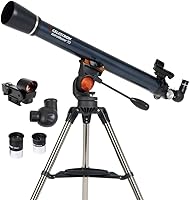
Celestron AstroMaster 70AZ Refractor Telescope for Moon
9.7/10 our score
See it on Amazon
- 4
 Check it
Celestron StarSense Explorer LT 114AZ Newtonian Smartphone
Best for guided family sky tours - 5
 Check it
Blue Marble NASA Lunar Telescope for Kids Ages
Best for young Moon learners - 6
 Check it
MEEZAA Telescope for Adults & Kids
Best for family travel and larger optics - 7
 Check it
EACONN Telescopes for Adults Astronomy
Best for simple portable family setup - 8
 Check it
Hawkko Portable Telescope for Kids & Beginners
Best for creative family projects
The best family telescopes for shared observing
The best family telescope depends on how your household will observe. The Travel Scope 70mm is the easiest all-round starting point, while the StarSense Explorer adds guided target finding and the 114mm reflector gives more light-gathering capacity.
Celestron Travel Scope 70mm Beginner Portable Telescope: Best for shared first sessions
- 70mm refractor
- No-tool setup
- 20mm and 10mm eyepieces
- Backpack included
The lightweight 70mm refractor is quick for adults to set up and easy for children to share. The backpack and full-height tripod also make it practical for family trips.
Pros
- Fast no-tool setup
- Day and night use
- Backpack included
Cons
- Smaller aperture than the 80mm and 114mm picks
- Manual focus
The Celestron Travel Scope 70mm is the strongest shared first telescope because its 70mm refractor and full-height tripod are easy to use at home or away. Its altazimuth mount keeps pointing simple for adults and children.
The 20mm and 10mm eyepieces give wide and close-up views. Families can start with the wider view, center the Moon or another target, then switch eyepieces for a closer look.
Setup takes seconds without tools. The optical tube, preassembled mount and tripod, finderscope, star diagonal, eyepieces and accessories fit in the included backpack.
This model also works for daytime scenery and wildlife. Its 4.2 lb weight makes it the easiest pick here to carry between the backyard, a campsite and a storage cupboard.
Choose it when several family members need a low-friction way to take turns. Our guide to the best easy to use telescope covers similar setup priorities.
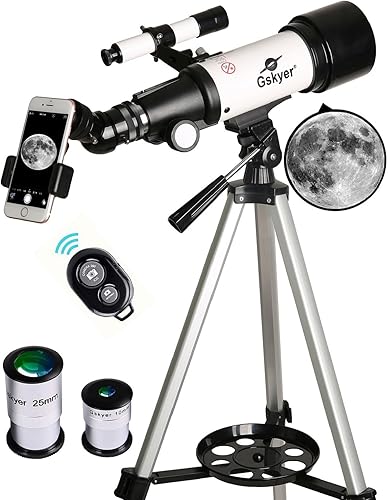
Gskyer Telescope: Best for phone-assisted family viewing
- 70mm aperture
- 400mm focal length
- 3x Barlow lens
- Smartphone adapter and wireless remote
Gskyer adds a smartphone adapter and wireless remote to a portable 70mm refractor. Families can use the eyepiece for direct viewing or share an image through a phone.
Pros
- Portable carry bag
- Phone adapter included
- Adjustable aluminum tripod
Cons
- More setup pieces to organize
- Manual focus
Gskyer suits families who want a portable 70mm refractor with phone sharing. Its 400mm focal length, adjustable aluminum tripod and carry bag make it practical for travel.
The fully coated glass lens and 70mm aperture gather light for the Moon, planets and daytime landscapes. Two eyepieces and a 3x Barlow lens give a range from wider views to higher magnification.
A 5x24 finderscope with cross-hair lines helps an adult place the telescope near a target first. Start with low power, then move up once the view is steady.
The smartphone adapter and wireless camera remote let one person view through the eyepiece while another captures an image or video. That helps keep a second person involved during shared sessions.
At 5.7 lb, it is heavier than the Travel Scope 70mm but still manageable for family outings. Pack the tube, tripod and accessories securely in the carry bag before travel.
Choose Gskyer when phone-assisted sharing matters as much as direct viewing. It suits families who want a travel refractor with more to do around each session.
Celestron AstroMaster 70AZ Refractor Telescope for Moon: Best for steady backyard sessions
- 70mm fully coated optics
- Manual alt-azimuth mount
- Adjustable tripod
- 20mm and 10mm eyepieces
The adjustable tripod and panhandle give adults and children a comfortable way to share Moon and planet viewing. Its longer 900mm focal length suits a backyard setup.
Pros
- Stable full-height tripod
- Simple panhandle control
- Day and night viewing
Cons
- Heavier than the travel picks
- Less convenient for carrying far
The Celestron AstroMaster 70AZ is best for families planning regular backyard sessions around a stable adjustable tripod. Its 70mm fully coated achromatic refractor supports Moon, planet, star cluster and daytime landmark viewing.
It suits a fixed observing spot better than frequent long walks. Once set up in one place, the family can return quickly and keep the routine familiar for children.
The manual altazimuth mount uses a panhandle to move up, down and side to side. That control style helps children learn to point the telescope while adults make small corrections.
The 20mm and 10mm eyepieces provide different viewing levels, and the erect image diagonal keeps daytime targets oriented correctly. The StarPointer red dot finderscope helps the family find a broad target first, then switch to the main eyepiece.
At 10.8 lb, it is much heavier than the travel models. The full-height adjustable tripod still suits a fixed spot, so tighten the legs and mount before each session and keep the scope capped when stored.
Celestron StarSense Explorer LT 114AZ Newtonian Smartphone: Best for guided family sky tours
- 114mm Newtonian reflector
- StarSense smartphone guidance
- 25mm and 10mm eyepieces
- 2x Barlow lens
StarSense uses a smartphone to guide families toward stars, planets, nebulae and galaxies. The 114mm reflector also gathers more light than the smaller refractors here.
Pros
- Smartphone sky guidance
- Largest aperture in this group
- Deep-sky targets included
Cons
- Requires a compatible smartphone
- Heavier than compact family scopes
The Celestron StarSense Explorer LT 114AZ is the best family telescope for learning the night sky with smartphone help. Its 114mm Newtonian reflector gathers more light than the smaller refractors in this roundup.
That larger aperture gives the family more light for planets and deep-sky targets than the 70mm and 80mm models listed here. Dock a compatible smartphone, open the StarSense app and follow the on-screen arrows to a target.
The app suggests stars, planets, nebulae, galaxies and clusters based on time and location. Instead of hunting blind, everyone can follow the same arrows and learn why a target was chosen for that night.
The manual altazimuth mount has altitude slow-motion adjustment with a sliding rod. The 25mm and 10mm eyepieces support wider and closer views, and the included 2x Barlow lens adds another option.
The red dot finderscope gives a simple way to aim the tube. Use it to get close, then switch to the eyepiece and focus slowly.
At 10.4 lb, it suits a backyard or nearby spot better than long carrying trips. Keep the tripod on firm ground and allow time for everyone to take a turn.
Families that want more guided discovery should consider these best high powered telescope options. Check phone compatibility before you buy and keep the phone charged.
Blue Marble NASA Lunar Telescope for Kids Ages: Best for young Moon learners
- NASA-branded lunar telescope
- Low- and high-power eyepieces
- Tabletop tripod
- Learning guide
This compact NASA-branded telescope gives children ages 8 and up a simple way to begin with the Moon. The tabletop tripod keeps the setup close to a table or other stable surface.
Pros
- Child-focused learning guide
- Simple lunar purpose
- Tabletop design
Cons
- Less flexible for broad astronomy
- Needs a stable viewing surface
The Blue Marble NASA Lunar Telescope is the most focused choice for children ages 8 and up who want to start with the Moon. Its tabletop tripod, finder scope and low- and high-power eyepieces keep the first sessions centered on lunar viewing.
That narrow purpose is a strength for a first telescope. A child can start with one clear target and learn how focusing, pointing and eyepiece changes work.
A smooth mounting system helps the viewer scan across the lunar surface. Slow movement is best, because a fast move can make it easy to lose the Moon and start over.
The included learning guide gives children a simple astronomy activity to pair with the observing session. It can turn a short viewing session into a lesson about craters and lunar features.
The compact design is easy to place on a table, but the family needs a stable surface at a comfortable height. Test the table first and keep the telescope away from edges where it could be knocked.
The lens dust cap is useful between sessions. Keep it on the lens when the telescope is stored, and handle the eyepieces gently when you swap them.
It is less flexible than the larger refractors for broad daytime and deep-sky use. Choose this pick when a child’s interest begins with Moon craters and a small learning setup.
For broader family astronomy, move up to a 70mm or 80mm refractor. Those models give more options for planets, daytime targets and shared sessions.
MEEZAA Telescope for Adults & Kids: Best for family travel and larger optics
- 80mm aperture
- 500mm focal length
- 20x to 150x magnification
- Phone adapter and waterproof backpack
MEEZAA combines an 80mm refractor with a foldable adjustable tripod, phone adapter and waterproof backpack. It suits families who want one kit for camping, daytime nature viewing and astronomy.
Pros
- Larger 80mm aperture
- Travel backpack included
- Wide stated magnification range
Cons
- Manual focus
- Lower score than the top portable picks
MEEZAA fits families who want an 80mm aperture and a travel kit for both astronomy and daytime nature viewing. Its 500mm focal length and fully multi-coated optics support Moon and planet sessions.
The larger aperture gathers more light than a 70mm model. That can help with a brighter Moon view and give the family a stronger starting point for planets on a clear night.
The 25mm and 10mm eyepieces plus 3x Barlow lens give a stated 20x to 150x range. A 5x24 finder scope helps locate targets, while the 45° zenith mirror gives an upright viewing angle.
Families should treat the top end of that range with care. Higher magnification makes the view more sensitive to movement, so begin with a lower power and only move up when the target is steady.
The adjustable aluminum tripod ranges from 16.92 to 44.48 inches. That range can suit seated or lower viewing positions, and the waterproof backpack helps organize the telescope for camping or travel.
The backpack is useful for keeping eyepieces and small accessories together. Pack it before you leave and check that the tube and tripod are secure for the trip.
The phone adapter adds a shared recording activity, though families should expect manual focus and manual pointing. One person can observe while another prepares a phone image.
Choose MEEZAA when a larger refractor and full accessory kit matter more than the lightest carry weight. It suits active families who want one kit for several kinds of outdoor viewing.
EACONN Telescopes for Adults Astronomy: Best for simple portable family setup
- 80mm aperture
- 600mm focal length
- 30x to 66x magnification
- Phone adapter and backpack
EACONN offers an 80mm refractor with a carrying backpack, adjustable tripod and phone adapter. Its rough adjustment and positioning gimbal helps several family members take turns pointing the scope.
Pros
- 80mm aperture
- Portable storage bag
- 2-year warranty
Cons
- Fewer stated magnification options
- Manual focus
EACONN offers a portable 80mm refractor for families who want more aperture than a 70mm travel telescope. Its 600mm focal length, adjustable tripod and backpack suit backyard use and trips.
The 80mm aperture gives the family more light-gathering capacity for night sessions. It is a step up from smaller travel scopes while still fitting a portable kit.
The K20mm and K9mm eyepieces provide stated 30x to 66x magnifications. A 5x24 finder scope with a crosshair helps locate objects, and the customized phone adapter supports smartphone use with the two eyepieces.
The phone adapter is matched to the two eyepieces in the kit. Select the correct position for the eyepiece in use, so the phone sits in line with the view.
Its rough adjustment and positioning gimbal has a scale for altitude and azimuth changes. That can make turn-taking easier because family members can see how the telescope is being moved.
The scale also helps an adult reset the view after a child has moved it. Small movements are easier to teach when the control points are clear.
EACONN is a practical middle option, but it has fewer stated magnification levels than some competing kits. The manual focus also means the family should learn slow focusing.
Choose it when an 80mm aperture, portability and a 2-year warranty are priorities. Pack the backpack carefully and keep the optics capped between sessions.
Hawkko Portable Telescope for Kids & Beginners: Best for creative family projects
- 80mm aperture
- 20x to 150x magnification
- Phone adapter
- Decorate stickers and backpack
Hawkko adds decorate stickers and a phone adapter to an 80mm family telescope. The backpack and adjustable 4-stage tripod support travel, while the customization gives children a role before observing begins.
Pros
- 80mm optics
- Family personalization
- Portable backpack
Cons
- Manual focus
- Some optical tube measurements need careful checking
Hawkko is a good family pick when children want to help personalize the equipment before observing. Its 80mm fully multi-coated objective lens, phone adapter and decorate stickers combine astronomy with a simple creative project.
The stickers give children a role before the telescope is even set up. That can make the kit feel like a shared project rather than equipment owned by an adult.
The 25mm and 10mm eyepieces with 3x Barlow lens provide a stated 20x to 150x range. Families can begin with a wider view, center the Moon, then try a closer view.
The wider view should be the default start for every session. It is easier to find a target and easier for a child to keep in view.
The storage backpack holds the telescope, tripod, eyepieces and accessories. Its upgraded 4-stage adjustable aluminum tripod is designed for different heights, which helps adults and children share a session.
A full-height tripod still needs firm ground. Extend each stage evenly, tighten the locks, and test the height before a child looks through the eyepiece.
The phone adapter lets families capture an observation moment. It adds a second activity for someone who is waiting for a turn.
Hawkko uses an altazimuth mount and manual focus, so the family still needs to learn basic pointing and focusing. Choose it when portability, personalization and a phone adapter are more useful than app-guided target finding.
How we compared telescopes for family use
We gave the highest scores to telescopes that combine easy controls, shared viewing comfort and useful setup features. Aperture matters, but a scope that stays packed away is less useful than a lighter model the family can set up often.
The Celestron Travel Scope 70mm, Gskyer and AstroMaster all use 70mm refractors with eyepieces for different viewing levels. The Travel Scope favors portability, Gskyer adds phone sharing, and the AstroMaster favors a steadier backyard setup.
The 80mm MEEZAA, EACONN and Hawkko models add more aperture and family-friendly accessories. Their backpacks and adjustable tripods support travel, while their phone adapters or stickers give children an active role.
The StarSense Explorer stands apart with its 114mm reflector and smartphone sky guidance. The Blue Marble telescope takes the simplest child-focused route by concentrating on lunar viewing with a tabletop tripod.
Our scores weigh specs, features and buyer feedback against what families need for shared observing.
| Product | Best for | Aperture | Mount | Weight | Our score |
|---|---|---|---|---|---|
| Celestron Travel Scope 70mm Beginner Portable Telescope | shared first sessions | 70mm | Altazimuth | 4.2 lb | 9.7 |
| Gskyer Telescope | phone-assisted family viewing | 70mm | Altazimuth | 5.7 lb | 9.7 |
| Celestron AstroMaster 70AZ Refractor Telescope for Moon | steady backyard sessions | 70mm | 10.8 lb | 9.7 | |
| Celestron StarSense Explorer LT 114AZ Newtonian Smartphone | guided family sky tours | 114mm | Altazimuth | 10.4 lb | 9.5 |
| Blue Marble NASA Lunar Telescope for Kids Ages | young Moon learners | 9.4 | |||
| MEEZAA Telescope for Adults & Kids | family travel and larger optics | 80mm | Altazimuth | 8.8 | |
| EACONN Telescopes for Adults Astronomy | simple portable family setup | 80mm | 8.7 | ||
| Hawkko Portable Telescope for Kids & Beginners | creative family projects | 80mm | Altazimuth | 8.6 |
What makes a telescope comfortable for adults and children?
A telescope is comfortable for a family when the tripod, controls and eyepiece position work for different viewers. An adjustable tripod helps, but the observing surface also matters.
Eyepiece height matters most. A scope that is too high or too low forces viewers to bend, stretch or lose balance while they look.
Set the tripod on firm, level ground and tighten its adjustment points before viewing. Keep mount controls within reach of the adult helping, then let children take turns looking and making small adjustments.
An adult should stay close during first sessions. That person can hold the tripod steady, reset the view and show the child how to focus without rushing.
A tabletop model such as the Blue Marble NASA Lunar Telescope needs a stable table at a suitable height. Clear the surface and keep drinks, bags and loose items away from the tripod feet.
Full-height models are more flexible, but they can be heavier to move and need more room around the tripod. Spread the legs evenly for a steadier stance and plant each leg firmly before moving the tube.
Adjust tripod height between turns instead of asking a shorter viewer to stand on a stool or reach up. Manual altazimuth controls and a panhandle are easier for a child to use with help than a complex setup.
Keep the pace calm and structured, with one person looking and the adult managing controls until the child is ready to try. Move to a sheltered spot if wind or soft ground makes the view shake.
Caps on the lenses and a backpack or case for accessories keep the next session ready to start. If simplicity is your main concern, start with our guide to the best easy to use telescopes.
What can a family see with these telescopes?
Most of these telescopes are suited to the Moon, bright planets and daytime targets. The 70mm and 80mm refractors are approachable choices for first sessions, while the 114mm reflector is the strongest option here for brighter deep-sky targets.
Start with a low-power or wider-view eyepiece. Center the target, focus slowly and then change to the higher-power eyepiece if the view remains steady.
Clouds, wind, humidity and city light affect the view. For families observing from a bright neighborhood, compare our guide to the best telescope for light pollution.
The Moon is often the easiest first target because its bright surface and visible craters give children a clear result quickly. Never point a telescope at the Sun without a proper solar filter.
Should you choose a refractor or a reflector?
Choose a refractor when your family wants simple setup, daytime use and low-maintenance viewing. Choose the StarSense Explorer reflector when a larger aperture and guided night-sky targets matter more.
Refractors use a front objective lens and make up most picks here. Sharing is mostly mount movement, focusing and eyepiece changes.
An adult can set the tripod, point the tube and focus, while a child learns to look and describe what is visible.
Refractors in this group also support daytime viewing with an erect image diagonal. That makes them flexible for wildlife, landscapes and other land-based targets.
A reflector uses mirrors inside the tube. The StarSense Explorer uses a 114mm Newtonian reflector, the largest aperture in this group.
It offers more light, but also brings smartphone setup and a heavier telescope into the session.
The app guidance helps beginners choose a target and follow arrows instead of searching without a plan. Refractors still need care, so switch eyepieces slowly, refocus after each change and start with lower power for a steadier view.
Both types need a stable tripod and a clear view. Aperture helps, but wind, clouds and light pollution can limit what a family sees on a given night.
For most first family telescopes, ease of use should come before maximum aperture. A 70mm or 80mm refractor often fits shared daytime and nighttime sessions better.
Choose the reflector for guided deep-sky targets if the family accepts the phone step. Choose a refractor for a simple kit that can be packed, carried and used for many purposes.
Families interested in a compact reflector design can also read about the best Maksutov Cassegrain telescopes, although they serve a different balance of size and viewing goals.
How should you set up a family observing session?
Set up before the sky is fully dark, place the tripod on stable ground and begin with a wide view. Give each person one clear task, such as holding the observing list, watching the tripod or taking the next turn at the eyepiece.
Allow the telescope to adjust to outdoor conditions before expecting the sharpest view. Keep caps on the optics when the telescope is stored, and use the supplied backpack or case where one is included.
Avoid rushing to the highest magnification. A lower-power view is easier to center, and a steady target gives children a better first experience than a shaky close-up.
A simple plan works well: Moon first, then a bright planet or star cluster, followed by a daytime target on another session. Keep sessions short enough that every family member gets several turns.
Which telescope is best for family use?
The Celestron Travel Scope 70mm is the best telescope for family use when you want the lightest, simplest all-round setup. Its 70mm refractor, no-tool assembly, full-height tripod, two eyepieces and backpack make sharing easy.
That combination is why it leads this list for shared first sessions. Adults can set it up quickly, children can take turns at the eyepiece, and the backpack keeps the whole kit together for storage or travel.
Pick the Gskyer if smartphone sharing is central to your family sessions. Its phone adapter and wireless remote add a second way for family members to join the observation.
Choose the AstroMaster 70AZ for a heavier backyard setup. The adjustable tripod and panhandle suit a fixed spot where the family observes often.
Choose the StarSense Explorer for guided night-sky tours. Its smartphone guidance and 114mm reflector suit families who want help finding targets and more light for deep-sky viewing.
Choose the Blue Marble for a child-focused lunar start. Its tabletop design and learning guide keep the first sessions simple and centered on the Moon.
The MEEZAA, EACONN and Hawkko are better fits when an 80mm aperture, backpack and family accessories matter. Each gives the family more aperture than a 70mm scope, with different extras for travel, phone use or personalization.
Use the size, mount and carrying needs of your household as the final decision rule. The best family telescope is the one your household will set up, share and store without friction.
Our top 3 picks at a glance
-
1
Best for shared first sessions
Celestron Travel Scope 70mm Beginner Portable Telescope
9.7/10 our score
See it on Amazon -
2
-
3
Best for steady backyard sessions
Celestron AstroMaster 70AZ Refractor Telescope for Moon
9.7/10 our score
See it on Amazon
Frequently asked questions
What is the best telescope for family use?
The Celestron Travel Scope 70mm is the best telescope for family use when quick setup, shared viewing and portability matter most. It has a 70mm aperture, full-height tripod, 2 eyepieces and a backpack.
Choose the StarSense Explorer if your family wants smartphone guidance to find sky targets.
What should families look for in a telescope?
Families should look for a simple mount, a stable tripod, quick setup and an aperture suited to the targets they want to see. A 70mm refractor can be easy to share, while an 80mm or 114mm telescope gathers more light.
A phone adapter or sky-guidance app can add shared activities.
Can children and adults use the same telescope?
Yes. A telescope with an adjustable tripod and manual alt-azimuth mount can work for both children and adults.
Keep the controls simple, place the tripod on a stable surface and let each viewer take a turn.
For younger children, an adult should handle setup and safe pointing.
Are family telescopes useful during the day?
Several family telescopes here support daytime viewing as well as astronomy. Refractors such as the Travel Scope 70mm, Gskyer, AstroMaster, MEEZAA, EACONN and Hawkko can be used for landscapes or wildlife.
Never point any telescope at the Sun without a proper solar filter designed for that telescope.
Is a larger aperture better for family stargazing?
A larger aperture can gather more light, but it also matters how easily your family can set up and move the telescope. The 114mm StarSense Explorer offers the largest aperture here, while the 70mm travel models are lighter and faster to share.
Pick the size your family will use often.