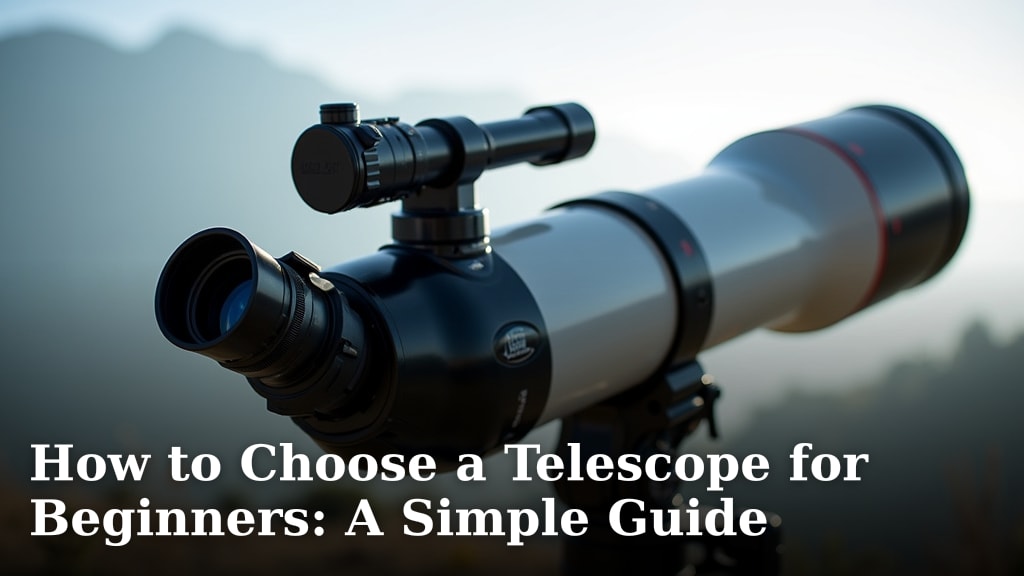
How to Choose a Telescope for Beginners: A Simple Guide
Choosing your first telescope can feel a bit overwhelming, but the easiest way to pick one is to focus on your budget and what you want to see in the night sky. For beginners, refractors or Dobsonians are often recommended because they offer a great balance of price and performance. Don’t worry about fancy features; a simple, sturdy telescope will get you looking at planets and the moon right away.
Many people jump into astronomy with a huge telescope. However, we found that starting with a more manageable scope helps you learn the ropes. It’s important to understand that aperture, or the size of the main lens or mirror, is more important than magnification. A larger aperture gathers more light, showing you brighter and clearer images of celestial objects like star clusters and nebulae.
- Consider your budget first.
- Think about what you want to view (planets, moon, deep-sky objects).
- Prioritize aperture (light-gathering ability) over high magnification.
- Refractors and Dobsonians are good starting points.
- Keep it simple for your first telescope.
We’ll walk you through the key things to consider so you can find a telescope that will bring the wonders of space right to your backyard.
Your First Telescope: What Beginners Need to Know
Picking out your very first telescope can feel like navigating outer space itself. Don’t worry, we’re here to guide you. We’ve researched what makes a telescope great for someone just starting out. The most important thing is to match the telescope to what you hope to see and how much you want to spend.
Think of it like buying your first car. You wouldn’t start with a race car, right? You’d want something reliable and easy to handle. The same applies to telescopes. A beginner’s scope should be user-friendly. It should help you learn the basics without frustrating you. We found that simplicity and quality optics trump fancy gadgets every time for newcomers.
Understanding the Basics: Aperture is King
When we talk about telescopes, you’ll hear a lot about “aperture.” This is simply the diameter of the main lens or mirror. Think of it as the telescope’s “eye.” A bigger eye gathers more light. More light means you’ll see brighter and more detailed images. This is more important than how much the telescope magnifies, or “power.”
Many beginner telescopes come with claims of super high magnification. But what really matters is how much light it can collect. A telescope with a small aperture and high magnification will give you a dim, blurry view. It’s like trying to see a distant object through a tiny, smudged peephole. We found that aperture is the single biggest factor in telescope performance.
For beginners, we recommend looking for a scope with an aperture of at least 70mm for refractors or 6 inches (150mm) for reflectors. This will give you a great view of the Moon’s craters, the rings of Saturn, and Jupiter’s moons. You’ll even start to see some brighter star clusters and nebulae.
Types of Telescopes for Beginners
There are a few main types of telescopes. For your first one, two types stand out as excellent choices: refractors and Dobsonians. We found these offer the best starting point for most new astronomers.
Refractor Telescopes: The Classic Choice
Refractor telescopes use lenses to gather and focus light. They are often the sleek, tube-like telescopes you might picture. They are generally good for viewing the Moon and planets.
Pros:
- Simple to use: They are pretty much ‘set it and forget it.’
- Low maintenance: No need for frequent alignment or adjustments.
- Good for bright objects: Excellent for lunar and planetary viewing.
- Durable: The sealed tube protects the optics from dust and damage.
Cons:
- Pricey for large apertures: Getting a large objective lens is expensive.
- Can be heavy: Larger refractors can be quite long and bulky.
- Chromatic aberration: Cheaper models might show color fringing around bright objects.
We found that smaller, quality refractors (around 70-90mm aperture) are fantastic for beginners. They are portable and offer crisp views of the planets.
Dobsonian Telescopes: Big Aperture, Big Views
Dobsonian telescopes are a type of reflector telescope. They use mirrors to gather light. The “Dobsonian mount” is a simple, sturdy wooden base that makes them easy to point and track objects. These are often recommended for those who want the largest aperture for their money.
Pros:
- Excellent value: You get a lot of aperture for your dollar.
- Great for deep-sky objects: Their large light-gathering power is perfect for nebulae and galaxies.
- Easy to assemble and use: The mount is intuitive.
Cons:
- Bulky: Even smaller Dobsonians can be quite large to transport.
- More collimation needed: Mirrors might need occasional alignment (called collimation).
- Limited to manual tracking: They don’t have motorized tracking built-in.
We found that if your main goal is to see fainter deep-sky objects, a Dobsonian is often the best route. A 6-inch or 8-inch Dobsonian is a popular and capable choice for beginners.
Reflector vs. Refractor: Which is Right for You?
So, which one should you pick? It really depends on your priorities. We’ve seen many beginners ask this exact question.
- For crisp planetary views and ease of use: A small to medium refractor (70-100mm aperture) is a great pick.
- For seeing the faintest smudges of galaxies and nebulae on a budget: A Dobsonian (6-inch or larger aperture) is usually the winner.
It’s a trade-off between portability, ease of maintenance, and the types of objects you’ll see most clearly. Many experts suggest starting with either type is a good introduction to the hobby.
Understanding Magnification (and Why It’s Overrated)
Telescope power, or magnification, is usually advertised with big numbers. Don’t fall for this trap! Magnification tells you how much bigger an object appears. But if the telescope isn’t gathering enough light (small aperture), that magnified image will be dim, blurry, and shaky.
Think about trying to zoom in on a grainy, low-resolution photo. The more you zoom, the worse it looks. The same happens with telescopes. High magnification is only useful if you have a large aperture to start with. For beginners, we found that sticking to lower to medium magnifications (usually 50x to 150x) provides the clearest and most rewarding views.
Most telescopes come with a couple of eyepieces that give you different magnification levels. You’ll likely find yourself using the lower-power eyepieces most often for finding and viewing objects. Higher powers are reserved for very specific, bright targets on clear nights.
Considering Your Budget and Location
Your budget will naturally guide your choices. We found that good beginner telescopes typically range from $150 to $500. While you can find cheaper scopes, they often suffer from poor optics or flimsy construction.
Budget-Friendly Options
If you’re on a tighter budget, a smaller refractor (like a 70mm) or a 6-inch Dobsonian are excellent starting points. These offer a lot of viewing potential without breaking the bank. Many people are happily observing the Moon and planets with these for years.
Where Will You Be Looking?
Where you plan to do most of your stargazing matters. If you live in a city with a lot of light pollution, a telescope with a large aperture is even more important. Light pollution washes out fainter objects. We found that larger apertures help cut through the haze better.
If you have to travel to a darker site, portability becomes a bigger factor. A smaller refractor might be easier to pack up and take with you. A Dobsonian, while great optically, can be a bit more of a hassle to move.
Essential Features to Look For (and What to Skip)
When you’re browsing, keep these key features in mind. We’ve learned that some features are more important than others.
- Sturdy Mount: This is crucial for stable views. A wobbly mount makes high-magnification viewing impossible.
- Quality Optics: Look for clear lenses or mirrors. Avoid “plastic” looking components.
- Included Eyepieces: A good starting set will give you a couple of magnification options.
- Finder Scope: This is a small, low-power scope attached to the main telescope. It helps you aim. A red-dot finder is often preferred by beginners.
What should you skip? We advise against telescopes that heavily promote extreme magnification or come with tons of accessories you’ll likely never use. Focus on the core components: the main tube and the mount.
Your Telescope Checklist
Here’s a quick rundown to help you make your choice:
- Confirm your budget.
- Decide what you want to see most (planets, moon, galaxies).
- Prioritize aperture (light-gathering ability).
- Consider refractor vs. Dobsonian based on your needs.
- Ensure the mount is stable and user-friendly.
- Don’t get swayed by “high magnification” claims.
Choosing your first telescope is an exciting step. By focusing on aperture, understanding the basic types, and setting a realistic budget, you’ll be well on your way to enjoying the wonders of the night sky. We found that a well-chosen beginner telescope can provide years of enjoyment and discovery. To enhance your stargazing, learn what is a star chart and how it can help you navigate the night sky.
Conclusion
You’re now ready to choose your first telescope with confidence. Remember, focus on your budget and what you want to observe. A telescope with a larger aperture will give you brighter, clearer views than one with high magnification. We found that a refractor or Dobsonian is an excellent starting point for most beginners, offering a great balance of performance and price. Don’t overcomplicate your first purchase; a simple, well-built telescope will provide years of enjoyment. Take the next step and start your stargazing journey tonight!
Frequently Asked Questions
What’s the biggest mistake beginners make when buying a telescope?
Many beginners get too caught up in high magnification numbers. We found that a telescope with a small aperture and high magnification will give you a dim, blurry image. Prioritizing a larger aperture for better light-gathering ability is much more important for clear views.
Can I see the planets with a beginner telescope?
Yes, absolutely! With a beginner telescope, you can expect to see impressive details of the Moon’s craters and the rings of Saturn. You’ll also be able to spot Jupiter’s four largest moons. These are fantastic targets for your first observing sessions.
How much should I expect to spend on a good beginner telescope?
We found that quality beginner telescopes typically range from $150 to $500. While cheaper options exist, they often have poorer optics or less stable mounts. Investing a bit more upfront ensures a much more rewarding experience.
Is a red-dot finder scope really that important?
Yes, a finder scope is very helpful for beginners. It’s a small, low-power scope that helps you aim your main telescope. A red-dot finder is especially user-friendly because it projects a red dot onto the sky, making it easy to align with your target.
What’s the difference between a refractor and a Dobsonian for a beginner?
Refractors are classic, tube-shaped telescopes using lenses, great for planets and easy to use. Dobsonians are reflector telescopes with a simple, sturdy base, offering more aperture for your money, which is better for fainter deep-sky objects like nebulae and galaxies.