Celestron vs Meade Telescopes: Which Should You Choose? (November 2026)
Choose Celestron when you want a clear beginner path and broad product support; compare Meade model by model when its optical design and mount fit your observing goals. The right choice depends more on aperture, mount and intended use than on the logo alone.
On this page (11 sections)
- Celestron vs Meade telescopes: which brand should you buy?
- How do Celestron and Meade telescope ranges differ?
- Which brand offers better optical quality?
- Which telescope is easiest for a beginner?
- Which telescope is better for planets?
- Which telescope is better for deep-sky viewing?
- Which telescope is best for travel?
- What ownership details should you compare?
- Celestron vs Meade for astrophotography
- Which Celestron telescope should you choose?
- Final choice: Celestron vs Meade telescopes
Choose Celestron when you want a clear beginner path and broad model choices; compare Meade model by model when its aperture, mount and support fit your plan. In a Celestron vs Meade telescopes comparison, the brand name matters less than the optical design, mount and targets you will actually use.
Celestron's options here range from a simple 70mm refractor to a 130mm Newtonian reflector. The smaller refractors favor quick setup and easy pointing, while the larger reflector gives beginners more aperture and slow-motion controls.
Meade should be judged by the same questions: what do you want to view, how much setup will you accept, and can you still get the support or accessories you need? Our guide to what is the best telescope brand explains why no single brand wins for every observer.
 Best for simple Moon viewing
Celestron AstroMaster 70AZ Refractor Telescope for Moon
Celestron vs Meade telescopes: which brand should you buy?
Buy the model that matches your observing habits, not the logo on the tube. A telescope used often from a simple mount can be a better choice than a larger instrument that stays packed away.
It helps to think about your space first. A balcony, a shared yard and a dark site each suit a different size and weight, and storage matters as much as viewing.
Compare these details before choosing:
- Aperture affects how much light the telescope can gather.
- Optical design changes the view, size and care routine.
- The mount controls how easy it is to point and follow an object.
- Included eyepieces shape your first useful magnifications.
- Support and accessory availability affect ownership over time.
Also consider who will carry and adjust it. A light tube on a sturdy tripod suits a younger observer, while a heavier reflector suits an adult who has room to store it safely.
For a broader third option, compare the best Explore Scientific telescopes with the exact Celestron or Meade model you are considering.
How do Celestron and Meade telescope ranges differ?
Celestron's beginner range shown here covers both easy refractors and a larger reflector, while a Meade comparison needs to be made one model at a time. Brand-level labels cannot tell you whether a particular telescope suits your yard, balcony or dark-sky trips.
A refractor uses a front objective lens. The Celestron AstroMaster 70AZ and Gskyer 70mm are examples of this style, with manual alt-azimuth mounts and straightforward pointing.
A Newtonian reflector uses a primary mirror. The Celestron AstroMaster 130EQ has a 130mm mirror and a German equatorial mount with slow-motion controls, so it offers a different learning path from a small refractor.
Meade also has model families with different designs and mounts, so avoid comparing brands by aperture alone. Read the exact focal length, mount type, included eyepieces and setup instructions before deciding.
What happened to Meade telescopes?
Meade ownership and product availability are separate questions from optical performance. If you are considering an older or discounted Meade telescope, check the exact model's current support, parts and accessory situation first.
Our guide on what happened to Meade telescopes gives more context for that ownership question. The goal is not to reject a brand automatically, but to avoid buying a telescope you cannot maintain or use comfortably.
Does Meade still make telescopes?
Confirm current availability for the exact Meade model before you build your decision around it. Product ranges and support channels can change, and an older model may have different ownership needs from a current one.
See does Meade still make telescopes for a focused look at that question. Then compare the available Meade model with a current Celestron option using the same aperture, mount and target checklist.
Which brand offers better optical quality?
Celestron vs Meade quality depends on the exact optical system, coatings, aperture and alignment, not the brand name alone. A larger aperture can gather more light, but a stable mount and usable controls still determine how much of that capability you enjoy.
The Celestron AstroMaster 70AZ has fully coated 70mm achromatic refractor optics and a 900mm focal length. Its longer focal length suits a more focused view of the Moon and planets, while the refractor design also supports daytime land viewing.
The Celestron AstroMaster 130EQ uses 130mm optics with aluminum and SiO₂ coatings. Its larger mirror gives it more light-gathering potential than a 70mm telescope, which can matter for dimmer targets and deeper observing goals.
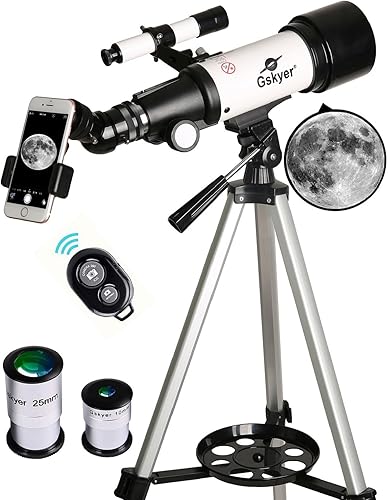
The Gskyer also uses a 70mm refractor, but its 400mm focal length creates a different viewing experience. Its compact size, carry bag and smartphone adapter favor travel and casual sessions.
Use our guide to how do I know if a telescope is good quality to check the details that matter. Look for clear optical specifications, a mount suited to the tube and accessories that match your intended targets.
Which telescope is easiest for a beginner?
A manual alt-azimuth mount is usually the simplest starting point for casual Moon and planet viewing. It moves up, down and side to side in a way that feels familiar, but you still need to make small adjustments as the sky appears to move.
The Celestron AstroMaster 70AZ includes a manual alt-azimuth mount with a panhandle. Its 70mm optics, 20mm and 10mm eyepieces, erect image diagonal and red-dot finder create a complete beginner setup for day or night use.
The Gskyer uses an alt-azimuth mount, too. Its 70mm aperture, 400mm focal length, 2 eyepieces, 3x Barlow lens, 5x24 finder scope, carry bag and smartphone adapter make it the more travel-focused choice in this group.
The Blue Marble NASA Lunar Telescope is aimed at ages 8 and up. Its tabletop tripod, finder scope, low- and high-power eyepieces and learning guide make it a child-focused way to start with the Moon.
Use how do I know what telescope to choose if you are still unsure about setup, target and size. Your best first telescope is the one you can place securely, point without frustration and use often.
Which telescope is better for planets?
Choose by aperture and control quality first, then consider brand. For Moon and planet sessions, you want a steady mount, usable magnification and a way to keep the target centered.
The AstroMaster 70AZ offers 70mm fully coated optics, a 900mm focal length and 20mm and 10mm eyepieces. Its manual alt-azimuth mount is easier to understand than a more complex tracking system, but you must adjust it by hand.
The AstroMaster 130EQ has 130mm optics and a 650mm focal length. Its German equatorial mount includes slow-motion controls for right ascension and declination, which can help you make smaller manual corrections after you learn the mount.
The Blue Marble telescope keeps the goal narrower. It is built around lunar viewing, with a smooth mounting system and 2 eyepieces for low- and high-power views.
For a target-specific choice, read our Jupiter telescope buying guide. It explains why aperture, focus, seeing conditions and mount control all matter when you want more than a quick look at the Moon.
Which telescope is better for deep-sky viewing?
The Celestron AstroMaster 130EQ is the strongest fit in this group for a beginner whose priority is deep-sky viewing. Its 130mm Newtonian reflector has more aperture than the 70mm refractors, and the equatorial mount adds slow-motion controls.
More aperture can help reveal fainter objects, but it does not remove the need for dark skies, correct focus and realistic expectations. A telescope's performance also depends on setup and the conditions on the night.
The 70mm refractors can still suit bright star clusters and lunar or planetary sessions. Their smaller tubes and simpler mounts may make them easier to carry outside, which can lead to more frequent observing.
A Meade reflector may be a fair alternative if its exact aperture, mount and condition fit your needs. Compare those details directly rather than assuming that a similar tube size will produce the same view.
Which telescope is best for travel?
The Gskyer is the clearest travel choice here because its telescope and adjustable aluminum tripod fit in a carry bag. Its 70mm aperture keeps it useful for beginner viewing while its 400mm focal length keeps the optical tube compact.
The Celestron AstroMaster 70AZ is also beginner friendly, but its full-height adjustable tripod and 10.8 lb assembled weight make it more suited to backyard use or planned dark-sky trips.
The 130EQ weighs 17 lb and uses a larger 130mm optical system. That extra size supports deeper viewing goals, but it asks more of your storage space and transport routine.
Before choosing a Meade for travel, measure the packed telescope, tripod and accessories rather than judging from the optical tube alone. A portable telescope needs a practical way to carry every part safely.
What ownership details should you compare?
Check support, parts, accessories and setup help for the exact model before you buy. Ownership is easier when you can replace a missing accessory, understand the mount and get answers when a problem appears.
The Celestron AstroMaster 70AZ and 130EQ include astronomy software, red-dot finders and multiple eyepieces. Celestron also states a 2-year US warranty and US-based technical support for these models.
Those terms are model-specific. Do not assume another Celestron telescope or a Meade telescope has the same warranty or support arrangement.
For older Meade equipment, confirm the condition of the mount, the availability of matching accessories and the instructions before committing. Our Meade ownership guides can help you frame those checks.
Keep the optics capped when the telescope is stored, avoid moisture and let equipment adjust to outdoor conditions before a session. Never point any telescope at the Sun without a proper solar filter designed for that exact use.
Celestron vs Meade for astrophotography
Astrophotography depends more on the mount and camera connection than on choosing Celestron or Meade. A manual alt-azimuth telescope can support simple phone experiments, while longer exposures need a setup designed for controlled tracking.
The Gskyer includes a smartphone adapter and wireless remote, so it offers a simple path for trying phone-based images. Its manual alt-azimuth mount still requires careful pointing and steady handling.
The AstroMaster 130EQ includes compatibility with iPhone, iPad and Android devices in its product data, plus an erect-image 20mm eyepiece, a 10mm eyepiece and a red-dot finder. Its equatorial mount gives it a different control layout from the manual alt-azimuth models.
For a fuller comparison, read Celestron vs Meade for astrophotography. Match the camera, adapter, mount and target before treating a telescope as an imaging system.
Which Celestron telescope should you choose?
Choose the AstroMaster 70AZ for simple Moon and planet sessions, the Gskyer for travel, the Blue Marble for a child focused on the Moon, and the AstroMaster 130EQ for more aperture and deep-sky goals.
The AstroMaster 70AZ suits an adult or child who wants a full height tripod, manual alt azimuth controls and day or night use. Its 70mm fully coated refractor, 900mm focal length and 20mm and 10mm eyepieces keep early sessions straightforward.
The Gskyer suits a beginner who carries a telescope in a bag to different places. Its 70mm aperture, 400mm focal length, adjustable aluminum tripod, carry bag, smartphone adapter and wireless remote favor portable use over a fixed backyard setup.
The Blue Marble NASA Lunar Telescope suits a child ages 8 and up who mainly wants to view the Moon. Its tabletop tripod, finder scope, low and high power eyepieces and learning guide keep the effort focused and age appropriate.
The AstroMaster 130EQ suits a beginner who wants a larger 130mm Newtonian reflector for planets and deeper targets. Its 650mm focal length, German equatorial mount with slow motion controls, red dot finder and 20mm and 10mm eyepieces ask for more setup time and storage space.
Final choice: Celestron vs Meade telescopes
Pick Celestron when one of these clearly matches your use: simple 70mm refractor viewing, portable beginner sessions, or a 130mm reflector for deeper targets. Pick Meade when the exact model offers the aperture, mount, condition and support you can use with confidence.
Start by naming your main target. A family that wants the Moon from the yard needs a different setup from a beginner who wants galaxies on dark site trips.
That one choice narrows the mount, aperture and accessories you truly need.
Then check the mount in daily use. A manual alt azimuth mount is intuitive for quick pointing, but you will move it by hand as an object drifts.
An equatorial mount with slow motion controls takes longer to learn, yet it gives finer adjustment once you know the axes.
Check size and care before you commit. A compact refractor is easier to move and store, while a larger reflector needs more room and a steadier surface.
Keep the optics capped, protect the lenses from moisture and let the telescope adjust to outdoor temperature before viewing.
For Celestron vs Meade reviews, treat broad brand opinions as a starting point. The final decision should come from the telescope's optical design, mount, included accessories and the amount of setup you will accept.
If both brands offer a model that fits, choose the one whose eyepieces, finder and tripod you can use without extra spending. Confirm the warranty and support terms for that exact model, since those terms can differ across a range.
For a final check, picture your first month of use. You should be able to set it up on a clear night, find a bright target and pack it away without dread.
That practical routine matters more than a badge on the tube.
Frequently asked questions
Is Celestron better than Meade?
Celestron isn't automatically better than Meade. Compare the exact telescope's aperture, optical design, mount, included eyepieces and support terms.
Celestron's AstroMaster range here covers simple 70mm refractor use and a larger 130mm reflector, while a Meade choice should be judged by the same practical details.
Are Celestron and Meade telescopes good for beginners?
Both brands offer telescope types that can suit beginners, but ease depends on the model. A manual alt-azimuth refractor is usually simpler to point than an equatorial reflector.
Start with the mount and setup you can use regularly, then choose the aperture that matches your targets.
Which is better for planets, Celestron or Meade?
The exact model matters more than the brand. Look for adequate aperture, stable controls and an eyepiece range that lets you change the view.
The Celestron AstroMaster 70AZ offers 70mm optics and simple manual controls, while the AstroMaster 130EQ offers 130mm optics and slow-motion controls.
Which brand is better for astrophotography?
Neither brand wins for every type of astrophotography. A telescope, mount and camera must work together, and a manual alt-azimuth mount has different limits from a German equatorial mount.
Compare the exact setup, then read our Celestron vs Meade astrophotography guide before choosing.
How do I choose between Celestron and Meade?
Choose by target, aperture, mount and ownership needs. Pick a simple refractor for quick Moon and planet sessions, a larger reflector for more light gathering, or a travel model when storage and transport matter most.
Then confirm the current support and accessory options for the exact model.



