9 Best Telescopes for Deep Sky Astrophotography (November 2026)
The best telescopes for deep sky astrophotography include the DWARFLAB Dwarf Mini Smart Telescope for pocket-sized deep sky imaging, the Celestron StarSense Explorer LT 114AZ Newtonian Smartphone for guided beginner observing, and the MEEZAA Telescope for large-aperture beginner setups.
On this page (5 sections)
The best telescope for deep sky astrophotography for most beginners is the ZWO Seestar S30 Pro, because its app control, auto tracking and built-in processing simplify imaging nebulae, galaxies and star clusters.
That mix matters when you want results without first learning a separate camera, mount and software workflow. A system that finds the target, follows it and processes the image gives you feedback on framing, focus and sky conditions in one session.
Choose the Celestron NexStar 8SE for larger optics, or the SVBONY SV503 if you already have a camera and mount. This roundup covers complete smart systems, traditional telescopes and a dedicated optical tube.
Deep sky imaging rewards stable tracking, a clear focus, enough light gathering and a target that fits the telescope's field of view. A wide nebula needs different framing from a small galaxy.
The best choice depends on whether you want an automated smart telescope, a traditional reflector or a camera-ready optical tube. Portability also changes the answer, since a scope you will actually carry to a darker site often gets used more.
Setup time deserves the same attention as aperture. A telescope that takes a long time to assemble can eat into the best dark hours, while a compact system can be ready before the sky fully darkens.
Care also affects results over a season. Clean optics, a charged battery, a firm tripod and a calm surface make a bigger difference than many beginners expect.
For a first purchase, think about the targets you most want to photograph and the site you will use most often. If you want a wider overview, compare these picks with our guide to the best telescope for astrophotography.
Beginners may also want the shorter learning curve covered in best beginner telescope for astrophotography. Read those guides alongside the product notes below, and watch how each telescope handles tracking.
Our picks at a glance
-
1
 Best for pocket-sized deep sky imaging
DWARFLAB Dwarf Mini Smart Telescope
9.5/10 our score
See it on Amazon -
2
 Best for guided beginner observing
Celestron StarSense Explorer LT 114AZ Newtonian Smartphone
9.5/10 our score
See it on Amazon -
3
- 4
 Check it
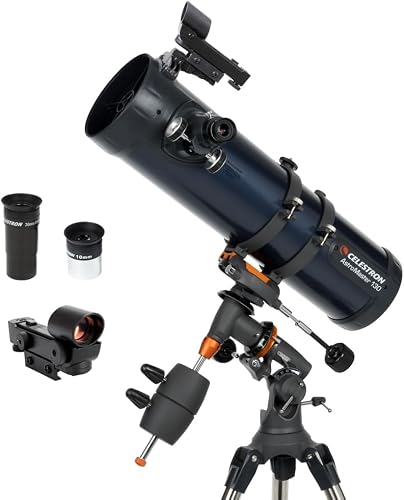
Celestron AstroMaster 130EQ Telescope for Deep-Sky Beginners
Best for classic beginner astronomy - 5
 Check it
ZWO Seestar S30 Pro Smart Telescope
Best for simple deep sky capture - 6
 Check it
Celestron NexStar 8SE Computerized Telescope
Best for large computerized optics - 7
 Check it
DWARFLAB Dwarf 3 Smart Telescope
Best for portable dual-camera imaging - 8
 Check it
Sky-Watcher Flextube 250 Dobsonian 10-inch Collapsible Large
Best for maximum visual light gathering - 9
 Check it
SVBONY SV503 Telescope for Adults High Powered
Best for a dedicated camera-ready refractor
Which telescopes are best for deep sky astrophotography?
The best telescopes for deep sky astrophotography are the DWARFLAB Dwarf Mini and ZWO Seestar S30 Pro for simple automated imaging, while the Celestron NexStar 8SE and SVBONY SV503 suit more involved setups. Traditional Dobsonians and manual equatorial telescopes can show deep sky targets, but their mounts require more work for long exposures.
Our score weighs the stated optics, tracking, imaging features, portability and fit for this keyword. We compared smart telescopes, beginner reflectors, a computerized Schmidt-Cassegrain and a dedicated refractor so you can match the setup to your goals.
| Product | Best for | Weight | Focal length | Mount | Our score |
|---|---|---|---|---|---|
| DWARFLAB Dwarf Mini Smart Telescope | pocket-sized deep sky imaging | 1.85 lb | 150 mm | Altazimuth and equatorial | 9.5 |
| Celestron StarSense Explorer LT 114AZ Newtonian Smartphone | guided beginner observing | 1000 mm | Manual altazimuth | 9.5 | |
| MEEZAA Telescope | large-aperture beginner setups | 650 mm | Equatorial mount | 9.4 | |
| Celestron AstroMaster 130EQ Telescope for Deep-Sky Beginners | classic beginner astronomy | 650 mm | Equatorial mount | 9.3 | |
| ZWO Seestar S30 Pro Smart Telescope | simple deep sky capture | 160 mm | Alt-azimuth with equatorial mode | 9.3 | |
| Celestron NexStar 8SE Computerized Telescope | large computerized optics | 2032 mm | Computerized alt-azimuth | 9.3 | |
| DWARFLAB Dwarf 3 Smart Telescope | portable dual-camera imaging | 3 lb | Altazimuth | 9.1 | |
| Sky-Watcher Flextube 250 Dobsonian 10-inch Collapsible Large | maximum visual light gathering | 1200 mm | Altazimuth Dobsonian | 8.9 | |
| SVBONY SV503 Telescope for Adults High Powered | a dedicated camera-ready refractor | 714 mm | Tripod mount | 8.1 |
DWARFLAB Dwarf Mini Smart Telescope: Best for pocket-sized deep sky imaging
- 1.85 lb portable design
- Sony IMX662 sensor
- 90-second exposures
- Auto GOTO and EQ mode
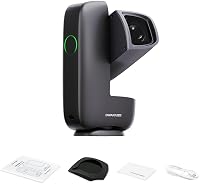
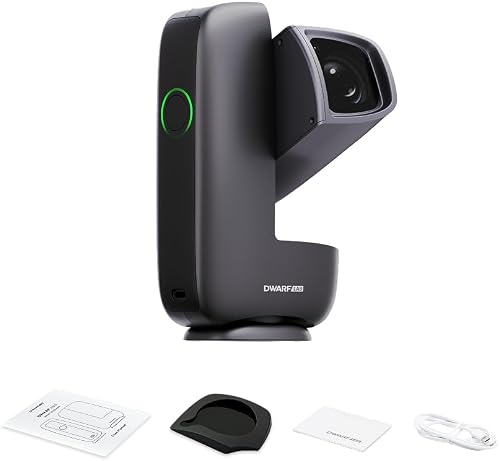
The Dwarf Mini combines app control, automated targeting, long exposures and built-in processing in a 1.85 lb body. It suits beginners who want to take deep sky images from dark-sky trips without carrying a full telescope setup.
Pros
- Very light
- Auto GOTO
- 90-second exposures
Cons
- 30 mm objective lens
- Battery powered
The DWARFLAB Dwarf Mini is the lightest imaging-focused choice here at 1.85 lb. Its 30 mm objective lens, Sony IMX662 sensor, app control and Auto GOTO make it easy to carry to a darker site and point at a faint nebula or cluster.
EQ mode supports single-frame exposures up to 90 seconds. Built-in light pollution filters, auto-stacking and cloud processing reduce the amount of separate equipment and software you need to learn.
The 150 mm focal length gives a wide view for larger deep sky targets. That wider framing suits objects that would fill or overflow a longer telescope, and it makes initial focusing and framing less demanding.
The box includes the telescope, 1 filter, a USB-C to USB-C charging cable and a cleaning cloth. Keep the lens clean and the battery charged before you leave, since the whole session depends on that small built-in system.
Choose it when portability and automation matter most. Its small objective lens means it is a different kind of tool from the larger traditional reflectors below, so set expectations around faint detail accordingly.
Celestron StarSense Explorer LT 114AZ Newtonian Smartphone: Best for guided beginner observing
- 114 mm Newtonian reflector
- Smartphone sky navigation
- Manual altazimuth mount
- 25 mm and 10 mm eyepieces
The StarSense Explorer LT 114AZ is a visual telescope with smartphone guidance for finding deep sky targets. Its 114 mm reflector can show bright nebulae, galaxies and star clusters, while the manual mount limits long-exposure imaging.
Pros
- Smartphone sky guidance
- 114 mm reflector
- Includes 2x Barlow lens
Cons
- Manual tracking
- Not an automated imaging mount
The Celestron StarSense Explorer LT 114AZ is a strong beginner option for finding and viewing deep sky objects. Its 114 mm Newtonian reflector uses a smartphone app with sky recognition to guide you toward targets such as the Orion Nebula and Andromeda Galaxy.
The manual altazimuth mount has an altitude slow-motion adjustment with a sliding rod. That helps you center objects, but it does not replace the precise motorized tracking needed for long exposures.
The telescope includes 25 mm and 10 mm eyepieces, a 2x Barlow lens, a red dot finderscope, a tripod and a smartphone dock. The 25 mm eyepiece gives a wider, easier view for locating a target, while the 10 mm and Barlow raise magnification once the object is centered.
Choose it if learning the sky and viewing come before dedicated imaging. Set it up on firm ground, check that the phone is secure in the dock, and allow time for the app to settle on your location before you start.
MEEZAA Telescope: Best for large-aperture beginner setups
- 150 mm aperture
- 650 mm focal length
- 26X to 130X magnification
- Equatorial mount and phone adapter
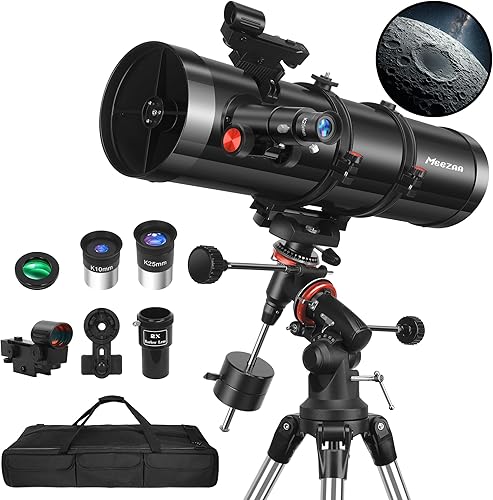
The MEEZAA 150EQ gives beginners a 150 mm reflector, manual equatorial controls and a phone adapter. It is a useful starting point for bright deep sky targets, but serious long exposures still depend on careful manual tracking.
Pros
- 150 mm aperture
- Equatorial mount
- Carry bag included
Cons
- Manual focus
- Manual tracking
The MEEZAA 150EQ gives beginners a 150 mm aperture and a 650 mm focal length. Its 26X to 130X range, equatorial mount and slow-motion controls make it useful for learning how to aim and follow targets manually.
A phone adapter supports basic camera experiments, while the 25 mm and 10 mm eyepieces, 2X Barlow lens, finderscope and moon filter cover common first steps. The carry bag helps keep the telescope tube and accessories together.
The 25 mm eyepiece is the better starting point for finding a deep sky target, because it shows more sky around the object. Move to the 10 mm or the Barlow only after the target is centered, or the view becomes harder to hold steady.
Long-exposure deep sky work will require careful alignment and tracking practice. Level the tripod, tighten the tray and slow-motion controls, and expect to nudge the mount often as the sky turns.
Celestron AstroMaster 130EQ Telescope for Deep-Sky Beginners: Best for classic beginner astronomy
- 130 mm Newtonian reflector
- German equatorial mount
- Slow-motion controls
- 20 mm and 10 mm eyepieces
The AstroMaster 130EQ pairs 130 mm optics with a German equatorial mount and slow-motion controls. It suits beginners who want to learn the sky and experiment with basic camera work around bright targets.
Pros
- 130 mm optics
- Slow-motion controls
- Adjustable tripod
Cons
- Manual tracking
- 17 lb assembled weight
The Celestron AstroMaster 130EQ combines 130 mm Newtonian optics with a German equatorial mount. Its right ascension and declination slow-motion knobs help you make small manual adjustments while observing planets and deep sky targets.
The 650 mm focal length gives a relatively wide view compared with the longer NexStar 8SE. It includes 20 mm and 10 mm eyepieces, a StarPointer red dot finderscope, a tripod and mount, and astronomy software.
The 20 mm eyepiece with its erect image corrector gives a comfortable starting view for brighter deep sky objects. It also helps with daytime or terrestrial use, while the 10 mm eyepiece is better reserved for planets and tighter targets.
At 17 lb fully assembled, it is manageable for backyard use but less convenient than a smart telescope. Pick it when you want to learn a traditional equatorial setup before moving to more specialized imaging equipment.
Set the tripod height before you polar align, and check the slow-motion knobs for smooth movement in both axes. A small vibration at this stage will follow every view and every short exposure.
For deep sky work, start with bright clusters and the Orion Nebula, where the 130 mm aperture and wide view are forgiving. Keep exposures short and adjust focus carefully, since manual tracking will limit how long you can hold a target.
ZWO Seestar S30 Pro Smart Telescope: Best for simple deep sky capture
- App control
- Auto tracking and GOTO
- 4K dual camera
- One-tap capture and processing
The Seestar S30 Pro is the easiest pick for app-controlled deep sky imaging in this group. Auto tracking, light pollution filters, one-tap processing and a 4.6 degree field of view suit wide nebulae and star clusters.
Pros
- Auto tracking
- Built-in processing
- Portable 3.6 lb design
Cons
- 30 mm objective lens
- Designed for deep sky rather than planetary observing
The ZWO Seestar S30 Pro is the easiest all-in-one choice for many deep sky beginners. Its 30 mm objective lens, 160 mm focal length, 4.6 degree field of view and app control suit wide nebulae, galaxies and star clusters.
Auto GOTO, auto tracking and one-tap capture reduce the setup burden. The telescope also includes light pollution filters, automatic mosaic stitching, AI noise reduction and processing, plus EQ mode for deep sky imaging.
The 3.6 lb body and included tripod make it practical for travel. Keep it stationary during deep sky imaging so the tracking system can work accurately.
Choose the Seestar if you want finished images with fewer separate camera and software decisions. It is designed for deep sky work rather than planetary observation, so judge it on wide deep sky framing and ease of use.
That wide field is the main advantage in daily use, since large nebulae and clusters can be framed without the tight alignment a long focal length demands. It also suits the Milky Way and star trails, where the goal is atmosphere and context rather than fine detail on a small target.
For care, protect the optics in transit, keep the battery charged before a trip and let the unit settle on a firm surface before imaging. Avoid touching the setup during a session, and give the tracking time to settle after you change targets.
Celestron NexStar 8SE Computerized Telescope: Best for large computerized optics
- 8-inch Schmidt-Cassegrain optics
- 40,000+ object database
- SkyAlign
- Computerized GoTo mount
The NexStar 8SE brings much more light-gathering power than the compact smart scopes. Its computerized GoTo mount finds and tracks targets, while the alt-azimuth design is better suited to visual observing and shorter imaging sessions than long-exposure deep sky work.
Pros
- 8-inch optics
- Automated GoTo
- 40,000+ object database
Cons
- Long 2032 mm focal length
- Alt-azimuth mount
The Celestron NexStar 8SE is the largest computerized optical system in this roundup. Its 8-inch Schmidt-Cassegrain optics gather more light than the compact smart telescopes, and the 2032 mm focal length gives a narrower view suited to smaller targets.
The computerized alt-azimuth mount uses SkyAlign and a database of more than 40,000 objects. It automatically slews to and tracks selected targets, which helps with locating and following faint objects during an observing session.
The package includes a 25 mm eyepiece, StarPointer finderscope, star diagonal, NexStar+ hand control, single fork arm mount and tripod. The long focal length makes accurate alignment especially important for imaging.
Pick the 8SE if visual deep sky observing and computerized pointing are major goals. For long-exposure astrophotography, the alt-azimuth mount has limits that a dedicated equatorial imaging mount avoids.
In practice, that long focal length means the view through the 25 mm eyepiece is already fairly magnified, so centering with the red dot finder matters before you check focus. A small alignment error is also more obvious, which is why the three-star SkyAlign routine is worth doing carefully.
Set it up on firm ground and allow the optics to reach outdoor temperature before a serious session. Keep the hand control and eyepiece stored dry, and check the tripod legs again after the first hour, since settling can shift alignment.
DWARFLAB Dwarf 3 Smart Telescope: Best for portable dual-camera imaging
- 3 lb design
- Dual imaging system
- 4K auto tracking
- AZ/EQ modes
The Dwarf 3 adds a dual-camera system to a compact smart telescope. Its telephoto lens handles deep space objects, while the wide-angle camera covers the Milky Way and star trails.
Pros
- Portable
- Auto tracking
- Built-in processing
Cons
- Small objective lens
- Altazimuth mount
The DWARFLAB Dwarf 3 is a portable smart telescope for people who want both deep sky and wide-field imaging. Its 3 lb body uses a dual-camera system, with a telephoto lens for deep space objects and a wide-angle camera for the Milky Way and star trails.
Auto tracking, 4K capture, app control and built-in processing keep the workflow simple. EQ mode adds another option when you are working on deep sky targets.
The package includes a carrying bag, magnetic filters, filter pouch, wipe cloth and USB-C cable. The bag and pouch matter in practice, because a small smart scope still needs its optics protected in transit and at the site.
Choose it over the Dwarf Mini if the second camera and broader daytime use matter to you. The telephoto side suits closer deep sky framing, while the wide-angle side is the one to plan around for the Milky Way.
Sky-Watcher Flextube 250 Dobsonian 10-inch Collapsible Large: Best for maximum visual light gathering
- 10-inch aperture
- Collapsible optical tube
- 94% reflective mirrors
- 25 mm and 10 mm eyepieces
The Flextube 250 offers the largest aperture here for visual views of faint nebulae, galaxies and clusters. Its Dobsonian mount is simple and smooth, but it does not provide the tracking needed for conventional long-exposure astrophotography.
Pros
- 10-inch aperture
- Collapsible tube
- Smooth Teflon bearings
Cons
- 42 lb
- Manual altazimuth mount
The Sky-Watcher Flextube 250 has the largest aperture in this group at 10 inches. Its 1200 mm focal length and 94% reflective mirrors can reveal more visual detail in faint nebulae, galaxies and clusters than the smaller reflectors.
The collapsible optical tube makes storage and transport easier than a fixed 10-inch tube. The Dobsonian mount uses Teflon bearings and tension control handles for smooth manual movement.
It includes 25 mm and 10 mm Plossl eyepieces, an 8x50 right-angle finder scope, a 2-inch Crayford-style focuser and a 1 1/4-inch adapter. The larger focuser gives room for wider eyepieces, while the finder scope helps you place bright targets before you switch to a higher power eyepiece.
At 42 lb, it is a substantial setup. Choose it for visual deep sky observing and large-aperture value.
It is not the right pick if your main goal is conventional long-exposure astrophotography because the mount is manual altazimuth.
SVBONY SV503 Telescope for Adults High Powered: Best for a dedicated camera-ready refractor
- 102 mm aperture
- 714 mm f/7 focal length
- S-FPL51 ED glass
- Dual-speed focuser and field rotator
The SVBONY SV503 is an optical tube for astrophotographers who already have a suitable mount and camera plan. Its ED glass, dual-speed focuser, 360 degree field rotator and 90 mm focus travel support careful camera setup.
Pros
- ED glass
- Dual-speed focuser
- 360 degree field rotator
Cons
- No finder scope
- Mount and camera planning required
The SVBONY SV503 is the most specialized camera-ready optical tube here. Its 102 mm aperture, 714 mm f/7 focal length and S-FPL51 ED glass are aimed at clear, controlled imaging with reduced color fringing.
A dual-speed focuser gives finer focus adjustment, while the 360 degree field rotator helps position a camera without rotating the tube. The 90 mm focus travel leaves room for accessories such as filter wheels and field flatteners.
The package includes a dovetail plate, tube rings, lens cover, dust cover and 2-inch to 1.25-inch adapter. There is no finder scope, and the tube uses a tripod mount, so you need to plan the camera and tracking system separately.
Pick it when you already understand the rest of an imaging setup. For a first telescope with automated capture, one of the smart scopes is simpler.
That separation is both the strength and the trade-off of this choice. You gain control over the camera, filters and framing, but you also carry the responsibility for balance, focus and tracking from the start.
The f/7 focal ratio and 714 mm focal length suit smaller nebulae, galaxies and clusters better than very wide fields. Plan your first targets around that framing, and check focus again as the temperature drops during the night.
For care, keep the retractable hood extended in use and the lens covered when stored, since dust on the objective will show in every image. The field rotator is best adjusted before you fine tune focus, so camera alignment does not undo your final focus.
What should you look for in a telescope for deep sky astrophotography?
Look first for accurate tracking, a usable field of view and a practical focusing system, then compare aperture and portability. A large mirror helps gather light, but a telescope that cannot keep a target centered will limit long exposures.
Tracking quality matters in a practical way. Even a short exposure will smear if the mount drifts, and longer exposures make small errors much more obvious.
For visual observing, slow motion controls can be enough, but imaging asks more from the mount.
Field of view is the next filter. A wide scope can frame a large nebula or the Milky Way in one view, while a long focal length crops the target and demands tighter alignment.
The right choice depends on the objects you plan to photograph most.
Focusing deserves more attention than it often gets. Deep sky images are unforgiving of soft focus, and temperature changes during the night can move the best focus point.
A dual-speed focuser, generous focus travel or reliable autofocus makes repeatable focus easier to achieve.
A smart telescope combines the optical tube, camera, tracking and processing in one system. The Dwarf Mini, Dwarf 3 and Seestar S30 Pro reduce setup decisions, which can matter more than maximum aperture for a first imaging system.
Traditional telescopes give you more control. Equatorial mounts such as those on the MEEZAA 150EQ and AstroMaster 130EQ can teach manual tracking, while a camera-ready refractor such as the SV503 leaves more choices open for the rest of the system.
Portability and care should be part of the decision too. A lighter system is easier to transport, level and protect from dew, and a scope you can set up quickly is more likely to be used on clear nights.
Check total weight, what is included in the box, and whether the mount suits the exposures you actually plan to take.
Is a dark sky needed for deep sky astrophotography?
A dark sky is helpful because city glow reduces contrast around faint nebulae and galaxies, but it is not required for every target. Light pollution filters and image stacking can improve results from brighter locations.
Bright targets such as the Moon, planets and the Orion Nebula can still work well from a city yard. Faint galaxies and weak outer nebulosity are the ones that suffer first, because city glow washes out the low contrast detail you are trying to record.
Our guide on Do You Need a Dark Sky to Use a Telescope? explains what changes between a city yard and a darker observing site. For travel, compare the compact choices in our guide to the best portable telescope for astrophotography.
Shelter matters as much as darkness. A yard or balcony with a clear view of the target can beat a darker site where the telescope is unstable or the view is blocked.
Choose a spot with firm ground and a short walk from power and storage.
Keep the telescope stable, avoid touching the setup during an exposure and allow the optics to reach the outdoor temperature before focusing. A flat surface, a clear view and calm air also help reduce blur and vibration.
Handling the gear gently also helps. Wipe optics only when needed, keep caps on when not observing, and give the mount time to settle after setup.
Small vibrations from wind, footsteps or a loose tripod leg can matter more than beginners expect.
Can you use a DSLR for deep sky astrophotography?
You can use a DSLR with a suitable telescope, but compatibility depends on the camera connection, focus travel, mount and target. A traditional optical tube may need additional accessories, while a smart telescope uses its own camera and app.
The first check is mechanical. The camera must reach focus behind the telescope, the adapter must hold it firmly, and the added weight must not overload the mount.
If any of those fail, the session will be frustrating no matter how good the optics are.
The second check is tracking. A DSLR can record a bright, short exposure handheld through a telescope in some cases, but deep sky imaging needs the sky to stay still in the frame.
That is why the mount matters as much as the camera body.
Read our guide to the best telescope for DSLR astrophotography if you already own a DSLR. For an 8-inch option, our best 8 inch telescope for astrophotography guide covers the trade-off between aperture, focal length and mount design.
If you do not yet own a camera, a smart telescope may be the simpler purchase. It removes the adapter and focus questions, and built-in processing can show you whether deep sky imaging is something you want to pursue further.
Which telescope should you choose?
Choose the DWARFLAB Dwarf Mini if you want the lightest automated option, or the ZWO Seestar S30 Pro if one-tap deep sky capture and processing matter most. Choose the Celestron NexStar 8SE for large computerized optics and visual observing.
If you want to learn a traditional setup, the MEEZAA 150EQ and AstroMaster 130EQ offer manual equatorial controls. Choose the Sky-Watcher Flextube 250 for the most visual aperture, or the SVBONY SV503 when you already have a camera and tracking plan.
Think about your first season rather than your longest wish list. If you are new to the night sky, automation and a short setup will teach you targets, framing and patience without overwhelming you.
Match the choice to the site you will use most. A balcony or small yard favors a compact smart scope, while a dark field site makes a larger reflector or computerized telescope easier to set up and level.
Match it also to the targets you care about most. Wide nebulae and the Milky Way suit the shorter smart telescopes, while smaller galaxies and tighter clusters reward longer focal lengths and larger optics.
Keep the total system in mind, not just the telescope. Batteries, tripods, adapters, storage and transport all affect whether you image on a clear night or leave the gear at home.
The best telescope for deep sky astrophotography is the one whose tracking, field of view and setup match the way you will actually use it. Protect the optics, give the mount time to settle and let the telescope reach the outdoor temperature.
Our top 3 picks at a glance
-
1
Best for pocket-sized deep sky imaging
DWARFLAB Dwarf Mini Smart Telescope
9.5/10 our score
See it on Amazon -
2
Best for guided beginner observing
Celestron StarSense Explorer LT 114AZ Newtonian Smartphone
9.5/10 our score
See it on Amazon -
3
Frequently asked questions
What is the best telescope for deep sky astrophotography?
The ZWO Seestar S30 Pro is the best telescope for deep sky astrophotography for many beginners because it combines app control, auto tracking, light pollution filtering and one-tap processing. Choose the Celestron NexStar 8SE for larger optics, or the SVBONY SV503 when you already have a camera and mount.
Is a large aperture always better for deep sky astrophotography?
A larger aperture gathers more light, which can help reveal faint targets. However, aperture alone does not provide accurate tracking.
A 10-inch Dobsonian can be excellent for visual observing, while a smaller smart telescope may produce easier deep sky images because its tracking and processing are automated.
Can a Dobsonian telescope take deep sky photos?
A Dobsonian can show deep sky objects clearly, especially when it has a large aperture such as 10 inches. Its manual altazimuth mount is not designed for conventional long exposures, so it is better suited to visual observing or short camera exposures than tracked deep sky imaging.
Do you need dark skies for deep sky astrophotography?
Dark skies make faint nebulae and galaxies easier to capture, but you can still image from a city with suitable filters and longer image integration. Smart telescopes such as the Dwarf Mini and Seestar S30 Pro include light pollution features that can help in brighter locations.
Can a beginner start with a smart telescope?
Yes. Smart telescopes are often the simplest starting point because app control, automated targeting and tracking remove much of the manual setup.
The Dwarf Mini, Dwarf 3 and Seestar S30 Pro are designed around portable, app-controlled imaging, while traditional telescopes require more decisions about mounts, cameras and focusing.