8 Best Telescopes for Kids to See Planets (October 2026)
The best telescopes for kids to see planets include the Gskyer Telescope for a first planetary scope, the Blue Marble NASA Lunar Telescope for Kids Ages for Moon-first learners, and the Koolpte Telescope for Kids for a longer focal length.
On this page (7 sections)
- Which telescopes for kids to see planets made the list?
- Best telescopes for kids to see planets
- What helps a child see planets clearly?
- How should you choose a telescope for your child?
- What can kids realistically see through these telescopes?
- How do you make the first observing night easier?
- Which telescope should you choose?
The Gskyer Telescope is the best telescope for kids to see planets for its 70 mm aperture, finder scope and two eyepieces with a 3x Barlow lens. For a child ages 8 and up who wants a Moon-first learning kit, the Blue Marble NASA Lunar Telescope offers a guide and tabletop tripod.
A telescope can show bright planets as small disks, but they won't look like the large images in books. Start with the Moon, learn how to aim and focus, then try planets when they're visible.
For help choosing a manageable setup, read how to pick a telescope for your kid.
If you’re weighing a simpler first scope, compare our guide to a good starter telescope for kids.
Our picks at a glance
-
1
-
2
 Best for Moon-first learners
Blue Marble NASA Lunar Telescope for Kids Ages
9.4/10 our score
See it on Amazon -
3

- 4
 Check it
MEEZAA Telescope for Adults & Kids
Best for a family sharing one scope - 5
 Best for tool-free setupCheck it
- 6
 Check it
Wow in the World Kids’ Telescope & Astronomy
Best for guided sky learning - 7
 Check it
Dianfan Telescope for Kids & Adults
Best for a portable 80 mm scope - 8
 Check it
Sobrzy Telescope for Kids 8-12
Best for a simple starter kit
Which telescopes for kids to see planets made the list?
The Gskyer leads this group for its combination of aperture, finder scope and eyepiece choices. Other picks serve different ages and learning styles.
We compared the optical details, aiming aids, tripod designs and beginner-focused extras.
Our score weighs specs and features against the needs of a child learning to locate and observe bright planets. A higher score means a closer fit for this roundup’s focus, not a promise of a particular view.
| Product | Best for | Aperture | Focal length | Mount | Our score |
|---|---|---|---|---|---|
| Gskyer Telescope | a first planetary scope | 70 mm | 400 mm | Altazimuth | 9.7 |
| Blue Marble NASA Lunar Telescope for Kids Ages | Moon-first learners | Equatorial | 9.4 | ||
| Koolpte Telescope for Kids | a longer focal length | 70 mm | 500 mm | Altazimuth | 9.3 |
| MEEZAA Telescope for Adults & Kids | a family sharing one scope | 80 mm | 500 mm | 8.8 | |
| Jvcla Telescope for Kids | tool-free setup | 70 mm | 300 mm | 8.7 | |
| Wow in the World Kids’ Telescope & Astronomy | guided sky learning | 8.6 | |||
| Dianfan Telescope for Kids & Adults | a portable 80 mm scope | 80 mm | 500 mm | 8.5 | |
| Sobrzy Telescope for Kids 8-12 | a simple starter kit | 50 mm | 400 mm | 8.2 |
Best telescopes for kids to see planets
These picks pair beginner-friendly aiming and controls with optics suited to the Moon and bright planets. For older beginners, compare telescopes for kids ages 10–15.
Start at low magnification, center the target, then switch eyepieces if the view remains clear.
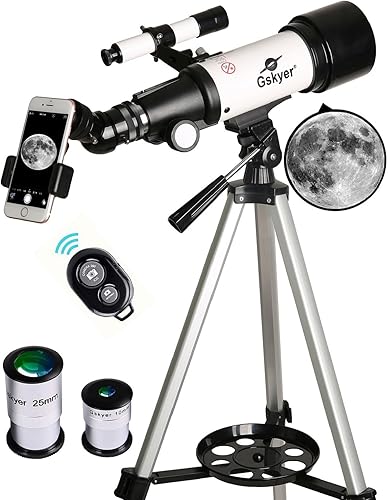
Gskyer Telescope: Best for a first planetary scope
- 70 mm aperture
- 400 mm focal length
- Two eyepieces and a 3x Barlow lens
- 5x24 finder scope
Two eyepieces and a 3x Barlow lens give beginners options for finding a planet at lower power and trying a closer view. The adjustable tripod and carry bag suit family observing sessions at home or away.
Pros
- Finder scope helps locate targets
- Adjustable tripod
- Phone adapter and wireless remote included
Cons
- High magnification can make targets harder to keep centered
- Requires careful focusing
The Gskyer is a first choice for a family that wants one scope for the Moon, bright planets and daytime viewing. Its 70 mm aperture and finder scope help a new observer gather light and aim before looking through the main eyepiece.
The two replaceable eyepieces and 3x Barlow lens provide ways to change magnification. Begin with the lower-power view to find a target, since a highly magnified view can be harder for a child to keep centered.
The adjustable aluminum tripod and carry bag make it easier to set up in different spots. A phone adapter and wireless camera remote are included for trying phone images.
Pick it for a child ready to practice aiming and focusing, with an adult nearby to help. Its manual focus requires small adjustments, so give the child time to learn what a sharp view looks like.
Blue Marble NASA Lunar Telescope for Kids Ages: Best for Moon-first learners
- Tabletop tripod
- Finder scope
- Low- and high-power eyepieces
- Learning guide
The finder scope, two eyepieces and learning guide help a child start with the Moon before trying bright planets. Its tabletop tripod and smooth mount system support simple scanning.
Pros
- Learning guide included
- Tabletop tripod
- Designed for beginners
Cons
- Moon-focused kit
- Tabletop setup needs a steady surface
The Blue Marble NASA Lunar Telescope suits a child whose first goal is the Moon, with bright planets as a next step. Its finder scope and low- and high-power eyepieces support the basic sequence of locating an object, centering it and trying a closer view.
The included tabletop tripod and smooth mount system help the child scan the lunar surface. The learning guide adds context about the Moon for a first observing session.
This telescope is designed for ages 8 and up. Set it on a steady table and help with alignment and focus while your child learns the controls.
Choose it for a guided Moon-first introduction that can lead into bright-planet viewing. Its emphasis is lunar observing, so consider another pick if a taller tripod or more adjustable observing position is a priority.
Koolpte Telescope for Kids: Best for a longer focal length
- 70 mm aperture
- 500 mm focal length
- Two eyepieces and a 3x Barlow lens
- Phone adapter and case
The 500 mm focal length and two eyepieces give a family a straightforward set of magnification choices. A finder scope helps with aiming, and the adjustable tripod and case support outdoor use.
Pros
- Finder scope included
- Adjustable aluminum tripod
- Phone adapter and wireless remote
Cons
- Manual focus takes practice
- Higher magnification is sensitive to movement
The Koolpte gives families a 70 mm refractor with a 500 mm focal length and two eyepieces. A 3x Barlow lens adds another magnification option, while the finder scope helps children locate a bright planet before viewing through the main tube.
Its adjustable aluminum tripod, phone adapter, wireless remote and carrying case make the set useful for backyard sessions and trips. The 500 mm focal length gives families another option alongside the Gskyer’s 400 mm focal length.
As with any beginner scope, start with lower power. Higher magnification may be less forgiving when the tripod shifts or a child nudges the tube.
Pick it if a carrying case and 500 mm focal length fit your plans. Expect to spend time learning the manual focus and practicing steady movement across the sky.
MEEZAA Telescope for Adults & Kids: Best for a family sharing one scope
- 80 mm aperture
- 500 mm focal length
- 20x to 150x magnification
- Adjustable tripod
The 80 mm aperture and adjustable tripod suit a family that wants adults and children to share observing. The kit includes two eyepieces, a 3x Barlow lens and a finder scope.
Pros
- Largest aperture in this group
- Tripod adjusts for different viewing heights
- Backpack and phone adapter included
Cons
- More parts to keep track of
- High magnification can be difficult for new observers
The MEEZAA is a family-sharing option with an 80 mm aperture, 500 mm focal length and an adjustable tripod. It has the largest aperture in this group, which may suit a household that wants one scope for adults and children to share.
It comes with two eyepieces, a 3x Barlow lens and a finder scope. The stated magnification range is 20x to 150x, so begin at the lower end when finding a target and use more power only when the image stays steady.
A phone adapter, waterproof backpack and colorful space stickers are also included. The tripod adjusts from 16.92 to 44.48 inches.
Choose it when several family members will take turns at the eyepiece. The kit has several pieces, so keep its eyepieces and accessories together between sessions.
Jvcla Telescope for Kids: Best for tool-free setup
- 70 mm aperture
- 300 mm focal length
- 15x to 150x magnification
- Phone adapter and wireless remote
The tool-free setup and finder scope make this a practical choice for a child who wants to help assemble and aim a scope. Its two eyepieces, erecting eyepiece and Barlow lens offer several viewing options.
Pros
- No tools required for setup
- Finder scope included
- Phone adapter and wireless remote
Cons
- Shorter focal length than several picks here
- The included magnification range takes patience to learn
The Jvcla makes setup a focus with its tool-free assembly and finder scope. Its 70 mm aperture suits a beginner’s Moon and bright-planet sessions, while two eyepieces, an erecting eyepiece and a Barlow lens provide several viewing options.
The stated magnification range runs from 15x to 150x. A child may find it easier to locate a planet at lower power before trying a closer view.
A phone adapter and wireless remote are included. The 300 mm focal length and manual focus distinguish this setup from the 500 mm models in this list.
Pick it for a child who wants to help assemble the scope. An adult can guide the first aiming and focus adjustments, then let the child practice with a bright target.
Wow in the World Kids’ Telescope & Astronomy: Best for guided sky learning
- 25x and 50x eyepieces
- Star wheel
- Illustrated observing guide
- Audio content
The star wheel and illustrated guide help young observers decide what to look for, while the audio content adds a learning activity. The 25x and 50x eyepieces keep the choices simple.
Pros
- Star wheel and guide included
- Audio content included
- Adjustable tripod
Cons
- Only two magnification choices
- The star wheel is for the Northern Hemisphere
The Wow in the World kit is the learning-focused pick here, with a star wheel, an illustrated guide and audio content. Its 25x and 50x eyepieces keep magnification choices straightforward for a young beginner.
The guide introduces the telescope and suggests objects to look for, including the Moon and planets such as Mars, Jupiter and Saturn. The star wheel helps identify stars and constellations for a date and time in the Northern Hemisphere.
Its adjustable tripod extends up to 48 inches, and the scope has a focus knob and altitude adjustment handle. The included learning materials can help children build basic observing habits.
Choose this kit for guided family learning, especially when a child enjoys using a star chart and listening to science content. Its two magnification settings offer fewer viewing choices than the other refractors here.
Dianfan Telescope for Kids & Adults: Best for a portable 80 mm scope
- 80 mm aperture
- 500 mm focal length
- 20x to 150x magnification
- Backpack and phone adapter
This 80 mm refractor pairs two eyepieces with a 3x Barlow lens for a wide choice of magnification. Its backpack, phone adapter and adjustable tripod suit families who plan to carry the scope outdoors.
Pros
- 80 mm aperture
- Backpack included
- Two reusable astronomy-themed stickers
Cons
- Higher magnification needs steady support
- Setup takes about 15 minutes
The Dianfan is an 80 mm refractor for families who want a portable setup. It combines a 500 mm focal length with two eyepieces and a 3x Barlow lens, for a stated magnification range of 20x to 150x.
A finder scope helps with aiming, while the adjustable tripod supports backyard or outdoor use. The set also includes a phone adapter, a water-resistant backpack and reusable astronomy-themed stickers.
Dianfan says setup takes about 15 minutes and includes an illustrated manual. Help children with assembly and begin at low power, since high magnification makes a planet harder to keep in view.
Pick it if the backpack and 80 mm aperture suit your family’s outings. The broad magnification range offers room to experiment, but steady support and patient aiming still matter.
Sobrzy Telescope for Kids 8-12: Best for a simple starter kit
- 50 mm aperture
- 20x to 100x magnification
- Finder scope
- Two eyepieces
The 50 mm aperture, finder scope and two eyepieces keep this kit focused on basic observing for ages 8–12. It includes an adjustable tripod and a lunar filter.
Pros
- Simple kit for beginners
- Finder scope included
- Portable for backyard sessions
Cons
- Smallest aperture in this group
- Age range is aimed at older children
The Sobrzy is a starter kit for ages 8–12, with a 50 mm aperture, finder scope and two eyepieces. It offers a stated range of 20x to 100x, plus an adjustable tripod and lunar filter.
This is the smallest aperture in the roundup, so it sits behind the larger refractors for families prioritizing aperture. Its basic set of parts may suit a child beginning with the Moon and learning how to point a telescope.
The kit also includes a 1.5x erecting eyepiece. Keep the first session simple by using one eyepiece at a time and practicing how to center a bright target.
Choose it as a basic age-targeted starter kit for a child who wants to explore astronomy. It is less suited to families seeking a larger aperture or equipment for adults and children to share.
What helps a child see planets clearly?
A child is more likely to get a useful planetary view with a stable tripod, a properly aligned finder scope and a low-power start. Magnification matters, but it cannot replace careful aiming, focus and steady air.
Set the telescope outdoors and let it adjust to the surrounding temperature before observing. Avoid looking through a closed window, since glass can blur or distort the view.
Choose a bright planet that is visible, then center it at low power before switching eyepieces. Give the child time to make small focus and aiming changes rather than turning every control at once.
Never point a telescope at or near the Sun. Looking at the Sun through a telescope can cause serious and permanent eye damage.
How should you choose a telescope for your child?
Choose by the child’s age, patience and willingness to learn the controls, then compare the tripod and included aiming aids. A complicated kit can frustrate a beginner, while a simple scope may suit a child starting with basic observing.
For ages 5–10, see our best telescopes for kids ages 5–10. To compare a working telescope with a play-focused option, read our guide to toy telescopes for kids.
A finder scope helps locate a small planet before viewing through the eyepiece. A steady tripod also matters, since a small bump can move the target out of view at higher magnification.
What can kids realistically see through these telescopes?
Kids can see the Moon’s craters and may see bright planets as small disks when the planets are visible and conditions cooperate. The view won't match colorful close-up photographs, which can rely on larger equipment or image processing.
Jupiter and Saturn are popular targets when visible, but a beginner should first learn to locate and focus on the Moon. Let children take turns making careful adjustments and describing what they see.
A telescope is for distant objects, not satellites passing overhead. For that question, read whether you can see satellites with a telescope.
For a common expectation about lunar viewing, see whether a telescope can see the flag on the Moon.
How do you make the first observing night easier?
Keep the first session short and focus on one or two bright targets. Set up before dark, practice the controls in daylight on a distant land object, and start with the lowest-power eyepiece at night.
Help the child align the finder scope before the session, since it needs to point where the telescope points. Then center the Moon or a bright planet in the finder and make small adjustments while looking through the main eyepiece.
A notebook can make observing feel like an activity: write down the target, date and a quick sketch. If your child is curious about how a scope works, try this guide to making a telescope for kids alongside observing.
Which telescope should you choose?
Choose the Gskyer for a well-rounded first planetary scope, the Blue Marble for a guided Moon-first kit, or the Wow in the World set for its star wheel and learning materials. Pick MEEZAA or Dianfan if your family wants an 80 mm aperture, and prioritize tool-free setup with Jvcla.
For a basic age-targeted kit, consider Sobrzy. Whichever you choose, begin with the Moon, practice aiming and focus, and move to bright planets when they're visible.
Our top 3 picks at a glance
-
1
-
2
Best for Moon-first learners
Blue Marble NASA Lunar Telescope for Kids Ages
9.4/10 our score
See it on Amazon -
3
Frequently asked questions
Can kids see planets through a telescope?
Yes, children can see bright planets such as Jupiter and Saturn when they are visible, though the view depends on sky conditions, focus and steady aiming. A telescope shows these planets as small objects, not as large, colorful images.
Start with the Moon, then try a bright planet at low power before switching eyepieces.
What can a child see with a beginner telescope?
A beginner telescope can show the Moon’s craters and, when visible, bright planets such as Jupiter and Saturn. What you can make out depends on the telescope, the atmosphere and how steadily the scope is set up.
A finder scope and low-power eyepiece help locate and center an object before you try more magnification.
Is higher magnification better for seeing planets?
No. Higher magnification enlarges the view but can also make a target dimmer and harder to keep centered.
Start with the lower-power eyepiece to find the planet, then try a higher-power view if the image stays clear.
A steady tripod and calm air matter as much as magnification.
What should I look for in a telescope for a child?
Look for a finder scope, a stable tripod, simple controls and eyepieces that offer both low and higher power. These features help a child locate an object before attempting a closer view.
Choose a setup the child can help manage, and plan to observe together at first.