9 Best Toy Telescopes for Kids (October 2026)
The best toy telescopes for children include the Gskyer Telescope for a first real telescope, the Blue Marble National Geographic Pirate Telescope Adventure Activity for pirate pretend play, and the Luzsco Telescope for Kids for manual space play.
On this page (5 sections)
The best toy telescopes for kids range from pretend-play spyglasses to beginner telescopes for real Moon viewing. Choose the National Geographic pirate kit for crafts and treasure hunts, the projector telescope for indoor space images, or a tripod scope if your child wants to look at the sky.
A telescope toy can mean very different things. Some are props for imaginative play; others are simple optical instruments, and a few are designed to project pictures indoors.
If your child wants to observe the Moon or planets, start with our guide to what makes a good starter telescope for kids.
For help matching a scope to age and attention span, read How Do I Pick a Telescope for My Kid? What to Know.
Our picks at a glance
-
1
-
2
 Best for pirate pretend play
Blue Marble National Geographic Pirate Telescope Adventure Activity
9.7/10 our score
See it on Amazon -
3

- 4
 Check it
Blue Marble NASA Lunar Telescope for Kids Ages
Best for Moon-focused beginners - 5
 Check it
NauticalMart 6 Inch Brass Telescope with Wooden
Best for a keepsake spyglass - 6
 Check it
Little Experimenter Projector Telescope
Best for bedroom space pictures - 7
 Check it
Aubric Retro Pirate Telescope Zoomable 25x30 Spyglass
Best for pirate play outdoors - 8
 Check it
Hawkko 80mm Aperture 500mm Telescope for Kids
Best for family sky sessions - 9
 Check it
Aubric Pirate Monocular Telescope for Kids
Best for a pocket-size prop
How we chose toy telescopes for kids
We compared the products by the activity they support, the parts included, the stated age guidance and whether they are meant for real optical viewing or pretend play. Our score weighs specs and features against what you're shopping for.
That distinction matters. A spyglass can be fun for backyard adventures without being a useful astronomy telescope, while a basic refractor can give a child a first look at the Moon with adult help.
| Product | Best for | Aperture | Focal length | Mount | Our score |
|---|---|---|---|---|---|
| Gskyer Telescope | a first real telescope | 70 mm | 400 mm | Altazimuth | 9.7 |
| Blue Marble National Geographic Pirate Telescope Adventure Activity | pirate pretend play | 9.7 | |||
| Luzsco Telescope for Kids | manual space play | 9.5 | |||
| Blue Marble NASA Lunar Telescope for Kids Ages | Moon-focused beginners | 9.4 | |||
| NauticalMart 6 Inch Brass Telescope with Wooden | a keepsake spyglass | 9.1 | |||
| Little Experimenter Projector Telescope | bedroom space pictures | 9.0 | |||
| Aubric Retro Pirate Telescope Zoomable 25x30 Spyglass | pirate play outdoors | 8.9 | |||
| Hawkko 80mm Aperture 500mm Telescope for Kids | family sky sessions | 80 mm | 500 mm | Altazimuth | 8.9 |
| Aubric Pirate Monocular Telescope for Kids | a pocket-size prop | 8.2 |
Best toy telescopes for kids by play style
The best choice depends on whether your child wants a first astronomy setup, an indoor activity or a handheld prop. These picks are ordered by their overall fit for this search, with pretend-play options clearly separated from sky-viewing telescopes.
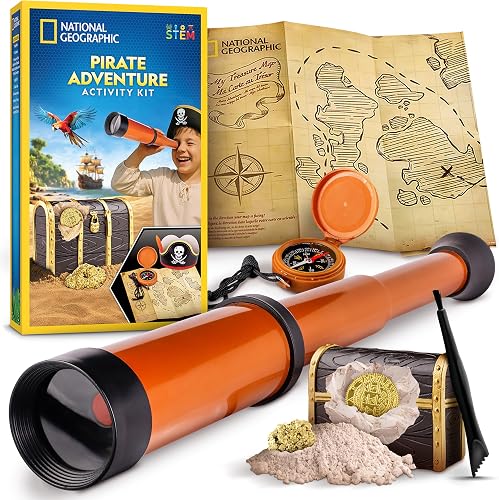
Blue Marble National Geographic Pirate Telescope Adventure Activity: Best for pirate pretend play
- Working spyglass and compass
- Treasure dig kit
- Pirate hat and map craft
- Recommended for ages 4 and up
A pretend-play kit that adds a working spyglass and compass to crafts, a treasure hunt and a learning guide.
Pros
- Several activities in one kit
- Spyglass and compass support outdoor play
- No batteries required
Cons
- Made for pretend exploration, not astronomy
- Small parts and dig activities need age-appropriate supervision
The Blue Marble National Geographic Pirate Telescope Adventure Activity kit is the top pick for pretend exploration. It pairs a working spyglass and compass with a treasure dig, pirate hat, map, stickers and a learning guide.
Kids can dig for a replica Brasher doubloon and a genuine pyrite specimen, then use the spyglass and compass during backyard play. The activities make this a fuller play set than a standalone spyglass, but it isn't an astronomy telescope for viewing the Moon or planets.
The kit is marked for ages 4 and up and doesn't require batteries. For more preschool-focused options, see telescopes for 4-year-olds.
Younger children may need help with the dig activity and small pieces.
Choose it for a pirate-themed birthday gift or a screen-free activity with several parts to explore. Pick a tripod telescope instead if your child specifically wants to study the night sky.
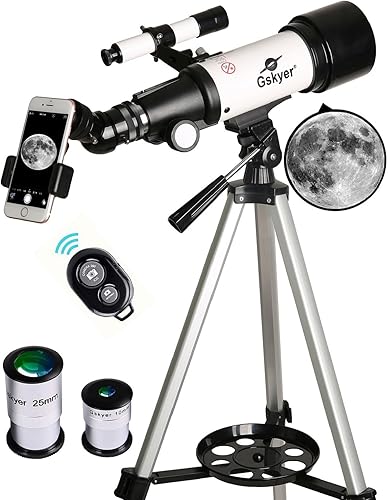
Gskyer Telescope: Best for a first real telescope
- 70 mm aperture
- 400 mm focal length
- Adjustable tripod and carry bag
- Phone adapter and wireless camera remote
A compact refractor with a tripod and beginner accessories for children ready to try real sky observing with an adult.
Pros
- Carry bag included
- Two eyepieces and a 3x Barlow lens
- Phone adapter and wireless remote
Cons
- Needs steady setup and adult help for a young child
- Never point it toward the Sun
Gskyer is a strong choice for a child ready to try an actual telescope rather than a telescope-shaped toy. Its 70 mm aperture and 400 mm focal length sit in a compact refractor format, with an adjustable tripod and carry bag for storage or travel.
The kit includes two replaceable eyepieces, a 3x Barlow lens and a 5x24 finder scope. Those accessories give a parent and child a few parts to learn, though a young beginner may need help aligning the finder and aiming the telescope.
A phone adapter and wireless camera remote add a way to capture an observation through a smartphone. Treat those as extras, not a reason to expect detailed space photos from a beginner setup.
Choose Gskyer if your child is curious about the Moon and you can help with setup and focusing. For more choices aimed at planetary observing, see telescopes for kids to see planets.
Never aim it at or near the Sun.
Luzsco Telescope for Kids: Best for manual space play
- 50 mm objective lens
- Two eyepieces and Barlow lens
- Finderscope and tripod
- Designed for ages 6–12
A child-oriented telescope kit with several parts to set up and explore, aimed mainly at Moon observation.
Pros
- Multiple accessories for setup
- Moon observation guide included
- Portable for family outings
Cons
- Distant stars and deep-sky objects need dark skies and more capable equipment
- Adult help may be useful during setup
Luzsco fits a child who likes setting up and exploring a beginner telescope kit. It includes two eyepieces, a finderscope, a Barlow lens and a tripod, along with a Moon observation guide.
The telescope is designed for children ages 6–12, and its product description focuses on lunar viewing. That makes it a better match for a first Moon session than a toy spyglass, though a parent can help with setup and focusing.
Use the included guide to keep the first activity simple: set up the scope, locate the Moon and try the eyepieces one at a time. Distant stars and deep-sky objects need very dark skies, good weather and more capable equipment.
Choose Luzsco when you want a kit centered on astronomy. For more age-specific options, see our guide to best telescopes for kids 5-10.
Blue Marble NASA Lunar Telescope for Kids Ages: Best for Moon-focused beginners
- Tabletop tripod
- Finder scope
- Low- and high-power eyepieces
- Recommended for ages 8 and up
A beginner telescope centered on locating the Moon and scanning its surface with two eyepieces and a tabletop tripod.
Pros
- Moon-focused learning guide
- Tabletop setup
- Finder scope helps locate the Moon
Cons
- Designed around lunar observing
- A steady table is needed for setup
Blue Marble's NASA Lunar Telescope is a Moon-focused option for children ages 8 and up. It comes with a tabletop tripod, finder scope and low- and high-power eyepieces, so a child can locate the Moon and scan across its surface.
A tabletop format is useful when you have a sturdy outdoor table or another stable surface. The included learning guide adds context about lunar features, giving a parent and child something to discuss while observing.
This pick is meant to introduce astronomy, not act as a general-purpose toy projector or pirate spyglass. Set it up with an adult and allow time to practice aiming before the Moon session.
Choose it when lunar observing is the main goal and you prefer a compact tabletop arrangement. If your child is older and wants a more traditional setup, compare the options in our guide to the best telescope for kids age 10-15.
NauticalMart 6 Inch Brass Telescope with Wooden: Best for a keepsake spyglass
- Brass handheld spyglass
- Wooden box
- Push-and-pull focusing
- Decorative nautical style
A small brass spyglass with a wooden box for children who enjoy nautical props, role play or a display piece.
Pros
- Compact handheld format
- Push-and-pull focus
- Wooden box included
Cons
- Not a tripod-mounted astronomy telescope
- Better suited to older children with careful handling
The NauticalMart 6-inch brass telescope suits children who enjoy nautical collectibles and role play. It is a handheld spyglass with a wooden box, and focusing uses a push-and-pull motion.
That format is easy to bring into pretend play, but it does not provide the stable tripod setup most beginners want for astronomy. Its decorative brass style may also appeal to older kids who like collecting or displaying nautical items.
Show a child how to focus on a distant daytime object before taking it outdoors. The simple handheld design takes a steady grip, and it is not a substitute for a Moon-viewing telescope.
Choose this spyglass for a keepsake or pirate-themed game. For a child who wants to see lunar craters, a tripod-mounted scope is a better fit.
Little Experimenter Projector Telescope: Best for bedroom space pictures
- Projects 24 space images
- 2x magnification
- Foldable tripod
- Activity book included
A space-themed toy that pairs simple viewing with projection discs for showing images on a bedroom wall.
Pros
- Projection adds an indoor activity
- Swivels for different viewing angles
- Activity book included
Cons
- A toy projector rather than a telescope for detailed sky observation
- Requires 3 included AG13 batteries
The Little Experimenter Projector Telescope is an indoor space toy that can project 24 images onto a bedroom wall. It has 2x magnification, a foldable tripod and an activity book.
Projection makes this a different kind of gift from a real astronomy scope. A child can swivel it to change the viewing angle, then use the discs to display pictures of planets, spacecraft and other space themes.
The toy uses 3 included AG13 batteries. Its projection feature is the main draw, so don't choose it if the goal is detailed views of the Moon through a telescope.
Choose it for a younger child who would enjoy a bedroom activity and space pictures. For an at-home craft activity instead, try how to make a telescope for kids.
Aubric Retro Pirate Telescope Zoomable 25x30 Spyglass: Best for pirate play outdoors
- Handheld spyglass and compass
- Collapsible design
- Leather case
- 25x magnification stated
A collapsible brass-style spyglass and compass for children drawn to pirate play and outdoor exploring.
Pros
- Compass adds a navigation activity
- Collapsible for storage
- Leather case included
Cons
- Handheld design is harder to keep steady than a tripod scope
- Made for terrestrial viewing and play, not sky observation
Aubric's retro spyglass pairs a collapsible handheld telescope with a compass and leather case. It is a pirate-style outdoor prop for children who want to explore the yard, go camping or play at being a captain.
The product describes 25x magnification and a 30 mm objective diameter. Those figures don't make it a stable astronomy setup: the handheld tube can be harder to aim steadily than a telescope on a tripod.
The compass gives the set a second activity, and the collapsible design makes it easier to pack away. This is a better fit for terrestrial play than for locating planets or studying the Moon.
Choose it when the pirate look and compass are part of the appeal. For actual sky observation, choose one of the tripod refractors higher on this list.
Hawkko 80mm Aperture 500mm Telescope for Kids: Best for family sky sessions
- 80 mm aperture
- 500 mm focal length
- Adjustable tripod
- Two eyepieces and 3x Barlow lens
A refractor kit with an 80 mm aperture, adjustable tripod and accessories for family Moon and daytime viewing.
Pros
- Tripod adjusts for children and adults
- Phone adapter included
- Space-themed stickers included
Cons
- Needs more setup than a simple spyglass
- Adult guidance can help a beginner use the accessories
Hawkko is a larger beginner refractor for families who want a telescope that can serve both children and adults. It has an 80 mm aperture, 500 mm focal length and adjustable tripod, with two eyepieces and a 3x Barlow lens.
A phone adapter and space-themed stickers are also included. The stickers can make setup feel personal, while the adapter gives you a way to try phone photos through the telescope.
The added accessories and adjustable tripod make this a more involved choice than a simple toy. An adult can help a new observer assemble it, aim it and learn how the eyepieces change the view.
Choose Hawkko when a family wants to share Moon viewing and daytime observation with a scope sized for both kids and adults. For a younger child who mainly wants a simple play activity, the projector or pirate kit will be easier to start with.
Aubric Pirate Monocular Telescope for Kids: Best for a pocket-size prop
- Handheld collapsible monocular
- 30 mm objective lens
- Leatherette carry bag
- 25x magnification
A pocket-size brass-style monocular for travel, games and pretend exploration when a child wants a handheld prop.
Pros
- Collapsible for storage
- Carry bag included
- Compact handheld format
Cons
- Not a stable astronomy setup
- Needs careful focusing and a steady hand
The Aubric Pirate Monocular is the most compact handheld option here. It has a 30 mm objective lens, collapsible design and carry bag, with stated 25x magnification.
A pocket-size monocular works for pretend exploring, games and distant daytime scenes. It is less suitable for astronomy because the child has to hold it steady without a tripod.
Its brass finish and small carry bag make it easy to take along on outings. Show your child how to focus and point it at a safe, stationary target before using it outdoors.
Choose this one for a simple handheld prop or travel companion. If your child is asking about stars and planets, start with a tripod telescope instead.
How do you choose between a toy and a real telescope?
Choose a pretend-play spyglass for pirate adventures, an image projector for indoor fun, and a tripod telescope for viewing the Moon. The word “telescope” appears across all three kinds of toys, but their uses are quite different.
For a child who enjoys crafts and themed play, the National Geographic kit includes more activities than a spyglass alone. A projector adds a different kind of indoor play, while a refractor gives your child a chance to learn how to aim and focus on a real object.
Consider your child's patience, too. A handheld toy is quick to pick up, while an astronomy telescope takes practice and often works best with an adult nearby.
What should a first telescope for a child include?
A first astronomy telescope should have a stable support, simple eyepieces and a clear target for the first session, such as the Moon. These features give a child a manageable way to learn aiming and focusing.
A finderscope can help locate the Moon, while a tabletop or adjustable tripod gives the telescope a steadier base. More magnification alone doesn't ensure an easier or better view, so look at the full setup and the child's interest.
Plan a short first session with an adult handling setup. Keep the telescope pointed away from the Sun at all times, even when nobody is looking through it.
Which toy telescope is right for your child?
Choose the National Geographic kit if pretend pirate play is the goal, and the Little Experimenter if wall projections sound more fun. Pick Gskyer, Luzsco or the NASA Lunar Telescope when your child is ready to learn real telescope observing with adult help.
For a compact Moon-focused setup, consider the NASA model's tabletop tripod. If your child wants an outdoor prop that fits in a bag, the Aubric spyglass options are simpler to carry, but they are not replacements for tripod-mounted astronomy scopes.
Look at our starter telescope guide for kids before buying if your child is asking to observe planets or the Moon regularly. Match the tool to the activity, and the first telescope experience will be easier to plan.
Our top 3 picks at a glance
-
1
-
2
Best for pirate pretend play
Blue Marble National Geographic Pirate Telescope Adventure Activity
9.7/10 our score
See it on Amazon -
3
Frequently asked questions
Are toy telescopes good for looking at planets?
Some toys are made for pretend play or projecting pictures and won't show planets through an astronomical telescope. For real sky viewing, choose a telescope with a tripod and optical eyepieces, then start with the Moon.
See our best telescope for kids to see planets guide for options intended for astronomy.
What is the difference between a spyglass and a kids telescope?
A spyglass is handheld and often sold for pirate or outdoor pretend play. A kids astronomy telescope usually sits on a tripod and uses eyepieces to view the Moon or other distant objects.
Pick by the activity your child wants, since the two styles serve different purposes.
What age is right for a toy telescope?
Follow the age guidance for the specific toy and consider whether your child can hold, focus or assemble it with help. The National Geographic pirate activity kit is marked for ages 4 and up, while the Luzsco telescope is designed for ages 6–12.
An adult can make real sky viewing easier for younger beginners.
Can kids use a telescope during the day?
Some beginner telescopes can be used for distant daytime scenes, and a spyglass is intended for handheld terrestrial viewing. Keep telescopes pointed away from the Sun at all times.
An adult should supervise outdoor observing.