9 Best Telescopes with Automatic Alignment (November 2026)
The best telescopes with automatic alignment include the Gskyer Telescope for simple manual setup, the DWARFLAB Dwarf Mini Smart Telescope for lightweight smart observing, and the MEEZAA Telescope for large manual optics.
On this page (5 sections)
The best telescope with automatic alignment for most first-time buyers is the ZWO Seestar S30 Pro. It gives the shortest path from opening the box to seeing something interesting on a phone screen.
Its automatic GoTo, automatic tracking and one tap imaging remove much of the searching that can put beginners off. You still need proper setup, but the routine is guided rather than guessed.
The Celestron NexStar 8SE is the stronger choice for large visual optics. If you want to look through an eyepiece at the Moon, planets and brighter deep sky objects, its bigger aperture changes the experience.
Automatic alignment helps the mount work out where it is pointed. That matters most on a first night, when star charts and manual controls can feel slow and confusing.
It does not remove the need for a level setup, clear sky or careful focus. A wobbly tripod or roofline can still spoil the session.
Smart telescopes automate more through an app and sky recognition. Computerized visual telescopes automate pointing and tracking while keeping a more traditional feel.
We compared alignment systems, optical size, control method and portability across these 9 picks. Portability mattered as much as optics, since a telescope that fits in a car boot or backpack is more likely to leave the house.
Our score weighs specs, features and buyer feedback against the brief. A high score means a good fit for this task, not for every observing style.
Products are listed from highest score to lowest. Use that order as a starting point, then check control style, size, space and patience for setup.
Our picks at a glance
-
1
-
2
 Best for lightweight smart observing
DWARFLAB Dwarf Mini Smart Telescope
9.5/10 our score
See it on Amazon -
3
- 4
 Check it
ZWO Seestar S30 Pro Smart Telescope
Best for most first-time smart users - 5
 Check it
Celestron NexStar 8SE Computerized Telescope
Best for large automated optics - 6
 Check it
Gskyer 130EQ Professional Astronomical Reflector Telescope
Best for manual equatorial learning - 7
 Check it
Celestron SkyPortal WiFi Module
Best for upgrading a Celestron mount - 8
 Check it
Sky-Watcher Heritage 150 Tabletop Dobsonian Telescope
Best for portable manual aperture - 9
 Check it
UNISTELLAR Odyssey Smart Telescope
Best for automated live stacking
Which telescope with automatic alignment is best for you?
The best choice depends on whether you want phone-based imaging, an eyepiece view or a lighter setup. Smart telescopes automate more of the process, while computerized visual telescopes usually offer larger apertures and a more traditional observing experience.
Gskyer Telescope: Best for simple manual setup
- 70mm aperture
- 400mm focal length
- 5x24 finder scope
- Phone adapter and wireless remote
This compact refractor is easy to carry and includes a phone adapter, but its alignment is manual rather than automatic.
Pros
- Portable carry-bag design
- Phone adapter included
- Adjustable aluminum tripod
Cons
- No automatic alignment
- Manual focus and pointing
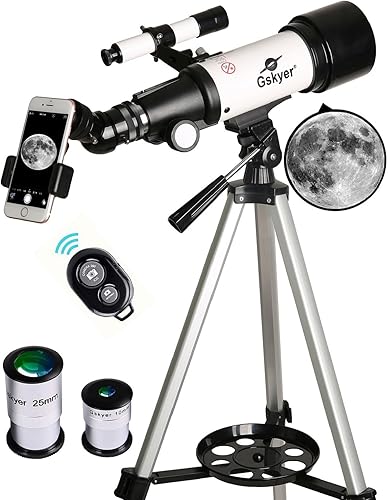
The Gskyer Telescope is the exception here because it uses manual alignment. Its 70mm aperture, 400mm focal length and altazimuth mount make it straightforward for kids and beginners learning basic pointing.
Learning to move the mount up and across teaches the sky directly. Mistakes are easy to correct with the finder.
The 5x24 finder scope helps you locate targets after roughly aiming the main tube. Crosshair lines help centre a bright object in the main eyepiece view.
Two eyepieces and a 3X Barlow lens give several viewing options. Lower power gives a wider view for finding, while higher power suits the Moon and closer detail.
The phone adapter and wireless remote help with simple smartphone images. The telescope will not find or track targets automatically, so you will keep nudging the mount as objects drift.
The adjustable aluminum tripod and carry bag support travel and storage. The telescope and tripod fit inside the bag for trips to a park or darker spot.
Setup is mostly extending and levelling the tripod and checking mount movement. Choose it if low complexity and portability matter more than automatic alignment.
DWARFLAB Dwarf Mini Smart Telescope: Best for lightweight smart observing
- 1.85 lb body
- App control
- Auto GOTO
- 360-degree pivot
- Up to 90-second exposures
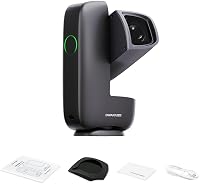
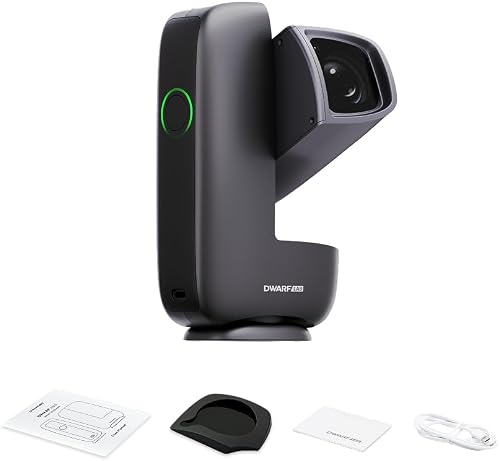
The Dwarf Mini combines app control, automatic GoTo and a 1.85 lb body for portable digital observing and imaging.
Pros
- Very light
- Auto GOTO
- Built-in processing
Cons
- Small 30mm objective lens
- Smartphone-based viewing
The DWARFLAB Dwarf Mini is the lightest smart telescope here, with a 1.85 lb body and app control. That makes it the easiest to carry on a walk or pack for a weekend away.
Select a target in the built in sky atlas, then use Auto GOTO and the 360 degree pivot to point it. The app guides the choice, so you do not need to learn star patterns first.
Its 30mm objective lens and 150mm focal length suit digital observing rather than an eyepiece session. You watch on a phone screen while the small optics collect light for the sensor.
The app supports Equatorial mode for more advanced tracking. That can help with longer exposures, but it still needs a stable position and clear view.
Built in light pollution filters help from a town or lit campsite. They will not remove all city glow, yet they can improve contrast for nebulae and clusters.
Single frame exposures up to 90 seconds let the system gather faint detail over time. Shorter exposures are simpler for the Moon or bright targets and reduce star trails.
The kit includes a filter, USB-C to USB-C charging cable and cleaning cloth. Choose it for hiking, camping or travel when a full size tube would be inconvenient.
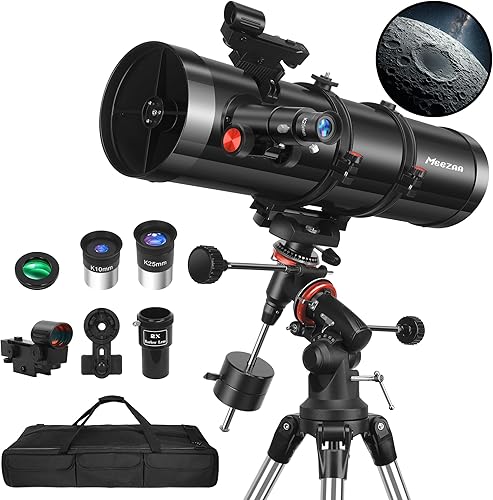
MEEZAA Telescope: Best for large manual optics
- 150mm aperture
- 650mm focal length
- Equatorial mount
- 26X to 130X magnification
The MEEZAA offers a large aperture and manual equatorial tracking, making it useful for buyers who want more light gathering than app control.
Pros
- 150mm aperture
- Slow-motion controls
- Carry bag included
Cons
- No automatic alignment
- Manual setup
The MEEZAA Telescope is a manual alternative for buyers who want 150mm aperture and an equatorial mount. That combination gives you more light gathering than a small beginner refractor or a compact smart scope.
The two eyepieces and 2X Barlow lens cover magnification from 26X to 130X. Lower power helps you find objects, while higher power is better for lunar detail and planet views on steady nights.
A red dot finderscope helps you aim the main tube at a bright target. It is quicker for many beginners than a small finder with a narrow view.
A moon filter helps reduce glare during lunar viewing. That can make bright phases more comfortable and help surface detail stand out.
The phone adapter supports simple phone based recording. You can share a view with family, though the mount still needs manual control during the session.
This model does not automate alignment or target finding. You will learn to set up the equatorial mount and move it along the sky yourself.
Slow motion controls can make fine adjustments smoother once you find a target. Patience helps, especially at higher magnification when small movements shift the view.
The sturdy tripod and carry bag make storage and transport more manageable. Check the ground is firm before you tighten the legs and mount.
Choose it when light gathering and manual tracking matter more than pressing a button to locate an object. It suits a learner who wants a larger reflector without electronics.
ZWO Seestar S30 Pro Smart Telescope: Best for most first-time smart users
- Automatic GoTo and tracking
- App control
- 4K dual camera
- Built-in light pollution filters
The Seestar S30 Pro handles targeting, tracking and one-tap imaging through an app, with a compact 3.64 lb design.
Pros
- Automatic targeting
- One-tap capture
- Portable tripod kit
Cons
- Not intended for planetary observation
- Smartphone or tablet required
The ZWO Seestar S30 Pro is the strongest all around smart choice because it combines automatic GoTo, automatic tracking and app control in a 3.64 lb telescope. You can view through a smartphone or tablet instead of using a traditional eyepiece.
That design makes it welcoming for first time users. Power on, connect the app, choose a target and the system handles pointing and following.
Its 30mm objective lens and 160mm focal length support deep sky and wide field imaging. The short focal length gives a broad view that suits large nebulae, clusters and sky landscapes.
Built in light pollution filters help in brighter urban environments. They improve colour and contrast, though a darker site will still give cleaner results.
AI noise reduction and automatic mosaic stitching are aimed at quick image creation. They help the app build a usable picture without manual editing.
The one tap modes cover the Milky Way, star trails, nebulae and galaxies. That range makes it easy to try different subjects on the same night.
ZWO says this model is not intended for planetary observation. Planets need a different optical approach, so choose a visual telescope or a larger planetary setup for that goal.
Keep it stationary during deep sky imaging so the tracking system can work accurately. Bumps to the tripod or a loose surface can ruin a long capture.
The compact tripod kit makes it travel friendly for camping and trips. Charge the battery before you go and protect the optics from dew and dust.
Celestron NexStar 8SE Computerized Telescope: Best for large automated optics
- 8-inch Schmidt-Cassegrain optics
- SkyAlign
- 40,000+ object database
- Computerized GoTo mount
The NexStar 8SE pairs large optics with computerized GoTo and SkyAlign, giving you a stronger visual setup with more alignment hardware.
Pros
- Large 8-inch aperture
- SkyAlign technology
- Hand control included
Cons
- Heavier than smart scopes
- Requires centering three bright stars or planets
The Celestron NexStar 8SE is the best pick when you want large visual optics with computerized alignment. Its 8 inch Schmidt Cassegrain system gathers more light than the compact smart telescopes, while the computerized altazimuth mount handles GoTo movement and tracking.
SkyAlign asks you to centre any three bright stars or planets. The mount then calculates its position, which is quicker than learning a full manual alignment routine.
The NexStar+ hand control can select from a database of more than 40,000 objects. That makes it easy to jump from the Moon to a galaxy without hunting with a finder.
The package includes a 25mm eyepiece, star diagonal, StarPointer red dot finderscope, tripod and single fork arm mount. You have the basics for visual observing straight away.
Celestron also lists compatibility with laptops, desktops, smartphones and GPS devices. That gives you room to add control and location accessories as your skills grow.
The 2032mm focal length gives high magnification for planets and the Moon. It also means the view is narrower, so good alignment and finding help a lot.
This is a heavier and larger setup than the smart scopes here. It needs space to store and a firm patch of ground to set up on.
If you want a traditional GoTo experience, compare this model with our guide to the best go to telescope. For wireless control, the Celestron SkyPortal WiFi Module can be considered where compatibility fits.
Gskyer 130EQ Professional Astronomical Reflector Telescope: Best for manual equatorial learning
- 130mm aperture
- 650mm focal length
- German EQ mount
- Wireless camera remote
This 130mm reflector teaches manual equatorial tracking while adding a wireless remote for smartphone photos.
Pros
- 130mm aperture
- German EQ mount
- Three eyepieces and 3X Barlow lens
Cons
- No automatic alignment
- 30.1 lb listed weight
The Gskyer 130EQ is a manual equatorial reflector with a 130mm aperture and 650mm focal length. Its German EQ mount can help you learn how celestial objects move across the sky, but it does not provide automatic alignment.
That learning curve is the point for some buyers. Setting up an equatorial mount teaches you about polar alignment and tracking in a way a GoTo system hides.
The included eyepieces, 3X Barlow lens and finderscope give you several ways to start observing. Start with the lowest power to find a target, then increase magnification slowly.
A wireless remote can pair with an iPhone or Android device for basic photos and videos. It is a simple way to share a view without holding the phone to the eyepiece.
The 130mm aperture gathers enough light for the Moon, planets and brighter deep sky targets. Expect better detail than a small refractor, but views still depend on sky darkness and seeing.
Manual focus and manual tracking need regular attention. As the Earth rotates, you nudge the mount to keep the target centred.
At 30.1 lb, this is a heavier choice than the portable smart scopes. You will want a clear space in a garden or a car boot for transport.
Pick it when you want a larger reflector and manual equatorial practice, and have a suitable place to set it up. It suits a patient learner who enjoys the process.
Celestron SkyPortal WiFi Module: Best for upgrading a Celestron mount
- Wireless smartphone control
- SkyPortal app
- 100,000+ object database
- No external power required
This accessory adds wireless phone control to compatible Celestron computerized telescopes, but it is not a telescope by itself.
Pros
- Phone-based control
- Sky Tour feature
- No external power required
Cons
- Requires a compatible Celestron telescope
- Does not replace the telescope mount
The Celestron SkyPortal WiFi Module is an upgrade for compatible Celestron computerized telescopes, not a complete telescope. It lets an iOS or Android smartphone or tablet control the telescope through the SkyPortal app.
You plug the module into the telescope hand control or AUX port. Your phone then becomes a wireless hand control for alignment and GoTo movement.
The app can guide alignment, identify objects and send the mount to a selected target. Tap an object on screen and the telescope slews to centre it in the eyepiece.
Its database contains more than 100,000 objects. That wide catalogue covers planets, star clusters, nebulae and galaxies for long evening sessions.
The Sky Tour feature creates a viewing list based on your time and location. That helps when you are unsure what to look at next.
Audio descriptions cover hundreds of popular objects. They add history and context while you observe, which can be useful for family groups.
This module works with current Celestron computerized telescopes and select older models. Check your mount compatibility before choosing it, as it cannot upgrade a manual mount.
It does not need external power. That makes it simple to keep in a case with your other accessories.
Sky-Watcher Heritage 150 Tabletop Dobsonian Telescope: Best for portable manual aperture
- 150mm aperture
- 750mm focal length
- Collapsible tube
- Tabletop altazimuth mount
The Heritage 150 gives you 150mm aperture in a collapsible manual design, so it suits viewers who value light gathering over automated alignment.
Pros
- Large 150mm mirror
- Collapsible tube
- Rubber feet for stability
Cons
- Manual pointing
- Needs a stable table
The Sky-Watcher Heritage 150 is a portable manual telescope with 150mm aperture. Its collapsible tube reduces storage space, while the tabletop altazimuth mount keeps the design simple.
That mix suits people who want aperture without a full tripod setup. You can place it on a sturdy table at home or take it to a dark site.
The 750mm focal length and borosilicate parabolic primary mirror suit lunar and planetary viewing as well as brighter deep sky targets. The fast focal ratio gives a relatively wide view for a telescope of this size.
Rubber feet help reduce vibration, but the telescope still needs a stable table. A wobbly surface will make high magnification views shake.
The 1.25 inch helical focuser is simple to use. Focus changes smoothly, which helps when you swap between eyepieces.
Collapsing the tube helps with storage and transport. It also keeps the setup less intimidating for someone with limited space.
There is no automatic alignment or motorized tracking. You will need to find targets and follow them by hand.
Choose this model if you prefer a large manual reflector and want fewer electronic parts to manage. It suits a visual observer who values simplicity and portability.
UNISTELLAR Odyssey Smart Telescope: Best for automated live stacking
- 85mm optics
- Stellar Autofocus
- Smart Star Finder
- Live image stacking
The Odyssey automates focus, sky recognition and target finding, then builds images through live stacking in its app.
Pros
- Automatic target tracking
- No polar alignment
- Tripod included
Cons
- No eyepiece
- Requires compatible phone or tablet
The UNISTELLAR Odyssey automates focus, sky recognition and target finding through Stellar Autofocus and Smart Star Finder. Its 85mm optics, motorized tracking and live image stacking support both planetary and deep sky viewing.
That automation suits someone who wants to spend more time watching than adjusting. The system identifies the sky and keeps the target in view for you.
You control the telescope through the UNISTELLAR app on a compatible phone or tablet. Android 10 or iOS 18 or later is required, so check your device before you buy.
The telescope uses Wi Fi after the app is downloaded, so an internet connection is not required during observing. That is useful at a remote dark site with no signal.
Images build during observation through live stacking. Results depend on the target, sky conditions and how long you spend collecting light.
The kit includes the telescope, tripod, dust cap, charging cable and adjustment tools. The dust cap helps protect the optics when the telescope is stored.
With up to 5 hours of rechargeable battery use, it suits longer sessions. Battery life varies with temperature and use, so cold nights may shorten the time.
There is no eyepiece, so viewing is through the app screen. That makes sharing easy, but it is a different feel from looking through an eyepiece.
How automatic alignment changes setup
Automatic alignment mainly reduces the work of finding position and locating targets. It does not make every setup instant, because the mount still needs a firm base and clear sky.
Think of it as help with orientation rather than a replacement for setup. The telescope still has to be level, stable and pointed at open sky.
A computerized model such as the NexStar 8SE uses a hand control and SkyAlign. You centre three bright objects and the mount works out the rest.
Smart models such as the Seestar S30 Pro and Dwarf Mini use an app, sky maps and automated routines. You pick an object and the system points and tracks.
The UNISTELLAR Odyssey combines Smart Star Finder, Stellar Autofocus and motorized tracking. That suits someone who wants the telescope to handle more of the early setup.
Each system has limits. A blocked view, loose tripod or bright horizon can stop alignment working well.
Manual models still have a place. The MEEZAA, Gskyer 130EQ and Heritage 150 let you learn the sky and control viewing directly.
That direct control can build skill faster for some people. You learn star patterns, mount movement and focus by doing.
The trade off is time and patience. Manual finding is slower, especially for faint deep sky objects.
Choose the level of automation that matches your patience and goals. Let the system help, but keep the basics of setup in mind.
Smart telescope or computerized telescope?
Choose a smart telescope if your main goal is phone based viewing and imaging. The Seestar S30 Pro, Dwarf Mini and Odyssey build the experience around an app rather than an eyepiece.
That approach works well for sharing with friends and family. Everyone can look at the same screen and watch an image build.
Choose a computerized telescope if you want larger traditional optics. The NexStar 8SE gives you an 8 inch Schmidt Cassegrain system, a hand control and an eyepiece based viewing setup.
That feel is more direct for visual observing. You look through the eyepiece and control the mount separately.
A smart telescope may be easier to share because several people can view the screen. A traditional telescope may feel more personal for one observer at a time.
Smart scopes use smaller optics and rely on sensors and processing. Computerized visual scopes use larger optics and rely on your eye at the eyepiece.
Neither style is better for every target. Smart scopes shine for quick deep sky images, while larger visual optics can show fine lunar and planetary detail.
For a broader comparison of tracking systems, see our guide to the best telescope with auto tracking. If laptop control matters, our guide to the best telescopes that connect to laptop covers that use case.
Consider where you observe most often. A compact smart scope suits travel, while a larger computerized setup suits a fixed garden spot.
How to set up an automatically aligned telescope
Start by placing the tripod or base on firm, level ground. Tighten the adjustment points, attach the optical tube or smart unit, and give the system a clear view of the sky.
Avoid soft grass, loose decking or a slope if you can. A firm base keeps the view steady and helps alignment stay accurate.
Follow the app or hand control alignment prompts. Centre targets carefully when asked, and avoid moving the mount once alignment begins.
If the system asks for bright stars, choose ones that are well clear of buildings and trees. A clear patch of sky gives it more to work with.
For smart imaging, keep the telescope stationary during the exposure or stacking session. Even small bumps can spoil the final image.
City light can affect results, so use built in light pollution filters where the model includes them and choose a darker location when practical. A short drive can make a real difference.
Protect the optical surfaces from dust and moisture. Use the dust cap or cover when the telescope is not in use.
Let a cold telescope reach the outdoor temperature before extended use. That reduces focus drift and dew on the optics.
Keep eyepieces and finder lenses clean with a soft cloth. Small marks can scatter light and reduce contrast.
Never point any telescope at the Sun unless the exact setup is designed and safely filtered for solar viewing. Unfiltered sunlight can cause serious eye damage.
Which automatic alignment telescope should you buy?
The ZWO Seestar S30 Pro is the best overall choice for simple app controlled alignment, tracking and imaging. It suits first time buyers who want guided setup and quick results on a phone or tablet.
Pick the DWARFLAB Dwarf Mini when low weight is the deciding factor. Its 1.85 lb body makes it the easiest smart telescope here to carry for travel and camping.
Pick the Celestron NexStar 8SE when larger visual optics matter most. Its 8 inch Schmidt Cassegrain system and SkyAlign suit a traditional eyepiece experience with computerized GoTo.
Choose the UNISTELLAR Odyssey if automated focus and live stacking are central to your plans. Stellar Autofocus and Smart Star Finder handle much of the early work for you.
If you prefer to learn manual observing, the MEEZAA, Gskyer 130EQ or Sky-Watcher Heritage 150 offers more direct control. Those models reward patience and build sky knowledge.
Think about where you will observe before you decide. A compact smart scope fits a car trip, while a larger computerized telescope needs storage space and a stable site.
Also consider how you like to view. App screens are social and easy to share, while an eyepiece feels more direct and personal.
For satellite observing after your setup is ready, continue with our guide to the best telescopes for spotting satellites in orbit. That guide covers fast moving targets that need a different approach.
Gskyer Telescope: Best for simple manual setup
- 70mm aperture
- 400mm focal length
- 5x24 finder scope
- Phone adapter and wireless remote
This compact refractor is easy to carry and includes a phone adapter, but its alignment is manual rather than automatic.
Pros
- Portable carry-bag design
- Phone adapter included
- Adjustable aluminum tripod
Cons
- No automatic alignment
- Manual focus and pointing
DWARFLAB Dwarf Mini Smart Telescope: Best for lightweight smart observing
- 1.85 lb body
- App control
- Auto GOTO
- 360-degree pivot
- Up to 90-second exposures
The Dwarf Mini combines app control, automatic GoTo and a 1.85 lb body for portable digital observing and imaging.
Pros
- Very light
- Auto GOTO
- Built-in processing
Cons
- Small 30mm objective lens
- Smartphone-based viewing
MEEZAA Telescope: Best for large manual optics
- 150mm aperture
- 650mm focal length
- Equatorial mount
- 26X to 130X magnification
The MEEZAA offers a large aperture and manual equatorial tracking, making it useful for buyers who want more light gathering than app control.
Pros
- 150mm aperture
- Slow-motion controls
- Carry bag included
Cons
- No automatic alignment
- Manual setup
ZWO Seestar S30 Pro Smart Telescope: Best for most first-time smart users
- Automatic GoTo and tracking
- App control
- 4K dual camera
- Built-in light pollution filters
The Seestar S30 Pro handles targeting, tracking and one-tap imaging through an app, with a compact 3.64 lb design.
Pros
- Automatic targeting
- One-tap capture
- Portable tripod kit
Cons
- Not intended for planetary observation
- Smartphone or tablet required
Celestron NexStar 8SE Computerized Telescope: Best for large automated optics
- 8-inch Schmidt-Cassegrain optics
- SkyAlign
- 40,000+ object database
- Computerized GoTo mount
The NexStar 8SE pairs large optics with computerized GoTo and SkyAlign, giving you a stronger visual setup with more alignment hardware.
Pros
- Large 8-inch aperture
- SkyAlign technology
- Hand control included
Cons
- Heavier than smart scopes
- Requires centering three bright stars or planets
Gskyer 130EQ Professional Astronomical Reflector Telescope: Best for manual equatorial learning
- 130mm aperture
- 650mm focal length
- German EQ mount
- Wireless camera remote
This 130mm reflector teaches manual equatorial tracking while adding a wireless remote for smartphone photos.
Pros
- 130mm aperture
- German EQ mount
- Three eyepieces and 3X Barlow lens
Cons
- No automatic alignment
- 30.1 lb listed weight
Celestron SkyPortal WiFi Module: Best for upgrading a Celestron mount
- Wireless smartphone control
- SkyPortal app
- 100,000+ object database
- No external power required
This accessory adds wireless phone control to compatible Celestron computerized telescopes, but it is not a telescope by itself.
Pros
- Phone-based control
- Sky Tour feature
- No external power required
Cons
- Requires a compatible Celestron telescope
- Does not replace the telescope mount
Sky-Watcher Heritage 150 Tabletop Dobsonian Telescope: Best for portable manual aperture
- 150mm aperture
- 750mm focal length
- Collapsible tube
- Tabletop altazimuth mount
The Heritage 150 gives you 150mm aperture in a collapsible manual design, so it suits viewers who value light gathering over automated alignment.
Pros
- Large 150mm mirror
- Collapsible tube
- Rubber feet for stability
Cons
- Manual pointing
- Needs a stable table
UNISTELLAR Odyssey Smart Telescope: Best for automated live stacking
- 85mm optics
- Stellar Autofocus
- Smart Star Finder
- Live image stacking
The Odyssey automates focus, sky recognition and target finding, then builds images through live stacking in its app.
Pros
- Automatic target tracking
- No polar alignment
- Tripod included
Cons
- No eyepiece
- Requires compatible phone or tablet
| Product | Best for | Optical design | Aperture | Mount | Our score |
|---|---|---|---|---|---|
| Gskyer Telescope | simple manual setup | Refractor | 70mm | Altazimuth | 9.7 |
| DWARFLAB Dwarf Mini Smart Telescope | lightweight smart observing | 9.5 | |||
| MEEZAA Telescope | large manual optics | Newtonian reflector | 150mm | Equatorial | 9.4 |
| ZWO Seestar S30 Pro Smart Telescope | most first-time smart users | 9.3 | |||
| Celestron NexStar 8SE Computerized Telescope | large automated optics | Schmidt-Cassegrain | 8 inches | 9.3 | |
| Gskyer 130EQ Professional Astronomical Reflector Telescope | manual equatorial learning | Reflector | 130mm | Equatorial | 9.2 |
| Celestron SkyPortal WiFi Module | upgrading a Celestron mount | 9.1 | |||
| Sky-Watcher Heritage 150 Tabletop Dobsonian Telescope | portable manual aperture | Reflector | 150mm | Manual altazimuth | 8.5 |
| UNISTELLAR Odyssey Smart Telescope | automated live stacking | Smart telescope | 85mm | 8.3 |
Our top 3 picks at a glance
-
1
-
2
Best for lightweight smart observing
DWARFLAB Dwarf Mini Smart Telescope
9.5/10 our score
See it on Amazon -
3
Frequently asked questions
What is the best telescope with automatic alignment for beginners?
The ZWO Seestar S30 Pro is the best telescope with automatic alignment for many beginners because it combines app control, automatic GoTo targeting, tracking and one-tap imaging. The DWARFLAB Dwarf Mini is lighter, while the Celestron NexStar 8SE offers larger 8-inch optics and a computerized SkyAlign mount.
What does automatic alignment do on a telescope?
Automatic alignment helps a computerized telescope determine its position so the mount can find selected objects. The process still needs a clear view of the sky and correct setup.
Celestron SkyAlign uses three bright stars or planets, while smart telescopes use app-guided sky recognition and automated target finding.
Is a smart telescope the same as a GoTo telescope?
Both can find and track celestial targets, but they are designed around different viewing styles. A GoTo telescope such as the Celestron NexStar 8SE normally uses an eyepiece and hand control.
Smart telescopes send live or processed images to a phone or tablet instead.
Can automatic alignment replace a stable tripod?
No. Automatic alignment can reduce pointing work, but the telescope still needs a stable base.
Set the tripod or mount on firm ground, tighten the adjustment points, and keep the optical tube still during alignment.
Smart imaging models also need to remain stationary for accurate tracking.