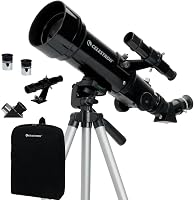
9 Best Telescopes for Spotting Satellites in Orbit (October 2026)
The best telescopes for spotting satellites in orbit include the Gskyer Telescope for a light manual setup, the MEEZAA Telescope for a larger manual refractor, and the DWARFLAB Dwarf Mini Smart Telescope for app-guided target finding.
On this page (7 sections)
- Which telescopes work best for spotting satellites in orbit?
- Manual telescopes for following a moving satellite
- Smart telescopes for app-based satellite observing
- Is a monocular a practical satellite-viewing option?
- How do you choose a telescope for spotting satellites?
- How can you make a satellite pass easier to follow?
- Which telescope should you pick for satellite spotting?
The best telescopes for spotting satellites in orbit are wide-field scopes that are easy to aim by hand. Satellites move across the sky quickly, so a simple mount and low magnification can matter more than high power.
Smart scopes may help locate targets, but you should confirm they support satellite tracking.
This roundup compares manual refractors, a handheld monocular and app-controlled imaging scopes. For a quick overview of what to expect in the eyepiece, see can you see satellites with a telescope?.
Our picks at a glance
-
1
-
2

-
3
 Best for app-guided target finding
DWARFLAB Dwarf Mini Smart Telescope
9.5/10 our score
See it on Amazon
- 4
 Check it
ZWO Seestar S30 Pro Smart Telescope
Best for automated imaging - 5
 Check it
Pankoo 12x60 HD Monocular Telescope for Adults
Best for handheld wide-field viewing - 6
 Check it
DWARFLAB Dwarf 3 Smart Telescope
Best for portable smart imaging - 7
 Check it
Fuoibl Telescope for Kids and Adults
Best for learning manual aiming - 8
 Check it
MEEZAA Telescope for Adults & Kids
Best for family observing - 9
 Best for beginner practiceCheck it
Which telescopes work best for spotting satellites in orbit?
A manual telescope with a short focal length is often the easiest place to start, while smart models suit people who want app-based imaging and automated positioning. No included product confirms satellite-specific tracking, so treat automatic tracking as a general feature until you verify its target support.
We compared the stated focal lengths, mounts, fields of view, finder scopes and control features against the needs of a moving target. Our score weighs specs, features and buyer feedback against what you're shopping for.
| Product | Best for | Aperture | Focal length | Mount | Our score |
|---|---|---|---|---|---|
| Gskyer Telescope | a light manual setup | 70mm | 400mm | Altazimuth | 9.7 |
| MEEZAA Telescope | a larger manual refractor | 90mm | 800mm | Altazimuth | 9.6 |
| DWARFLAB Dwarf Mini Smart Telescope | app-guided target finding | 150mm | Altazimuth and equatorial | 9.5 | |
| ZWO Seestar S30 Pro Smart Telescope | automated imaging | 160mm | Alt-azimuth; supports equatorial mode | 9.3 | |
| Pankoo 12x60 HD Monocular Telescope for Adults | handheld wide-field viewing | 9.2 | |||
| DWARFLAB Dwarf 3 Smart Telescope | portable smart imaging | Altazimuth | 9.1 | ||
| Fuoibl Telescope for Kids and Adults | learning manual aiming | 70mm | 300mm | Altazimuth | 8.9 |
| MEEZAA Telescope for Adults & Kids | family observing | 80mm | 500mm | Altazimuth | 8.8 |
| Jvcla Telescope for Kids | beginner practice | 70mm | 300mm | Altazimuth | 8.7 |
Manual telescopes for following a moving satellite
Manual scopes let you steer the tube directly, which can be useful when a pass does not match a smart scope's supported target list. Start at low magnification, then guide the mount along the satellite's path.
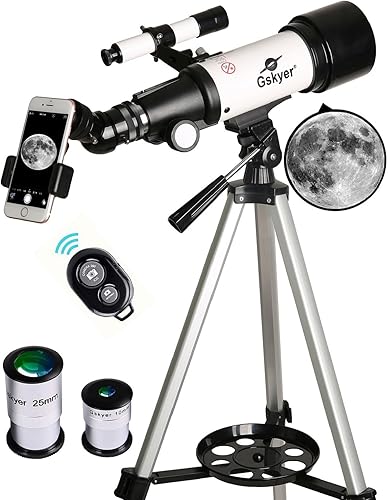
Gskyer Telescope: Best for a light manual setup
- 70mm aperture
- 400mm focal length
- Altazimuth mount
- 5x24 finder scope
Its short 400mm focal length and finder scope suit broad, manual sweeps across the sky. The altazimuth mount lets you move the tube up, down and side to side.
Pros
- Compact refractor
- Finder scope included
- Carry bag included
Cons
- Manual aiming takes practice
- No satellite tracking feature specified
The Gskyer Telescope earns the top spot for a straightforward manual setup. Its 400mm focal length is shorter than those of the other refractors here, and the 5x24 finder scope gives you a separate way to line up the tube before looking through the eyepiece.
The altazimuth mount moves up, down and side to side. You may need to make quick, repeated corrections as a satellite crosses the sky.
It comes with two eyepieces and a 3x Barlow lens. Start with the 25mm eyepiece for a broader view than the 10mm eyepiece provides.
Choose this if you want a compact refractor for learning manual aiming. It also comes with a carry bag, phone adapter and wireless camera remote.
MEEZAA Telescope: Best for a larger manual refractor
- 90mm aperture
- 800mm focal length
- Altazimuth mount
- Straight-through finder scope
The 90mm aperture gathers light, while its manual altazimuth mount keeps aiming straightforward. Its longer tube gives a narrower view than shorter focal-length options with similar eyepieces.
Pros
- Largest aperture among the manual refractors here
- Finder scope included
- Carry bag included
Cons
- Manual tracking takes practice
- Longer focal length means a narrower field
The MEEZAA Telescope is the manual refractor choice with the largest stated aperture here, at 90mm. Its 800mm focal length and two eyepieces give you options for other observing, but a longer focal length narrows the view compared with a shorter scope using a similar eyepiece.
Its altazimuth mount lets you follow a moving object by hand. The straight-through finder scope helps you point toward the path, while the included 10mm and 25mm eyepieces let you begin with the broader view.
A 3x Barlow lens is included, but adding magnification makes a fast-moving target harder to keep inside the eyepiece. Save it for other observing rather than your first attempt at following a pass.
Choose this model if you also want a larger-aperture refractor for general night-sky viewing. Its tripod adjusts from 28 to 46 in, and the accessories fit in a carry bag.
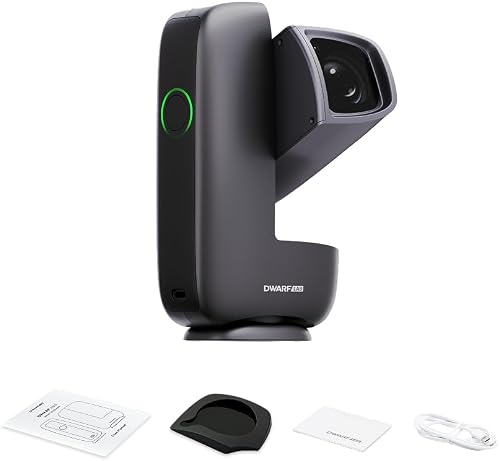
DWARFLAB Dwarf Mini Smart Telescope: Best for app-guided target finding
- App control
- Auto GOTO
- 360° pivot
- 150mm focal length
App control, Auto GOTO and a 360° pivot can make it easier to point toward a selected target. Its automated features are for positioning and imaging, so confirm satellite support before relying on it to follow a pass.
Pros
- App includes an interactive star map
- Auto GOTO and 360° pivot
- Compact, lightweight design
Cons
- No satellite-specific tracking support stated
- Image capture is central to its design
The DWARFLAB Dwarf Mini Smart Telescope weighs 1.85 lb and is built for app-controlled imaging. It includes an interactive star map, Auto GOTO and a 360° pivot for selecting and pointing toward supported targets.
Its stated focal length is 150mm, and the device uses app control and processing features for imaging. It does not use a traditional eyepiece-first observing routine.
The Dwarf Mini offers an equatorial mode and supports single-frame exposures up to 90 seconds. These features do not confirm that it can follow a satellite during a pass.
Choose it if you value portability and app-guided target selection for supported astronomy targets. Confirm whether its software handles satellites as moving targets.
ZWO Seestar S30 Pro Smart Telescope: Best for automated imaging
- App-controlled
- Automatic GOTO and tracking
- 160mm focal length
- Smartphone and tablet compatible
Automatic GOTO and tracking help with supported imaging targets. The scope is designed for astrophotography, so verify that satellite targets are supported before choosing it for visual pass following.
Pros
- Automatic GOTO and tracking
- App works with smartphones and tablets
- Portable design
Cons
- Designed for imaging rather than planetary observation
- Satellite-specific support is not stated
The ZWO Seestar S30 Pro offers automatic GOTO and tracking for supported astrophotography targets. Its 160mm focal length and app control fit a compact imaging workflow, with smartphone or tablet compatibility.
It has imaging modes for deep-sky objects, the Moon and the Sun, along with automatic image processing. The telescope is designed for deep-sky objects and is not intended for planetary observation.
Satellite tracking support is not specified.
The compact format can be convenient if you want an automated imaging scope to carry outdoors. For satellite viewing, check whether the app can track a pass rather than simply point to a fixed coordinate.
Choose it for app-guided astrophotography first, and consider satellite observing a secondary use after checking support. Readers comparing automated options can also look at a telescope with auto tracking or a GoTo telescope guide.
Pankoo 12x60 HD Monocular Telescope for Adults: Best for handheld wide-field viewing
- 12x magnification
- 60mm objective lens
- 6.5° field of view
- Handheld monocular
A 6.5° field of view makes this handheld monocular a practical option for sweeping along a visible satellite path. Its fixed 12x magnification gives less flexibility than a telescope with interchangeable eyepieces.
Pros
- Wide stated field of view
- Handheld design
- Tripod and phone holder included
Cons
- Fixed 12x magnification
- No tracking mount
The Pankoo 12x60 HD Monocular Telescope for Adults has a 6.5° field of view and 12x magnification. That field of view can help you scan along a satellite's path without aiming a long telescope tube.
Its 60mm objective lens and fully multi-coated optics are paired with a handheld monocular. A tripod and smartphone holder are included if you want more stable viewing or to try recording through the optic.
The fixed 12x magnification gives you fewer ways to adapt the view. You cannot switch to a lower-power eyepiece for a wider view, and the monocular has no tracking mount.
Choose this for a portable way to watch bright satellites and other distant targets. For a comparison of telescope and spotting-scope styles, start with what is a spotting scope?.
DWARFLAB Dwarf 3 Smart Telescope: Best for portable smart imaging
- App-controlled
- Automatic tracking
- Auto GOTO
- Portable design
Automatic tracking and app control can simplify supported imaging sessions. The product is built around astrophotography, so check for satellite tracking support before treating it as a pass-following scope.
Pros
- Automatic tracking and Auto GOTO
- Portable design
- App-based image processing
Cons
- Satellite-specific tracking is not stated
- Imaging features may be more than a casual observer needs
The DWARFLAB Dwarf 3 Smart Telescope combines app control with automatic tracking and Auto GOTO. It's designed as a portable smart imaging scope, so its automated controls may help with supported targets, but satellite-specific tracking is not confirmed.
Its dual imaging system handles telephoto and wide-angle imaging, and the dedicated app can process images without a computer. That makes it different from manual refractors, where you look through an eyepiece and move the tube yourself.
The product weighs 3 lb according to its title and includes a carrying bag. For a satellite pass, first check that the app can select and follow the object as it moves across the sky.
Choose it if you want portable imaging with automatic features for supported targets. If your main goal is visual satellite watching, a wide-field manual telescope may be easier to control.
Fuoibl Telescope for Kids and Adults: Best for learning manual aiming
- 70mm aperture
- 300mm focal length
- 15x to 150x magnification
- 5x24 finder scope
Its 300mm focal length and lower 15x setting support a wider view for locating targets. Start at low magnification and use the finder to learn how to keep a moving object in view.
Pros
- Lower-power eyepiece option
- Finder scope included
- Phone adapter included
Cons
- Manual tracking requires frequent adjustments
- No motorized tracking
The Fuoibl Telescope for Kids and Adults has a 300mm focal length and a 70mm aperture. Its 15x lower setting is the useful starting point for locating a satellite because it gives a wider view than the higher-power options.
The 5x24 finder scope can help you aim the main tube, and the altazimuth mount gives you direct control over direction. The product includes 6mm and 20mm eyepieces and a 3x Barlow lens.
Start with the 20mm eyepiece, which gives lower magnification than the 6mm eyepiece. The finder scope image is inverted, which is normal for this design.
Choose it if you want a beginner-oriented manual scope with a phone adapter. It has no motorized tracking, so expect to follow the satellite yourself.
MEEZAA Telescope for Adults & Kids: Best for family observing
- 80mm aperture
- 500mm focal length
- 5x24 finder scope
- Altazimuth mount
The 5x24 finder scope can help you line up a broad target before looking through the eyepiece. Its manual altazimuth mount works for practice, though a satellite can cross the view before you finish adjusting.
Pros
- Finder scope included
- Adjustable tripod
- Backpack included
Cons
- Manual aiming and tracking
- Longer focal length than the shortest manual picks
The MEEZAA Telescope for Adults & Kids pairs an 80mm aperture with a 500mm focal length. Its 5x24 finder scope and altazimuth mount support a manual workflow: locate the pass, point the tube, then guide it along.
The 25mm eyepiece gives you a broader starting view than the 10mm eyepiece. Begin with the 25mm option for a satellite, since the wider view gives you more time to correct your aim.
This scope includes a 3x Barlow lens, a phone adapter and an adjustable aluminum tripod. It also comes with a waterproof backpack and 45° zenith mirror.
Choose it for a family kit that can serve other sky and daytime viewing, too. The backpack helps carry the scope and accessories between observing spots.
Jvcla Telescope for Kids: Best for beginner practice
- 70mm aperture
- 300mm focal length
- 15x to 150x magnification
- 5x24 finder scope
The 300mm focal length and low-power viewing option can help with wide-field manual searching. Its finder scope and simple mount give beginners a way to practice aiming before a pass.
Pros
- Low-power viewing option
- Finder scope included
- Phone adapter included
Cons
- Manual tracking
- No satellite-specific features
The Jvcla Telescope for Kids has a 300mm focal length and offers a 15x low-magnification option. These features can help with manual searching, where a broad view and simple movement matter more than automated following.
Its finder scope helps with initial alignment, and the tripod supports the tube while you adjust it. The finder scope image may appear inverted, which the product information describes as normal.
The set includes 20mm and 6mm eyepieces, a 1.5x erecting eyepiece and a 3x Barlow lens. Start with the 20mm eyepiece for lower magnification, and avoid adding magnification until you can keep the target in view.
Choose this if you want a beginner scope for learning to point and follow objects by hand. It also includes a phone adapter and wireless remote.
Smart telescopes for app-based satellite observing
Smart telescopes can reduce the effort of selecting and framing supported targets, but their automated features don't automatically apply to satellites. Check the app's target catalog and tracking options before buying one specifically for orbital passes.
Is a monocular a practical satellite-viewing option?
A handheld monocular can be easier to sweep across a bright pass than a telescope on a tripod, though its fixed magnification gives you fewer ways to adapt the view. It is a simple choice for casual watching rather than detailed imaging.
How do you choose a telescope for spotting satellites?
Choose a scope you can point quickly and keep steady, then confirm any automated features support satellites specifically. A high magnification number alone doesn't make a telescope better for a fast pass.
- Start with field of view. A broader view gives you more room to find and follow a moving target.
- Favor easy mount movement. An altazimuth mount is intuitive for hand-guiding, but it needs frequent nudges.
- Use the finder first. Align it with a distant daytime object before observing at night, then use it to point near the expected pass.
- Check tracking claims carefully. Auto GOTO and automatic tracking may cover selected stars or deep-sky objects, not satellites.
- Plan the pass. Use a current satellite-tracking source to know when and where to look. The telescope itself may not provide that information.
If you want a traditional telescope for other night-sky targets, compare aperture and observing goals in our guide to the best telescope for galaxies. For another refractor reference, see the SVBONY SV48P 102mm telescope review.
How can you make a satellite pass easier to follow?
Use low magnification, a stable support and a clear prediction of the satellite's path. Practice moving the telescope smoothly before the pass begins, because a bright satellite may cross the view in a short time.
Set up in an open area with a clear horizon in the expected direction. Let your eyes adjust to the dark and keep a pass chart handy.
Dim any phone screen so it doesn't wash out your night vision.
Start with the widest eyepiece or view available. If you lose the satellite, return to the finder or broad view and reacquire it rather than searching at high magnification.
A satellite usually appears as a point of light moving against the stars. Beginner telescopes generally won't show details such as panels, so judge success by finding and following the pass.
Which telescope should you pick for satellite spotting?
Pick the Gskyer Telescope if you want a compact, short-focal-length manual refractor, and choose the Pankoo monocular for casual handheld scanning. Consider a smart scope if you want app-based imaging, but confirm it supports moving satellite targets before relying on automatic tracking.
For a broader explanation of what a telescope can show, read can you see satellites with a telescope? before choosing by magnification alone.
Our top 3 picks at a glance
-
1
-
2
-
3
Best for app-guided target finding
DWARFLAB Dwarf Mini Smart Telescope
9.5/10 our score
See it on Amazon
Frequently asked questions
Can a telescope track satellites automatically?
Some smart telescopes include automatic tracking for supported targets, but that doesn't guarantee they can follow satellites. Satellite passes move quickly and follow changing paths, so check the scope's app or control system for satellite support before buying.
A manual wide-field setup may be simpler for occasional viewing.
What magnification is best for spotting satellites?
Start with low magnification and a wide field of view. A satellite can cross a narrow eyepiece view quickly, leaving little time to adjust the mount.
Once you can locate and follow a pass, try higher magnification only if your scope and mount keep the object in view.
Is a spotting scope good for viewing satellites?
A spotting scope can work for a bright pass if it has a stable support and a field wide enough for you to follow the satellite. Its terrestrial viewing design may be convenient in daylight, too.
For a simple overview of the tradeoffs, read what a spotting scope is.
Can you photograph satellites through a telescope?
Yes, but photographing a fast-moving satellite takes careful timing and a way to keep it in the frame. A phone adapter may help record what you see, while smart scopes are designed for app-based image capture.
Before buying, check whether the camera workflow supports moving satellite targets.
Are smart telescopes good for satellites?
Smart telescopes can simplify finding and tracking supported targets, but many focus on astrophotography rather than fast satellite passes. Check for satellite-specific control and tracking before choosing one for this job.
If laptop control matters to your wider astronomy plans, compare telescopes that connect to a laptop and telescopes with USB connections and software.