9 Best Telescopes for Galaxies (October 2026)
The best telescopes for observing galaxies include the MEEZAA Telescope for a manual 150mm reflector, the MEEZAA Telescope for a 90mm refractor, and the DWARFLAB Dwarf Mini Smart Telescope for pocket-sized imaging.
On this page (6 sections)
The Celestron NexStar 8SE Computerized Telescope is the strongest visual pick for galaxies here, with an 8-inch aperture and computerized GoTo mount. For a manual option, the 150mm MEEZAA reflector offers substantial aperture; for phone-based imaging, choose a smart telescope.
Galaxies are faint, extended objects. Even a capable telescope usually shows them as dim smudges with limited structure, not as bright, colorful images like those made with long-exposure cameras.
This roundup compares scopes for different observing styles. We checked aperture, mount type, automation and included features, while separating traditional eyepiece viewing from app-based imaging.
Our picks at a glance
-
1
-
2

-
3
- 4
 Check it
Celestron NexStar 8SE Computerized Telescope
Best for visual light gathering - 5
 Check it
Celestron AstroMaster 130EQ Telescope for Deep-Sky Beginners
Best for beginner manual tracking - 6
 Check it
ZWO Seestar S30 Pro Smart Telescope
Best for app-based galaxy imaging - 7
 Check it
DWARFLAB Dwarf 3 Smart Telescope
Best for portable smart imaging - 8
 Check it
Hawkko 90mm Aperture 900mm Telescope for Adults
Best for a longer-focus refractor - 9
 Best for travel and bright targetsCheck it
How we chose telescopes for galaxies
Aperture is the first specification to compare for visual galaxy observing because it determines how much light the telescope can collect. Larger apertures can help reveal fainter objects, though your sky conditions and experience still shape what you can see.
We also considered the mount and how the telescope is meant to be used. Manual mounts give you direct control, while computerized GoTo systems can help locate targets; smart telescopes use cameras and apps to create images instead of a conventional eyepiece view.
The products below include visual telescopes and imaging-focused smart models, so they are not interchangeable. We ranked each one for its fit with galaxy observation and its stated features, not from comparative product trials.
Our score weighs specs, features and buyer feedback against what you're shopping for.
Compare the best telescopes for galaxies
The most useful quick comparison is aperture for visual scopes and imaging workflow for smart telescopes. A 30mm smart imaging device should not be read as equivalent to a 30mm visual telescope because it captures and processes images differently.
| Product | Best for | Aperture | Focal length | Mount | Our score |
|---|---|---|---|---|---|
| MEEZAA Telescope | a manual 150mm reflector | 150mm | 650mm | Equatorial | 9.4 |
| MEEZAA Telescope | a 90mm refractor | 90mm | 800mm | Alt-azimuth | 9.6 |
| DWARFLAB Dwarf Mini Smart Telescope | pocket-sized imaging | 9.5 | |||
| Celestron NexStar 8SE Computerized Telescope | visual light gathering | 8 in | Computerized alt-azimuth | 9.3 | |
| Celestron AstroMaster 130EQ Telescope for Deep-Sky Beginners | beginner manual tracking | 130mm | 650mm | Equatorial | 9.3 |
| ZWO Seestar S30 Pro Smart Telescope | app-based galaxy imaging | 30mm | 160mm | 9.3 | |
| DWARFLAB Dwarf 3 Smart Telescope | portable smart imaging | 9.1 | |||
| Hawkko 90mm Aperture 900mm Telescope for Adults | a longer-focus refractor | 90mm | 900mm | Alt-azimuth | 9.0 |
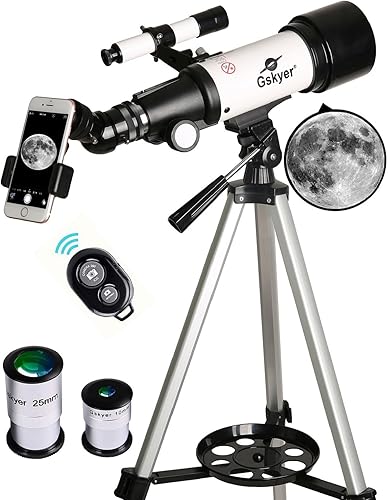
| Gskyer Telescope | travel and bright targets | 70mm | 400mm | Alt-azimuth | 9.7 |
The best telescopes for galaxies by observing style
Choose by how you want to observe: through an eyepiece, with computerized pointing, or by capturing images on a phone. These options serve different goals even when they share the same night-sky targets.
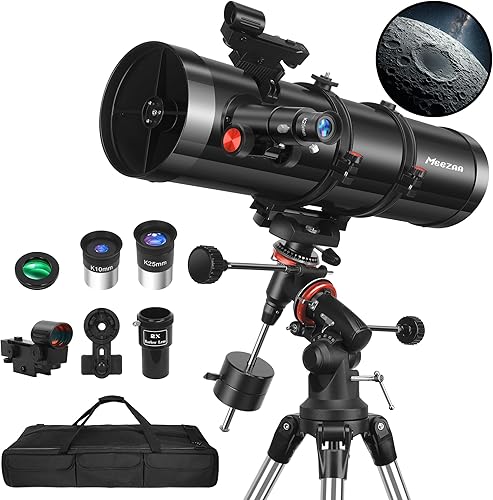
MEEZAA Telescope: Best for a manual 150mm reflector
- 150mm aperture
- 650mm focal length
- German equatorial mount
- Slow-motion controls
A 150mm reflector offers a useful light-gathering step up from the smaller refractors here, with manual controls for following objects.
Pros
- 150mm reflector aperture
- Equatorial mount with slow-motion controls
- Includes 25mm and 10mm eyepieces
Cons
- Manual tracking takes practice
- The product name is shared with another MEEZAA telescope in this list
The MEEZAA 150EQ is a manual reflector with a 150mm aperture and a 650mm focal length. Its German equatorial mount has precision dials and slow-motion controls, so it can be used to learn how to follow an object across the sky.
The package includes 25mm and 10mm eyepieces, a 2X Barlow lens, red-dot finder, Moon filter, phone adapter and carry bag. Its 26X to 130X magnification range is specified, but galaxy viewing often benefits from starting with a wider, lower-power view.
A 150mm reflector is a more substantial visual option than the smaller refractors in this roundup. The equatorial mount requires setup and practice, particularly if you're new to aligning and tracking a telescope.
MEEZAA uses the same display name for another telescope in this roundup. Check the 150EQ model when comparing, because this pick is the 150mm reflector with a 650mm focal length.
For a broader view of scopes selected for both planets and galaxies, see our guide to the best telescope for planets and galaxies.
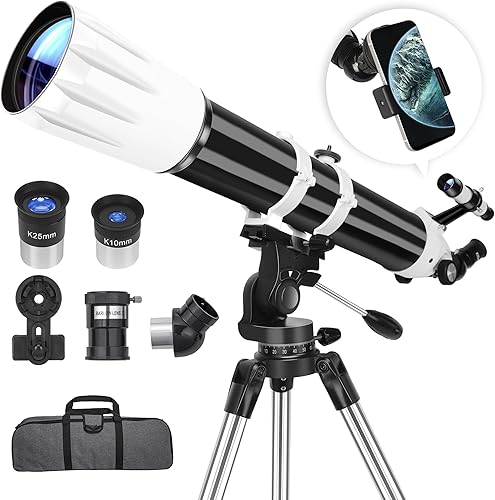
MEEZAA Telescope: Best for a 90mm refractor
- 90mm aperture
- 800mm focal length
- Fully multi-coated optics
- Alt-azimuth mount
This 90mm refractor is a straightforward manual choice for brighter targets and general night-sky viewing, though its aperture gathers less light than the reflectors.
Pros
- 90mm aperture
- Fully multi-coated optics
- Adjustable tripod and carry bag
Cons
- Less aperture than the reflector picks
- Manual aiming and tracking
The MEEZAA refractor suits general observing and brighter night-sky targets, with a 90mm aperture and 800mm focal length. Its fully multi-coated optical glass and alt-azimuth mount keep the setup in a familiar manual telescope format.
Two eyepieces, a 3X Barlow lens, phone adapter, finder scope, adjustable tripod and carry bag are included. Its 32X to 240X magnification range is specified, but that range doesn't measure how bright a galaxy will appear, so favor a clear, usable view over pushing magnification.
Compared with a 130mm or 150mm reflector, this refractor has less aperture for gathering light from faint objects. It can still serve as a general-purpose first telescope if the Moon, planets and brighter targets also matter to you.
For lunar detail, compare these telescopes for Moon craters.
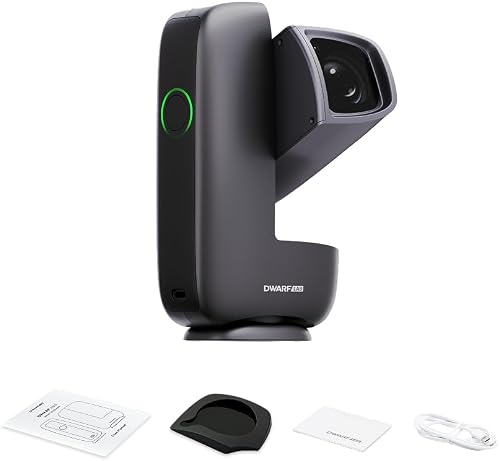
DWARFLAB Dwarf Mini Smart Telescope: Best for pocket-sized imaging
- 1.85 lb portable design
- App control and built-in sky atlas
- Auto GoTo
- Up to 90-second exposures
This compact smart telescope uses app control and automated tracking to capture deep-sky images, including faint nebulae and star clusters.
Pros
- Lightweight design
- Built-in sky atlas and Auto GoTo
- Supports long exposures up to 90 seconds
Cons
- Imaging rather than traditional eyepiece viewing
- A smaller imaging device than a full-size visual telescope
The DWARFLAB Dwarf Mini Smart Telescope is a compact imaging choice at 1.85 lb. It combines app control, an interactive sky atlas, Auto GoTo and support for single-frame exposures up to 90 seconds.
Its imaging features include EQ mode and built-in light-pollution filters. These features suit a portable camera-based workflow, but the device is designed for imaging rather than a traditional eyepiece view.
Choose it if portability and guided image capture matter more than aperture for direct visual observing. For seeing a galaxy with your own eye, prioritize a larger visual telescope and a darker site.
Celestron NexStar 8SE Computerized Telescope: Best for visual light gathering
- 8 in Schmidt-Cassegrain optics
- Computerized GoTo mount
- 40,000+ object database
- SkyAlign
Its 8-inch aperture is the largest among these visual scopes, while the GoTo mount can locate and track selected objects.
Pros
- Largest stated aperture among the visual picks
- Automated GoTo and tracking
- SkyAlign uses three bright stars or planets
Cons
- Requires alignment before computerized pointing
- Designed for visual observation and imaging, but the included setup is more involved than a simple manual mount
The Celestron NexStar 8SE Computerized Telescope is the strongest visual choice here when light gathering is the main priority. Its 8-inch Schmidt-Cassegrain optics are the largest aperture in this group of visual scopes, and the optical design pairs with a computerized mount.
The NexStar+ hand control includes a database of more than 40,000 objects. After alignment, the mount can slew to a selected target and track it, reducing the need to star-hop manually across the sky.
SkyAlign uses three bright stars or planets to calculate the telescope's position. You still need a clear view of alignment targets and a stable setup before using GoTo functions.
This model suits an observer who wants a direct eyepiece view and automated pointing. Its listed accessories include a 25mm eyepiece, star diagonal, StarPointer finder, tripod and hand control.
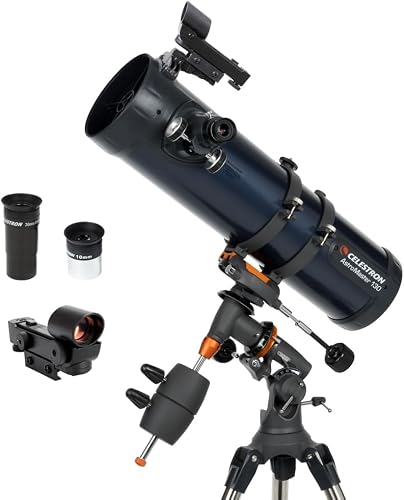
Celestron AstroMaster 130EQ Telescope for Deep-Sky Beginners: Best for beginner manual tracking
- 130mm Newtonian reflector
- German equatorial mount
- Slow-motion control knobs
- Red-dot finder
The 130mm Newtonian combines a beginner-oriented package with manual equatorial controls for learning to aim and follow targets.
Pros
- 130mm reflector aperture
- Slow-motion controls for both axes
- Includes two eyepieces
Cons
- Manual mount requires practice
- Smaller aperture than the 150mm and 8-inch visual options
The Celestron AstroMaster 130EQ Telescope for Deep-Sky Beginners is a beginner-oriented manual reflector with a 130mm Newtonian mirror. Its equatorial mount includes slow-motion controls for right ascension and declination, which help you make small adjustments as you observe.
The package includes a 20mm eyepiece, a 10mm eyepiece and a StarPointer red-dot finder. Celestron also includes a download of Starry Night astronomy software for planning sessions.
This is a reasonable option if you want a conventional telescope and are willing to learn manual aiming. Beginners focused on planetary observing can compare telescopes for seeing planets.
Its 130mm aperture is smaller than the 150mm reflector and 8-inch compound telescope above, but it remains a more galaxy-oriented choice than a short 70mm refractor.
Beginners who want a simpler starting point can compare more options in our guide to the best beginner telescope for deep space.
ZWO Seestar S30 Pro Smart Telescope: Best for app-based galaxy imaging
- App control
- Automatic GoTo and tracking
- Deep-sky imaging
- Built-in light-pollution filters
This compact smart telescope automates target finding and imaging, so it suits people who want galaxy photos on a phone rather than a direct eyepiece view.
Pros
- Automatic target finding and tracking
- Built-in light-pollution filters
- One-tap capture and processing
Cons
- Imaging-first rather than traditional eyepiece viewing
- Not intended for planetary observation
The ZWO Seestar S30 Pro Smart Telescope is designed for app-based astrophotography, not traditional eyepiece observing. Its automatic GoTo and tracking features find and follow targets while you view and capture images on a phone or tablet.
It has 30mm optics, a 160mm focal length and built-in light-pollution filters for imaging. The model is designed for deep-sky objects and isn't intended for planetary observation.
Its compact 3.64 lb body and one-tap capture and processing workflow suit someone who wants to collect galaxy images without manually aiming a visual telescope. You will be working with a digital image rather than looking at the galaxy directly through an eyepiece.
Compare this approach with other app-based options in our smart telescope comparison and see our picks for the best telescope with app control.
DWARFLAB Dwarf 3 Smart Telescope: Best for portable smart imaging
- App-controlled astrophotography
- Auto tracking
- Dual imaging system
- Portable 3 lb design
Its telephoto lens is designed for deep-sky objects, while the app handles tracking and cloud-powered image processing.
Pros
- Portable design
- Automatic tracking
- Telephoto and wide-angle imaging
Cons
- Image capture rather than direct visual observing
- Needs a phone and app workflow
The DWARFLAB Dwarf 3 Smart Telescope is a portable imaging device with automatic tracking and a dual imaging system. Its telephoto lens is described for deep-space objects, while its wide-angle camera covers targets such as the Milky Way and star trails.
The model works through the DWARFLAB app, which provides cloud-powered image processing. It weighs 3 lb and includes a carrying bag and magnetic filters.
This smart telescope suits anyone whose goal is capturing and processing images on a phone. If you want to inspect galaxies directly with your eye, a larger-aperture visual telescope is a better match.
Hawkko 90mm Aperture 900mm Telescope for Adults: Best for a longer-focus refractor
- 90mm aperture
- 900mm focal length
- Multi-coated optics
- Alt-azimuth mount
The 90mm refractor pairs a longer focal length with a manual alt-azimuth mount and a bundled phone adapter.
Pros
- 90mm aperture
- 900mm focal length
- Includes finder scope and phone adapter
Cons
- Less aperture than the reflector picks
- Manual mount
The Hawkko 90mm Aperture 900mm Telescope for Adults has a 90mm aperture and 900mm focal length, with an alt-azimuth mount. It offers a longer focal length than the MEEZAA 90mm model while keeping the same stated aperture.
Its kit includes 25mm and 10mm eyepieces, a 3X Barlow lens, finder scope, phone adapter, carry bag and stainless steel tripod. The phone adapter can capture images, while the telescope is a manual visual scope.
Like the other 90mm refractor here, it gathers less light than the larger reflectors. Consider it for a mix of brighter targets and general viewing, rather than choosing it specifically to maximize faint-galaxy visibility.
For a closer look at a different refractor, read our SVBONY SV48P 102mm telescope review.
Gskyer Telescope: Best for travel and bright targets
- 70mm aperture
- 400mm focal length
- Alt-azimuth mount
- Carry bag
A compact 70mm refractor with a carry bag suits travel and brighter targets, but its smaller aperture is a limit for faint galaxies.
Pros
- Compact refractor with carry bag
- Alt-azimuth mount
- Phone adapter and wireless remote included
Cons
- Smallest aperture among the visual scopes here
- Better suited to the Moon and planets than faint galaxies
The Gskyer Telescope is a 70mm refractor with a 400mm focal length, alt-azimuth mount and carry bag. Its compact design suits travel and brighter targets such as the Moon and planets.
The scope includes two eyepieces, a 3X Barlow lens, a 5x24 finder, phone adapter and wireless camera remote. Its smaller aperture makes it the least suited visual model here for faint galaxies, which can be difficult to detect even through larger telescopes.
Pick it if portability and bright targets are your priorities. If galaxies are the main reason you're buying a telescope, move up to a larger aperture and plan to observe away from city lights when possible.
What should you look for in a telescope for galaxies?
For visual galaxy viewing, start by comparing aperture, mount stability and the kind of targets you can realistically observe from your location. A large scope cannot remove light pollution, and a bigger magnification number alone does not guarantee a better view.
Is aperture the main factor for a telescope for galaxies?
Aperture is a key factor because a wider objective or mirror gathers more light. Among the visual scopes here, the Celestron NexStar 8SE Computerized Telescope has an 8-inch aperture, while the reflectors are 150mm and 130mm and the refractors range from 70mm to 90mm.
More aperture can help with faint targets, but it does not promise visible spiral arms or color. Dark skies, accurate focusing, clear air and choosing a bright galaxy also affect what reaches your eye.
Does telescope type matter for galaxies?
Reflectors and compound telescopes can offer larger apertures for visual observing. The 70mm and 90mm refractors here collect less light than the larger reflectors in this list.
Smart telescopes use sensors, software and image capture instead of a standard eyepiece view. They suit people who want to make galaxy images through an app, but they serve a different observing style from a visual telescope.
Do you need a computerized mount?
A computerized mount can help you locate targets and follow them, especially if you're new to the night sky. The Celestron NexStar 8SE Computerized Telescope includes a database and automated GoTo tracking, while the manual equatorial models require you to aim and make tracking adjustments yourself.
Automation does not make faint galaxies brighter. It can reduce time spent finding a target, leaving more time to observe it.
How can you improve a galaxy view at home?
You can improve your chances by choosing a dark observing spot, letting your eyes adapt and starting with a low-power eyepiece. Many galaxies look like soft, gray patches, so patience and realistic expectations matter.
Avoid bright screens and nearby lights while observing. If you can travel away from city lighting, a darker sky can improve contrast more than adding magnification.
Start with bright, well-known targets and use a star chart or telescope app to confirm where they are. If you're still deciding what a home telescope can show, our guide explains whether you can see galaxies with a home telescope.
Which telescope for galaxies should you choose?
Choose the Celestron NexStar 8SE Computerized Telescope if you want the largest stated aperture in this selection and computerized pointing for visual observation. The MEEZAA 150EQ is a manual reflector option, while the Celestron AstroMaster 130EQ Telescope for Deep-Sky Beginners suits a beginner who wants to learn equatorial tracking.
Pick a smart telescope if your goal is app-based galaxy imaging, and a 90mm refractor if you want a general-use scope for brighter targets as well. For a wider comparison of deep-sky and planetary options, see our guide to the best telescope for planets and deep space.
Our top 3 picks at a glance
-
1
-
2
-
3
Frequently asked questions
What kind of telescope is best for seeing galaxies?
A telescope with a larger aperture is usually the stronger choice for visual galaxy observing because it gathers more light. Among the visual models here, the 8-inch Celestron NexStar 8SE has the largest stated aperture, followed by the 150mm and 130mm reflectors.
Dark skies and a well-chosen target matter too.
Can a small telescope show galaxies?
A small telescope can show some bright galaxies as faint patches, especially from a dark location, but it won't make them look like detailed color photographs. The 70mm Gskyer is compact and suited to brighter targets, while a larger aperture is a better fit when faint deep-sky objects are the priority.
Use low expectations for detail and give your eyes time to adapt to darkness.
Do smart telescopes show galaxies through an eyepiece?
Most smart telescope models in this guide are designed to capture images through an app, rather than provide a traditional eyepiece view. The ZWO Seestar S30 Pro and DWARFLAB models automate target finding or image processing.
Choose a conventional telescope if you want to observe directly through an eyepiece.
Does magnification make galaxies easier to see?
Magnification alone does not make a galaxy brighter. It spreads the light over a larger area, so a useful view depends on aperture, sky darkness, target size and atmospheric conditions.
Start with a lower-power eyepiece, find the galaxy, then try more magnification if the view stays clear.
Can you see galaxies from a city?
Some bright galaxies may be visible from a city, but light pollution reduces contrast and makes faint targets harder to spot. A darker observing site can improve the view more than simply increasing magnification.
For more on expectations and target selection, read our guide to seeing galaxies with a home telescope.



