9 Best Telescopes for Beginners to See Planets (October 2026)
The best beginner telescopes for viewing planets include the Celestron Travel Scope 70mm Beginner Portable Telescope for portable first views, the Gskyer Telescope for included phone accessories, and the Celestron AstroMaster 70AZ Refractor Telescope for Moon for simple sky pointing.
On this page (6 sections)
The best telescope for beginners to see planets is a simple refractor with a steady tripod and useful eyepieces, such as the Celestron Travel Scope 70mm. A longer focal length or larger aperture can also suit planetary viewing, while a child-focused kit may be a better fit for a young first-time observer.
These kits are for visual observing. Start with the Moon, then try bright planets when they are well placed in the evening sky.
For a broader comparison, see our guide to the best telescope for looking at planets.
Our picks at a glance
-
1
 Best for portable first views
Celestron Travel Scope 70mm Beginner Portable Telescope
9.7/10 our score
See it on Amazon -
2
-
3
 Best for simple sky pointing
Celestron AstroMaster 70AZ Refractor Telescope for Moon
9.7/10 our score
See it on Amazon
- 4
 Best for a larger refractor apertureCheck it
- 5
 Check it
CELTICBIRD Telescope for Adults High Powered
Best for an 80mm travel kit - 6
 Check it
Blue Marble NASA Lunar Telescope for Kids Ages
Best for children learning the Moon - 7
 Check it
ToyerBee Telescope for Adults & Kids
Best for a lightweight family kit - 8
 Check it
Educational Insights GeoSafari Starview Telescope
Best for guided kids’ activities - 9
 Check it
Educational Insights GeoSafari Vega 600 Telescope
Best for kids wanting a taller tripod
How we chose beginner telescopes for seeing planets
The best beginner telescope for seeing planets should be manageable to set up and include a practical way to find and follow a target. Adults starting out can compare our beginner telescopes for adults.
We compared the stated aperture, focal length, eyepieces, mount, setup features and included accessories against the needs of new visual observers.
A large magnification number alone did not decide the order. Planetary views also depend on steady mounting, careful focus, atmospheric conditions and the telescope’s optics, so a kit with more advertised magnification is not automatically the better choice.
Scores weigh specs, features and buyer feedback against what you’re shopping for. The first three picks are all 9.7 because they each have a distinct beginner-friendly strength: portability, smartphone accessories or simple manual pointing.
| Product | Best for | Aperture | Eyepieces | Mount | Our score |
|---|---|---|---|---|---|
| Celestron Travel Scope 70mm Beginner Portable Telescope | portable first views | 70mm | 20mm and 10mm | Altazimuth | 9.7 |
| Gskyer Telescope | included phone accessories | 70mm | Altazimuth | 9.7 | |
| Celestron AstroMaster 70AZ Refractor Telescope for Moon | simple sky pointing | 70mm | 20mm and 10mm | Altazimuth | 9.7 |
| MEEZAA Telescope | a larger refractor aperture | 90mm | Altazimuth | 9.6 | |
| CELTICBIRD Telescope for Adults High Powered | an 80mm travel kit | 80mm | Altazimuth | 9.5 | |
| Blue Marble NASA Lunar Telescope for Kids Ages | children learning the Moon | Low power and high power | 9.4 | ||
| ToyerBee Telescope for Adults & Kids | a lightweight family kit | 70mm | Tripod included | 9.1 | |
| Educational Insights GeoSafari Starview Telescope | guided kids’ activities | 8.2 | |||
| Educational Insights GeoSafari Vega 600 Telescope | kids wanting a taller tripod | 8.0 |
The best telescope for beginners to see planets: 9 picks
The Celestron Travel Scope 70mm is the top pick for beginners who value portability and straightforward setup. Choose among the remaining kits based on aperture, accessories, family use and how much space you have for the tripod.
Celestron Travel Scope 70mm Beginner Portable Telescope: Best for portable first views
- 70mm refractor
- 20mm and 10mm eyepieces
- No-tool setup
- Backpack included
A portable 70mm refractor with two eyepieces, a full-height tripod and a backpack. Its no-tool setup suits beginners who want to observe at home or take a telescope on a trip.
Pros
- Compact and travel-ready
- Two eyepieces for different views
- No-tool setup
Cons
- 70mm aperture is modest for faint objects
- A manual mount needs steady, small adjustments
The Celestron Travel Scope 70mm pairs a 70mm aperture with a compact refractor design. Its 20mm and 10mm eyepieces offer two starting views, and the included 5x24 finderscope helps you locate a target before switching to a closer view.
Setup needs no tools, and the full-height tripod and telescope fit into the included backpack. That makes it a practical choice if you plan to move between a backyard, campsite or other observing spot.
For more small, easy-to-carry options, browse compact beginner telescopes.
The kit also includes Starry Night software for identifying objects and planning a session.
The 70mm aperture makes this a modest visual telescope for faint objects. Begin with the 20mm eyepiece, then try the 10mm eyepiece when the target is centered and the view remains sharp.
Choose it if portability and quick setup matter most. Consider a larger aperture if planetary viewing is your main goal and you have room for a less compact setup.
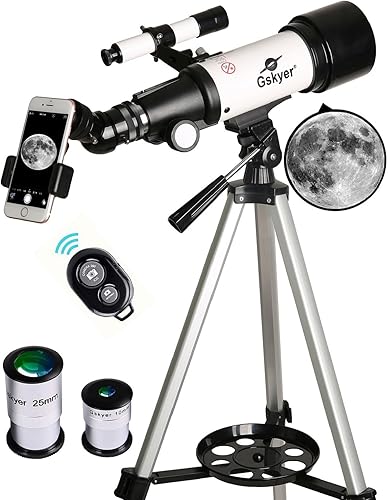
Gskyer Telescope: Best for included phone accessories
- 70mm aperture
- 400mm focal length
- Two eyepieces and 3x Barlow lens
- Phone adapter and wireless remote
This 70mm refractor comes with two eyepieces, a 3x Barlow lens and accessories for attaching a smartphone. Its carry bag and adjustable tripod add portability.
Pros
- Several viewing options in the box
- Phone adapter and remote included
- Carry bag included
Cons
- The short focal length favors a compact setup
- More magnification does not guarantee a sharper view
The Gskyer is a 70mm refractor with a 3x Barlow lens, phone adapter and wireless camera remote. It also includes two eyepieces, a finder scope and a carry bag, giving a beginner several ways to explore the sky and try simple phone captures.
Its 400mm focal length makes it a compact telescope. The adjustable tripod offers different viewing positions, while the bag helps keep the scope and tripod together between sessions.
The 5x24 finder has crosshair lines to help locate targets.
A Barlow lens increases magnification, but higher power can make a target harder to keep steady and focus. Try the eyepieces without the Barlow first, then add it only when the image remains clear.
See our beginner’s guide to using a telescope for a simple way to get started.
Choose Gskyer if the phone accessories are useful to you. For a scope with a manual panhandle mount, compare it with the AstroMaster below.
Celestron AstroMaster 70AZ Refractor Telescope for Moon: Best for simple sky pointing
- 70mm fully coated optics
- 20mm and 10mm eyepieces
- Manual altazimuth mount
- StarPointer red dot finder
The AstroMaster combines a 70mm refractor with a manual altazimuth mount and panhandle. The included 20mm and 10mm eyepieces provide two starting magnifications.
Pros
- Simple up, down and side-to-side controls
- Red dot finder included
- No-tool setup
Cons
- Less portable than the travel-focused picks
- Manual tracking takes practice
The Celestron AstroMaster 70AZ uses a manual altazimuth mount with a panhandle. You can point the scope up, down and side to side, a familiar control style for beginners.
Its 70mm fully coated optics and 20mm and 10mm eyepieces provide two starting magnifications. A StarPointer red dot finder helps you aim the tube, while the erect image diagonal supports daytime viewing of land-based targets as well as nighttime observing.
The adjustable tripod is designed for seated or standing use, and setup requires no tools. The controls can help you learn to find a bright planet and keep it in view.
Choose it if simple pointing controls matter most. For more options from the same brand, see our guide to the best Celestron telescope for planets.
MEEZAA Telescope: Best for a larger refractor aperture
- 90mm aperture
- 800mm focal length
- 10mm and 25mm eyepieces with 3x Barlow
- Phone adapter and carry bag
A 90mm refractor with an 800mm focal length, two eyepieces and a 3x Barlow lens. The kit also includes a phone adapter, adjustable tripod and carry bag.
Pros
- Largest stated aperture in this roundup
- Longer focal length than the 70mm travel scopes
- Carry bag included
Cons
- More parts to set up than a compact travel scope
- A phone adapter does not replace a visual eyepiece
The MEEZAA has a 90mm aperture and 800mm focal length, the largest stated aperture among these picks. It includes 25mm and 10mm eyepieces, a 3x Barlow lens, a phone adapter, an adjustable tripod and a carry bag.
The longer focal length and eyepiece set give beginners several ways to frame a target. Begin with the 25mm eyepiece to find a planet, then try the 10mm if the view is steady.
A Barlow can raise magnification further, but focus and viewing conditions affect how much detail is visible.
The kit includes more accessories to arrange than a compact travel scope. The phone adapter lets you try snapshots, while visual observing starts with an eyepiece.
Choose MEEZAA if you want a larger-aperture refractor and a kit with several accessories. If you’re considering an 8-inch scope, our guide explains whether an 8 inch telescope is good for beginners.
CELTICBIRD Telescope for Adults High Powered: Best for an 80mm travel kit
- 80mm aperture
- 600mm focal length
- 20mm and 9mm eyepieces
- Backpack, phone adapter and Moon filter
This 80mm refractor pairs two eyepieces with an adjustable tripod, backpack and phone adapter. A Moon filter is included for lunar observing.
Pros
- 80mm aperture
- Backpack holds the accessories
- Moon filter included
Cons
- Manual mount requires hand tracking
- Tripod height and packed gear need space
The CELTICBIRD combines an 80mm aperture and 600mm focal length with a backpack, phone adapter and Moon filter. Its two eyepieces are 20mm and 9mm, and the adjustable tripod’s height ranges from 17.7 to 52 inches.
This kit may suit a family that wants to carry the telescope outdoors and try lunar observing as well as bright planets. The included Moon filter is intended for lunar observing, while the 5x24 finder helps you aim.
The phone adapter offers a way to try basic phone images through the eyepiece.
As with other manual refractors, the mount needs small hand adjustments to keep a planet centered. A stable surface and careful focus matter more than pushing the telescope to its highest advertised magnification.
Choose it if you want an 80mm scope with a backpack and lunar accessory. If cost is part of your decision, compare the best budget telescopes for planets and review the cost of a telescope to see planets.
Blue Marble NASA Lunar Telescope for Kids Ages: Best for children learning the Moon
- Low- and high-power eyepieces
- Finder scope
- Tabletop tripod
- Learning guide included
A child-focused telescope designed around finding and viewing the Moon. Its tabletop tripod, finder scope, two eyepieces and learning guide give families a simple starting point.
Pros
- Made for young beginners
- Tabletop tripod is compact
- Learning guide included
Cons
- Moon-focused kit rather than an all-purpose adult telescope
- Tabletop tripod limits viewing height
The Blue Marble NASA Lunar Telescope is designed for children ages 8 and up who are beginning with the Moon. It comes with a finder scope, low- and high-power eyepieces, a tabletop tripod and a learning guide.
Its tabletop tripod and simple kit suit a parent and child learning to find the Moon together. The guide adds background about lunar features, so an observing session can pair looking through the scope with learning what the child is seeing.
This is a child-focused lunar telescope. Its tabletop tripod needs a steady surface at a comfortable viewing position.
Choose it as a first telescope for a young observer whose main target is the Moon. For a broader selection aimed at children, browse our telescopes for kids guide.
ToyerBee Telescope for Adults & Kids: Best for a lightweight family kit
- 70mm aperture
- 300mm focal length
- 20mm and 6mm eyepieces with 3x Barlow
- Phone adapter and wireless remote
This 70mm refractor includes two eyepieces, a 3x Barlow lens, phone adapter and wireless remote. A star chart is included to help beginners learn the sky.
Pros
- Lightweight design
- Phone adapter and remote included
- Star chart included
Cons
- Short 300mm focal length
- A long list of magnifications cannot ensure a clear planetary image
The ToyerBee is a lightweight 70mm refractor with a 300mm focal length. Its kit includes 20mm and 6mm eyepieces, a 3x Barlow lens, a phone adapter, wireless remote and star chart.
The short tube and included accessories suit a family that wants a portable telescope for casual observing. The star chart can help new users learn where to look, while the phone adapter and remote let you experiment with capturing a view.
ToyerBee describes magnification up to 150x, but that figure does not tell you how much detail will remain visible. Begin with lower magnification, center the target and add power only if the image stays clear and the tripod remains steady.
Choose it if portability and phone accessories are priorities. Compare its 300mm focal length with the 600mm or 800mm options above if planetary viewing is your main goal.
Educational Insights GeoSafari Starview Telescope: Best for guided kids’ activities
- 10x and 50x eyepieces
- Tabletop tripod
- Activity journal
- Portable kids’ kit
The Starview is a portable kids’ telescope with 10x and 50x eyepieces, a tabletop tripod and an activity journal. It suits learning basic sky-scanning and observing habits.
Pros
- Activity journal gives children guided projects
- Two eyepieces included
- Compact tabletop tripod
Cons
- Kid-focused design
- 50x is a modest magnification for planetary detail
The GeoSafari Starview is a kids’ telescope with 10x and 50x eyepieces, a tabletop tripod and an activity journal. Its compact format is aimed at children learning to scan the sky and adjust eyepieces.
The journal includes guided projects, and the telescope can also be used for nature viewing. The tabletop tripod needs a firm surface at a height that lets the child look through the eyepiece comfortably.
At 50x, planetary targets will appear small. This is a starter learning tool for exploring the Moon, stars and sky-scanning basics.
Choose it for guided activities and a compact tabletop setup. If your child wants a taller tripod, the Vega 600 below is a different style of kit.
Educational Insights GeoSafari Vega 600 Telescope: Best for kids wanting a taller tripod
- 50mm objective lens
- Two eyepieces
- 5x24 finder scope
- Adjustable tripod up to 50 inches
The Vega 600 is a kids’ refractor kit with two eyepieces, a finder scope and an adjustable tripod that reaches 50 inches. It can serve for both sky and nature viewing.
Pros
- Taller tripod than tabletop kits
- Finder scope included
- Portable design
Cons
- 50mm objective is the smallest here
- Maximum magnification claims do not indicate useful planetary detail
The GeoSafari Vega 600 includes a 50mm objective lens, two eyepieces, a 5x24 finder and an adjustable tripod up to 50 inches tall. That taller tripod gives it a different setup from the tabletop kids’ telescopes in this roundup.
It is designed for both sky and nature viewing. The finder can help a young observer aim at a bright target, while the adjustable height offers flexibility for standing or seated use.
The 50mm objective is smaller than the apertures on the adult-oriented refractors above. Educational Insights describes magnification from 30x to 150x, but maximum magnification does not promise clear planetary detail.
Start with one of the lower-power eyepieces and focus carefully.
Choose it if a child wants a taller tripod and a scope for sky and nature viewing. For a beginner focused on planets, the larger-aperture refractors are stronger starting points.
What should a beginner telescope have for planet viewing?
A beginner telescope for planet viewing should pair usable optics with a mount you can point steadily. Aperture, focal length, eyepieces, finder and tripod all affect the experience, so compare the whole kit rather than choosing by a single magnification number.
A 70mm or 80mm refractor is a manageable place to start. A larger aperture can gather more light, but it may also come with a larger tube and tripod that take more room to store and set up.
A manual altazimuth mount is straightforward to move up, down and side to side. Set it on firm ground and make small adjustments as you track a planet across the view.
How much magnification do you need to see planets?
You don’t need the highest advertised magnification to begin observing planets. A lower-power eyepiece makes it easier to find a target, and a higher-power eyepiece can be useful only when the image remains sharp and steady.
Atmospheric turbulence, focus and tripod movement can blur a magnified view. Try the included eyepieces before adding a Barlow lens, and stop increasing power when the image loses clarity.
What can beginners expect to see?
Beginners can start with the Moon and try brighter planets when they are visible from their location. Expect small views through an eyepiece, with the detail you can make out changing with conditions and telescope setup.
Choose a clear, steady evening and keep the telescope away from shaky decks or surfaces. For targets beyond the planets, compare these visual kits with a telescope for planets and galaxies, since faint deep-sky observing asks different things of a telescope.
Which beginner telescope should you choose?
Choose the Celestron Travel Scope 70mm if you want a portable first telescope with quick setup and two eyepieces. Pick the AstroMaster 70AZ if its panhandle controls suit you, or choose MEEZAA for the largest stated aperture in this group.
For a child focused on the Moon, the Blue Marble kit gives you a tabletop tripod and learning guide. If you’re choosing for general family use, compare setup space, tripod height and how often you’ll carry the scope before you decide.
Our top 3 picks at a glance
-
1
Best for portable first views
Celestron Travel Scope 70mm Beginner Portable Telescope
9.7/10 our score
See it on Amazon -
2
-
3
Best for simple sky pointing
Celestron AstroMaster 70AZ Refractor Telescope for Moon
9.7/10 our score
See it on Amazon
Frequently asked questions
Can a beginner telescope show planets?
Yes. A beginner telescope can show the Moon and brighter planets, though the amount of visible detail depends on aperture, optics, steadiness, focus and sky conditions.
Start with a low-power eyepiece to find the target, then try a higher-power one if the view stays sharp.
What can you see with a beginner telescope?
The Moon’s larger craters and bright planets are common first targets. The view varies with the telescope and observing conditions, so expect small planetary images rather than the large, colorful pictures used in astronomy books.
A steady tripod and careful focus make it easier to see what the optics can show.
Is a refractor or reflector easier for a beginner?
A refractor uses a lens at the front of the tube and often needs little setup beyond mounting and focusing. A reflector uses mirrors and may need more care, including occasional alignment.
For a first planetary scope, compare the full kit and mount as well as the optical design.
Does higher magnification mean a better planet view?
No. Magnification enlarges the image, but it also makes blur and shaking more noticeable.
The telescope’s aperture, optics, focus, mount and atmospheric steadiness all affect useful detail.
Use the lowest power that makes the target easy to see, then increase magnification only while the image remains clear.
Can you take planet photos with these telescopes?
Some kits here include smartphone adapters or camera remotes, but those accessories do not make a telescope an imaging system. They can help you try simple phone snapshots through an eyepiece.
For dedicated planetary imaging, see our guide to best telescope for astrophotography of planets.



