9 Best Telescopes with Automatic Tracking (November 2026)
The best telescopes with automatic tracking include the Dianfan Telescope for traditional viewing with phone support, the MEEZAA Telescope for beginner manual astronomy, and the Celestron NexStar 6SE Schmidt-Cassegrain Telescope for serious visual astronomy.
On this page (7 sections)
- The best telescope with auto tracking for each type of observer
- How do automatic telescopes keep targets centered?
- Do beginners need a computerized telescope?
- What should you check before buying a tracking telescope?
- How should you set up and use an automatic telescope?
- Can a reflector telescope work with tracking?
- Which automatic-tracking telescope should you choose?
The best telescope with auto tracking is the Celestron NexStar 6SE for visual astronomy, thanks to its 6 in Schmidt-Cassegrain optics, computerized GoTo mount and 40,000-plus-object database. Choose a DWARFLAB or ZWO smart telescope if app control and astrophotography matter more than viewing through a traditional eyepiece.
Automatic tracking solves the main problem caused by Earth's rotation: a target drifts across the field of view while you observe. A tracking mount keeps it centered after setup, which is especially useful at higher magnification and during long exposures.
If you are still deciding between automatic tracking and guided target finding, compare these picks with our guide to best telescopes with automatic alignment. For satellite work, see our guide to the best telescopes for spotting satellites in orbit.
Our picks at a glance
-
1

-
2

-
3
 Best for serious visual astronomy
Celestron NexStar 6SE Schmidt-Cassegrain Telescope
9.5/10 our score
See it on Amazon
- 4
 Check it
DWARFLAB Dwarf Mini Smart Telescope
Best for lightweight smart tracking - 5
 Check it
Celestron StarSense Explorer LT 114AZ Newtonian Smartphone
Best for guided manual target finding - 6
 Check it
ZWO Seestar S30 Pro Smart Telescope
Best for simple deep-sky imaging - 7
 Check it
Gskyer Telescope 600x90mm AZ Astronomical Refractor Telescope
Best for manual lunar and terrestrial viewing - 8
 Check it
Gskyer 130EQ Professional Astronomical Reflector Telescope
Best for manual equatorial tracking - 9
 Check it
DWARFLAB Dwarf 3 Smart Telescope
Best for portable day and night imaging
The best telescope with auto tracking for each type of observer
The Celestron NexStar 6SE is the best traditional tracking telescope here, while the DWARFLAB and ZWO models make tracking part of an app-controlled imaging workflow.
Our score weighs optical specifications, tracking features, setup approach and fit for people searching for computerized telescopes for astronomy. We checked the stated specifications and features, but we did not test these telescopes ourselves.
| Product | Best for | Aperture | Focal length | Mount | Our score |
|---|---|---|---|---|---|
| Dianfan Telescope | traditional viewing with phone support | 90mm | 800mm | Altazimuth mount | 9.7 |
| MEEZAA Telescope | beginner manual astronomy | 90mm | 800mm | Altazimuth mount | 9.6 |
| Celestron NexStar 6SE Schmidt-Cassegrain Telescope | serious visual astronomy | 6 in | 1500mm | Computerized altitude-azimuth single fork arm | 9.5 |
| DWARFLAB Dwarf Mini Smart Telescope | lightweight smart tracking | 150mm | Altazimuth and equatorial mount | 9.5 | |
| Celestron StarSense Explorer LT 114AZ Newtonian Smartphone | guided manual target finding | 114mm | 1000mm | Manual altazimuth mount | 9.5 |
| ZWO Seestar S30 Pro Smart Telescope | simple deep-sky imaging | 160mm | Alt-azimuth with equatorial mode | 9.3 | |
| Gskyer Telescope 600x90mm AZ Astronomical Refractor Telescope | manual lunar and terrestrial viewing | 90mm | 600mm | Altazimuth mount | 9.2 |
| Gskyer 130EQ Professional Astronomical Reflector Telescope | manual equatorial tracking | 130mm | 650mm | Equatorial mount | 9.2 |
| DWARFLAB Dwarf 3 Smart Telescope | portable day and night imaging | Altazimuth mount | 9.1 |
Dianfan Telescope: Best for traditional viewing with phone support
- 90mm aperture
- 800mm focal length
- 32x to 240x magnification
- Stainless steel tripod and phone adapter
This refractor gives beginners a conventional telescope setup with a 90mm objective lens, manual focus and a phone adapter. It does not provide automatic tracking, but it offers a simple route into visual observing.
Pros
- 90mm fully coated objective lens
- 32x to 240x magnification range
- Included carry bag and phone adapter
Cons
- Manual focus
- No automatic tracking
The Dianfan Telescope is a manual refractor, so it is not an automatic-tracking telescope. It suits beginners who want a conventional setup first and are happy to move the telescope themselves as objects drift.
Its 90mm aperture and 800mm focal length give a useful balance for lunar and terrestrial viewing. The fully coated objective lens helps gather light, while the phone adapter offers a simple way to start capturing views with a smartphone.
Two eyepieces and a 3x Barlow lens provide a stated 32x to 240x magnification range. Lower powers are easier for finding targets, and higher powers reward calm air and a steady tripod.
The 45 degree zenith mirror gives upright images for terrestrial use. That makes distant scenery easier to follow in daylight as well as at night.
The stainless steel tripod and included carry bag support outdoor use and storage. Dianfan says assembly takes about 15 minutes, so it can be ready for a first session without a long setup.
Manual focus keeps the control layout straightforward for a first telescope. You will need to refocus and recenter targets often, especially at higher magnification.
Choose it if you want a conventional scope for the Moon, nature and city views. Skip it if your main goal is a target that stays centered without repeated manual adjustments.
MEEZAA Telescope: Best for beginner manual astronomy
- 90mm aperture
- 800mm focal length
- Fully multi-coated optical glass
- 10mm and 25mm eyepieces with 3x Barlow lens
The MEEZAA is a manual refractor for beginners who want strong basic optics and a phone adapter. Its 32x to 240x range supports lunar viewing, but it will not keep a target centered automatically.
Pros
- Fully multi-coated lenses
- Adjustable 28 to 46 in tripod
- Carry bag and phone adapter included
Cons
- Manual tracking
- No computerized mount
The MEEZAA Telescope is another manual 90mm refractor for beginners. It is aimed at people who want to learn the sky by pointing the telescope themselves.
Its 800mm focal length and fully multi-coated optical glass support lunar observing and basic stargazing. The 90mm aperture gathers enough light for bright views of the Moon and clearer detail under dark skies.
The included 10mm and 25mm eyepieces work with the 3x Barlow lens to provide different viewing powers. Start with the lower power to find a target, then increase magnification once it is centered.
Its stainless steel tripod adjusts from 28 to 46 inches. That range helps different observers, including younger users and adults, find a comfortable viewing height.
The carry bag, phone adapter, accessory tray, finder scope and zenith mirror are included with the telescope. Keeping accessories in one bag makes transport and storage simpler at home or on a trip.
MEEZAA says its detailed paper manual supports quick assembly. Read the finder scope section before your first session, as it saves time when locating the Moon.
This telescope suits someone who wants direct control and a simple learning process. For automatic locating and tracking, move up to the NexStar 6SE or choose an app-controlled smart telescope.
Celestron NexStar 6SE Schmidt-Cassegrain Telescope: Best for serious visual astronomy
- 6 in Schmidt-Cassegrain optics
- Fully computerized GoTo mount
- 40,000+ object database
- SkyAlign technology
The NexStar 6SE is the strongest visual astronomy choice here when you want a computerized mount, automatic locating and tracking. Its 6 in optics also give it more light-gathering ability than the compact smart telescopes.
Pros
- Automatic GoTo locating and tracking
- 40,000+ object database
- SkyAlign alignment system
Cons
- Heavier 21 lb setup
- More complex than a manual starter scope
The Celestron NexStar 6SE is the best traditional telescope for automatic tracking because its computerized GoTo mount both locates and follows celestial objects. Its 6 in Schmidt-Cassegrain optics also provide more light-gathering ability than the compact digital models in this roundup.
The NexStar+ hand control gives access to a database of more than 40,000 objects. SkyAlign asks you to center any 3 bright stars or planets, even when you do not know their names, then calculates the alignment.
The 1500mm focal length and 25mm eyepiece suit detailed views of the Moon and planets, while the 6 in aperture also supports galaxies, nebulae and globular clusters. The 21 lb weight is the main trade-off against the lighter smart telescopes.
Choose the NexStar 6SE if you want visual astronomy through an eyepiece with computerized control. Read our guide to the best GoTo telescope if you want to compare this type of mount with other GoTo designs.
DWARFLAB Dwarf Mini Smart Telescope: Best for lightweight smart tracking
- 1.85 lb portable design
- App control
- Auto GOTO and 360 degree pivot
- Up to 90-second exposures
The Dwarf Mini is a compact digital telescope for app-controlled tracking and astrophotography. Its 1.85 lb body, 360 degree pivot and 90-second exposure support favor portability over traditional eyepiece viewing.
Pros
- Very light 1.85 lb design
- Auto GOTO and 360 degree pivot
- Built-in light pollution filters
Cons
- 30mm objective lens
- Designed around app-based imaging
The DWARFLAB Dwarf Mini is the most portable automatic-tracking choice here. It weighs 1.85 lb and fits into a backpack or large pocket for travel.
It combines app control, Auto GOTO and 360 degree pivot movement. That design suits quick sessions where you select a target on a phone and let the device move to it.
Its 30mm objective lens and Sony IMX662 sensor are designed for digital capture rather than traditional eyepiece viewing. You view and control the session through the app instead of looking through an eyepiece.
The telescope supports equatorial mode and single-frame exposures up to 90 seconds. Longer exposures help reveal faint deep-sky detail that would be hard to see in a short phone snapshot.
Built-in light pollution filters and cloud processing help shape the imaging workflow. They are useful in bright urban skies, though a dark site will still give better results.
The package includes a filter, USB-C to USB-C charging cable and cleaning cloth. Keep the lens clean and the battery charged before a trip, as both matter for a smooth session.
Pick it for travel, camping and quick app-controlled imaging. Its small objective lens means the experience differs from the brighter visual views available through a 6 in or 130mm conventional telescope.
Celestron StarSense Explorer LT 114AZ Newtonian Smartphone: Best for guided manual target finding
- 114mm Newtonian reflector
- Smartphone sky navigation
- 1000mm focal length
- Manual altazimuth mount
This Celestron uses a smartphone to guide you toward celestial targets, but the manual mount does not track them automatically. It suits beginners who want app assistance while still moving the telescope themselves.
Pros
- 114mm reflector optics
- StarSense smartphone guidance
- 10mm and 25mm eyepieces included
Cons
- Manual target tracking
- Requires phone-based guidance
The Celestron StarSense Explorer LT 114AZ helps you find objects with a smartphone, but it does not provide automatic tracking. It is best understood as a guided manual telescope.
Its manual altazimuth mount uses altitude slow-motion adjustment. You follow the on-screen arrows and continue moving the telescope yourself, so the app guides you rather than driving the mount.
The 114mm Newtonian reflector has a 1000mm focal length and high-reflectivity coatings. That combination suits detailed views of the Moon and bright planets when the air is calm.
Celestron lists the Moon, Jupiter, Saturn, Orion Nebula and Andromeda Galaxy among the targets suited to this setup. Bright targets are a sensible starting point for new users.
The StarSense app analyzes star patterns and creates a list of recommended objects for your time and location. That list reduces guesswork on your first nights under the sky.
The package includes 10mm and 25mm eyepieces, a 2x Barlow lens, a finderscope and a preassembled mount and tripod. A preassembled mount saves early setup time and lets you focus on learning the controls.
Choose it if smartphone guidance matters more than motorized tracking. It is a useful middle ground for beginners who want help finding targets while learning manual telescope control.
ZWO Seestar S30 Pro Smart Telescope: Best for simple deep-sky imaging
- App-controlled GoTo and tracking
- 4K dual-camera imaging
- Built-in light pollution filters
- Automatic mosaic stitching
The Seestar S30 Pro is built for app-controlled astrophotography, with automatic targeting, tracking and one-tap processing. It is designed for deep-sky and wide-field imaging, not planetary observation.
Pros
- Automatic GoTo and tracking
- 4K dual-camera imaging
- Smartphone and tablet control
Cons
- Not intended for planetary observation
- 30mm objective lens
The ZWO Seestar S30 Pro is a strong choice for app-controlled deep-sky imaging. It combines automatic GoTo targeting and tracking in a compact 3.6 lb design.
Its 30mm objective lens and 160mm focal length support wide-field imaging. That shorter focal length suits large targets and sweeping night scenes rather than tight planetary views.
Built-in light pollution filters, automatic mosaic stitching and AI image processing are aimed at producing clearer photos. They help shape the final image after the device captures the data.
The S30 Pro offers 4K dual-camera imaging and one-tap processing. You can view the night sky live on a smartphone and share results without moving data to a computer first.
It is designed for deep-sky objects and is not intended for planetary observation. Planets need different magnification and processing, so this is not the right tool for that job.
Keep it stationary during deep-sky imaging so the tracking remains stable and accurate. Wind, a loose tripod or repeated handling can spoil a long session.
Choose it if your priority is capturing and sharing images from a phone or tablet. For a traditional eyepiece view of planets, the NexStar 6SE is a better fit.
Gskyer Telescope 600x90mm AZ Astronomical Refractor Telescope: Best for manual lunar and terrestrial viewing
- 90mm aperture
- 600mm focal length
- 24x, 60x and 120x eyepiece powers
- Adjustable aluminum tripod
This Gskyer refractor is a manual telescope for lunar, planetary and terrestrial viewing. Its adjustable tripod and 90mm aperture make it approachable, but it does not automatically locate or track targets.
Pros
- 90mm fully coated optics
- 3 eyepieces and 3x Barlow lens
- 31.5 to 49 in adjustable tripod
Cons
- Manual operation
- No automatic tracking
The Gskyer 600x90mm AZ is a manual refractor for lunar, planetary and terrestrial viewing. It offers a simple visual setup without the extra steps of a computerized mount.
Its 90mm aperture and 600mm focal length provide a shorter tube than longer 800mm refractors. That can make storage and transport easier in a car or at a campsite.
The telescope includes eyepieces rated at 24x, 60x and 120x, plus a 3x Barlow lens. The Barlow triples the power of each eyepiece, so choose the lowest power that shows the detail you want.
Its fully coated optical glass and 6x30 finderscope support basic target finding and viewing. The finder scope helps you place a target in the main view before you switch to a higher power.
The adjustable aluminum tripod reaches about 31.5 to 49 inches. Set the legs firmly on level ground and tighten each section before observing.
A 48 degree erecting BAK7 prism keeps the setup useful for terrestrial viewing as well as astronomy. Upright images make wildlife and distant scenery easier to observe in the daytime.
Choose it when manual operation and a flexible tripod matter more than computerized control. It can be a better first step for someone who wants to practice pointing before buying an automatic mount.
Gskyer 130EQ Professional Astronomical Reflector Telescope: Best for manual equatorial tracking
- 130mm aperture
- 650mm focal length
- German equatorial mount
- Wireless camera remote
The Gskyer 130EQ offers a large 130mm reflector and an equatorial mount that supports precise manual tracking as celestial objects move. It is not a computerized telescope, so finding and following targets still requires user input.
Pros
- 130mm reflector aperture
- German equatorial mount
- Wireless remote compatible with iPhone and Android
Cons
- 30.1 lb weight
- No computerized tracking
The Gskyer 130EQ is the best manual option here for learning equatorial tracking. Its 130mm reflector gives a large aperture for its tube size.
The 650mm focal length suits bright targets and many deep-sky objects. A larger aperture gathers more light, which helps faint objects appear brighter through the eyepiece.
The German equatorial mount is designed to follow celestial movement through manual adjustments. It moves in a way that matches the sky, but you still turn the controls yourself.
The short 24 in optical tube and fast f/5 focal ratio keep the tube length manageable for its aperture. That helps with storage and with moving the telescope around a garden or balcony.
The telescope includes 3 eyepieces, a 3x Barlow lens, a finderscope and an adjustable tripod. Start with a lower power eyepiece, then use the Barlow only when the view is steady.
Its wireless camera remote pairs with an iPhone or Android device for taking photos or videos. That remote does not turn the telescope into a computerized tracker, so you still control the mount yourself.
Choose it if you want a larger manual reflector and an equatorial learning path. Its 30.1 lb weight makes it less convenient for frequent travel than the smart telescopes.
DWARFLAB Dwarf 3 Smart Telescope: Best for portable day and night imaging
- 3 lb design
- Dual imaging system
- 4K auto-tracking
- Smartphone, laptop and computer compatibility
The Dwarf 3 combines automatic tracking with telephoto and wide-angle imaging for astronomy, wildlife and landscapes. Its 3 lb body and app-based processing suit portable imaging more than classic eyepiece observing.
Pros
- 4K auto-tracking
- Dual day and night imaging
- 2-year manufacturer warranty
Cons
- App-controlled imaging design
- Less suited to traditional eyepiece use
The DWARFLAB Dwarf 3 is the best automatic-tracking choice here for portable day and night imaging. Its 3 lb design suits travel and quick outdoor sessions.
The dual imaging system pairs a telephoto lens with a wide-angle camera. The telephoto lens is intended for distant subjects and deep-space objects, while the wide-angle camera captures the Milky Way and star trails.
Its 4K auto-tracking supports astronomy, wildlife and landscape subjects. The device follows a selected subject, so you can focus on framing and timing rather than constant manual adjustments.
The app provides one-touch cloud processing. You can enhance images without a PC or complex software, which suits users who want results on a phone.
The Dwarf 3 works with smartphones, laptops and personal computers. That wider device support helps if you prefer a larger screen for reviewing images later.
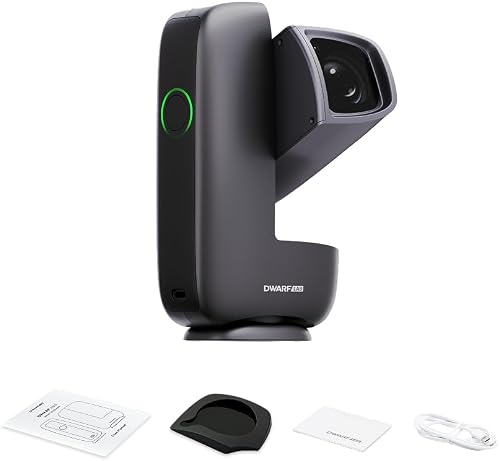
The package includes a carrying bag, magnetic filters, filter pouch, wipe cloth and USB-C cable. Organize filters in the pouch and keep the optics clean between sessions.
Choose it if you want one compact imaging device for celestial and daytime subjects. For visual observing through a standard eyepiece, choose a conventional telescope instead.
How do automatic telescopes keep targets centered?
Automatic telescopes use a motorized mount that turns to follow Earth as it rotates. That keeps a target centered instead of letting it drift out of view.
The mount needs position information before it can track. That comes from alignment, an app, or an internal control system.
Alignment usually happens at the start of a session. You point at known bright stars or planets so the mount learns where it is aimed.
GoTo then adds target selection. You choose an object on a hand control or app, and the telescope slews toward it.
Tracking holds the object near the center of the field. This matters most at higher magnification, where even a small drift moves the target quickly.
The NexStar 6SE uses SkyAlign and a hand control. SkyAlign asks you to center any 3 bright stars or planets, even if you do not know their names.
The DWARFLAB and ZWO models use app-controlled functions for target selection, pointing, and tracking. Smart telescopes also steady the device during long exposures, which helps the camera record faint detail without streaked stars.
The Celestron StarSense Explorer LT 114AZ is different. It helps you find targets, but its manual mount still requires you to move the telescope, so it is guided finding, not automatic tracking.
A manual equatorial mount is a middle option. It can make following an object smoother, but you still make every adjustment.
Check the mount type before you buy if tracking is your main goal. Also check whether the telescope is built for eyepiece viewing or camera imaging, as the experience is very different.
Do beginners need a computerized telescope?
Beginners do not need a computerized telescope, but automatic tracking can make long viewing sessions easier. It is most useful when you want to observe many targets, use higher magnification or capture images.
A manual refractor such as the Dianfan or MEEZAA gives you direct control and fewer electronic steps. A smartphone-guided reflector such as the StarSense Explorer LT 114AZ adds help with finding objects without adding a motorized mount.
Choose computerized tracking when your main goal is convenience and repeated target viewing. If you want a simple learning process, a manual telescope may teach more about the sky's layout.
Our guide to Do Beginners Need a Computerized Telescope? explains the trade-off between learning the sky manually and using automated assistance.
What should you check before buying a tracking telescope?
Check whether the telescope tracks visually, captures images, or does both. A traditional computerized scope such as the NexStar 6SE is built around eyepiece viewing, while the Seestar S30 Pro and DWARFLAB models are built around app-controlled imaging.
Also compare the mount, aperture and setup weight. The NexStar 6SE has a 6 in aperture and weighs 21 lb, while the Dwarf Mini weighs 1.85 lb and uses a 30mm objective lens.
Check how alignment works before you buy. A system that asks you to center bright stars may suit you better than a workflow that depends on a phone, tablet or computer.
For computer-based imaging, compare our guides to best telescopes that connect to a laptop and best telescopes with USB connections and software. If you are considering a Wi-Fi refractor, read our Celestron AstroFi 90 Wi-Fi refractor review.
How should you set up and use an automatic telescope?
Set the tripod or telescope on firm, level ground before alignment. A stable base reduces shaking while the mount moves and while you focus.
Use a clear night with calm air and low light pollution when possible. Clouds, wind, and turbulence reduce detail even when the mount tracks correctly.
Dark skies help faint objects stand out. If you live under bright city lights, travel to a darker site for deep-sky targets.
Give the telescope time to finish alignment. Rushing setup often leads to inaccurate pointing later in the night.
After selecting a target, use a lower-power view first when needed. A wider view makes it easier to confirm the target is centered.
Then move to higher magnification once it is centered. Higher power shows more detail, but also shows tripod shake and air movement more clearly.
Smart telescopes need a stationary position during imaging. Avoid touching the device during a long exposure, as even small bumps can spoil tracking and blur the final image.
Protect optical surfaces from dust and moisture. Store the telescope in its case or bag when it is not in use.
Let the telescope adjust to outdoor temperatures before observing. Keep eyepieces and lenses clean with a soft cloth, as fingerprints and dust reduce contrast.
Plan your session around a few bright targets first. The Moon, Jupiter, and Saturn are good early choices for learning the controls.
Can a reflector telescope work with tracking?
Yes, a reflector telescope can work with tracking on a motorized mount. The mirror optics do not prevent tracking, because the mount controls how the tube moves.
Motorized mounts locate a target after alignment and then follow it as Earth rotates. That keeps the object centered for visual observing or camera imaging.
The Gskyer 130EQ uses an equatorial mount that supports manual tracking. You still make the adjustments yourself, but the mount moves in a way that follows the sky.
The DWARFLAB Dwarf Mini uses an altazimuth and equatorial mount with automatic app-controlled functions. Its design is built around digital capture rather than traditional eyepiece viewing.
Reflectors can offer larger apertures for the size of the optical tube. That larger aperture gathers more light for faint deep-sky objects.
An altazimuth mount moves up and down and side to side. A motorized version can track well for visual observing, though long camera exposures may need extra care.
An equatorial mount follows the rotation of the sky more directly. That design is often preferred for longer imaging sessions.
Check whether tracking is manual, motorized, or app-controlled before you buy. Compare our guide to the best reflector telescopes for astronomy if you prefer Newtonian designs.
Choose a reflector for light gathering and value at larger sizes. Choose a refractor if you prefer a simpler sealed tube and easier daytime use.
Either design can track well with the right mount. The mount and setup routine matter as much as the optical design.
Which automatic-tracking telescope should you choose?
Choose the Celestron NexStar 6SE if you want the strongest traditional visual telescope with automatic locating and tracking. Its 6 in optics, computerized GoTo mount, and SkyAlign system make it the most complete eyepiece-focused choice here.
That choice suits observers who want to look through an eyepiece and visit many targets in one night. The hand control and large object database reduce time spent searching the sky.
Choose the DWARFLAB Dwarf Mini for the lightest smart tracking setup. Its 1.85 lb body and app control suit travel, camping, and quick imaging sessions.
Choose the ZWO Seestar S30 Pro for deep-sky imaging from a phone or tablet. Its automatic targeting, 4K dual-camera imaging, and one-tap processing suit users who want shareable photos.
Choose the Dwarf 3 for portable day and night capture. The dual imaging system and 4K auto-tracking suit astronomy, wildlife, and landscape subjects in one compact device.
Choose a Dianfan, MEEZAA, or Gskyer model if you prefer manual control and do not need a motorized mount. Those scopes teach pointing skills and keep the setup simple.
Choose the StarSense Explorer LT 114AZ if you want smartphone guidance without motorized tracking. It helps you find targets while you still control the telescope yourself.
Your best pick depends on how you want to observe. Visual astronomy, app-based imaging, and manual learning each lead to a different telescope.
Our top 3 picks at a glance
-
1
-
2
-
3
Best for serious visual astronomy
Celestron NexStar 6SE Schmidt-Cassegrain Telescope
9.5/10 our score
See it on Amazon
Frequently asked questions
What is automatic tracking on a telescope?
Automatic tracking keeps a celestial target centered as Earth rotates. A computerized mount uses a motor and alignment information to follow the object after you select it.
Smart telescopes combine this function with app control and imaging, while manual equatorial mounts still need user adjustments.
What is the best telescope with auto tracking for beginners?
The Celestron NexStar 6SE is the strongest beginner-friendly visual pick here if you want a conventional eyepiece telescope with computerized GoTo and tracking. The DWARFLAB Dwarf Mini and ZWO Seestar S30 Pro are easier choices for app-based astrophotography.
Do computerized telescopes need alignment?
Usually, yes. The NexStar 6SE uses SkyAlign by asking you to center 3 bright stars or planets.
Smart telescopes use app-based systems and automatic target functions.
Alignment gives the mount the position information it needs to point and track accurately.
Is GoTo the same as automatic tracking?
No. GoTo moves a telescope to a selected target, while tracking keeps that target centered afterward.
Many computerized telescopes provide both functions.
Check for both automatic locating and tracking if you want the telescope to find an object and follow it during an observing session.
Can a manual telescope track stars?
Yes, an equatorial manual mount can make tracking easier because its movement follows the sky's rotation. The Gskyer 130EQ uses a German equatorial mount, but it does not automatically follow targets.
You still turn the controls as the object moves.