9 Best Telescopes With Phone Attachments (November 2026)
The best telescopes with phone attachments include the Gskyer Telescope for a travel-ready phone kit, the Dianfan Telescope for a 90 mm refractor bundle, and the MEEZAA Telescope for eyepiece and Barlow options.
On this page (4 sections)
The best telescope with phone attachment for most beginners is the Gskyer Telescope, with a phone adapter and wireless camera remote included. For a larger refractor, look at the Dianfan or MEEZAA; for smartphone-guided target finding, consider a Celestron StarSense model.
A phone attachment can mean two different things: a bracket that aligns your camera with the eyepiece for photos, or a dock that uses your phone to guide the telescope toward objects. This roundup includes both, so check each pick's phone role before buying.
If you want a phone to help you find objects, see our guide to the best telescope with app guidance. For models centered on phone connection and control, compare our best telescope that connects to a phone.
Our picks at a glance
-
1
-
2

-
3

- 4
 Check it
Celestron StarSense Explorer DX 130AZ Smartphone Guided
Best for guided deep-sky targets - 5
 Check it
CELTICBIRD Telescope for Adults High Powered
Best for an 80 mm portable kit - 6
 Check it
Celestron StarSense Explorer LT 114AZ Newtonian Smartphone
Best for guided 114 mm viewing - 7
 Check it
Celestron Basic Telescope Eyepiece Smartphone Adapter
Best for adding phone photos - 8
 Check it
OXK Optics 12x56 Monocular Telescope for Adults High
Best for a compact daytime phone setup - 9
 Check it
CELTICBIRD Telescope for Adults High Powered
Best for a longer refractor tube
The best telescopes with phone attachments for different needs
The Gskyer is the top fit for a complete travel kit with photo accessories, while the Celestron StarSense models use phones for sky guidance. We compared the features and how closely each setup fits eyepiece photography or smartphone-assisted observing.
Our score weighs specs, features and buyer feedback against what you're shopping for. A phone adapter and a guidance dock solve different problems, so the scores reflect each product's fit for this topic.
| Product | Best for | Optical design | Aperture and focal length | Phone accessory | Our score |
|---|---|---|---|---|---|
| Gskyer Telescope | a travel-ready phone kit | Refractor | 70 mm, 400 mm | Smartphone adapter and wireless camera remote | 9.7 |
| Dianfan Telescope | a 90 mm refractor bundle | Refractor | 90 mm, 800 mm | Phone adapter included | 9.7 |
| MEEZAA Telescope | eyepiece and Barlow options | Refractor | 90 mm, 800 mm | Phone adapter included | 9.6 |
| Celestron StarSense Explorer DX 130AZ Smartphone Guided | guided deep-sky targets | Newtonian reflector | 130 mm, 650 mm | 9.6 | |
| CELTICBIRD Telescope for Adults High Powered | an 80 mm portable kit | Refractor | 80 mm, 600 mm | Upgraded phone adapter included | 9.5 |
| Celestron StarSense Explorer LT 114AZ Newtonian Smartphone | guided 114 mm viewing | Newtonian reflector | 114 mm, 1000 mm | 9.5 | |
| Celestron Basic Telescope Eyepiece Smartphone Adapter | adding phone photos | 9.2 | |||
| OXK Optics 12x56 Monocular Telescope for Adults High | a compact daytime phone setup | Smartphone holder included | 9.0 | ||
| CELTICBIRD Telescope for Adults High Powered | a longer refractor tube | Refractor | 80 mm, 900 mm | Phone mount included | 8.9 |
Gskyer Telescope: Best for a travel-ready phone kit
- 70 mm aperture
- 400 mm focal length
- Phone adapter and wireless camera remote
- Carry bag
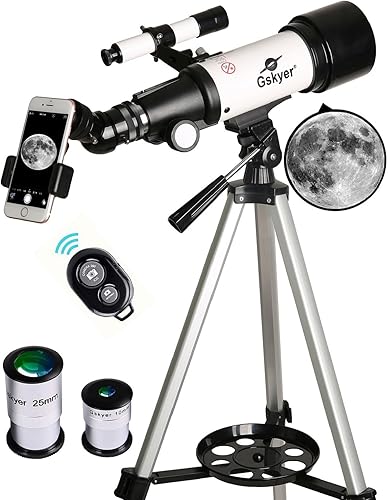
This compact refractor includes both a phone adapter and a wireless remote for taking images through the eyepiece. Its carry bag holds the telescope and tripod.
Pros
- Phone adapter and remote included
- Carry bag included
- Two eyepieces and 3x Barlow lens
Cons
- Smaller aperture than the 80 mm and 90 mm refractors here
The Gskyer Telescope is the clearest fit if you want to start taking phone pictures without buying a separate adapter. It includes a smartphone adapter and wireless camera remote, along with a carry bag for the telescope and tripod.
The 70 mm refractor has a 400 mm focal length and an altazimuth mount. Two replaceable eyepieces and a 3x Barlow lens let you switch magnification, while the 5x24 finder scope helps locate a target before you center it in the eyepiece.
The remote can help you trigger a shot without touching the phone screen, which can shift the alignment. Keep expectations practical: phone-through-eyepiece images depend on a steady view, focus and the camera's position over the eyepiece.
Choose this kit if portability and the included photo accessories matter more than aperture. For phone photography with a telescope you already own, the best telescope lens for a phone guide can help you compare separate adapters.
Dianfan Telescope: Best for a 90 mm refractor bundle
- 90 mm aperture
- 800 mm focal length
- Phone adapter and carry bag
- Stainless steel tripod
The 90 mm refractor combines a phone adapter with two eyepieces, a 3x Barlow lens and a carry bag. It is a fit for buyers who want a complete telescope kit with a larger aperture.
Pros
- 90 mm aperture
- Stainless steel tripod
- Phone adapter and bag included
Cons
- Phone camera remote is not specified
Dianfan suits buyers who want a 90 mm refractor with a phone adapter in the same kit. It includes an 800 mm focal length, two eyepieces, a 3x Barlow lens, a stainless steel tripod and a carry bag.
The phone adapter is intended for capturing images through the telescope. The 45-degree zenith mirror is described for upright terrestrial viewing, so this setup can also serve daytime viewing when you want a correctly oriented image.
Dianfan gives a 32x to 240x magnification range. High magnification can make it harder to keep a target centered, so start with a lower-power eyepiece and move up only after focusing and centering.
Choose this option if you want a larger-aperture refractor kit with a phone adapter and bag. The phone camera remote is not specified, so plan to use your phone's timer or remote shutter if touching the screen moves the image.
MEEZAA Telescope: Best for eyepiece and Barlow options
- 90 mm aperture
- 800 mm focal length
- Phone adapter
- 10 mm and 25 mm eyepieces with 3x Barlow
This refractor pairs a phone adapter with two eyepieces and a 3x Barlow lens. The stainless steel tripod adjusts from 28 to 46 inches.
Pros
- Two eyepieces and 3x Barlow
- Phone adapter and carry bag included
- Adjustable stainless steel tripod
Cons
- Phone camera remote is not specified
MEEZAA is another 90 mm refractor bundle with an included phone adapter. Its 800 mm focal length pairs with 10 mm and 25 mm eyepieces and a 3x Barlow lens, plus a carry bag and adjustable stainless steel tripod.
The tripod adjusts from 28 to 46 inches, which gives you a range of viewing heights. The adapter is intended for phone photos and videos through the eyepiece, making this a straightforward choice for someone who wants an all-in-one kit.
For clearer first images, begin with the 25 mm eyepiece, center a bright target, then adjust the focus before attaching or aligning the phone. Higher magnification can make camera alignment and tracking more demanding.
Choose MEEZAA if the eyepiece options and adjustable tripod fit your plans. The phone camera remote is not specified, and a stable setup still matters when you capture an image.
Celestron StarSense Explorer DX 130AZ Smartphone Guided: Best for guided deep-sky targets
- 130 mm Newtonian reflector
- StarSense smartphone sky guidance
- Manual altazimuth mount with dual-axis slow-motion controls
- Two eyepieces
StarSense uses a docked phone to guide you toward targets through the eyepiece. This model is for locating and observing objects, rather than a kit described with a phone photography adapter.
Pros
- 130 mm aperture
- Guided target finding through StarSense
- Dual-axis slow-motion controls
Cons
- No eyepiece phone photography adapter is specified
The Celestron StarSense Explorer DX 130AZ is for people who want the phone to help locate targets. Dock the phone, open the StarSense Explorer app and follow on-screen arrows; the app uses sky recognition to help identify the telescope's position.
This is a 130 mm Newtonian reflector with a 650 mm focal length. Its manual altazimuth mount has dual-axis slow-motion controls, and the kit includes 25 mm and 10 mm eyepieces.
The phone dock supports guided observing, but it is not described as a phone camera adapter for taking pictures through the eyepiece. If that is your main goal, choose one of the refractor kits with a phone adapter or add a compatible adapter separately.
For more detail on this model, read our Celestron StarSense Explorer DX 5 review. Choose it when guided trips through the sky matter more than a bundled eyepiece photography bracket.
CELTICBIRD Telescope for Adults High Powered: Best for an 80 mm portable kit
- 80 mm aperture
- 600 mm focal length
- Phone adapter and moon filter
- Backpack included
The phone adapter, moon filter and backpack make this an accessory-rich 80 mm refractor kit. Its two eyepieces provide 30x and 66x magnification.
Pros
- Phone adapter and moon filter included
- Backpack holds accessories
- Tripod adjusts from 17.7 to 52 inches
Cons
- Phone camera remote is not specified
This CELTICBIRD 80 mm refractor includes a phone adapter, moon filter and backpack. Its 600 mm focal length and adjustable aluminum tripod make it a compact kit for a beginner who also wants the option to carry the setup.
The telescope comes with 20 mm and 9 mm eyepieces, listed for 30x and 66x magnification, plus a 5x24 finderscope. The tripod adjusts from 17.7 to 52 inches, a broad height range for different viewing positions.
The included phone adapter is meant for taking photos through the phone camera. The moon filter is an additional observing accessory; follow its instructions and never aim a telescope at the Sun.
Pick this model if you want a portable refractor kit with a backpack and moon filter. If guided app features matter more than taking phone pictures, compare it with our Celestron StarSense reviews.
Celestron StarSense Explorer LT 114AZ Newtonian Smartphone: Best for guided 114 mm viewing
- 114 mm Newtonian reflector
- StarSense smartphone sky guidance
- Altitude slow-motion adjustment
- Two eyepieces and 2x Barlow
The LT 114AZ uses a docked smartphone and StarSense app to guide you to sky targets. Its phone role is guidance; the included kit does not specify an adapter for taking pictures through the eyepiece.
Pros
- 114 mm aperture
- StarSense guided target finding
- 2x Barlow lens included
Cons
- No eyepiece phone photography adapter is specified
The StarSense Explorer LT 114AZ uses a phone for guided sky tours, not as an eyepiece photography camera mount. Dock your phone and use the app's arrows to find stars, planets and other targets.
This Newtonian reflector has a 114 mm aperture and 1000 mm focal length. It includes 25 mm and 10 mm eyepieces, a 2x Barlow lens and a manual altazimuth mount with altitude slow-motion adjustment.
The difference matters if you are shopping for a complete photo kit. The phone dock can help you find what to observe, while a separate eyepiece adapter is needed to position a phone camera for images.
Choose the LT 114AZ if guided target finding is the main phone feature you want. If you're weighing reflector designs, our Schmidt-Cassegrain vs Newtonian comparison explains how the Newtonian design fits into that choice.
Celestron Basic Telescope Eyepiece Smartphone Adapter: Best for adding phone photos
- Fits eyepieces 29 mm to 45 mm in diameter
- Adjustable phone clamp
- Alignment knob
- Works with many optical devices
This adapter can add phone photography to a compatible telescope you already own. Check your eyepiece diameter and phone fit before choosing it.
Pros
- Fits many 1.25 in eyepieces
- Alignment knob helps center the camera
- Works with several types of optical devices
Cons
- Adapter only, telescope sold separately
The Celestron Basic Telescope Eyepiece Smartphone Adapter helps add phone photography to a telescope you already own. Its eyepiece clamp fits diameters from 29 mm to 45 mm, including many 1.25 in telescope eyepieces.
A phone clamp holds the device while an alignment knob centers its camera over the eyepiece. The adapter can also rotate 90 degrees for portrait or landscape framing, and it works with several types of optical devices.
Before choosing it, measure your eyepiece and check that your phone fits the holder. The telescope is not included, so this is an add-on rather than a complete telescope kit.
Choose it if your current telescope has a compatible eyepiece and you want to try phone images. It is also a practical route if you prefer selecting the telescope separately from the camera mount.
OXK Optics 12x56 Monocular Telescope for Adults High: Best for a compact daytime phone setup
- 12x56 monocular
- Smartphone holder and adjustable tripod
- Fully multi-coated optics
- Portable case
This compact monocular pairs a phone holder with an adjustable tripod for distant daytime scenes. It is an alternative for casual viewing, not a telescope for astronomy.
Pros
- Phone holder and tripod included
- Portable case included
- 12x magnification
Cons
- Monocular rather than an astronomy telescope
The OXK Optics 12x56 is a monocular with a phone holder, rather than an astronomy telescope. It suits daytime scenes such as wildlife, travel or sports when you want a compact optical device and a way to record the view.
The kit includes a smartphone holder, adjustable tripod and portable case. The monocular has 12x magnification and a 56 mm objective, with fully multi-coated optics.
That makes it a useful adjacent option, but it is not a substitute for a telescope kit designed for astronomy. Choose it for daytime viewing and casual phone capture, not for observing planets or deep-sky targets.
CELTICBIRD Telescope for Adults High Powered: Best for a longer refractor tube
- 80 mm aperture
- 900 mm focal length
- Phone mount
- Carry bag
This 80 mm refractor has a longer 900 mm focal length and includes a phone mount, carry bag and two eyepieces. Consider it if those details suit your observing setup.
Pros
- 900 mm focal length
- Phone mount and carry bag included
- Two eyepieces included
Cons
- Phone camera remote is not specified
This CELTICBIRD refractor offers an 80 mm aperture, 900 mm focal length and phone mount. It also includes two eyepieces, a 5x24 finder scope, adjustable aluminum tripod and carry bag.
The longer focal length distinguishes it from the other 80 mm CELTICBIRD option here. Its phone mount is intended to help capture images through a phone, while the bag keeps the telescope accessories together for transport.
Choose this model if the 900 mm focal length fits your observing plans and you want a phone mount included. The remote camera control is not specified, so handle the phone gently after alignment to reduce movement.
What should a phone telescope attachment do?
A phone photography adapter should hold the phone camera over the eyepiece and let you adjust its position. A smartphone guidance dock has a different job: it helps you point the telescope toward targets.
Look for an adapter that grips the eyepiece securely and gives you room to center the phone camera. The Celestron adapter's 29 mm to 45 mm fit range is one example of why eyepiece diameter matters.
A guidance app can still be useful, especially if you're new to finding objects. The DWARFLAB DWARF Mini review covers a different kind of phone-connected observing setup.
How do you take steadier photos through a telescope?
Start with a bright, easy target such as the Moon, use a lower-power eyepiece and focus the telescope before aligning your phone. A stable tripod and a remote shutter or timer can reduce movement when you take the picture.
Center the target in the eyepiece first. Then place the phone camera over the eyepiece and adjust its position until the view fills the phone screen without dark edges; small alignment changes can make a large difference.
Which telescope with a phone attachment should you choose?
Pick the Gskyer if you want a travel-ready refractor with both a phone adapter and wireless camera remote. Choose the Dianfan or MEEZAA if you prefer a 90 mm refractor bundle, and select a StarSense model if phone-guided target finding is your priority.
For a phone photo kit, confirm that the accessory holds your camera over the eyepiece. For guided observing, choose a dock and app that help you locate targets, then add an eyepiece adapter only if you also want to capture images.
A smart telescope such as the DWARF Mini follows another approach, with phone-based control central to the observing experience.
Our top 3 picks at a glance
-
1
-
2
-
3
Frequently asked questions
Can you take pictures through a telescope with a phone?
Yes. A phone adapter holds the phone camera over the eyepiece so it can record the view.
A steady tripod, careful camera alignment and a bright target such as the Moon make the first attempts easier.
A phone adapter is different from a telescope app dock, which guides you to targets but may not hold the camera over the eyepiece.
Is a phone attachment included with every telescope here?
No. The Gskyer, Dianfan, MEEZAA and CELTICBIRD refractors include phone adapters or mounts.
The Celestron StarSense models use a docked phone for sky guidance, while the Celestron Basic Adapter is a separate accessory for a compatible eyepiece.
Check the role of the phone attachment before you choose.
What should I check before buying a phone adapter?
Check that the clamp fits your phone and that the adapter fits the telescope eyepiece. The Celestron Basic Adapter is designed for eyepieces from 29 mm to 45 mm in diameter.
Also make sure the adapter lets you center the camera over the eyepiece, since alignment affects how much of the view appears in the image.
Can a phone telescope take clear pictures of planets?
A phone can record the view through an eyepiece, but a sharp image depends on focus, alignment, a stable mount and viewing conditions. The Moon is a useful first target because it is bright and easy to center.
Expect phone-through-eyepiece images to differ from dedicated astronomy-camera results.