DWARFLAB DWARF Mini Smart Telescope Review: Worth It? (November 2026)
The DWARFLAB DWARF Mini suits buyers who want a very portable, app-controlled telescope for automated astrophotography. Its 1.85 lb weight and 90-second exposure support are appealing, while its 30 mm objective makes it a compact imaging choice rather than a conventional eyepiece telescope.
On this page (8 sections)
- What does the DWARF Mini offer?
- How well does the DWARF Mini fit automated astrophotography?
- Is the DWARF Mini good for beginners?
- How portable is the DWARF Mini?
- What are the DWARF Mini’s main trade-offs?
- How does the DWARF Mini compare with the Seestar S30 Pro?
- What should you consider before buying?
- Is the DWARF Mini worth considering?
The DWARFLAB DWARF Mini is a lightweight smart telescope for app-controlled astrophotography, with Auto GOTO, EQ mode and exposures up to 90 seconds. Its 1.85 lb weight makes it easy to carry, but its 30 mm objective is better understood as a compact imaging tool than a traditional telescope for eyepiece viewing.
This review compares the DWARF Mini’s published features with two alternatives that suit different observing styles. We checked the specs against the needs of buyers considering automated astrophotography.
What does the DWARF Mini offer?
The DWARF Mini combines a 30 mm objective, app control and automated tracking in a device weighing 1.85 lb. It includes a built-in sky atlas, 360° pivot freedom, EQ mode, image processing and support for exposures up to 90 seconds.
DWARFLAB Dwarf Mini Smart Telescope: Best for lightweight imaging
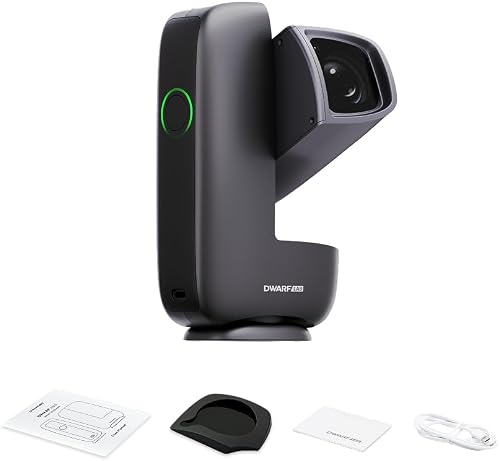
- 1.85 lb weight
- App control with built-in sky atlas
- Auto GOTO and 360° pivot
- EQ mode and exposures up to 90 seconds
A compact, app-controlled option for buyers who want automated tracking and deep-sky imaging features in a lightweight package.
Pros
- 1.85 lb stated weight
- Auto GOTO and 360° pivot
- EQ mode and up to 90-second exposures
- Built-in light pollution filters and cloud processing
Cons
- 30 mm objective is small for a conventional visual telescope
- Imaging depends on a smartphone app and powered device
- The compact design may not suit buyers seeking a traditional eyepiece setup
Its portability is the main draw: the compact telescope is designed to fit in a backpack or large pocket. The included items are the telescope, a filter, a USB-C to USB-C cable and a cleaning cloth.
DWARF Mini smart telescope review: key details
The DWARF Mini supports automated imaging with app-guided target selection. Its listed optical details include a 30 mm objective and 150 mm focal length, while the brand description also refers to a 1016 mm equivalent focal length.
| Detail | DWARFLAB DWARF Mini |
|---|---|
| Objective lens diameter | 30 mm |
| Weight | 1.85 lb |
| Focal length | 150 mm |
| Mount modes | Altazimuth and equatorial |
| Tracking | Auto GOTO |
| Rotation | 360° pivot |
| Maximum single-frame exposure | 90 seconds |
| Control | Smartphone app |
| Included items | Filter, USB-C cable, cleaning cloth |
The available specs use different focal-length descriptions, so compare the 150 mm optical focal length with the stated equivalent figure carefully. For practical setup and framing, the app and the telescope’s own field of view are more useful than treating those two numbers as interchangeable.
How well does the DWARF Mini fit automated astrophotography?
The DWARF Mini is a strong fit for portable, automated imaging because it combines target selection, tracking and exposure control in one compact system. The 90-second exposure support and EQ mode provide options for capturing dimmer targets, while built-in filters and processing are intended to simplify the imaging workflow.
DWARFLAB describes dark frame calibration to reduce thermal noise, an Astro Filter for nebula contrast and infrared sensitivity, and a Duo-Band Filter optimized for H-alpha and OIII wavelengths. The package data confirms one filter is included, so check which filter is supplied with the exact configuration you plan to buy.
The compact format also sets limits. A 30 mm objective gathers less light than a larger telescope, so this model prioritizes convenient digital imaging over the brightness and direct eyepiece experience of a larger optical tube.
Think about your whole session, not only the telescope weight. You’ll need a charged device, a stable location and time to learn the app’s controls and image settings.
Is the DWARF Mini good for beginners?
The DWARF Mini can suit beginners who want guided, app-based imaging instead of manual sky navigation. Selecting a target in the built-in atlas and letting Auto GOTO handle pointing reduces the steps involved in finding an object.
That ease of control doesn’t remove every learning curve. You’ll still need to understand basic sky conditions, keep the instrument steady and decide which targets make sense for its compact optics.
If you’d rather view the Moon, planets and bright deep-sky objects directly through an eyepiece, consider a manual guided telescope. The best Explore Scientific telescopes page can help compare conventional optical setups, while the Celestron below is a specific smartphone-guided alternative.
Celestron StarSense Explorer LT 114AZ Newtonian Smartphone: Best for eyepiece observing

- 114 mm Newtonian reflector
- Smartphone-guided sky navigation
- Manual altazimuth mount
- Includes 25 mm and 10 mm eyepieces
A manual telescope for buyers who prefer looking through an eyepiece, with smartphone guidance to help locate targets.
Pros
- Larger 114 mm aperture
- Includes two eyepieces
- App-guided target finding
- Manual slow-motion altitude adjustment
Cons
- 10.4 lb stated weight
- Manual aiming and tracking
- Different observing style from automated astrophotography
The Celestron StarSense Explorer LT 114AZ uses a 114 mm Newtonian reflector and includes 25 mm and 10 mm eyepieces. Its phone app guides you toward targets, but you aim and track the telescope manually.
How portable is the DWARF Mini?
At 1.85 lb, the DWARF Mini is notably light to carry compared with a traditional telescope setup. Its compact design can work well for travel, hiking or bringing an imaging system to a darker location.
A low carry weight helps when you have a long walk from a parking area or need to pack around other gear. It doesn’t tell you how long the battery will last, so plan power around your session and check the manual for charging guidance.
Also consider the observing spot. A clear view of the sky, a stable surface and protection from nearby lights can matter more to your images than shaving a little weight from the kit.
For a wider view of smart telescope support options, see our guide to the best smart telescope mount. A compatible mount can help with setup choices, but verify what the DWARF Mini supports before adding hardware.
What are the DWARF Mini’s main trade-offs?
The DWARF Mini’s key trade-off is portability and automation in exchange for a small aperture and app-centered use. Buyers wanting a compact imaging companion may value that balance; buyers wanting direct visual observing may prefer a larger conventional telescope.
Its 30 mm objective is smaller than the 114 mm reflector in the Celestron StarSense Explorer. The Celestron is also substantially heavier at 10.4 lb, and its manual mount makes it a different kind of tool rather than a direct replacement.
A smart telescope’s image output also depends on software, power and conditions at the observing location. Cloud processing and one-tap enhancements can help simplify image finishing, but they don’t remove clouds, haze or obstructed views.
How does the DWARF Mini compare with the Seestar S30 Pro?
The Seestar S30 Pro is a larger smart telescope with a stated 4.6° field of view and dual-camera imaging, while the DWARF Mini weighs less and supports single-frame exposures up to 90 seconds. Both offer app control and automated target tracking.
ZWO Seestar S30 Pro Smart Telescope: Best for wider-field smart imaging

- App-controlled automatic GOTO and tracking
- Dual-camera 4K imaging
- 4.6° field of view
- EQ mode support
A smart imaging alternative with a stated 4.6° field of view and dual-camera imaging for buyers comparing automated sky photography.
Pros
- Automatic GOTO and tracking
- Dual-camera imaging
- Built-in light pollution filters
- Supports equatorial mode
Cons
- 3.64 lb stated weight
- Designed for deep-sky imaging, not planetary observation
- Requires a stationary setup for deep-sky imaging
The Seestar S30 Pro weighs 3.64 lb and supports EQ mode. ZWO describes it as designed for deep-sky imaging, not planetary observation, and advises keeping it stationary during deep-sky imaging for stable tracking.
If you’re weighing an upgrade or switching between these models, our Seestar S30 vs DWARF Mini comparison focuses on the practical differences. The Seestar S30 Pro vs DWARF Mini comparison gives another side-by-side decision guide, and our ZWO Seestar S30 Pro review covers that model on its own.
What should you consider before buying?
Buy the DWARF Mini when low carry weight and automated imaging are your main priorities. Its feature set is aimed at making target selection and image capture easier to manage from a phone.
Before choosing, decide what you want to do most often:
- For lightweight travel, the DWARF Mini’s 1.85 lb weight is an advantage.
- For eyepiece viewing, a conventional telescope such as the Celestron provides a larger aperture and included eyepieces.
- For a smart imaging alternative with a wider stated field of view, compare the Seestar S30 Pro.
- For long exposures, check that your planned targets and setup suit EQ mode and the exposure workflow.
The Seestar S30 vs S50 vs DWARF 3 guide covers other smart telescope choices in the family. You can also read our Seestar S50 vs DWARF 3 comparison for a focused look at two alternatives, or the DWARFLAB Draco smart telescope review for another model from the same brand.
Is the DWARF Mini worth considering?
The DWARF Mini is worth considering if you want a 1.85 lb smart telescope with app control, automated tracking and long-exposure support. Its size and automation make it a compelling travel-focused imaging choice, especially if direct eyepiece viewing isn’t your main goal.
Pick the DWARF Mini for compact automated astrophotography, the Celestron StarSense Explorer LT 114AZ for a larger eyepiece telescope with phone guidance, or the Seestar S30 Pro if its wider stated field of view and dual-camera imaging better fit your plans. These DWARF Mini smart telescope reviews point to a clear decision: choose based on whether portability, visual observing or a broader smart imaging setup matters most.
Frequently asked questions
What is the DWARFLAB DWARF Mini?
The DWARFLAB DWARF Mini is a compact, app-controlled smart telescope for automated imaging. It weighs 1.85 lb, includes Auto GOTO and a built-in sky atlas, and supports EQ mode with single-frame exposures up to 90 seconds.
It is designed around smartphone control and image capture rather than conventional eyepiece viewing.
Can the DWARF Mini photograph deep-sky objects?
Yes, the DWARF Mini includes automated tracking, EQ mode, auto-stacking and exposures up to 90 seconds for deep-sky imaging. Its 30 mm objective and compact sensor platform make it a small imaging system, so set expectations around a portable smart telescope rather than a large-aperture instrument.
Is the DWARF Mini easy for beginners to use?
The DWARF Mini is designed for app control, with a built-in sky atlas and target selection that starts automated tracking. Those features reduce manual setup steps, though you still need to learn the app, choose a suitable observing location and keep the telescope positioned steadily for imaging.
Should I choose the DWARF Mini or a traditional telescope?
Choose the DWARF Mini if portability and automated imaging matter most. A traditional telescope such as the Celestron StarSense Explorer LT 114AZ is a better fit if you want to observe through an eyepiece, since it has a 114 mm reflector and includes two eyepieces.



