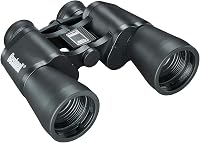
Bushnell Falcon 10x50 Binoculars Review: Worth It? (November 2026)
The Bushnell Falcon 10x50 Wide-Angle Binoculars suit beginners who want large, bright 10x50 views for the moon, bright stars and daytime use. Choose them for simple InstaFocus use and a wide 300-foot field of view at 1,000 yards, knowing that 10x hand holding still takes some practice.
On this page (11 sections)
- Bushnell Falcon 10x50 binoculars at a glance
- Who the Bushnell Falcon suits best
- What 10x50 means in daily use
- Why magnification and field of view matter for beginners
- How InstaFocus changes setup and use
- Size, weight and carrying the Falcon
- Optics, grip and build details
- How to set up the Falcon for stargazing
- Care and storage in general terms
- Trade-offs against the alternatives
- Final verdict on the Bushnell Falcon 10x50
The Bushnell Falcon 10x50 Wide-Angle Binoculars are a simple beginner choice for bright 10x viewing. They pair 10x magnification with 50 mm objective lenses, fully coated Porro prism optics and an InstaFocus system.
Our score weighs specs, features and buyer feedback against what you're shopping for. We compared the Falcon with two other large-objective models so you can see the trade-offs before you buy.
This bushnell falcon 10x50 wide angle binoculars review focuses on daily use for stargazing, nature study and live events. You will see what the numbers mean, how to set the pair up and when an alternative makes more sense.
Bushnell Falcon 10x50 binoculars at a glance
The Falcon gives you 10x50 Porro prism binoculars with a wide field of view. It is aimed at adults who want a go-everywhere pair for sports, sightseeing, nature study, backpacking, theatre or concerts.
Bushnell Falcon 10x50 Wide-Angle Binoculars: Best for simple beginner astronomy

- 10x magnification
- 50 mm objective lenses
- Porro prism with fully coated optics
- InstaFocus system
- 300-foot field of view at 1,000 yards
- Carrying case and neck strap
A straightforward 10x50 pair for beginners who want bright views without a complex focusing routine. Its wide field of view helps you find sky objects and follow daytime targets.
Pros
- 10x50 format gives a 5 mm exit pupil
- InstaFocus suits quick daytime and night views
- Wide field of view helps beginners find objects
- Rubberized grip aids secure handling
Cons
- 830 g is heavy for long handheld sessions
- 10x magnification can shake in unsteady hands
- Porro design is bulkier than compact roof-prism models
The package includes binoculars, a carrying case and a neck strap. That matters because a 10x50 pair is easier to carry and protect when it leaves the house.
Bushnell describes the design as all-weather with non-slip rubber grip pads. The enclosure has a rubberized, abrasion-resistant finish, which helps with grip in cold or damp conditions.
Who the Bushnell Falcon suits best
The Falcon suits first-time astronomy buyers who want simple focusing. InstaFocus removes a fiddly focusing routine, so you can look up and find a bright object quickly.
It also suits daytime users who watch birds, follow sports or look across a landscape. Bushnell lists those uses directly, and the 300-foot field of view at 1,000 yards helps you keep a moving target in view.
It is less ideal if you want the smallest pair in a bag. At 830 g, the Falcon is a full-size Porro design, so you should plan for it as a deliberate carry item rather than a pocket pair.
If you are still deciding on size, start with what binoculars to buy. That guide helps you match magnification and lens size to the views you plan to use most.
What 10x50 means in daily use
The Falcon uses 10x magnification and 50 mm objective lenses. Divide 50 by 10 and you get a 5 mm exit pupil, which is the beam of light that reaches your eye.
A 5 mm exit pupil is helpful after dark because your eye pupil opens in low light. It does not make the view brighter than the optics allow, but it helps the pair match your eye more comfortably than a smaller exit pupil.
The apparent angle of view is 5.7 degrees. That is the view you perceive through the eyepieces, while the field of view is 300 feet at 1,000 yards in the open scene.
A wide field of view helps beginners find objects. You can sweep across a constellation or follow a bird without losing it as quickly as you would with a narrow-view pair.
Our explanation of binoculars 10x50 meaning breaks down magnification, objective size and exit pupil in plain terms.
Why magnification and field of view matter for beginners
Ten times magnification is strong enough to show the moon's shape and craters in broad terms. It also brings distant birds, players and landmarks closer without the shake and narrow view that come with higher power.
Higher magnification is not always better for learning the sky. A narrower field makes it harder to find a star you intended to see, especially when you are new to star patterns.
The Falcon's 300-foot field of view at 1,000 yards is a key beginner feature. It gives you room to sweep, settle on a target and understand where that target sits among nearby stars.
Eye relief is 9 mm. That is the distance from the eyepiece your eye should sit for a full view, and fold-down eyecups help eyeglass wearers adjust their position.
If you want the strongest 10x50 views for astronomy, compare options in best 10x50 binoculars for astronomy. The Falcon appears here as a practical, wide-view contender rather than a high-power specialist.
How InstaFocus changes setup and use
The Falcon uses InstaFocus for fast focus on moving targets. Bushnell presents it as a system for quick viewing, and the fixed-focus description means less adjustment before each look.
That suits astronomy beginners who want to point, look and move on. You spend less time turning a focus wheel and more time learning the patterns overhead.
It also suits daytime event viewing. When a bird lands or play moves across a field, a simple focus approach helps you reacquire the scene.
The trade-off is control. If you wear glasses or have eyes that focus differently, fold-down eyecups and eye position become more important because the system is not built around a separate fine-focus routine.
Set the interpupillary distance first, then raise the pair and check that both barrels align. Small eye-position changes can affect brightness and edge comfort, so take a few seconds to settle.
Size, weight and carrying the Falcon
The Falcon weighs 830 g and measures 9.3 x 8.2 inches for the binoculars. Its package measures 13.5 x 8.4 x 3.7 inches, which gives you a sense of the space it needs in a bag.
That weight is manageable for short sessions, but it adds up during a long night. Your arms may tire, and the image may shake more as fatigue sets in.
Rest your elbows on a table, a fence or your knees when you can. For astronomy, a seated position with support often gives a steadier view than standing with unsupported arms.
The included carrying case and neck strap help with transport and handling. Use the strap to reduce the risk of a drop, and keep the pair in the case when it is not in use.
Bushnell lists the country of origin as China and the model name as Bushnell Falcon 10x50. The manufacturer part number is 13-3450C, which is useful if you need to confirm the exact variant before you buy.
Optics, grip and build details
The Falcon uses Porro prisms with fully coated optics for light transmission. Bushnell also names BK7 prisms in its description, and the coating is listed as fully coated.
Fully coated optics help reduce reflections and support a bright, clear view. In practice, clean lenses and correct eye position matter as much as the coating label.
The rubberized, abrasion-resistant finish and non-slip grip pads help you hold the pair with gloves or cold hands. That grip also helps when the housing gets damp during outdoor use.
Fold-down eyecups are listed as a highlight. They help both eyeglass and non-eyeglass wearers find a comfortable eye position without pressing hard against the eyepieces.
The color is black in a pack of one. The design is made for adults, so check the fit and eye relief if you plan to share it with younger viewers.
How to set up the Falcon for stargazing
Start with eye alignment, a supported position and a wide target. Adjust the width between the barrels until you see one round image with both eyes open.
Then find a bright, easy target such as the moon or a bright star. Sweep slowly and stop when the target sits near the centre of the field of view.
Use the 300-foot field of view at 1,000 yards to your advantage. A slower sweep gives you time to notice when the target enters the edge of the view.
For the moon, expect a bright, high-contrast disc at 10x. Porro prism optics with fully coated lenses should give a clear view, but a slight change in angle can reduce glare.
Keep sessions short at first. Lower your arms, reset your eye position and sweep again, because fatigue can make a good pair feel unsteady.
Care and storage in general terms
Store the Falcon in its case, away from grit and damp. The included carrying case and neck strap are part of the package, so use them rather than leaving the lenses exposed in a bag.
Clean lenses with a soft cloth and minimal pressure. Hard rubbing can leave marks or damage coatings, so use gentle strokes and stop when the view is clear.
Keep the rubberized housing away from harsh chemicals. A damp cloth followed by drying is enough for normal outdoor dust and light moisture.
If the pair gets wet in the field, dry the outside and let it air dry before you close it in the case. That habit helps protect the optics and the rubber finish.
Let the binoculars reach outdoor temperature gradually on cold nights. That reduces the chance of condensation forming on cold surfaces when you bring them back inside.
Trade-offs against the alternatives
The Falcon's main trade-off is size and weight for a simple 10x50 view. At 830 g, it is heavier than a compact pair and needs more bag space.
Its 9 mm eye relief is also tighter than some alternatives. Eyeglass wearers should use the fold-down eyecups and check that they can see the full field without strain.
The field of view is a strength. At 300 feet at 1,000 yards, it is wider than the FLYANT 20x50 figure of 168 yards at 1,000 yards, which helps with finding and following targets.
Magnification is another trade-off. The Falcon's 10x view is steadier and wider than 20x, but it will not show distant detail as strongly as the FLYANT model.
FLYANT 20x50 alternative
The FLYANT model gives 20x magnification with 50 mm objective lenses. That doubles the Falcon's magnification, but its exit pupil falls to 2.5 mm.
That smaller exit pupil can make dim views less comfortable. It also means eye position matters more when you look after dark.
The FLYANT field of view is 168 yards at 1,000 yards. Compared with the Falcon's 300 feet at 1,000 yards, that is a much narrower window for sweeping the sky.
Manual center focus gives you direct control, and the 26 mm eyepiece is designed to fit the eye structure. Its weight is listed as 0.89 kg, close to the Falcon.
Choose the FLYANT if distant detail matters most and you can support the pair steadily. Choose the Falcon if a wider, simpler view matters more for learning and daytime use.
Bushnell PowerView alternative
The PowerView gives 10x magnification and 50 mm objective lenses in Realtree AP camouflage. It also uses InstaFocus and BK-7 prism multi-coated optics.
Its exit pupil is 5 mm, the same as the Falcon. Its eye relief is listed as 10 mm, slightly more than the Falcon's 9 mm.
The apparent angle of view is 6.5 degrees, compared with 5.7 degrees for the Falcon. The field of view figure is listed as 113.2, which is not directly comparable in wording to the Falcon's feet-at-yards figure.
Fold-down eyecups help eyeglass wearers, and the rubber grips give a non-slip hold. The case and instructions are included in the package.
Choose the PowerView if camouflage styling fits hunting or field use. Choose the Falcon if the stated 300-foot field of view and black finish fit your needs better.
For another 10x50 Bushnell comparison, read our nikon aculon a211 10x50 binoculars review and our pentax sp 10x50 wp binoculars review.
Final verdict on the Bushnell Falcon 10x50
Pick the Falcon if you want simple InstaFocus, a 5 mm exit pupil and a wide field of view. It is a sensible first 10x50 pair for the moon, bright stars, birds and live events.
Pick the FLYANT 20x50 if you want stronger magnification and accept a narrower view. Pick the PowerView if camouflage and a 10 mm eye relief figure matter more than the Falcon's field of view.
This bushnell falcon 10x50 wide angle binoculars review comes back to the same rule: match magnification to your support and your target. A steady 10x view you can find and follow often beats a shaky 20x view you cannot hold.
Check eye relief, weight and field of view against your plans before you buy. Then use the case and strap from day one, because a protected large-objective pair will serve you longer.
Frequently asked questions
Are the Bushnell Falcon 10x50 binoculars good for astronomy?
They suit beginners who want bright, wide views of the moon and bright stars. The 10x magnification and 50 mm objective lenses give a 5 mm exit pupil, which helps in dim light.
Start with wide open star fields, then move to the moon and bright planets.
What does 10x50 mean on the Bushnell Falcon?
The first number, 10, is magnification, and the second number, 50, is the objective lens diameter in millimetres. That combination gives a 5 mm exit pupil when you divide 50 by 10.
Our guide to binoculars 10x50 meaning explains how those figures affect brightness and field of view.
Do I need a tripod for 10x50 binoculars?
You can start handheld, but 10x magnification makes small movements easy to see. A tripod or a supported rest helps for the moon and long stargazing sessions.
The Falcon data does not list a tripod mount, so check the exact model and a suitable adapter before you plan tripod use.