Celestron StarSense Explorer 150mm Review: Worth It? (October 2026)
The Celestron StarSense Explorer 150mm suits beginners who want phone-guided object finding and a 6-inch reflector in a tabletop Dobsonian. Its manual base needs a firm raised surface, and you'll need a smartphone to use StarSense guidance.
On this page (9 sections)
- What does the StarSense Explorer 150mm review find?
- How does the phone guidance work?
- What can the 150mm telescope show?
- Will a tabletop base work for your observing spot?
- Does the Celestron tripod solve the height problem?
- When does the 8-inch StarSense Explorer make more sense?
- How does it compare with the FirstScope?
- What should you check before buying?
- Who should choose the Celestron StarSense Explorer 150mm?
The Celestron StarSense Explorer 150mm suits beginners who want guided object finding with a 6-inch reflector. Its app points you toward celestial targets, while the manual tabletop Dobsonian base keeps movement simple.
The main decision is whether you can provide a stable support and have a compatible smartphone. If you want a larger aperture, compare it with the 8-inch model below.
What does the StarSense Explorer 150mm review find?
The StarSense Explorer 150mm combines 150mm Newtonian optics with smartphone-guided finding. It is most appealing if locating targets is your main beginner hurdle and you have a steady table or the compatible Celestron tripod.
Celestron StarSense Explorer 150mm App-Enabled Tabletop Dobsonian: Best for guided deep-sky viewing
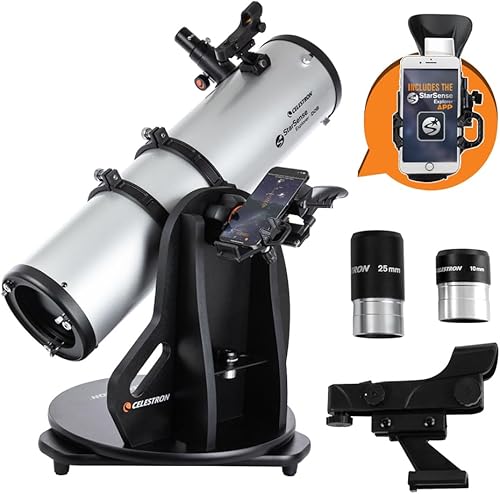
- 150mm Newtonian reflector
- StarSense Explorer smartphone app
- Manual tabletop Dobsonian base
- 25mm and 10mm eyepieces
A 6-inch reflector with phone-guided object finding for beginners who want help locating targets. Its tabletop base works best when you have a steady surface at a comfortable height.
Pros
- StarSense uses sky recognition to guide you toward targets
- App suggests objects based on time and location
- Includes 25mm and 10mm eyepieces
- 150mm aperture suits lunar, planetary and brighter deep-sky viewing
Cons
- Phone guidance depends on a compatible smartphone
- Tabletop base needs a stable support
- Manual tracking requires you to move the telescope
Celestron includes 25mm and 10mm eyepieces, a StarPointer red-dot finderscope and the StarSense smartphone dock. The app generates a list of targets for your time and location, then uses on-screen arrows to guide you; the bullseye turns green when you are aimed at the selected object.
Is the StarSense Explorer 150mm worth considering?
Consider it if you want a 6-inch reflector and guided help finding stars, planets, nebulae and other targets. The app's sky recognition is a practical distinction from relying on a phone's gyroscope alone.
The trade-off is that guidance does not make the telescope motorized. You point and track manually, so the app helps locate an object while your hands keep it in view.
How does the phone guidance work?
StarSense uses sky recognition to identify star patterns overhead and pinpoint the telescope's position. You dock a smartphone, open the app and follow its arrows to the target.
Celestron says the app builds a curated list based on your time and location. That can help narrow down what to observe, especially when you are still learning names and positions in the sky.
The phone is part of the locating system, so check that your device is compatible and that you are comfortable using it outdoors. You will also need enough battery for the session and a way to keep the phone steady in its dock.
When the bullseye turns green, you look through the eyepiece. The telescope remains manual: nudge the base to follow an object as it moves across the sky.
What can the 150mm telescope show?
The 150mm aperture is suited to lunar, planetary and brighter deep-sky observing, according to Celestron. The company names the Moon, Jupiter, Saturn, Orion Nebula and Andromeda Galaxy among possible targets.
Actual views depend on conditions, including light pollution, atmospheric steadiness and how high a target is above the horizon. The app can help you locate an object, but it cannot make faint targets brighter or improve poor sky conditions.
The included 25mm and 10mm eyepieces give you two starting magnifications. Begin with the 25mm eyepiece for a wider view and easier target acquisition, then try the 10mm when a target is centered and conditions support a closer look.
If aperture is your main priority, compare this model with the best 6 inch aperture telescope options. A larger mirror may collect more light, but the full telescope also needs to fit your storage, transport and setup routine.
Will a tabletop base work for your observing spot?
The tabletop Dobsonian base works when you have a stable, level support at a comfortable height. A wobbly table can make aiming and tracking harder, and a low surface may put fences or nearby objects in the way.
Before choosing a spot, think about what the telescope will stand on and how you will sit or stand while observing. Keep the base away from a surface that shifts when you lean in to use the eyepiece.
A tabletop format can be easier to store than a floor-standing Dobsonian, but it does not remove the need for a clear view of the sky. Our guide explains whether a tabletop telescope is good for beginners and what to plan for before buying.
For advice on the mount style, see whether a Dobsonian telescope is good for beginners. Manual movement is straightforward, though it takes practice to keep a target centered at higher magnification.
Does the Celestron tripod solve the height problem?
The compatible Celestron tripod raises the tabletop telescope to a more adjustable observing height. Its legs adjust from 24 to 41 inches, and the built-in tray can hold eyepieces.
Celestron Tripod for StarSense Explorer Tabletop Dobsonians: Best for a higher viewing position

- Adjustable height
- Accessory tray
- Folding legs
- Made for StarSense Explorer tabletop Dobsonians
This adjustable tripod raises a compatible tabletop Dobsonian for standing or seated observing. It also helps when a low tabletop position would leave fences or other obstacles in the way.
Pros
- Adjustable from 24 to 41 in
- Accessory tray keeps eyepieces close
- Folding legs support transport
- Three captured screws secure the base
Cons
- Adds a separate 9 lb piece of gear
- Designed for StarSense Explorer tabletop Dobsonians
The tripod is made specifically for StarSense Explorer tabletop Dobsonians. Three captured screws attach the base, while the folding legs make it easier to transport than a fixed-height stand.
Its 9 lb weight is an extra item to carry and store. Choose it if a higher position will make observing more comfortable or help clear low obstacles; skip it if you already have a sturdy support at the right height.
When does the 8-inch StarSense Explorer make more sense?
The 8-inch model is worth comparing if you want a larger 203mm aperture and can manage a heavier floor-standing telescope. It retains phone-guided finding, but weighs 43.4 lb.
Compare 8-inch and 10-inch telescope sizes before choosing.
Celestron StarSense Explorer 8" Dobsonian Telescope: Best for a larger aperture

- 203mm Newtonian reflector
- StarSense Explorer smartphone app
- Manual Dobsonian base
- 1200mm focal length
A floor-standing 8-inch alternative that keeps StarSense phone guidance while providing a larger aperture. Its weight and larger footprint call for more storage and moving space.
Pros
- Larger 203mm aperture
- StarSense app guides object finding
- Manual Dobsonian base
- Includes 25mm eyepiece and red-dot finderscope
Cons
- Weighs 43.4 lb
- Needs more storage and setup space than a tabletop model
- Manual tracking still requires movement by hand
This model has a 1200mm focal length and a manual Dobsonian base. Its size and weight make storage and moving it between observing spots a bigger part of the decision than with the 150mm tabletop model.
For a broader look at larger reflectors, read our guide to choosing a 10 inch telescope. If you want to compare Celestron models by budget or use, see best Celestron telescopes under 500 dollars and our guide to the best Celestron telescope.
How does it compare with the FirstScope?
The 150mm StarSense Explorer offers a larger aperture and phone-guided object finding compared with a basic tabletop telescope. The Celestron FirstScope is a different choice for readers who want a simpler, smaller tabletop instrument.
Read our Celestron FirstScope tabletop telescope review for that model's strengths and trade-offs. Compare the two around your intended targets, storage space and whether guided finding matters to you.
If you are leaning toward more aperture, our best 10 inch aperture telescope guide covers larger options. Those models need more space and setup effort, so consider portability alongside the mirror size.
What should you check before buying?
Check smartphone compatibility, support height and storage space before choosing the 150mm model. Those practical details determine whether the guided system and tabletop design fit your routine.
Measure the shelf or vehicle space where the telescope will go, and identify a stable observing surface near your usual viewing spot. If you plan to observe from a yard or balcony, check for fences, railings and rooflines that block low targets.
Think about who will use it, too. The tabletop base can put the eyepiece at a convenient height for some observers, but the support you choose affects comfort.
Who should choose the Celestron StarSense Explorer 150mm?
Choose the StarSense Explorer 150mm if guided finding, 6-inch optics and a compact tabletop base match your needs. It is less suitable if you need a self-tracking mount or do not have a stable support and compatible phone.
For a beginner who wants help locating targets, the app is the clearest reason to choose this model. Pick the tripod if you need adjustable height, the 8-inch Dobsonian if you want a larger aperture and can handle its weight, or the FirstScope if a simpler tabletop telescope is a closer fit.
Frequently asked questions
Is the Celestron StarSense Explorer 150mm good for beginners?
It can suit beginners who want help locating objects, since the StarSense Explorer app analyzes star patterns and guides you with on-screen arrows. You still move the telescope by hand, and the tabletop base needs a stable support.
Consider whether you have a compatible smartphone and a suitable observing surface.
What can you see with the StarSense Explorer 150mm?
Celestron describes the 150mm reflector as suitable for the Moon, planets such as Jupiter and Saturn, and brighter deep-sky targets such as the Orion Nebula and Andromeda Galaxy. What you can see depends on sky conditions, target position and observing location, with darker skies revealing more deep-sky objects.
Does the Celestron StarSense Explorer 150mm need a tripod?
The telescope has a tabletop Dobsonian base, so it needs a firm, level surface at a useful height. The separate Celestron tripod is made for StarSense Explorer tabletop Dobsonians and adjusts from 24 to 41 inches.
It can help if a table is too low or nearby obstacles block your view.
Should you choose the 150mm or 8-inch StarSense Explorer?
Choose the 150mm tabletop model if its base and 25 lb weight better fit your storage and setup needs. The 8-inch Dobsonian has a larger 203mm aperture, but it weighs 43.4 lb and takes more room.
Both use StarSense phone guidance and manual Dobsonian movement.



