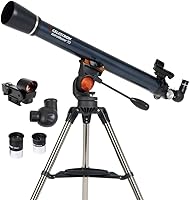
Dianfan 90mm 800mm Telescope Review: Worth It? (November 2026)
The Dianfan 90mm 800mm telescope is a strong beginner refractor for lunar viewing, casual stargazing and daytime targets. Its 90mm aperture, 800mm focal length, 32x–240x range and included phone adapter give it a useful mix of reach and flexibility.
On this page (8 sections)
- Dianfan 90mm 800mm telescope review at a glance
- How the Dianfan setup fits a beginner
- Is the 90mm aperture useful for beginners?
- Dianfan versus MEEZAA and HUGERSTAR
- What are the Dianfan's main strengths?
- What are the Dianfan's limitations?
- How to get clearer views with the Dianfan
- Is the Dianfan worth choosing?
The Dianfan 90mm 800mm telescope is a well-rounded beginner refractor for lunar viewing, casual stargazing and daytime observation. Its 90mm aperture, 800mm focal length, 32x-240x magnification range, stainless steel tripod and phone adapter give it a useful mix of reach and convenience.
This kit suits someone starting out rather than someone who already owns several telescopes. The tube is long enough for the Moon and distant daytime targets, while the included accessories cover the basics for a first night outside.
The 90mm front lens collects more light than a smaller starter refractor. That helps with brightness on the Moon and clearer daytime views, though it does not promise the same detail every night.
Air movement, haze and bright sky background still shape what you will see. A calm, clear night will show more than a windy night, even at the same magnification.
The 800mm focal length gives the telescope a focused, narrow field for its class. It suits craters and lunar seas, plus distant landmarks in daylight, but not a very wide view of large star fields.
The stated magnification range comes from two eyepieces plus a 3x Barlow lens. You can start low, find a target, then increase power once the image is steady and focused.
A stainless steel tripod and carrying bag make the setup easier to move between a garden, a field edge or a darker spot outside the city. The phone adapter adds a simple route for trying smartphone photos after you can centre a target confidently.
The main trade-off is that the highest magnification depends on steady air, careful focusing and a stable tripod. Set up on level ground, allow the tube to settle, focus slowly and keep expectations tied to the weather.
Dianfan 90mm 800mm telescope review at a glance
The Dianfan is best for a beginner who wants a 90mm refractor with an 800mm focal length and enough included equipment to begin observing without building a separate kit. Its fully coated 90mm objective lens is designed to gather more light than smaller beginner refractors.
Dianfan Telescope: Best for balanced beginner viewing

- 90mm aperture
- 800mm focal length
- 32x–240x magnification
- Stainless steel tripod
- Phone adapter and carry bag
The Dianfan combines a 90mm fully coated objective lens with an 800mm focal length and a 32x–240x range. Its stainless steel tripod, phone adapter and carry bag make it a flexible choice for beginners.
Pros
- 90mm aperture gathers more light than smaller beginner refractors
- 800mm focal length suits lunar and distant daytime viewing
- Includes a 3x Barlow lens, phone adapter and carry bag
- 45° zenith mirror supports upright terrestrial viewing
Cons
- Manual focus requires careful adjustment
- The full 240x range may be limited by air conditions and steadiness
- The 4.7 kg weight is worth considering for transport
The 45° zenith mirror keeps terrestrial images upright and correctly oriented, which makes the telescope more flexible for daytime viewing. The altazimuth mount is also a sensible match for learning basic left-right and up-down target movement.
What the Dianfan specifications mean in daily use
The 90mm aperture is the front objective diameter. A larger aperture can collect more light, which helps when you view the Moon, bright deep-sky targets and distant daytime subjects.
The 800mm focal length gives the telescope a relatively long optical reach for its class. It can make lunar features easier to frame, although the actual detail you see still depends on atmospheric conditions, focus and tripod steadiness.
The listed 32x–240x range comes from two eyepieces and a 3x Barlow lens. Treat 240x as an upper range rather than a guarantee of sharp viewing every night, because wind and atmospheric turbulence can make high-power views soft.
If you are comparing models by aperture, our guide to What Telescope Aperture Is Good for Beginners? explains why the front lens matters more than a large magnification number alone.
How the Dianfan setup fits a beginner
The Dianfan includes a stainless steel tripod, phone adapter, phone holder, carrying bag, telescope and accessories for a portable setup. The maker describes assembly as taking about 15 minutes, but the practical time depends on how familiar you are with the parts and instructions.
Set the tripod on flat ground and tighten each adjustment before attaching the telescope. A level surface reduces movement when you change the viewing direction or adjust focus.
The manual focus system is simple, but it needs small adjustments. Start with a bright, easy target such as the Moon, then turn the focus slowly until edges look as sharp as the conditions allow.
The phone adapter can help you share lunar views with a smartphone. Phone alignment takes patience, so center the target through the eyepiece before attaching the phone and keep the tripod still while you frame the image.
For a broader comparison, see our guide to the best refractor telescope for adults before deciding whether this size and style suit your observing plans.
Is the 90mm aperture useful for beginners?
A 90mm aperture is a practical middle ground for beginner astronomy because it gathers more light than many smaller starter telescopes without requiring a large optical tube. It can support clear lunar observing and bright daytime targets when the air is steady.
That balance is why this size suits a first serious refractor. It is big enough to feel like a step up from a small toy scope, yet still portable enough for family use and short trips in a car.
Aperture does not remove the effects of light pollution. City lights can wash out faint objects, so a darker location may improve the view more than adding magnification.
In practice, moving away from street lights and house lights often changes the night more than swapping eyepieces. The Moon will stay bright in both places, but faint targets benefit from a darker sky and calmer air.
The 800mm focal length also shapes the experience. It gives the Dianfan a focused observing style that suits the Moon and distant targets, while a wide, low-power view may be better for large star fields.
For beginners, that means choosing the right eyepiece for the target. Start low to locate and centre an object, then move up in power only while the image stays clear and the tripod stays still.
Read Why Does Aperture Matter on a Telescope? for a closer look at how aperture affects brightness, resolution and beginner expectations.
Dianfan versus MEEZAA and HUGERSTAR
All 3 telescopes in this comparison use a 90mm aperture and 800mm focal length, so the largest differences are in their included accessories and setup details. The right choice depends on whether you value the Dianfan's upright terrestrial viewing, MEEZAA's kit completeness or HUGERSTAR's moon filter.
MEEZAA Telescope
MEEZAA Telescope: Best for a complete starter kit

- 90mm aperture
- 800mm focal length
- Fully multi-coated optics
- 28–46 in stainless steel tripod
- Phone adapter and carry bag
MEEZAA offers the same 90mm aperture and 800mm focal length with a broad accessory set. Its 28–46 inch tripod range and included accessory tray suit shared family observing.
Pros
- Fully multi-coated optical glass lenses
- Includes 10mm and 25mm eyepieces plus a 3x Barlow lens
- Tripod adjusts from 28 to 46 inches
- Includes a finder scope, zenith mirror, tray, manual and carry bag
Cons
- Manual focus takes practice
- The 32x–240x range still depends on viewing conditions
- Its accessory count may take longer to organize
MEEZAA is a close alternative for someone who wants a clearly defined starter package. It includes 10mm and 25mm eyepieces, a 3x Barlow lens, a phone adapter, carry bag, user manual, stainless steel tripod, accessory tray, telescope tube, zenith mirror, finder scope and finder scope base.
Its tripod adjusts from 28 to 46 inches, which gives different users more control over viewing height. The fully multi-coated optical glass lenses are designed to improve brightness and clarity.
Choose MEEZAA if the accessory tray and stated tripod range matter more to you than the Dianfan's 45° zenith mirror details. Both have a 90mm aperture, 800mm focal length and 32x–240x magnification range.
HUGERSTAR Telescope
HUGERSTAR Telescope: Best for moon viewing with glare control

- 90mm aperture
- 800mm focal length
- 32x–240x magnification
- Moon filter
- Phone adapter and carrying bag
HUGERSTAR adds a moon filter to the same basic 90mm, 800mm refractor format. The adjustable tripod, finder scope, phone adapter and carrying bag make it a practical family astronomy option.
Pros
- Moon filter is included for more comfortable lunar viewing
- Fully multi-coated lenses
- Tripod adjusts from 28.7 to 46.4 inches
- Includes a 5x24 finder scope and 3x Barlow lens
Cons
- Manual focus still requires careful adjustment
- The moon filter is most useful for lunar viewing, not every target
- The complete kit needs room for storage
HUGERSTAR is the most targeted option for lunar viewing because it includes a moon filter. The filter reduces glare during Moon observation, while the 90mm aperture and fully multi-coated lenses support bright lunar views.
It also includes two replaceable eyepieces, a 3x Barlow lens, a 5x24 finder scope, an adjustable stainless steel tripod, an accessory tray, phone adapter and carrying bag. The tripod adjusts from 28.7 to 46.4 inches.
Choose HUGERSTAR if the moon filter and 5x24 finder scope are more useful to you than the Dianfan's upright terrestrial viewing setup. The filter is a lunar accessory, so it doesn't replace the need for good focus and steady air.
Our comparison of the best 90mm refractor telescope includes more guidance on choosing among refractors with this aperture.
What are the Dianfan's main strengths?
The Dianfan's strongest point is its balanced set of core specifications. A 90mm fully coated objective lens, 800mm focal length and 32x–240x range give beginners room to learn without making the telescope's purpose unclear.
The included stainless steel tripod supports a portable setup, and the carrying bag makes transport easier. The phone adapter adds a simple way to try smartphone images after you have learned to center and focus the target.
The 45° zenith mirror is useful for daytime observation because it presents upright, correctly oriented images. That makes the Dianfan more flexible than a telescope used only for night-sky viewing.
The 4.7 kg item weight is still worth considering before travel. Measure your storage space and think about how far you will carry the telescope from the vehicle to the observing spot.
What are the Dianfan's limitations?
The Dianfan cannot guarantee sharp 240x views in every location. High magnification narrows the field and makes vibration, wind and atmospheric turbulence easier to notice.
That limit is normal for a telescope in this class rather than a fault on its own. A gust of wind, a passing car or a warm roof below the tripod can soften the top end of the range.
Manual focus is also part of the learning curve. Beginners should expect small focus changes when switching eyepieces or moving between targets at different distances.
The adjustment is simple, but it rewards patience. Turn the focuser slowly, pause to let the image settle and judge sharpness at the edge of a bright feature.
A city location can limit what the 90mm aperture reveals. Bright urban skies make faint planets, nebulae and other dim objects harder to see, even when the telescope is working correctly.
Light pollution does not mean the telescope is broken. It means the sky background is bright, so low contrast details have less chance to stand out.
The included phone adapter does not turn the telescope into an automatic imaging system. Smartphone photography still depends on alignment, focus, steady support and the brightness of the target.
Phone photos work best as a simple record of a bright view, such as the Moon, rather than as a test of faint object imaging. Centre the target first, then attach the phone carefully.
The altazimuth mount is easy to learn, but movement can still make a high power view jump across the field. Small, gentle adjustments help more than pushing the telescope quickly.
Tripod setup also matters on uneven ground. Spread the legs evenly on a level surface, tighten the adjustments and pause after each move so shake can die down.
Care is another practical limit for a portable kit. Dust and moisture on the optics will reduce contrast, so keep the tube capped and store accessories in the bag.
Weight is worth weighing up before travel. At 4.7 kg for the item, the Dianfan is portable for many users, but a long walk from a parked car will feel different from a short move across a garden.
Used with those limits in mind, the Dianfan still covers its main uses well. The Moon, bright stars and suitable daytime targets remain the best match, especially on calm, clear nights away from bright lights.
How to get clearer views with the Dianfan
Choose a calm, cloudless night with low humidity when possible. Wind can shake the tripod, while atmospheric turbulence can blur the image even when the optics are focused.
Place the tripod on flat ground and keep the legs spread evenly. If the surface is uneven, position one leg toward the target to improve stability while viewing.
Begin with the lower magnification option and center the Moon or another bright target. Move to higher magnification only after the image is focused and the tripod remains steady.
Avoid touching the telescope tube while observing. Use the mount controls gently, and pause after each adjustment so the image can settle before judging sharpness.
Clean the optics only when needed and follow the care instructions for the telescope. Store the tube and accessories in the carrying bag when they are not in use, and keep moisture away from the equipment before storage.
Is the Dianfan worth choosing?
The Dianfan is worth choosing if you want a 90mm, 800mm refractor with a phone adapter, carrying bag and upright terrestrial viewing. It is especially suitable for beginners who want one setup for lunar observation, casual stargazing and daytime targets.
Choose MEEZAA if you prefer its larger stated accessory set and 28–46 inch tripod range. Choose HUGERSTAR if a moon filter and 5x24 finder scope matter most for your observing plans.
If value across the category is your main concern, compare this review with our guide to the best refractor telescope for the money. For a wider look at this optical design, see the best achromatic refractor telescope guide.
The Dianfan earns its 9.7 score from the combination of aperture, focal length, included viewing range, portable accessories and beginner-friendly use. Pick it when those details match your targets and observing location, and keep expectations realistic about weather, light pollution and high-power viewing.
Frequently asked questions
Is the Dianfan 90mm 800mm telescope good for beginners?
Yes. The Dianfan has a 90mm aperture, 800mm focal length, manual focus, an altazimuth mount, two eyepieces and a 3x Barlow lens.
Its 32x–240x range supports lunar viewing, while the included tripod, phone adapter and carry bag make the kit approachable for a beginner.
What can you see with the Dianfan 90mm 800mm telescope?
The Dianfan is suited to the Moon, including lunar craters and seas, along with bright stars and suitable daytime targets. A 90mm aperture gathers useful light, but haze, wind, air turbulence and city light can reduce detail, especially at higher magnification.
Does the Dianfan telescope include a phone adapter?
Yes. The Dianfan includes a phone adapter and phone holder for use with a smartphone.
Phone photography through a telescope takes careful alignment and focus, so start with the Moon and use a stable, level tripod before trying smaller or dimmer targets.
How does the Dianfan compare with similar 90mm refractors?
The Dianfan, MEEZAA and HUGERSTAR all use a 90mm aperture and 800mm focal length. Dianfan emphasizes the 45° zenith mirror and carrying setup, MEEZAA includes a broad accessory set and adjustable tripod, while HUGERSTAR adds a moon filter and a 5x24 finder scope.