Do Telescopes Use Concave or Convex Lenses?
Most telescope objectives use convex lenses or concave mirrors, not concave lenses. Refractors bend light with convex objective lenses, while reflectors bounce light with a concave primary mirror.
On this page (9 sections)
- Why do telescope objectives need converging optics?
- Do telescopes use concave or convex lenses in refractors?
- Do refracting telescopes use mirrors?
- How do reflectors use concave mirrors instead of lenses?
- What part do concave lenses play in telescope systems?
- Why do eyepieces use both convex and concave elements?
- How can you tell which shape a telescope uses?
- What should beginners check before buying lenses or eyepieces?
- Do telescopes use concave or convex lenses: the bottom line
Most telescopes use convex lenses or concave mirrors to gather light. Refractors use a convex objective lens at the front, and reflectors use a concave mirror at the back.
This matters because shape decides what happens to light. A convex lens bends light inward.
A concave lens spreads light outward. A concave mirror bends light inward by reflection.
If you shop for a first scope, use this as a quick filter. Lenses refract, mirrors reflect, and eyepieces finish the job.
The sections below break down each part in plain terms.
Why do telescope objectives need converging optics?
Telescope objectives need converging optics because they must collect parallel starlight and bring it to a focus. A convex lens bends light inward as it passes through.
A concave mirror bends light inward by reflection.
Distant stars send rays that arrive almost parallel. The objective gathers them and squeezes them toward one focal point for the eyepiece.
A concave lens alone spreads light outward. It cannot form the focused image a telescope needs, so it is not used as the front objective.
Do telescopes use concave or convex lenses in refractors?
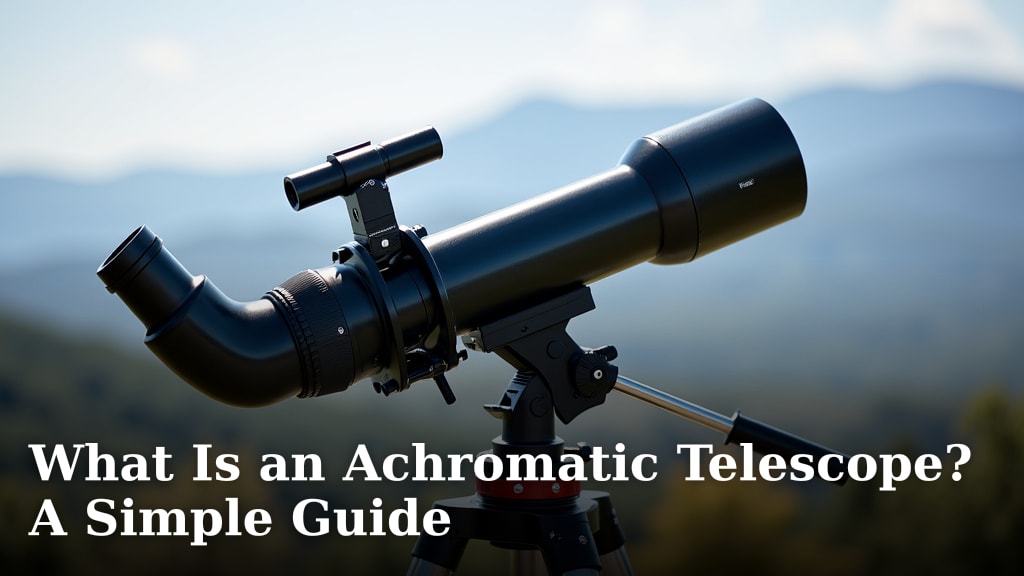
Refractors use convex lenses for the main objective. The front lens is thicker in the center and thinner near the edge, which bends light toward a focus behind the lens.
Our guide to how a refractor telescope works explains the full path from front lens to eyepiece. Light travels down the tube with no mirror in the basic path.
Many modern refractors use two or three lens elements together. An achromatic design pairs glass types to reduce color, as explained in [What Is an Achromatic Telescope?
A Simple Guide](/what-is-an-achromatic-telescope/).
The main element stays convex because it must bend light inward. [Is a Refractor Good for a Beginner?
What to Know](/is-a-refractor-good-for-a-beginner/) covers aperture, size, and cost for a first purchase.
Do refracting telescopes use mirrors?
Refracting telescopes do not use mirrors for the main image path. Light passes through lenses from front to back, then into the eyepiece.
That is the core difference between a refractor and a reflector.
There is a useful exception. Some refractors use a diagonal or star diagonal near the eyepiece.
That accessory may contain a small mirror or a prism to bend the light path by 90 degrees.
Our post on do refracting telescopes use mirrors covers that distinction in more detail. Mirrors can appear as small accessories, while the main objective stays refractive.
This is why product photos can be confusing. A refractor tube looks like a plain tube with no visible mirror.
A reflector tube usually shows a larger mirror cell at the back. Look at the design type first.
How do reflectors use concave mirrors instead of lenses?
Reflectors use a concave primary mirror to gather and focus light. The mirror sits at the back of the tube.
It catches incoming light and reflects it toward a focus inside the tube.
A small flat secondary mirror intercepts that light before the focus. It sends the beam sideways to the side focuser, where your eyepiece magnifies the image.
A convex lens bends light through glass. A concave mirror bends light by reflection.
Large mirrors often cost less per inch of aperture than large lenses.
What part do concave lenses play in telescope systems?
Concave lenses play a supporting role, not the main objective role. They appear in corrector and reducer elements that flatten the field or shorten the focal ratio.
They also appear inside eyepiece designs.
A corrector may sit in front of a telescope to improve star images across the field. A reducer shortens the effective focal length, which can help wide-field photography.
A concave element inside a telescope does not mean the objective is concave. The main part still converges light, while the concave part adjusts that beam.
Why do eyepieces use both convex and concave elements?
Eyepieces use mixed lens shapes to control magnification, eye relief, and field of view. The objective gathers light and forms an image.
The eyepiece then magnifies that image so your eye can see it.
Eye relief is the distance your eye sits from the eyepiece to see the full field. A well designed eyepiece balances magnification with that distance.
Barlow lenses add another layer by changing the effective focal length before light reaches the eyepiece.
That is where accessories like best gskyer telescope lenses fit into the system. Barlows and eyepieces do not replace the objective.
They change how the already focused image is presented to your eye.
How a Barlow lens changes magnification
A Barlow lens doubles or otherwise changes the magnification of an eyepiece by altering the light cone before it reaches the eyepiece. It does not gather more light.
It spreads the focused image over a larger scale so the eyepiece magnifies it more.
The Celestron Omni 1.25" 2X Barlow Lens slides into 1.25 in focusers and diagonals and accepts 1.25 in eyepieces. Celestron says it doubles the magnification of each eyepiece you own while keeping eye relief.
Its optics are fully multi-coated with blackened edges to help light transmission and reduce reflections.
If you already own a 10 mm and a 25 mm eyepiece, a 2X Barlow gives you four useful powers instead of two. That flexibility is why Barlows are a common first accessory.
The trade-off is that higher magnification also magnifies seeing effects. On nights with poor atmospheric stability, the extra power may show a shimmering image.
Use the Barlow for the Moon and planets first.
Who should choose the SVBONY 2X Barlow?
Choose the SVBONY 2X Barlow Lens if you want 2X magnification with a metal body and camera adapter option. It doubles the magnification of any 1.25 in eyepiece.
SVBONY also notes an M42x0.75 mm thread that can work with a separately sold T ring adapter for DSLR or SLR cameras.
The housing is blackened to help image contrast, and SVBONY describes a cemented doublet design to limit chromatic aberration as magnification rises. For visual use, that means a simple insert and go upgrade for lunar and planetary viewing.
For imaging, the thread adds a path that the Celestron model does not list.
The honest trade-off is focus behavior. Higher magnification narrows the field of view and makes focusing more sensitive.
Pair it with a stable mount and use it after you have centered the target at lower power.
How a long focal length eyepiece fits the system
A long focal length eyepiece gives you low magnification and a wide view of the sky. That is useful for finding objects, viewing the Moon, and seeing large star clusters.
It is the opposite end of the scale from a Barlow used with a short eyepiece.
The SVBONY Telescope Eyepiece 40mm uses a 1.25 in barrel and a 4 element Plossl design. SVBONY lists a 40 degree apparent field of view, fully multi-coated optics, and blackened lens edges to reduce stray light.
It also has a fold down rubber eye guard and an M28.5 x 0.6 filter thread.
Owners often pair a long eyepiece with a Barlow for two clear modes. Use the 40 mm alone to find and frame a target.
Add a Barlow when you want more detail on the Moon or a planet.
The limits are physical. Very low magnification can make small targets look too small, and a wide field can include more light pollution.
Choose the 40 mm for wide targets and initial scanning, not for splitting tight double stars.
How can you tell which shape a telescope uses?
You can tell by design type first, then by the optical path. Refractors use convex objective lenses.
Reflectors use concave primary mirrors. Catadioptric designs combine mirrors with corrector lenses.
Look for the focuser position. A refractor usually has the focuser at the back end.
A Newtonian reflector has it on the side near the front, where a secondary mirror redirects light.
Large refractors become heavy and costly because large glass lenses are hard to make. Reflectors scale to larger apertures more easily.
Also check barrel size before buying eyepieces or Barlows, as most here use 1.25 in.
What should beginners check before buying lenses or eyepieces?
Beginners should check barrel size, focal length, and intended target before buying any lens accessory. A 40 mm eyepiece, a 2X Barlow, and a short planetary eyepiece each solve a different problem.
Start with the eyepieces that came with your telescope and note their focal lengths and barrel size. A Barlow pairs well with longer eyepieces for planets.
A long eyepiece alone suits wide-field targets.
Keep caps on coated lenses when not in use. Hold eyepieces by the barrel, clean with a soft brush first, then a lens cloth.
Store in a case or dry box away from dew.
Do telescopes use concave or convex lenses: the bottom line
Do telescopes use concave or convex lenses? The main answer is convex lenses for refractors and concave mirrors for reflectors.
Concave lenses support correctors, reducers, and eyepiece designs, but they do not replace the converging objective.
Use design type as your first filter. Choose a refractor for a sealed tube and simple alignment.
Choose a reflector for larger aperture for the price.
For wide views, a long eyepiece like the 40 mm Plossl is a practical start. For Moon and planet detail, a Celestron or SVBONY 2X Barlow adds power without a new eyepiece.
Frequently asked questions
Do telescopes use concave or convex lenses?
Most use convex lenses for the main objective in refractors, and concave mirrors in reflectors. Concave lenses appear mainly as corrector or reducer elements, not as the main light-gathering part.
Eyepieces use combinations of convex and concave elements to form a comfortable image.
What is the difference between a concave and a convex lens?
A convex lens is thicker in the middle and thinner at the edges, so it bends light inward to a focus. A concave lens is thinner in the middle and thicker at the edges, so it spreads light outward.
Telescope objectives need that inward bend, which is why convex shapes dominate refractors.
Do reflectors use lenses at all?
A basic reflector uses a concave mirror as its main objective and sends light to a small flat secondary mirror. Many reflectors still use lenses in the eyepiece, and some designs add corrector lenses.
The main light gathering, though, comes from the mirror, not a big lens.