Newtonian Telescope vs Refractor: Which Should You Choose? (October 2026)
Choose a Newtonian for more aperture and deep-sky viewing on a budget, or a refractor for sealed optics and simpler care. Your space, targets and comfort with occasional mirror alignment should guide the choice.
On this page (7 sections)
- Newtonian telescope vs refractor: how do the optics differ?
- Which design is easier to maintain?
- Which telescope is easier to carry and set up?
- Which design is better for planets and the Moon?
- Which design works better for deep-sky objects?
- What does the view look like through each design?
- Which one should you choose?
Choose a Newtonian telescope for more aperture and deep-sky viewing on a budget, or a refractor for enclosed optics and simpler care. The right pick depends on what you want to observe, how you will carry the scope and whether mirror alignment is part of your routine.
A Newtonian uses a primary mirror at the back of the tube and a smaller secondary mirror near the front. A refractor gathers light through an objective lens at the front, then sends it to the eyepiece.
Both designs can show the Moon and planets. A Newtonian's larger aperture can help with dimmer targets, while a refractor's closed tube and lens system can make setup and upkeep feel simpler.
For a wider overview of different types of optical telescopes, compare the full set of designs before choosing.
 Best for simple lunar viewing
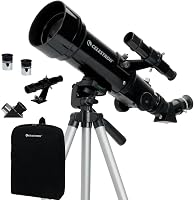
Celestron AstroMaster 70AZ Refractor Telescope for Moon
 Best for deep-sky guidance
Celestron StarSense Explorer DX 130AZ Smartphone Guided
Newtonian telescope vs refractor: how do the optics differ?
A Newtonian focuses light with mirrors, while a refractor focuses it through lenses. That difference affects tube layout, image orientation, maintenance and how much aperture you can get for your budget.
In a Newtonian, light enters the open end of the tube and reflects off a curved primary mirror. A smaller flat mirror redirects the focused light to an eyepiece mounted near the tube's front.
A refractor sends light through a lens at the front of the tube. The lens focuses the image toward an eyepiece at the back, and a diagonal can make viewing more comfortable.
Neither design is automatically better for every target. Aperture, optical quality, mount stability and the sky conditions where you observe all matter.
For a closer look at the broader reflecting vs refracting telescope choice, see how these designs compare beyond the Newtonian layout.
Is a Newtonian telescope a refractor?
No, a Newtonian telescope is a reflector, not a refractor. Newtonian telescopes use mirrors, while refractors use lenses as their main light-gathering optics.
The terms describe different optical designs. A Newtonian is one kind of reflecting telescope, so the useful comparison is Newtonian versus refractor or reflector versus refractor.
If you want the basics before comparing specific designs, start with what an astronomical telescope is.
Which design is easier to maintain?
A refractor is usually simpler to care for because its optics sit inside a closed tube. A Newtonian's mirror system is more exposed to dust, and the mirrors may need occasional alignment checks.
A refractor does not have a secondary mirror to align. Keep its lens caps on when the telescope is stored, and avoid touching or cleaning the glass unless it needs it.
A Newtonian can stay ready for many observing sessions without adjustment, but a knock during transport or a change in handling can shift mirror alignment. A collimation tool and basic instructions can help you check it when stars look soft or oddly shaped.
Dust on a mirror or lens usually does less harm than frequent cleaning. Follow the telescope manual and use suitable methods, since careless wiping can scratch coatings.
If you like the Newtonian's aperture advantage but want help with the design, see how a Newtonian telescope works.
Which telescope is easier to carry and set up?
A small refractor often offers a simpler grab-and-go setup, while Newtonians can give you more aperture in a compact tube. Compare the complete telescope, including its mount and tripod, rather than judging by optical tube alone.
A refractor's tube is typically long for its aperture, but smaller models can be easy to move. Enclosed optics also mean you can set it down without worrying as much about dust reaching the main lens.
Newtonians often have a shorter tube for the same focal length because the light path folds back on itself. Larger apertures can still make the tube, mount and tripod bulky, so check assembled weight and carrying needs.
The Celestron AstroMaster 70AZ is a 70mm refractor with a manual alt-azimuth mount and quick assembly. The StarSense Explorer LT 114AZ is a Newtonian reflector weighing 10.4 lb, with smartphone guidance to help find targets.
Before choosing, consider where the telescope will live and how far you need to carry it. If you need help weighing features against your observing plans, use how to choose a telescope.
Which design is better for planets and the Moon?
Both designs can show the Moon and planets; aperture, optics and steady tracking shape the view. A refractor can be convenient for bright targets, while a larger Newtonian can gather more light.
The Moon is bright and easy to find with either design. Jupiter and Saturn are also popular targets, but seeing fine detail depends on the telescope's optical quality, atmospheric steadiness and how well the scope is focused.
A refractor's enclosed tube can cool more quickly and resist stray light, though temperature changes can still affect the view. Newtonians may need time to reach outdoor temperature, especially when the mirror is much warmer than the air.
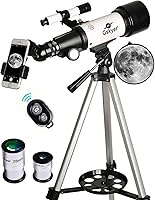
The 70mm Celestron AstroMaster 70AZ is described for the Moon, planets and bright star clusters. The Gskyer 90mm refractor is described for lunar and planetary observing as well as terrestrial targets.
Don't choose by the highest advertised magnification alone. Aperture, a stable mount and a sharp image at a useful magnification matter more than a large number on the box.
Which design works better for deep-sky objects?
A Newtonian is often the stronger choice for deep-sky observing because its design can deliver larger aperture for the money. More aperture gathers more light, which helps with dim galaxies, nebulae and star clusters.
The 130mm Celestron StarSense Explorer DX 130AZ has a larger aperture than the refractors listed here. Its maker describes it for targets such as the Orion Nebula and Andromeda Galaxy, and its phone app offers guided target finding.
A 114mm Newtonian also offers more aperture than a 70mm refractor. The LT 114AZ includes StarSense guidance and is lighter than the DX 130AZ, though its smaller mirror gathers less light.
Deep-sky views still depend on dark skies and realistic expectations. Many galaxies and nebulae appear as faint gray shapes through beginner telescopes, not colorful photographs.
To compare telescope designs used across amateur and professional observing, read what telescopes astronomers use.
What does the view look like through each design?
A Newtonian image is usually inverted or rotated, while a refractor with a suitable diagonal can give an upright view. For astronomy, image orientation usually matters less than it does for daytime landscapes.
Most Newtonians place the eyepiece on the side near the front of the tube. Depending on where the telescope points, you may need to crouch or shift position to look through it.
Refractors put the eyepiece at the back. A diagonal angles it upward, which can feel comfortable when observing objects high in the sky.
For land viewing, an erecting prism can make the image upright. The Gskyer refractor includes an erecting BAK7 prism, while the AstroMaster 70AZ includes an erect image diagonal.
If daytime wildlife or distant landmarks are a priority, a refractor may be easier to use. For an alternative made for terrestrial viewing, compare a telescope vs spotting scope.
Which one should you choose?
Choose a Newtonian if you want more aperture for deep-sky targets and can handle occasional mirror checks. Choose a refractor if you value enclosed optics, simple care and daytime use.
A Newtonian fits you if you want to explore the Moon, planets, star clusters and brighter nebulae with a larger mirror. Smartphone guidance can also make finding targets easier, especially when you're learning the night sky.
A refractor fits you if you want a straightforward setup for the Moon, planets and land targets. It avoids secondary-mirror alignment and can be convenient to store and take outside.
For a first telescope, your observing habits matter more than the design label. Pick the Newtonian for aperture and deep-sky potential; pick the refractor for simple upkeep and an upright daytime view.
If you're still comparing beginner options, read is a refractor good for a beginner.
Frequently asked questions
Is a Newtonian telescope a refractor?
No. A Newtonian is a type of reflecting telescope that uses mirrors, while a refractor uses lenses to bend and focus light.
Both can show the Moon and planets, but their optical paths, maintenance needs and typical strengths differ.
Which is easier to maintain, a Newtonian or refractor?
A refractor usually needs less optical adjustment because its lens assembly is enclosed. A Newtonian's exposed mirror can collect dust, and its alignment may need checking.
Either type benefits from careful storage and cleaning only when needed.
Is a Newtonian or refractor better for beginners?
Either can work for a beginner. A refractor is a straightforward choice if you want enclosed optics and simple care, while a Newtonian can provide more aperture for the money if you are comfortable learning basic mirror alignment.
Which telescope is more portable?
Portability depends on the whole setup, including the tube, mount and tripod. A small refractor is often easy to carry, but some Newtonians are compact too.
Compare assembled weight and tube length, and check whether you can carry everything in one trip.
Can you use a Newtonian telescope for daytime viewing?
A Newtonian can point at land targets, but its eyepiece view is usually inverted or rotated, and the viewing position may feel awkward. A refractor with an erecting prism or diagonal is often more convenient for daytime use.