Best 80mm Refractor Telescopes: Top 7 Picks (November 2026)
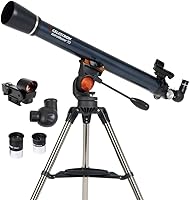
The best 80mm refractor telescopes include the Celestron StarSense Explorer LT 80AZ Smartphone Guided for phone-guided stargazing, the CELTICBIRD Telescope for Adults High Powered for a portable complete kit, and the EACONN Telescopes for Adults Astronomy for travel with a phone adapter.
On this page (7 sections)
- Which 80mm refractor telescopes suit each use?
- How we compared 80mm refractor telescopes
- What should you compare before choosing an 80mm refractor?
- Which 80mm refractor should you choose?
- Are 80mm refractors suitable for beginners?
- Can you use these 80mm refractors for astrophotography?
- Verdict: Which is the best 80mm refractor telescope?
The best 80mm refractor telescope for most beginners is the Celestron StarSense Explorer LT 80AZ, because its phone app uses sky recognition and on-screen arrows to help find targets. For imaging, choose between the SVBONY SV550 triplet APO and SV503 ED tube based on the optical design and focuser you need.
An 80mm refractor can fit backyard observing, family stargazing and portable imaging, but these scopes serve different jobs. Some picks include a tripod and eyepieces, while the SVBONY models are optical tube assemblies that need a mount and other setup parts.
For a broader shortlist by age and observing style, see our best refractor telescope for adults. This roundup compares 80mm models for visual use and imaging, with attention to mounts, accessories and portability.
Our picks at a glance
-
1
 Best for phone-guided stargazing
Celestron StarSense Explorer LT 80AZ Smartphone Guided
9.6/10 our score
See it on Amazon -
2
 Best for a portable complete kit
CELTICBIRD Telescope for Adults High Powered
9.5/10 our score
See it on Amazon -
3
 Best for travel with a phone adapter
EACONN Telescopes for Adults Astronomy
9.1/10 our score
See it on Amazon
- 4
 Best for triplet APO imagingCheck it
- 5
 Check it
MEEZAA Telescope for Adults & Kids
Best for family observing and daytime views - 6
 Check it
Celestron PowerSeeker 80EQ Refractor Telescope for Moon
Best for equatorial tracking practice - 7
 Check it
SVBONY SV503 Upgraded ED Refractor Telescope
Best for ED imaging with a flattener
Which 80mm refractor telescopes suit each use?
The Celestron StarSense Explorer is the clearest fit for guided visual observing, while the SVBONY tubes suit buyers building an imaging system. The included mount and accessories matter as much as aperture when you compare an 80mm refractor telescope.
Celestron StarSense Explorer LT 80AZ Smartphone Guided: Best for phone-guided stargazing
- 80mm refractor
- Smartphone sky recognition
- Manual altazimuth mount
- 25mm and 10mm eyepieces
StarSense uses phone-based sky recognition and on-screen arrows to help locate targets. It comes with two eyepieces, an erect image diagonal and a full-height tripod.
Pros
- Phone-guided target finding
- Manual slow motion adjustment
- Includes two eyepieces
Cons
- Requires a compatible smartphone for StarSense guidance
- Manual mount requires hand movement to track targets
The StarSense Explorer LT 80AZ is the easiest pick here for someone who wants help locating objects without learning the sky first. Dock a compatible smartphone, open the app and follow its arrows; sky recognition estimates the telescope's position from star patterns.
Its manual altazimuth mount moves up and down and side to side, with an altitude slow-motion adjustment for finer movement. That keeps setup approachable, though you still move the telescope by hand as an object drifts across the view.
The package includes 25mm and 10mm eyepieces, a 2x Barlow lens, an erect image diagonal, a red dot finder, tripod and phone dock. Celestron lists compatibility with Android 12 and later and iOS 18 and newer, including iPhone XR and newer models, so check your phone before choosing it.
Choose it for guided Moon, planet and brighter deep-sky sessions. Its 400mm focal length is the shortest in this group, which favors a wider view over the longer focal lengths in the beginner kits.
CELTICBIRD Telescope for Adults High Powered: Best for a portable complete kit
- 80mm aperture
- 600mm focal length
- Backpack and phone adapter
- 20mm and 9mm eyepieces
The CELTICBIRD pairs an 80mm refractor with a backpack, adjustable tripod, phone adapter and Moon filter. Its 20mm and 9mm eyepieces are specified for 30x and 66x magnification.
Pros
- Backpack holds the accessories
- Phone adapter included
- Moon filter included
Cons
- No electronic tracking
- Manual setup and aiming
The CELTICBIRD gives you a complete portable kit centered on an 80mm aperture and 600mm focal length. Its included backpack, adjustable tripod and phone adapter suit a buyer who wants to carry the telescope and accessories together.
The two eyepieces are specified for 30x and 66x magnification, and the kit includes a Moon filter and 5x24 finderscope. These features make it a practical visual starter set, but the phone adapter is for capturing images through the eyepiece, not for automatically finding targets.
The 17.7 to 52 in tripod height range can accommodate different observing positions. Before taking it outside, make sure the tripod is on a firm, level surface and that all fittings are secure.
Pick this model if the travel bag and included accessories matter more than phone guidance. For a comparable 80mm travel kit with an eyepiece-positioned phone adapter, consider the EACONN below.
EACONN Telescopes for Adults Astronomy: Best for travel with a phone adapter
- 80mm aperture
- 600mm focal length
- Backpack and phone adapter
- K20mm and K9mm eyepieces
EACONN includes a backpack, adjustable tripod, phone adapter and two eyepieces specified for 30x and 66x. Its positioning gimbal has altitude and azimuth scales for manual pointing.
Pros
- Backpack included
- Phone adapter has eyepiece positions
- Positioning gimbal has scales
Cons
- No electronic target guidance
- Manual altazimuth movement
EACONN pairs an 80mm aperture and 600mm focal length with a backpack, adjustable tripod and phone adapter. Its positioning gimbal has altitude and azimuth scales, which give you a reference while aiming by hand.
The two K eyepieces are specified for 30x and 66x magnification, and the kit has a 5x24 finder. The adapter has marked positions for the K20mm and K9mm eyepieces, which helps place a phone over the selected eyepiece for photos.
This is a visual-use kit with manual controls rather than a guided or tracking mount. Choose it if portability and a phone adapter are useful, and compare the included setup closely with the CELTICBIRD if both match your needs.
Our guide to the best refractor telescope for the money covers broader value tradeoffs across refractor types.
SVBONY SV550 AP0 Telescope: Best for triplet APO imaging
- 80mm ED triplet apochromat
- 480mm focal length
- 1:10 dual-speed focuser
- OTA
The SV550 is an optical tube assembly with triplet apochromatic optics and a 1:10 dual-speed focuser. It is aimed at observers and imagers who already have a suitable mount and accessories.
Pros
- Triplet APO design
- Dual-speed fine focusing
- Designed for visual observing and photography
Cons
- OTA, so a mount and observing accessories are separate needs
- More specialized than a complete beginner kit
The SVBONY SV550 is the specialized imaging choice in this roundup. Its 80mm triplet apochromatic design uses one S-FPL51 ED element and two correcting lenses, while the 1:10 dual-speed focuser supports finer focus adjustment.
This is an optical tube assembly, so plan for a mount, camera or eyepiece, and any adapters needed for your intended setup. The 480mm focal length is shorter than the SV503's, a useful distinction when comparing framing needs.
The SV550 is also described for visual observing, including Messier targets, but it is less of an all-in-one beginner kit than the refractors above. Choose it when the APO design and imaging-focused focus control are central to your plan.
For a wider look at options, compare our guide to the best refractor telescopes for astrophotography.
MEEZAA Telescope for Adults & Kids: Best for family observing and daytime views
- 80mm aperture
- 500mm focal length
- 45-degree zenith mirror
- Backpack and phone adapter
MEEZAA includes a 45-degree zenith mirror, phone adapter, adjustable tripod and waterproof backpack. Its kit is set up for family use, with two eyepieces and a 3x Barlow lens.
Pros
- 45-degree mirror for upright views
- Backpack and phone adapter included
- Tripod adjusts for different heights
Cons
- No electronic target guidance
- The broad accessory kit may be more than a simple visual setup needs
The MEEZAA is a family-oriented kit with an 80mm aperture, 500mm focal length and a 45-degree zenith mirror. That mirror presents an upright image, which can also make daytime landscape viewing more intuitive than a standard astronomical diagonal.
Its accessories include 25mm and 10mm eyepieces, a 3x Barlow, a 5x24 finder, phone adapter and waterproof backpack. The adjustable aluminum tripod is specified from 16.92 to 44.48 in, a lower range than the other travel kits here.
MEEZAA also includes space stickers and describes the scope for children and adults. That can make it inviting for shared family sessions, though the phone adapter still requires you to aim the telescope manually.
Choose it if you want one kit for family observing and daytime views. The CELTICBIRD has a taller tripod range, while the MEEZAA includes an upright-viewing mirror and a 3x Barlow.
Celestron PowerSeeker 80EQ Refractor Telescope for Moon: Best for equatorial tracking practice
- 80mm refractor
- 900mm focal length
- Manual German equatorial mount
- 20mm and 4mm eyepieces with 3x Barlow
The PowerSeeker 80EQ has a longer 900mm focal length and a manual German equatorial mount with a slow-motion rod. It includes two eyepieces and a 3x Barlow lens.
Pros
- Equatorial mount with slow-motion control
- 900mm focal length
- Includes two eyepieces and a Barlow
Cons
- Heavier than the compact altazimuth kits
- Equatorial setup takes more learning than simple up-and-down pointing
The PowerSeeker 80EQ is the long focal-length option among the beginner kits, at 900mm. Its manual German equatorial mount and slow-motion rod are designed to help follow objects as they appear to drift across the sky.
Equatorial mounts need a different setup and learning curve than altazimuth mounts, but the tracking motion can be useful for repeated observing. The package includes 20mm and 4mm eyepieces, a 3x Barlow lens, tripod and accessory tray.
At 16.4 lb, it is heavier than the compact kits listed here. That weight and the mount style make it a better fit for a planned observing spot than for someone prioritizing quick carry and setup.
Choose it if you want to learn equatorial mounting and prefer a longer focal length. If a lighter, simpler setup is the priority, compare it with the StarSense Explorer or the backpack kits.
SVBONY SV503 Upgraded ED Refractor Telescope: Best for ED imaging with a flattener
- 80mm ED refractor
- 560mm focal length
- 0.8x field flattener
- Dual-speed focuser
The SV503 combines an 80mm ED refractor with a 0.8x field flattener and a 2-inch dual-speed focuser. It is an optical tube for imaging setups, with no finder included.
Pros
- ED glass
- Field flattener included
- Dual-speed focusing
Cons
- Optical tube only
- No finder included
The SVBONY SV503 is an 80mm ED optical tube for imaging-focused setups. It combines S-FPL51 ED glass with a 0.8x field flattener and a 2-inch dual-speed focuser, features aimed at keeping stars sharper toward the edges of an image.
Its 560mm focal length is longer than the SV550's 480mm. The tube weighs 2.5kg, and the stated configuration includes the SV193 flattener, but it does not include a finder or mount.
This model suits a buyer who already has a camera system and mount plan. If you want a ready-to-use visual kit with tripod and eyepieces, one of the first five picks is a better match.
Choose the SV503 for an ED tube and included flattener. Choose the SV550 if you specifically want a triplet APO design and its 1:10 focuser.
How we compared 80mm refractor telescopes
We compared the listed aperture, focal length, optical design, mount type and included accessories against common visual and imaging needs. The score weighs those features against the likely use, with higher scores for a clear fit and useful included equipment.
A complete kit can get a beginner observing sooner, while an optical tube assembly gives an experienced buyer more control over the mount and camera setup. We also considered portability details such as included backpacks and stated tube weights.
What should you compare before choosing an 80mm refractor?
Choose an 80mm refractor by matching its optical tube, mount and accessories to how you plan to observe. Aperture is the shared size here, but focal length and mount design change the experience.
How does focal length affect an 80mm refractor telescope?
A longer focal length generally gives a narrower field of view with the same eyepiece and can make higher magnifications easier to reach. In this group, the 400mm StarSense is the shortest, while the 900mm PowerSeeker is the longest.
Focal length alone does not determine image quality or useful magnification. Eyepiece choice, sky conditions, mount stability and the target all matter, so avoid choosing by a magnification number alone.
Should you choose an altazimuth or equatorial mount?
An altazimuth mount moves up and down and left and right, making it intuitive for casual visual use. The StarSense, CELTICBIRD, EACONN and MEEZAA use this style, though only the StarSense adds phone-based target guidance.
An equatorial mount is designed to follow the sky's apparent drift with one main tracking axis after setup. The PowerSeeker 80EQ suits someone willing to learn that alignment, while the SVBONY tubes require you to supply a suitable mount.
When do ED and apochromatic optics matter?
ED and apochromatic designs are worth considering when color control and imaging are priorities. The SV550 uses a triplet APO design with ED glass, while the SV503 combines ED glass with a field flattener.
For a simple visual starter telescope, a complete refractor kit may be a more useful match than paying attention to optical design alone. Read our best achromatic refractor telescope guide to compare that design with ED options.
Which 80mm refractor should you choose?
Pick the StarSense Explorer if guided target finding is your priority, the CELTICBIRD or EACONN if you want a portable visual kit, and the PowerSeeker if you want an equatorial mount to learn. For imaging, choose the SV550 for a triplet APO tube or the SV503 for ED optics with a flattener.
If you're comparing aperture sizes as well, our 150mm refractor telescope guide explains what changes with a larger objective.
Are 80mm refractors suitable for beginners?
Yes, an 80mm refractor can be a good beginner telescope when the mount and included parts fit your needs. A complete kit with tripod, finder and eyepieces reduces the extra equipment you need to plan.
The StarSense Explorer adds phone guidance, while simpler manual kits ask you to learn aiming with a finder. Our guide on whether a refractor is good for a beginner explains what to expect from the design.
Can you use these 80mm refractors for astrophotography?
Some can be used for astrophotography, but the two SVBONY optical tubes are the picks designed around camera setups. The SV550 has a triplet APO design and fine focuser, while the SV503 includes a 0.8x field flattener.
A camera, mount and compatible adapters are still part of the full imaging system. The complete beginner kits include phone adapters for images through an eyepiece, which is a different approach from mounting a camera directly to an imaging telescope.
Verdict: Which is the best 80mm refractor telescope?
Choose the Celestron StarSense Explorer LT 80AZ for beginner-friendly target finding and a complete visual kit. Choose CELTICBIRD or EACONN for backpack portability, MEEZAA for family and daytime use, and PowerSeeker for equatorial mount practice.
For camera work, choose the SV550 if you want triplet APO optics, or the SV503 if ED glass and a field flattener fit your imaging setup. Match the tube to your mount and camera before buying.
Our top 3 picks at a glance
-
1
Best for phone-guided stargazing
Celestron StarSense Explorer LT 80AZ Smartphone Guided
9.6/10 our score
See it on Amazon -
2
Best for a portable complete kit
CELTICBIRD Telescope for Adults High Powered
9.5/10 our score
See it on Amazon -
3
Best for travel with a phone adapter
EACONN Telescopes for Adults Astronomy
9.1/10 our score
See it on Amazon
Frequently asked questions
What can you see with an 80mm refractor telescope?
An 80mm refractor can show the Moon, planets and brighter deep-sky objects, depending on sky conditions and the telescope setup. Celestron names the Moon, Jupiter, Saturn, Orion Nebula and Andromeda Galaxy as targets for its StarSense 80mm model.
A darker site helps with faint objects, while steady air helps keep planetary views clearer.
Is an 80mm refractor good for beginners?
Yes. An 80mm refractor can be a manageable first telescope, especially when it comes with a tripod, eyepieces and a simple manual mount.
For guided target finding, the Celestron StarSense Explorer uses a compatible phone and app.
Read more about whether a refractor is good for a beginner.
Can an 80mm refractor be used for astrophotography?
Yes, but check whether the scope is a complete telescope or an optical tube assembly and what mount your camera setup needs. The SVBONY SV550 and SV503 are imaging-oriented tubes, and the SV503 includes a field flattener.
See our guide to refractor telescopes for astrophotography for more on matching a scope to an imaging setup.
What is the difference between achromatic and ED refractors?
Achromatic and ED refer to optical designs that handle color differently. ED glass is used to reduce chromatic aberration, while the SV550's triplet APO design adds correcting glass to its ED element.
Compare options in our guide to the best achromatic refractor telescopes and best ED refractor telescopes.
Is 80mm enough aperture for astronomy?
An 80mm aperture is a useful compact size for the Moon, planets and brighter deep-sky targets. It gathers less light than larger apertures, so faint objects can be harder to see, especially under bright skies.
If you want a larger refractor, see our guide to choosing a 150mm refractor telescope.