7 Best Budget Telescopes for Planets (November 2026)
The best budget telescopes for viewing planets include the Celestron Travel Scope 70mm Beginner Portable Telescope for portable planetary viewing, the Gskyer Telescope for flexible beginner viewing, and the Celestron AstroMaster 70AZ Refractor Telescope for Moon for simple backyard setup.
On this page (8 sections)
- The best budget telescopes for planets
- How we chose these budget planetary telescopes
- What should you look for in a cheap telescope to see planets?
- Which budget telescope is best for Saturn?
- How much should you spend on a budget planetary telescope?
- How do you set up a budget telescope for planets?
- Can a budget telescope take planet photos?
- Verdict: which best budget telescope for planets should you choose?
The best budget telescope for planets for most beginners is the Celestron Travel Scope 70mm, because its 70mm aperture, fully coated glass lenses and 20mm and 10mm eyepieces cover basic lunar and planetary viewing.
Choose the PowerSeeker 80EQ for equatorial tracking or the HETEKAN for its larger 90mm aperture. That choice depends more on how you will observe than on a single headline number.
Affordable planetary viewing depends on more than a high magnification number. A steady mount, useful eyepieces and enough aperture matter when you want to study the Moon, Jupiter or Saturn.
It also depends on where you will use the telescope. A scope that is easy to carry and set up will often get more regular use than a heavier model left indoors.
If you are comparing the wider market, our guide to the best telescope for looking at planets explains the main designs and viewing limits.
Read that guide alongside this roundup if you are unsure whether a refractor or another design suits your first sessions. The picks below stay focused on budget models with practical planetary use.
Our picks at a glance
-
1
 Best for portable planetary viewing
Celestron Travel Scope 70mm Beginner Portable Telescope
9.7/10 our score
See it on Amazon -
2
-
3
 Best for simple backyard setup
Celestron AstroMaster 70AZ Refractor Telescope for Moon
9.7/10 our score
See it on Amazon
- 4
 Check it
Blue Marble NASA Lunar Telescope for Kids Ages
Best for young moon and planet learners - 5
 Check it
HETEKAN Telescope for Adults High Powered
Best for the largest aperture - 6
 Check it
Celestron PowerSeeker 80EQ Refractor Telescope for Moon
Best for manual sky tracking - 7
 Check it
SARBLUE Maksutov-Cassegrain Telescope for Adults Kids Astronomy
Best for compact high-contrast viewing
The best budget telescopes for planets
The best budget telescope for planets depends on your priority. Portable refractors are simple to carry, longer focal lengths help with tighter views, and equatorial mounts can make manual tracking easier after you learn the controls.
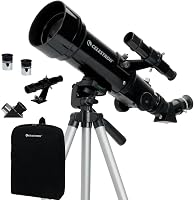
Celestron Travel Scope 70mm Beginner Portable Telescope: Best for portable planetary viewing
- 70mm refractor
- Fully coated glass lenses
- 20mm and 10mm eyepieces
- Backpack and full-height tripod
A portable 70mm refractor with fully coated glass lenses, two eyepieces, a finderscope and a backpack for storage.
Pros
- Quick no-tool setup
- Portable backpack included
- 20mm and 10mm eyepieces
Cons
- Manual focus
- Smaller aperture than the 90mm pick
The Celestron Travel Scope 70mm is the easiest all-around choice for beginners who want a telescope they can move between a backyard and a campsite. Its 70mm aperture and fully coated glass lenses suit the Moon, planets and daytime scenery.
That combination works for adults and children. Fully coated glass makes good use of the light entering the tube, which matters more than chasing extreme magnification.
The 400mm focal length gives a broad observing style. The included 20mm and 10mm eyepieces offer different views, with the wider eyepiece best for finding a target and the tighter one for a centred Moon or planet.
A 5x24 finderscope helps you locate targets before looking through the main tube. Align it in daylight so finder and main view point the same way before your first night session.
Setup is quick and tool-free. The full-height tripod, tube, eyepieces, diagonal and accessories fit into the included backpack.
Keep lens caps on when not in use and store the backpack in a dry place. The altazimuth mount is simple, though it needs manual adjustment as an object moves.
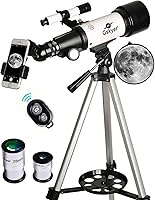
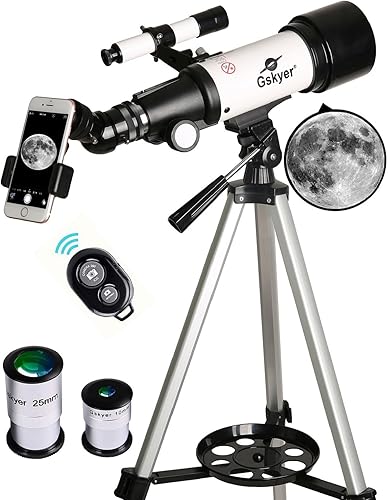
Gskyer Telescope: Best for flexible beginner viewing
- 70mm aperture
- 400mm focal length
- 3x Barlow lens
- Phone adapter and wireless remote
This 70mm refractor combines coated optics with a 3x Barlow lens, adjustable aluminum tripod, phone adapter and wireless remote.
Pros
- 3x Barlow lens included
- Adjustable tripod
- Phone adapter and remote
Cons
- Manual focus
- Short 400mm focal length
The Gskyer Telescope suits beginners who want a portable 70mm refractor with more viewing accessories. Its 400mm focal length and fully coated optics support lunar and planetary viewing, while the 3x Barlow lens increases the power of each eyepiece.
The Barlow gives more than one way to change the view without swapping eyepieces. Use the base eyepiece first, then add the Barlow only when the target is steady and well focused.
The 5x24 finder scope helps with target location. Its adjustable aluminum tripod and carry bag make it practical for travel.
The phone adapter with wireless remote gives a simple way to frame views through a smartphone. The adjustable tripod height also helps when adults and children take turns at the eyepiece.
Set the legs firmly on level ground and keep the telescope balanced before focusing. The altazimuth mount keeps controls familiar for a first-time user.
Its short focal length favors a wider viewing style, so do not assume the highest power will give the clearest image. Let the telescope adjust to outdoor temperature before a session.
Avoid big moves between warm indoor storage and cold outdoor use. Wipe only dry dust with a suitable cloth and keep optics capped in the carry bag.
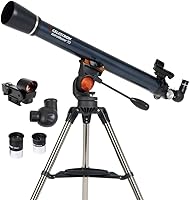
Celestron AstroMaster 70AZ Refractor Telescope for Moon: Best for simple backyard setup
- 70mm fully coated achromatic refractor
- 20mm and 10mm eyepieces
- Manual altazimuth mount
- StarPointer red dot finderscope
A 70mm refractor with a 900mm focal length, full-height adjustable tripod, manual altazimuth controls and two eyepieces.
Pros
- Longer focal length
- Easy panhandle controls
- Stable full-height tripod
Cons
- Heavier than the Travel Scope
- Manual tracking
The Celestron AstroMaster 70AZ is a strong choice for a fixed backyard setup where you want a longer focal length than the portable 70mm models. Its 70mm fully coated achromatic refractor has a 900mm focal length for Moon and planet viewing.
That longer focal length gives a tighter view of the Moon and bright planets than the 400mm portable models. It makes the telescope better suited to staying at home, where you can take time to set it up on firm ground.
The manual altazimuth mount uses a panhandle to point the telescope up, down and side to side. That layout is easy to understand, and the adjustable full-height tripod works for adults or children.
The 20mm and 10mm eyepieces provide two starting points. A StarPointer red dot finderscope helps you place a bright target in the main view before focusing.
Align the red dot finder in daylight using a distant landmark, then start at night with the Moon because it is easy to find. The erect image diagonal also helps for daytime viewing, while the included software can support planning later sessions.
The AstroMaster weighs 10.8 lb, so it is less travel-focused than the Travel Scope 70mm. In return, the longer tube and full-height tripod make it a better fit for backyard sessions.
Blue Marble NASA Lunar Telescope for Kids Ages: Best for young moon and planet learners
- 90x magnification
- Low- and high-power eyepieces
- Tabletop tripod
- Finder scope and learning guide
A child-friendly lunar telescope with two eyepieces, a finder scope, a tabletop tripod and a learning guide.
Pros
- Simple tabletop format
- Two eyepieces
- Learning guide included
Cons
- Designed around lunar viewing
- Tabletop tripod needs a firm surface
The Blue Marble NASA Lunar Telescope is best for a child who is beginning with the Moon and wants a simple learning setup. It is designed for ages 8 and up and includes low- and high-power eyepieces, a finder scope and a tabletop tripod.
That age range matters because the telescope is meant for guided use with a parent or adult nearby. The learning guide can give a young observer useful context about lunar features before looking through the eyepiece.
Its 90x magnification is intended for close lunar views, while the smooth mount helps scan across the lunar surface. The tabletop format keeps the telescope low and easy to store, but you need a firm, level surface for viewing.
A sturdy table or a level work surface works better than a soft or wobbling surface. Keep the telescope away from the edge, and set it down before a child leans in to look.
This is a more focused choice than the full-size refractors in this roundup. Choose it for a young learner who values a NASA-branded educational telescope, not for an adult who wants a full-height tripod.
Because it is built around lunar viewing, use it to learn the Moon first and keep expectations of planets modest. Store the eyepieces and dust cap with the telescope, and handle the mount gently so the tabletop setup stays easy for a child to use.
HETEKAN Telescope for Adults High Powered: Best for the largest aperture
- 90mm aperture
- 900mm focal length
- Three eyepieces
- 3x Barlow lens and adjustable tripod
The 90mm refractor offers the largest aperture here, with three eyepieces, a 3x Barlow lens, finder scope, phone adapter and adjustable tripod.
Pros
- Largest aperture in this group
- Three eyepieces
- Height-adjustable tripod
Cons
- Manual focus
- Higher magnification needs careful setup
The HETEKAN Telescope for Adults High Powered gives you the largest aperture in this group. Its 90mm aperture and 900mm focal length are paired with 25mm, 10mm and 6mm eyepieces plus a 3x Barlow lens.
That larger aperture collects more light than the 70mm models, which can help with fainter lunar and planetary detail. The long focal length gives a tighter view, but it asks for steadier handling and more careful focusing.
The stated magnification range is 36x to 450x. High magnification works best when the mount is steady and focus is adjusted carefully, so start with the lower-power eyepiece.
Work up through the eyepieces in small steps rather than jumping to the tightest view. If the image shakes or looks soft, return to a lower power and let the telescope settle.
The adjustable tripod moves horizontally and vertically, with height from 29 to 46 in. A 5x24 finder scope, phone adapter, carry bag and accessory tray are included.
Keep the tray clear of anything that could knock an eyepiece off. Store the tube with caps fitted to protect the optics.
Celestron PowerSeeker 80EQ Refractor Telescope for Moon: Best for manual sky tracking
- 80mm refractor
- Manual German equatorial mount
- 20mm and 4mm eyepieces
- 3x Barlow lens
An 80mm refractor with a 900mm focal length and an equatorial mount with a slow-motion altitude rod for following objects.
Pros
- Equatorial mount
- 80mm aperture
- 3x Barlow lens included
Cons
- Heavier setup
- Learning curve for equatorial controls
The Celestron PowerSeeker 80EQ is the best fit here if you want a manual mount built around tracking. Its 80mm refractor has a 900mm focal length, and the German equatorial mount uses a slow-motion altitude rod for following objects across the sky.
That mount design is the main reason to choose this model over a simple altazimuth scope. Once the telescope is set up correctly, the slow-motion control can make it easier to keep a planet in view during a longer look.
The package includes 20mm and 4mm eyepieces plus a 3x Barlow lens. The 4mm eyepiece is aimed at a tighter view, while the Barlow changes the power of the included eyepieces.
Start with the 20mm eyepiece to find and focus on a target, then move to the tighter options only when the image is stable. The Barlow gives another step in magnification, so test it in good conditions rather than assuming more power is always better.
Equatorial mounts take more practice than simple altazimuth mounts because the telescope must be oriented correctly before you track. Learn the mount controls in daylight first, using a distant landmark or the Moon.
At 16.4 lb, this is one of the heavier options here. It suits a backyard observer who values tracking controls more than quick packing.
SARBLUE Maksutov-Cassegrain Telescope for Adults Kids Astronomy: Best for compact high-contrast viewing
- Maksutov-Cassegrain design
- 750mm focal length
- 20mm eyepiece
- Tabletop tripod and phone adapter
A compact 60mm Maksutov-Cassegrain with a 750mm focal length, 20mm eyepiece, erect-image diagonal and tabletop tripod.
Pros
- Compact 20cm optical tube
- Long focal length
- Phone adapter included
Cons
- Smallest aperture here
- Tabletop tripod limits viewing height
The SARBLUE Mak60 is the compact option for buyers who want a long focal length in a short tube. Its Maksutov-Cassegrain design uses a 60mm objective and 750mm focal length, while the optical tube is only 20cm long.
That design packs a tighter viewing style into a much shorter tube than a conventional refractor of similar focal length. It suits observers who want the telescope to be easy to store, carry and set up on a table.
The included 20mm eyepiece provides 37.5x magnification. A fully multi-coated optical system, erect-image diagonal, phone adapter and tabletop tripod make the package suitable for basic Moon, planet and daytime viewing.
The erect-image diagonal helps for daytime targets because the view stays upright and unreversed. For night viewing, it keeps the eyepiece position comfortable when the telescope is used from a table.
The detachable lid exposes the internal construction, which can make the telescope useful as an educational object. Keep fingers away from the mirrors and protect the optical parts from dust.
Its tabletop mount is compact but less flexible than a full-height tripod. Choose it for storage and travel convenience, especially when a long tube would be awkward.
How we chose these budget planetary telescopes
We compared aperture, focal length, optical design, eyepieces, mount type, setup needs and portability against the needs of someone searching for a cheap telescope to see planets. We also considered whether each telescope gives a beginner a practical way to locate, focus and follow a target.
Aperture affects how much light the telescope can collect. The 90mm HETEKAN has the largest aperture here, while the 60mm SARBLUE is the smallest.
That does not make aperture the only deciding factor, because the mount and eyepiece choices affect how useful that light is at the eyepiece.
Focal length changes the viewing style. The 900mm Celestron AstroMaster and PowerSeeker are aimed at tighter views than the 400mm Travel Scope and Gskyer.
The SARBLUE combines a 750mm focal length with a short optical tube through its Maksutov-Cassegrain design.
Mount stability matters at higher magnification. The altazimuth models are simpler to point, the PowerSeeker adds a German equatorial mount, and the Blue Marble and SARBLUE use tabletop formats that need a firm surface.
Our score weighs specs, features and buyer feedback against what you are shopping for. The scores are not a promise of what every observer will see under every sky.
What should you look for in a cheap telescope to see planets?
For a best cheap telescope to see planets, look first for a clear aperture around 70mm or more, a stable mount and eyepieces that give you more than one useful viewing level. A larger advertised magnification number is not enough by itself.
A 70mm refractor is a practical starting point for the Moon and bright planets. An 80mm or 90mm aperture can give you more light-gathering capacity, but the tripod and mount still need to support careful focusing.
A longer focal length can help with close planetary views. The AstroMaster and PowerSeeker both use 900mm focal lengths, while the HETEKAN combines 900mm with a 90mm aperture.
For a first session, begin with the lowest-power eyepiece. Find the target with the finder scope, focus slowly, then change eyepieces only when the image is stable and centered.
Which budget telescope is best for Saturn?
The best budget telescope to see planets such as Saturn is the PowerSeeker 80EQ if you want a manual equatorial mount, or the HETEKAN if you prefer a larger 90mm aperture. The Celestron AstroMaster 70AZ is easier for beginners who want simple altazimuth controls.
Saturn is a small target, so steady support and accurate focus matter. A telescope can show Saturn's rings under suitable viewing conditions, but the view changes with the planet's position, atmospheric steadiness and your observing location.
Our guide to the best telescope to see rings of saturn covers the trade-offs between aperture, focal length and mount design.
How much should you spend on a budget planetary telescope?
The cost of a telescope to see planets varies by aperture, mount, accessories and optical design. A simple 70mm refractor is a sensible first step, while an 80mm or 90mm scope may suit you if you want more aperture or tracking control.
Think about how added cost is spent. A larger aperture can gather more light and an equatorial mount can help with tracking, but none of those features helps if the mount is not steady.
Do not choose by magnification alone. A steady mount and useful low-power eyepiece are often easier to use than extreme power that is hard to focus or hold steady.
Consider your observing space as well. A backyard with firm ground suits a full-height tripod, while a small patio may favour a tabletop model or portable scope that packs away quickly.
Storage and care are part of ownership. Keep eyepieces dry, store optics with caps fitted and let the telescope adjust to outdoor temperature before judging its view.
You can compare more Celestron options in our guide to the best celestron telescope for planets. For many beginners, best value is the telescope that is stable, complete and simple enough to use often.
How do you set up a budget telescope for planets?
Set the telescope on firm ground or a level tabletop, depending on the mount. Let the optical tube adjust to outdoor conditions before serious viewing, then begin with the lowest-power eyepiece and a bright target such as the Moon.
Manual focus is common across these picks. Turn the focus control slowly, keep the mount steady and avoid making large movements when the target is centered.
Never aim any telescope at the Sun without a proper solar filter designed for that telescope. The Moon and bright planets are safer starting targets, but a telescope still needs careful handling.
A telescope is not the right tool for every distant object. Read Can You See Satellites With a Telescope? for a better understanding of fast-moving targets, and see Can a Telescope See the Flag on the Moon? for the limits of planetary and lunar detail.
Can a budget telescope take planet photos?
Some budget telescopes include phone adapters, but smartphone photography is not the same as visual observing. The Gskyer, HETEKAN and SARBLUE include phone-related accessories, while the other models focus more on eyepiece viewing.
A phone adapter can help you hold a smartphone over the eyepiece. That makes framing easier than holding the phone by hand, and the wireless remote on the Gskyer can reduce the chance of shaking the telescope when you take a picture.
Keep expectations modest because focus, vibration, sky conditions and the moving target all affect the result. A planet moves across the field during an exposure, so even a steady mount cannot remove that challenge.
Start by getting a good visual view through the eyepiece before you add the phone. Centre the target, focus carefully and lock the mount, then attach the phone without pushing the telescope off target.
Use the lowest suitable power for your first attempts, since a wider view is easier to frame and keep centred. Short bursts or brief videos can also be more forgiving than a single still image when the target is moving.
If your main goal is imaging rather than visual planetary viewing, see our guide to the best budget telescope for astrophotography.
That guide is the better starting point for dedicated astrophotography. For occasional phone pictures alongside visual observing, the included adapters in this roundup are a useful bonus.
Verdict: which best budget telescope for planets should you choose?
The Celestron Travel Scope 70mm is the best overall choice for a beginner who wants a portable, simple refractor with two eyepieces and a backpack.
It keeps the essentials in one package, including fully coated glass optics, a finderscope and a full-height tripod. That makes it a practical first telescope for a backyard, a campsite or a shared family session.
Pick the Celestron AstroMaster 70AZ for a longer 900mm focal length and full-height backyard setup. Its panhandle mount and red dot finder suit observers who want a fixed home base rather than a travel scope.
Choose the PowerSeeker 80EQ if manual equatorial tracking is your priority. Its slow-motion altitude rod suits observers willing to learn equatorial setup for smoother following of planets.
Choose the HETEKAN if the 90mm aperture and three-eyepiece package matter most, or the SARBLUE Mak60 if compact storage is the deciding factor. The Gskyer remains a flexible beginner option with a Barlow lens, phone adapter and wireless remote, while the Blue Marble suits a child starting with the Moon.
Our top 3 picks at a glance
-
1
Best for portable planetary viewing
Celestron Travel Scope 70mm Beginner Portable Telescope
9.7/10 our score
See it on Amazon -
2
-
3
Best for simple backyard setup
Celestron AstroMaster 70AZ Refractor Telescope for Moon
9.7/10 our score
See it on Amazon