9 Best Celestron Telescopes for Planets (November 2026)
The best Celestron telescopes for planetary viewing include the Celestron AstroMaster 70AZ Refractor Telescope for Moon for simple family viewing, the Celestron StarSense Explorer DX 130AZ Smartphone Guided for guided planetary viewing, and the Celestron NexStar 6SE Schmidt-Cassegrain Telescope for automated tracking in a compact scope.
On this page (8 sections)
- Which Celestron telescope is best for planets?
- The best Celestron telescopes for planetary viewing
- How much aperture do you need for planets?
- What magnification is useful for planetary viewing?
- Which mount is easiest for planets?
- How should you set up a Celestron telescope for planets?
- Can these Celestron telescopes work for daytime viewing?
- Final verdict: which Celestron telescope should you choose?
The best Celestron telescope for planets for most beginners is the StarSense Explorer DX 130AZ. Its 130mm reflector gathers more light than the smaller beginner scopes, while StarSense guidance helps you locate Jupiter, Saturn, Mars and other targets with a smartphone.
Choose the Celestron NexStar 8SE for the greatest planetary detail in this group, the NexStar 6SE for computerized tracking in a smaller package, or the AstroMaster 70AZ if simple family viewing matters most.
If you are comparing brands as well as models, start with our guide to the best telescope for looking at planets. Buyers with a tighter budget can also compare the best budget telescope for planets.
Our picks at a glance
-
1
 Best for simple family viewing
Celestron AstroMaster 70AZ Refractor Telescope for Moon
9.7/10 our score
See it on Amazon -
2
 Best for guided planetary viewing
Celestron StarSense Explorer DX 130AZ Smartphone Guided
9.6/10 our score
See it on Amazon -
3
 Best for automated tracking in a compact scope
Celestron NexStar 6SE Schmidt-Cassegrain Telescope
9.5/10 our score
See it on Amazon
- 4
 Check it
Celestron PowerSeeker 127EQ Reflector Telescope for Home
Best for manual equatorial learning - 5
 Check it
Celestron StarSense Explorer DX 102AZ App-Enabled Refractor
Best for guided refractor views - 6
 Check it
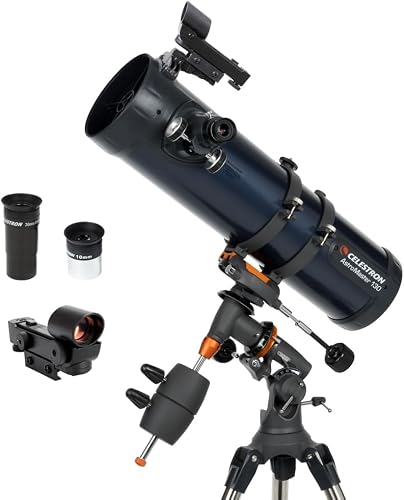
Celestron AstroMaster 130EQ Telescope for Deep-Sky Beginners
Best for planetary and deep-sky range - 7
 Check it
Celestron NexStar 8SE Computerized Telescope
Best for maximum planetary detail - 8
 Check it
Celestron PowerSeeker 80EQ Refractor Telescope for Moon
Best for entry-level equatorial tracking - 9
 Check it
Celestron Inspire 100AZ Beginner Refractor Telescope
Best for easy setup and phone use
Which Celestron telescope is best for planets?
The best choice depends on how much aperture, tracking and setup help you want. A small manual scope is welcoming for a first night, while a larger or computerized model rewards you with brighter views and easier following once you are ready.
The DX 130AZ is the strongest all-around beginner pick, while the NexStar models suit viewers who want the mount to locate and follow targets. Refractor and reflector designs in this group also handle daily use differently, from simple daytime pointing to deeper night sky work.
We compared the listed optical designs, apertures, focal lengths, mounts, included eyepieces and guidance systems. That comparison helps separate a scope that only looks powerful on paper from one you will actually set up often.
Our score weighs specs, features and buyer feedback against the needs of someone shopping for a Celestron telescope for planets. It also reflects honest trade-offs, such as manual tracking on guided scopes and extra alignment on computerized mounts.
Setup and care matter as much as optics for long term use. A stable tripod, careful focusing and easy access to eyepieces can make a modest telescope more enjoyable than a larger one that stays indoors.
Think about who will use it most and where it will live between sessions. A family sharing the view needs simple controls, while a solo observer may prefer guided finding or automatic tracking.
| Product | Best for | Optics | Mount | Focal length | Our score |
|---|---|---|---|---|---|
| Celestron AstroMaster 70AZ Refractor Telescope for Moon | simple family viewing | 70mm achromatic refractor | Manual alt-azimuth | 900mm | 9.7 |
| Celestron StarSense Explorer DX 130AZ Smartphone Guided | guided planetary viewing | 130mm Newtonian reflector | Manual alt-azimuth | 650mm | 9.6 |
| Celestron NexStar 6SE Schmidt-Cassegrain Telescope | automated tracking in a compact scope | 6-inch Schmidt-Cassegrain | Computerized altitude-azimuth single fork arm | 1500mm | 9.5 |
| Celestron PowerSeeker 127EQ Reflector Telescope for Home | manual equatorial learning | 127mm reflector | Manual German equatorial | 1000mm | 9.4 |
| Celestron StarSense Explorer DX 102AZ App-Enabled Refractor | guided refractor views | 102mm refractor | Manual alt-azimuth | 650mm | 9.4 |
| Celestron AstroMaster 130EQ Telescope for Deep-Sky Beginners | planetary and deep-sky range | 130mm Newtonian reflector | Equatorial mount | 650mm | 9.3 |
| Celestron NexStar 8SE Computerized Telescope | maximum planetary detail | 8-inch Schmidt-Cassegrain | Computerized altitude-azimuth single fork arm | 2032mm | 9.3 |
| Celestron PowerSeeker 80EQ Refractor Telescope for Moon | entry-level equatorial tracking | 80mm refractor | Manual German equatorial | 900mm | 8.7 |
| Celestron Inspire 100AZ Beginner Refractor Telescope | easy setup and phone use | 100mm refractor | Asymmetrical alt-azimuth design | 660mm | 8.6 |
The best Celestron telescopes for planetary viewing
The picks below are ordered by score. Each one solves a different problem, from simple manual viewing to computerized tracking and larger-aperture planetary detail.
Celestron AstroMaster 70AZ Refractor Telescope for Moon: Best for simple family viewing
- 70mm fully coated achromatic refractor
- Manual alt-azimuth mount
- 20mm and 10mm eyepieces
- StarPointer red dot finderscope
The 70AZ keeps setup and pointing simple while offering Moon and planet views through fully coated 70mm optics. Its erect image design also supports daytime land viewing.
Pros
- Simple manual controls
- Quick no-tool setup
- Useful for day and night viewing
Cons
- Less light gathering than the 130mm and 8-inch models
- Manual tracking
The Celestron AstroMaster 70AZ is the simplest choice for families who want to begin with the Moon and bright planets. Its fully coated 70mm achromatic refractor and 900mm focal length give you a straightforward optical setup without the alignment work required by computerized mounts.
The manual alt-azimuth mount uses a panhandle to point up, down and side to side. That layout is easy to understand, but you will need to make small adjustments as a planet moves across the view.
The included 20mm and 10mm eyepieces give you two starting points for wider and more detailed views. A StarPointer red dot finderscope helps with initial aiming, and the erect image diagonal keeps the view suitable for daytime landmarks as well as astronomy.
This is a good first telescope when ease of use matters more than maximum aperture. It is also a sensible choice for children and adults sharing short observing sessions.
Celestron StarSense Explorer DX 130AZ Smartphone Guided: Best for guided planetary viewing
- 130mm Newtonian reflector
- StarSense smartphone sky guidance
- Manual alt-azimuth mount
- Dual-axis slow-motion controls
The DX 130AZ combines the largest beginner-friendly aperture in this group with smartphone guidance. Its manual mount still needs user input, but the app helps locate planets and other targets.
Pros
- Bright 130mm optics
- Smartphone-guided target finding
- Slow-motion controls
Cons
- Manual tracking
- Requires a compatible smartphone
The Celestron StarSense Explorer DX 130AZ is the best all-around pick because it combines 130mm Newtonian optics with smartphone-guided target finding. The larger aperture gives it more light-gathering ability than the 70mm, 80mm, 100mm and 102mm models here.
That extra light helps with the Moon, bright planets and brighter deep-sky targets on dark nights. The 650mm focal length also keeps aiming more forgiving than a longer tube while you learn.
StarSense analyzes the sky through your phone and shows arrows toward selected targets. Once the bullseye turns green, the target should be ready in the eyepiece.
The app lists suitable targets for your time and place. You still need a compatible phone and a clear view above the horizon for guidance to work well.
The manual alt-azimuth mount has dual-axis slow-motion controls for small adjustments. They help you follow a planet after the app finds it, but they do not provide automatic tracking.
The 25mm and 10mm eyepieces give two useful starting points. Start at lower power to center a target, then switch when the image is steady and in focus.
Choose this model if you want strong beginner optics and app support. It suits backyard use and short trips to darker sites, provided the phone is charged and the tripod is on firm ground.
Celestron NexStar 6SE Schmidt-Cassegrain Telescope: Best for automated tracking in a compact scope
- 6-inch Schmidt-Cassegrain optics
- Computerized GoTo mount
- 40,000+ object database
- SkyAlign technology
The NexStar 6SE is a strong step-up choice for detailed planetary viewing with automated locating and tracking. SkyAlign uses 3 bright stars or planets for alignment.
Pros
- Automated locating and tracking
- Compact 6-inch optical design
- SkyAlign setup
Cons
- More setup than a manual mount
- Heavier than the smallest beginner scopes
The Celestron NexStar 6SE is the strongest choice for automated planetary viewing in a compact 6-inch design. Its Schmidt-Cassegrain optics use a 1500mm focal length, and the computerized mount can locate and track targets from a database of more than 40,000 objects.
SkyAlign helps set up the mount by asking you to center 3 bright stars or planets. You don't need to know their names for the system to calculate the alignment.
The included 25mm eyepiece, StarPointer finderscope and NexStar+ hand control give you the basic tools to begin. After alignment, the mount does the ongoing tracking, which is useful when you want to share a view or study a target for longer.
This model is a better fit for an intermediate user than someone seeking the quickest manual setup. Its computerized controls add capability, but they also add an alignment step before observing.
For a closer look at the same computerized family, read our Celestron NexStar Evolution 8 review.
Celestron PowerSeeker 127EQ Reflector Telescope for Home: Best for manual equatorial learning
- 127mm Newtonian reflector
- Manual German equatorial mount
- 20mm and 4mm eyepieces
- 3x Barlow lens
The PowerSeeker 127EQ gives beginners a larger reflector and an equatorial mount with slow-motion control. The included Barlow lens expands the usable magnification options.
Pros
- Large 127mm aperture
- Equatorial slow-motion controls
- 3x Barlow lens included
Cons
- Equatorial setup takes practice
- Manual locating and tracking
The Celestron PowerSeeker 127EQ gives you 127mm of reflector aperture and a manual German equatorial mount. It suits a beginner who wants to learn slow-motion tracking while keeping enough aperture for the Moon, planets and brighter deep-sky objects.
The 1000mm focal length gives a more magnified view than shorter beginner tubes, which can help with planetary detail. It also means careful focusing and a steady tripod matter more on windy or unsteady nights.
The mount uses slow-motion controls to follow objects as they move across the sky. Equatorial mounts take more practice than a simple alt-azimuth mount, but they give you a focused way to learn manual tracking.
Learning the two axes takes patience, especially when you first polar align by eye and balance the tube. Once that routine becomes familiar, small knob movements feel smoother than pushing the whole mount around.
Celestron includes 20mm and 4mm eyepieces plus a 3x Barlow lens. The Barlow expands the magnification options, but very high power is not always useful when the atmosphere is unsteady or the mount is vibrating.
Use the Barlow selectively, mainly on calm nights when the target stays sharp at lower power first. Keep eyepieces in the accessory tray so you can swap them without fumbling in the dark.
Pick this telescope if learning the mount is part of the goal. If you want guided target finding instead, the DX 130AZ is easier to aim.
Celestron StarSense Explorer DX 102AZ App-Enabled Refractor: Best for guided refractor views
- 102mm refractor
- StarSense smartphone sky recognition
- Manual alt-azimuth mount
- 25mm and 10mm eyepieces
The DX 102AZ offers guided target finding in a refractor design with an erect image diagonal. It suits beginners who want app help without moving to a computerized mount.
Pros
- Smartphone guidance
- Refractor design
- Slow-motion controls
Cons
- Less aperture than the DX 130AZ
- Manual tracking
The Celestron StarSense Explorer DX 102AZ is the best refractor option for beginners who want phone guidance. Its 102mm optics give it more light-gathering ability than the 70mm and 80mm refractors, while the StarSense dock helps you find targets.
The 650mm focal length pairs well with the included eyepieces for Moon and planet viewing at sensible starting magnifications. The refractor design also keeps the view straightforward, with no mirror alignment to worry about before a session.
StarSense uses sky recognition through your phone to show arrows toward a chosen object. When the bullseye turns green, the target should be ready in the eyepiece for closer inspection.
The manual alt-azimuth mount includes dual-axis slow-motion controls. Use the app to locate a planet, then use those controls to keep making small adjustments as the target moves.
Those controls do not track automatically, so high magnification still needs regular nudges from you. A calm pace, a comfy chair and a stable tripod make that manual work much easier to sustain.
A 25mm eyepiece and a 10mm eyepiece provide two useful starting views. The erect image diagonal also makes the telescope suitable for daytime viewing, which can add value for families who want one scope for more than astronomy.
Choose the DX 102AZ when you prefer refractor optics and simple app guidance. Choose the DX 130AZ when brighter views and more aperture take priority.
Celestron AstroMaster 130EQ Telescope for Deep-Sky Beginners: Best for planetary and deep-sky range
- 130mm Newtonian reflector
- German equatorial mount
- Right ascension and declination controls
- 20mm and 10mm eyepieces
The AstroMaster 130EQ pairs 130mm optics with manual equatorial controls. It fits beginners who want planetary views now and more room for deep-sky targets later.
Pros
- Bright 130mm optics
- Precise dual-axis controls
- Adjustable tripod
Cons
- Manual tracking
- Equatorial mount has a learning curve
The Celestron AstroMaster 130EQ is a strong choice for a beginner who wants planetary viewing plus room to explore deep-sky targets. Its 130mm Newtonian reflector matches the DX 130AZ in aperture, but its German equatorial mount uses manual right ascension and declination controls.
The 650mm focal length keeps the tube manageable for transport and setup in a backyard. The coated mirrors help deliver bright views, though you will still get the best results by letting the scope settle to outdoor temperature.
The dual-axis controls help you center and follow planets with small adjustments. This is more precise than simply pushing an alt-azimuth mount, but the equatorial design takes time to learn.
Practice with the Moon first, where a bright target makes the knob movements easier to judge. Learning to balance the tube and tighten the mount will reduce drift and make focusing less frustrating.
The 20mm eyepiece with built-in erect image corrector and the 10mm eyepiece give you two starting magnification levels. A StarPointer red dot finderscope helps with initial aiming.
Keep the eyepieces clean and stored in a case, and check the finderscope battery before a planned session. A simple checklist for tripod legs, mount clamps and focus helps a new user avoid rushed mistakes.
This model fits a learner who enjoys understanding the mount. If you want a phone to guide you to objects, the DX 130AZ offers a more direct path.
Celestron NexStar 8SE Computerized Telescope: Best for maximum planetary detail
- 8-inch Schmidt-Cassegrain optics
- Computerized GoTo mount
- 40,000+ object database
- SkyAlign technology
The NexStar 8SE has the largest aperture here, giving it the strongest potential for fine lunar and planetary detail. Its computerized mount locates and tracks targets after alignment.
Pros
- Largest aperture in this roundup
- Automated GoTo tracking
- Long 2032mm focal length
Cons
- More expensive class of setup
- More equipment to manage
The Celestron NexStar 8SE offers the largest aperture in this roundup and the strongest potential for fine planetary detail. Its 8-inch Schmidt-Cassegrain optics use a 2032mm focal length, while the computerized GoTo mount locates and tracks targets after alignment.
SkyAlign uses 3 bright stars or planets to establish the mount's position. The NexStar+ hand control then gives access to more than 40,000 objects, including planets, stars and deep-sky targets.
The 25mm eyepiece is included with the optical tube, single fork arm mount and tripod. Its longer focal length suits detailed views, but the setup is a bigger commitment than a small manual refractor.
For more support options, see our Celestron telescope tripod guide.
Choose the NexStar 8SE when aperture and automated tracking matter most. If you want similar computerized operation in a smaller 6-inch package, the NexStar 6SE is easier to carry.
Celestron PowerSeeker 80EQ Refractor Telescope for Moon: Best for entry-level equatorial tracking
- 80mm refractor
- Manual German equatorial mount
- 20mm and 4mm eyepieces
- 3x Barlow lens
The PowerSeeker 80EQ offers an accessible route into equatorial tracking with 80mm refractor optics. It is suited to Moon and bright planet viewing in a compact setup.
Pros
- Smooth equatorial controls
- Refractor optics
- Barlow lens included
Cons
- Smallest aperture among the equatorial picks
- Manual locating and tracking
The Celestron PowerSeeker 80EQ is an entry-level way to learn equatorial tracking with an 80mm refractor. Its 900mm focal length and coated optics suit Moon and bright planet viewing, while the German equatorial mount supports smooth manual adjustments.
The refractor design is simple to care for, with no collimation routine for a new user to learn. That makes it forgiving for families who want quick setup and easy storage.
The mount uses a slow-motion altitude rod and equatorial controls to follow movement across the sky. You will need to learn the axes and practice small movements, but that process teaches skills that transfer to larger equatorial setups.
Celestron includes 20mm and 4mm eyepieces and a 3x Barlow lens. Use the lower magnification first, then move higher when the target is centered and the air is steady.
The Barlow is best as an extra option rather than a daily necessity. On breezy nights or when the mount is still settling, lower power usually gives a calmer and more useful view.
This model has less aperture than the 127mm and 130mm reflectors, but the refractor design is simple to maintain. It suits a beginner who values an equatorial learning experience over maximum light gathering.
Store the Barlow and eyepieces in the tray, and give the tripod a firm stance before focusing. Those habits help a modest aperture perform at its best.
Celestron Inspire 100AZ Beginner Refractor Telescope: Best for easy setup and phone use
- 100mm fully coated refractor
- Built-in smartphone adapter
- Integrated red LED flashlight
- 20mm and 10mm Kellner eyepieces
The Inspire 100AZ focuses on quick setup, family use and phone-assisted Moon and planet images. Its erect image optics also support daytime viewing.
Pros
- Built-in smartphone adapter
- Easy tripod setup
- 100mm aperture
Cons
- Manual tracking
- Less aperture than the 130mm and 8-inch picks
The Celestron Inspire 100AZ is built around quick setup and family-friendly use. Its 100mm fully coated refractor sits on an asymmetrical mount, and the folding accessory tray helps get the tripod ready with fewer separate parts.
The 660mm focal length gives a wide enough starting view for the Moon and bright planets without making aiming feel overly sensitive. That balance suits children and adults sharing the eyepiece for the first time.
A built-in smartphone adapter supports Moon and planet images through the telescope. The integrated red LED flashlight can illuminate the accessory tray without using bright white light during an observing session.
The phone adapter is a neat extra for casual images, though it does not replace the guided finding of a StarSense model. Keep the phone secure, start with a bright target and allow time to focus before taking frames.
The included 20mm and 10mm Kellner eyepieces offer two starting views. Erect image optics support both astronomical and daytime targets, while the focus micrometer helps return to a familiar focus position.
Choose the Inspire 100AZ when setup and phone use matter more than automatic tracking. For app-guided target finding, the StarSense DX 102AZ is the more direct choice.
How much aperture do you need for planets?
Aperture affects how much light a telescope gathers and how much fine detail it can potentially show. The 70mm AstroMaster is easy to use, while the 102mm, 127mm and 130mm models offer a stronger balance of brightness and beginner-friendly size.
The 6-inch NexStar 6SE and 8-inch NexStar 8SE move into a higher-performance class. Their Schmidt-Cassegrain designs combine larger apertures with computerized mounts, so you get both more optical reach and automated tracking.
A larger telescope does not guarantee a sharper view every night. Atmospheric steadiness, careful focus, a stable tripod and allowing the telescope to adjust to outdoor conditions all affect what you see.
What magnification is useful for planetary viewing?
Useful magnification depends on the telescope, eyepiece and night conditions. Start with the lower-power eyepiece to find and center the planet, then try the shorter focal-length eyepiece when the image remains steady.
Magnification also changes with focal length, so the same eyepiece behaves differently in a 650mm refractor and a 2032mm Schmidt-Cassegrain. A sensible progression is to focus carefully at low power, let the view settle and only then move up a step.
The PowerSeeker 127EQ and 80EQ include 3x Barlow lenses, while the other models use their included eyepieces as the starting point. More magnification can make the target larger, but it can also make vibration and atmospheric blur easier to see.
A Barlow can be useful on a calm night, yet it will also magnify mount wobble and focus errors. If the image shimmers or shakes, step back to a lower power and check tripod stability first.
For more help choosing accessories, see our guide to the best eyepieces for Celestron telescopes. Keep the mount steady and focus carefully before deciding that you need more power.
Patience often beats power with planets, because detail only helps when the atmosphere cooperates. Short, calm sessions at moderate magnification can teach more than pushing to the highest setting every night.
Which mount is easiest for planets?
A manual alt-azimuth mount is usually the quickest to understand, while a German equatorial mount offers a more deliberate way to follow targets. A computerized GoTo mount does the locating and tracking after you complete its alignment.
Alt-azimuth mounts move up and down plus side to side, which matches how most people naturally point at the sky. That makes them friendly for first sessions, shared viewing and daytime targets.
Equatorial mounts move along axes aligned with the sky, so slow adjustments can follow a planet more smoothly over time. The trade-off is a steeper learning curve, since you must learn balancing, axes and polar alignment concepts.
The AstroMaster 70AZ and Inspire 100AZ are the simplest manual options. The StarSense DX 102AZ and DX 130AZ add smartphone guidance, but you still make the tracking adjustments yourself.
The PowerSeeker and AstroMaster 130EQ teach manual equatorial control. The NexStar 6SE and 8SE require alignment, then provide automated locating and tracking.
Computerized mounts are easiest to follow once aligned, but they add setup steps, power needs and more parts to manage. Choose the mount that matches your patience and observing style.
How should you set up a Celestron telescope for planets?
Set the tripod on firm ground, attach the optical tube as directed, fit the diagonal and eyepiece, and begin with the lower magnification. Give yourself a clear view of the sky and avoid observing through windows.
For an app-guided model, place the phone in its dock and follow the app's alignment instructions. For an equatorial model, learn the mount controls before attempting high magnification.
For a computerized model, complete SkyAlign using 3 bright stars or planets.
Our beginner telescope guide covers the wider choice between simple, guided and computerized setups. You can also read How to Use a Telescope for Beginners: A Beginner’s Guide before your first observing session.
Can these Celestron telescopes work for daytime viewing?
Several models suit both astronomy and terrestrial viewing. The AstroMaster 70AZ, StarSense DX 102AZ and Inspire 100AZ use features described for erect or daytime images, while the other picks focus more on night-sky use.
Erect image optics flip the view so landmarks, wildlife and scenery appear the right way round. That helps with daytime pointing and makes the telescope feel more natural for non-astronomy tasks.
Daytime viewing can help new users learn focusing and pointing before going outside at night. A distant hilltop, rooftop or tree line gives a forgiving target for practice.
It also builds confidence with eyepieces, focus and tripod adjustments in good light. You can learn how small knob movements change the view before darkness makes everything harder.
Daytime use has limits, since heat haze can blur distant views and bright light can wash out contrast. A shaded spot, steady tripod and modest magnification usually give the clearest results.
Keep the telescope away from the Sun unless you have a proper solar filter designed for the exact telescope and use it as directed. Never look directly at the Sun through an eyepiece or finder without that protection.
The best telescopes for bird watching guide can help if daytime wildlife viewing is a major part of your decision. For families, a scope that works day and night can earn more use across the year.
Final verdict: which Celestron telescope should you choose?
The best Celestron telescope for planets is the StarSense Explorer DX 130AZ if you want strong beginner optics with smartphone guidance. It pairs 130mm of aperture with app help for finding targets and slow-motion controls for following them.
Pick the AstroMaster 70AZ for the simplest family setup, the PowerSeeker 127EQ or AstroMaster 130EQ to learn manual equatorial tracking, and the NexStar 6SE or 8SE for computerized tracking. Each choice trades setup effort, aperture and how much the mount does for you.
The DX 102AZ suits refractor fans who want phone guidance without a large reflector. The Inspire 100AZ and PowerSeeker 80EQ suit buyers who value easy setup and learning the basics first.
Choose the NexStar 8SE when the largest aperture and maximum planetary detail matter most. Its long focal length and computerized mount reward careful setup and patience on steady nights.
If you plan to observe often, consider storage, transport and how quickly you can set up after work or school. A telescope that is easy to carry to the yard will often get more use than a heavier one that feels like a project.
Care is straightforward, with gentle lens cleaning, dry storage and a firm tripod setup. Keep eyepieces in a case, check batteries or phone charge before you go out and let the telescope settle to outdoor conditions.
If you are still weighing setup effort against optical reach, compare the cost of a telescope to see planets before deciding. Match the mount and aperture to your experience, and you will get far more from the Moon and planets on your first clear night.
Our top 3 picks at a glance
-
1
Best for simple family viewing
Celestron AstroMaster 70AZ Refractor Telescope for Moon
9.7/10 our score
See it on Amazon -
2
Best for guided planetary viewing
Celestron StarSense Explorer DX 130AZ Smartphone Guided
9.6/10 our score
See it on Amazon -
3
Best for automated tracking in a compact scope
Celestron NexStar 6SE Schmidt-Cassegrain Telescope
9.5/10 our score
See it on Amazon
Frequently asked questions
What is the best Celestron telescope for planets?
The Celestron StarSense Explorer DX 130AZ is the best Celestron telescope for planets for most beginners because it combines 130mm optics, smartphone-guided target finding and dual-axis slow-motion controls.
Choose the NexStar 8SE if automated tracking and the largest aperture matter more than simple setup.
Is a refractor or reflector better for viewing planets?
Both designs can show the Moon and planets. A refractor such as the AstroMaster 70AZ or StarSense DX 102AZ offers simple viewing and an erect image, while a reflector such as the DX 130AZ uses a larger aperture for brighter planetary views.
Mount stability and careful focusing matter as much as optical design.
What telescope size is good for seeing planets?
A telescope from 70mm to 130mm can show the Moon and bright planets, while larger apertures can reveal more fine detail when the atmosphere is steady. The 6-inch and 8-inch NexStar models add more light gathering and automated tracking.
A stable mount and sensible magnification still matter.
Do you need tracking to view planets?
You don't need tracking to begin viewing planets, but tracking keeps a target centered at higher magnification. Manual alt-azimuth and equatorial mounts require ongoing adjustments, while the NexStar 6SE and 8SE use computerized GoTo tracking after alignment.
Tracking is especially useful when sharing the view.