5 Best Newtonian Reflector Telescopes (November 2026)
The best Newtonian reflector telescopes include the Celestron PowerSeeker 114EQ Reflector Telescope for Backyard for first-time backyard astronomy, the Celestron PowerSeeker 127EQ Reflector Telescope for Home for family backyard viewing, and the MEEZAA Telescope for large-aperture starter kits.
On this page (5 sections)
The Celestron PowerSeeker 114EQ is the best Newtonian reflector telescope for most beginners because it balances a 114mm aperture, manual German equatorial mount and starter accessories. Its slow-motion altitude rod helps with small adjustments as objects drift across the sky.
The MEEZAA 150EQ is the stronger large-aperture choice for buyers who want more light gathering from the start. The PowerSeeker 127EQ gives families 127mm aperture while keeping a similar manual equatorial style.
Newtonian reflectors use a primary mirror to gather and focus light into an eyepiece. That mirror-based design is why aperture is often the first number to compare in this group.
Aperture is the diameter of the main mirror and affects how much light the telescope can collect. More light can help with dimmer deep sky objects, while a smaller aperture can still give clear views of the Moon and bright planets under suitable skies.
Focal length shapes the view when paired with an eyepiece. A longer focal length generally gives a narrower, more magnified view with the same eyepiece, while a shorter focal length can make framing wider targets easier.
Mount stability matters because even small movement is more noticeable as magnification rises. A manual equatorial mount does not track by itself, so slow motion controls help you follow an object.
Included accessories decide how quickly you can start and how much you need to add later. Eyepieces, a finderscope, a Barlow lens and a Moon filter each change the view or setup in a practical way.
This roundup compares five reflectors between 114mm and 150mm in aperture, with focal lengths from 650mm to 1000mm. Each kit mixes mounts, finders, eyepieces and phone or filter accessories differently.
For a first telescope, the right choice depends on where and how you will observe. A compact backyard model suits regular short sessions, while a larger aperture may suit darker sites and longer plans.
Setup and care also need honest thought before you buy. You will need a firm, level surface, dry storage, gentle handling and a calm routine for focusing and tracking.
Trade-offs appear in every pick here. Larger apertures gather more light but can be bulkier, and higher magnification can be less forgiving of wind, poor focus or unsteady air.
If you want a wider look at reflector designs, compare these picks with our guide to best reflector telescopes for astronomy. Beginners can also use our best reflector telescope for beginners guide to compare simpler starting points.
Use the sections below to match aperture, focal length, mount and accessories to your own observing habits. That match matters more than chasing the longest feature list.
Our picks at a glance
-
1
 Best for first-time backyard astronomy
Celestron PowerSeeker 114EQ Reflector Telescope for Backyard
9.7/10 our score
See it on Amazon -
2
 Best for family backyard viewing
Celestron PowerSeeker 127EQ Reflector Telescope for Home
9.4/10 our score
See it on Amazon -
3
- 4
 Check it
HSL 150EQ Astronomical Reflector Telescope for Adults
Best for filter-based planet viewing - 5
 Check it
SOLOMARK Telescope 130EQ Newtonian Reflector Telescopes
Best for smartphone-assisted observing
Which is the best Newtonian reflector telescope?
The Celestron PowerSeeker 114EQ earns the top spot because its 114mm Newtonian optics, manual equatorial mount and 3x Barlow lens cover the main needs of a first telescope. Its compact design also suits adults and children observing together.
Our score weighs specs, features and buyer feedback against what you're shopping for. The scores are not a promise of optical performance under every sky condition.
Celestron PowerSeeker 114EQ Reflector Telescope for Backyard: Best for first-time backyard astronomy
- 114mm Newtonian reflector
- Manual German equatorial mount
- 20mm and 4mm eyepieces
- 3x Barlow lens
- 5x24 finderscope
The 114mm aperture and simple manual controls make this a balanced starting point for Moon, planet and deep-sky observing.
Pros
- Compact and portable
- Two eyepieces and 3x Barlow lens
- Slow-motion altitude rod
Cons
- Manual focus
- Smaller aperture than the 150mm picks
The Celestron PowerSeeker 114EQ is a balanced choice for a first Newtonian reflector telescope. Its 114mm aperture is intended for views of the Moon, planets, distant stars and objects such as the Orion Nebula.
The 900mm focal length gives this model a longer optical system than the 650mm models in this group. Its manual German equatorial mount includes a slow-motion altitude rod, which helps you make small pointing and tracking adjustments as objects appear to move across the sky.
Two eyepieces, a 20mm and a 4mm, are included with a 3x Barlow lens. The Barlow can triple the magnification of each eyepiece, but higher magnification also makes shaking, focus and atmospheric conditions more noticeable.
The package includes a 5x24 finderscope, tripod, accessory tray and free astronomy software. Celestron also lists a 2-year US warranty and unlimited support from its US-based experts.
Choose it if you want a compact backyard telescope with a manual equatorial mount and a useful starting accessory set. For more aperture, move to one of the 150mm models.
Celestron PowerSeeker 127EQ Reflector Telescope for Home: Best for family backyard viewing
- 127mm Newtonian reflector
- Manual German equatorial mount
- 20mm and 4mm eyepieces
- 3x Barlow lens
- Slow-motion controls
This PowerSeeker adds aperture over the 114EQ while keeping a portable design and a familiar manual equatorial setup.
Pros
- 127mm aperture
- Four effective eyepiece combinations
- Stable tripod
Cons
- Manual focus
- Larger listed dimensions than the 114EQ
The Celestron PowerSeeker 127EQ is a good family choice when you want more aperture than the 114EQ but still prefer a manual German equatorial mount. Its 127mm Newtonian reflector is suited to the Moon, planets, distant stars and the Orion Nebula.
Its 1000mm focal length is the longest in this group. That can make the telescope a useful fit for viewers who want a narrower, more focused view, although locating and tracking objects still depends on careful manual adjustment.
The package includes 20mm and 4mm eyepieces plus a 3x Barlow lens. Together, these give you several magnification options, but the 4mm eyepiece with a Barlow is a demanding combination for a beginner.
A finderscope, stable tripod, slow-motion controls and an accessory tray support backyard use. The telescope is described as lightweight and portable, with a travel tripod included.
Choose this model if your household wants a 127mm reflector with family-friendly manual controls. Pick the 114EQ if compactness and a lower-aperture starting point matter more.
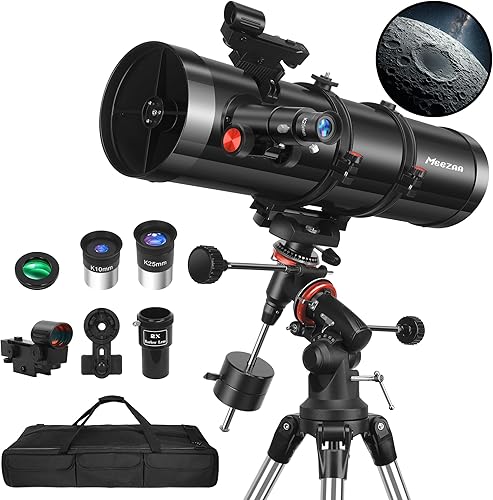
MEEZAA Telescope: Best for large-aperture starter kits
- 150mm aperture
- 650mm focal length
- 26x to 130x magnification
- 2x Barlow lens
- Phone adapter and moon filter
The 150mm aperture gathers more light than the smaller picks, and the kit includes a carry bag, phone adapter, moon filter and accessories.
Pros
- Largest aperture tied in this group
- Carry bag included
- No-tools setup
Cons
- Manual focus
- Shorter focal length than both PowerSeeker models
The MEEZAA 150EQ is the best Newtonian reflector telescope here for buyers who want a large-aperture starter kit. Its 150mm aperture and 650mm focal length are designed for bright views of deep-space objects, planets and the Moon.
The equatorial mount has precision dials and slow-motion control knobs for manual tracking. The stainless steel tripod has adjustable height, and the built-in tray keeps small observing items close at hand.
MEEZAA includes 25mm and 10mm eyepieces, a 2x Barlow lens, red dot finderscope, Moon filter, phone adapter, carry bag and instructions. The stated magnification range is 26x to 130x.
The shorter 650mm focal length can make this tube easier to carry than a longer telescope, while the 150mm aperture gives it a larger light-gathering opening than the two PowerSeeker models. A carry bag also helps with storage and travel.
Choose it if aperture and a complete accessory package matter most. Read our Omni XLT 150 telescope review for another 150mm-class comparison.
HSL 150EQ Astronomical Reflector Telescope for Adults: Best for filter-based planet viewing
- 150mm aperture
- 750mm focal length
- Manual German equatorial mount
- 5 color filters
- 3x Barlow lens
The HSL combines a 150mm aperture with a 3x Barlow lens, five color filters and a phone holder for a more accessory-focused setup.
Pros
- 150mm aperture
- Color filter set
- Wireless remote control
Cons
- Manual focus
- Highest stated magnification is demanding to use
The HSL 150EQ is aimed at adults who want a 150mm reflector with color filters and phone-oriented accessories. Its 150mm aperture and 750mm focal length give it the same aperture as the MEEZAA, but a different focal length and accessory mix.
The manual German equatorial mount uses a slow-motion altitude lever for tracking. A reflex finder helps with initial targeting, while the phone holder and wireless remote control support smartphone use.
HSL includes a 3x Barlow lens and five color filters in red, blue, orange, green and yellow. The stated combinations reach 90x, 112.5x and 345x, but the highest magnification requires steady setup and favorable air.
The package is a better match for someone who wants to experiment with filters and phone capture than for a buyer seeking the simplest possible setup. The optical tube is listed at 70cm long.
Choose it if the color-filter set is useful to your observing plans. Choose the MEEZAA instead if you want a carry bag, Moon filter and a stated 26x to 130x range.
SOLOMARK Telescope 130EQ Newtonian Reflector Telescopes: Best for smartphone-assisted observing
- 130mm aperture
- Fully coated glass optics
- 1.5x erecting Barlow lens
- 13% transmission Moon filter
- Cellphone adapter
The 130mm Newtonian includes a cellphone adapter, Moon filter and adjustable aluminum alloy tripod for manual observing and simple phone use.
Pros
- 130mm aperture
- Fully coated glass optics
- Smartphone adapter
Cons
- 1.5x Barlow lens
- Manual tracking
The SOLOMARK 130EQ is the best pick here for smartphone-assisted observing on a 130mm Newtonian reflector. It includes a cellphone adapter, a 1.5x erecting Barlow lens and a 13% transmission Moon filter for brighter lunar viewing.
Its fully coated glass optics and 130mm aperture are designed to improve light collection and image brightness. The 650mm focal length keeps it in the shorter-tube group, alongside the MEEZAA.
The German equatorial mount has a dial and fine-adjustment control cables. Its adjustable aluminum alloy tripod includes a tray for small accessories, and the telescope uses manual tracking.
SOLOMARK includes two eyepieces, the erecting Barlow, Moon filter and phone adapter. The product data also identifies the model as the Polaris 130EQ Newtonian.
Choose it if the included phone adapter and Moon filter fit your plans. The MEEZAA offers a larger 150mm aperture, while the PowerSeeker 127EQ offers a longer 1000mm focal length.
How do aperture and focal length change the view?
Aperture affects how much light a Newtonian reflector can gather, while focal length affects the optical system's viewing behavior and magnification with a given eyepiece. The products here range from 114mm to 150mm apertures and 650mm to 1000mm focal lengths.
The 150mm MEEZAA and HSL have the largest apertures in this group. The 114EQ has the smallest, but its 900mm focal length, compact design and accessory set keep it competitive for a beginner.
A larger aperture does not remove the need for stable setup. High magnification can make vibration, focus errors and moving targets harder to manage, especially when using a 3x Barlow lens.
For another style of reflector, see our GeoSafari Omega reflector telescope review. If you want to build a telescope instead of buying a complete package, our best build your own telescope kit guide covers that path.
Which mount is easiest to use for stargazing?
A manual German equatorial mount is useful when you want to make small tracking corrections as the Moon, planets and stars appear to move across the sky. Every telescope here uses an equatorial mount, but the included controls and accessories differ.
That difference matters in daily use. Some kits use slow-motion rods or levers, some add dials and control cables, and some rely on finders that differ in style and ease of alignment.
Start by placing the tripod on a flat surface and tightening the adjustment screws. A firm surface helps far more than any mount control when wind or uneven ground would otherwise shake the view.
Set the telescope at a comfortable height for the main user. Children, seated observers and standing adults may each need a different height, so adjust before you begin focusing.
Attach the tube and accessories according to the instructions. Make sure the finder is aligned before you chase a small target, since the main eyepiece view is much narrower.
Use the finder to aim before inserting a higher-power eyepiece. That order saves time and keeps a bright target from being lost after a magnification change.
Keep the telescope steady while focusing. Touch the focuser lightly and avoid leaning on the tripod, because contact can move the view at the moment you want it still.
Begin with the lower-power eyepiece, center the target, and move to higher magnification only when the view remains stable. Lower power gives a wider view and makes manual tracking easier to learn.
As an object drifts, make small corrections rather than large swings. Slow motion controls are designed for that gentle follow-through, and patience works better than hurried movement.
The PowerSeeker models emphasize slow-motion controls. The 114EQ uses a slow-motion altitude rod, and the 127EQ also uses manual German equatorial controls for family backyard use.
MEEZAA adds an adjustable stainless steel tripod and carry bag. Its equatorial mount also has precision dials and slow-motion control knobs for manual tracking.
SOLOMARK uses an adjustable aluminum alloy tripod with a tray for small accessories. Its German equatorial mount has a dial and fine-adjustment control cables for precise positioning.
HSL adds a slow-motion altitude lever and reflex finder. That finder style suits observers who prefer a simpler aiming aid over a magnifying finderscope.
Care for the mount means keeping screws snug without forcing them. Store the telescope dry, keep the tray free of grit and check that tripod legs and mount knobs still move smoothly before a session.
The honest trade-off is that manual tracking takes practice. It can feel rewarding once learned, but it will not match a powered mount for long, hands-free observation.
Which reflector telescope kit has the best accessories?
The MEEZAA 150EQ has the broadest general-purpose accessory package, with two eyepieces, a 2x Barlow lens, red dot finderscope, Moon filter, phone adapter, carry bag and instructions. The HSL 150EQ is stronger for buyers who specifically want color filters.
The PowerSeeker 114EQ and 127EQ both include 20mm and 4mm eyepieces plus a 3x Barlow lens. The 114EQ also includes a 5x24 finderscope, accessory tray and astronomy software.
The SOLOMARK includes two eyepieces, a 1.5x erecting Barlow lens, 13% transmission Moon filter and cellphone adapter. Its accessories suit basic Moon viewing and simple phone use.
The HSL 150EQ includes a 3x Barlow lens, five color filters, a phone holder and a wireless remote control. Its stated combinations reach 90x, 112.5x and 345x, so the highest setting needs a steady setup and favorable air.
Eyepieces set the starting magnification choices for each kit. A longer focal length eyepiece usually gives a wider, lower power view, while a shorter eyepiece raises magnification and narrows the view.
A Barlow lens multiplies the power of the eyepiece used with it. That can add useful options without buying more eyepieces, but it also magnifies shaking and focus errors.
A finderscope or reflex finder helps you aim the main tube before switching to an eyepiece. A red dot finder is quick for bright targets, while a 5x24 finderscope gives a magnified view for fainter ones.
A Moon filter reduces glare from a bright lunar surface. The SOLOMARK uses a 13% transmission filter, and MEEZAA includes a Moon filter for comfortable lunar viewing.
Color filters serve a different purpose from a Moon filter. HSL includes red, blue, orange, green and yellow filters for observers who want to experiment with planetary detail and cloud structure.
A phone adapter or holder supports simple smartphone use at the eyepiece. It suits casual sharing and record keeping, although steady mounting and careful focus still shape the result.
A carry bag and accessory tray affect daily convenience more than optics. MEEZAA includes a carry bag that fits the tube and parts, while tray designs on other models keep eyepieces close during a session.
Instructions and software also count as accessories in practical terms. The PowerSeeker models include astronomy software for planning, and MEEZAA includes instructions for a no-tools setup.
Remember that a longer accessory list does not automatically mean a better telescope. Choose the kit whose accessories match how you plan to observe, from simple Moon viewing to filter experiments or phone use.
How should you choose among these Newtonian reflectors?
Choose the PowerSeeker 114EQ for a compact first telescope with a 114mm aperture, manual equatorial mount and strong starter accessory set. Its 900mm focal length and 20mm and 4mm eyepieces give a practical range for Moon, planet and brighter deep sky viewing.
Choose the PowerSeeker 127EQ when you want a little more aperture and a 1000mm focal length for family backyard use. It keeps 20mm and 4mm eyepieces, a 3x Barlow lens and manual German equatorial controls in a familiar layout.
Choose the MEEZAA 150EQ for the largest aperture paired with a carry bag, Moon filter and phone adapter. Its 150mm aperture and 650mm focal length suit buyers who value light gathering and a complete starter package.
Choose the HSL 150EQ when five color filters and a wireless remote control matter more than a simpler accessory kit. It also pairs a 150mm aperture with a 750mm focal length, a 3x Barlow lens and a phone holder.
Choose the SOLOMARK 130EQ for a 130mm reflector with fully coated glass optics, a phone adapter and Moon filter. Its 650mm focal length and 1.5x erecting Barlow lens give it a different balance from the longer PowerSeeker tubes.
In every case, plan for a flat observing surface, careful focusing and realistic expectations about high magnification. Manual focus and manual tracking reward patience, especially when you move from a lower power eyepiece to a higher one.
Think about who will use the telescope most often. A model that is easy for adults and children to set up will likely be used more than a larger kit that stays in storage.
Think also about where you will observe. A compact model suits a backyard or campsite, while a larger aperture may be worth carrying to a darker site for dimmer objects.
Care should be part of the decision as well. Keep the tube, eyepieces and tripod dry, store accessories in the tray or bag provided and check screws and controls before each session.
For most new stargazers, the PowerSeeker 114EQ is the safest starting point. For more light gathering, the MEEZAA 150EQ is the clearest step up.
Our top 3 picks at a glance
-
1
Best for first-time backyard astronomy
Celestron PowerSeeker 114EQ Reflector Telescope for Backyard
9.7/10 our score
See it on Amazon -
2
Best for family backyard viewing
Celestron PowerSeeker 127EQ Reflector Telescope for Home
9.4/10 our score
See it on Amazon -
3