8 Best Telescopes for a Balcony (November 2026)
The best telescopes for balconies include the Gskyer Telescope for most balconies, the MEEZAA Telescope for a larger balcony, and the CELTICBIRD Telescope for Adults High Powered for adjustable tripod height.
On this page (4 sections)
The best telescope for a balcony is the Gskyer Telescope, with a 70mm aperture, 400mm focal length and adjustable tripod for restricted floor space.
Choose the SARBLUE Mak60 when storage length matters most, or a 90mm MEEZAA or HUGERSTAR when your balcony has room for a longer tube.
Balcony astronomy differs from backyard astronomy. You may face a narrow viewing angle, a railing blocking low targets and little room to move a tripod backward while aiming.
A short tube is often easier to live with, but aperture still matters. A 70mm aperture collects less light than 80mm or 90mm models, yet it can show the Moon, bright planets and daytime landscapes well enough for a starter scope.
The 400mm focal length keeps the tube compact when a wall, door or shade sits close behind you. A longer focal length can give closer views, but asks for more room to swing from one side of the sky to the other.
Think about who will use it most often. Children, guests and older observers may need a lower eyepiece and a simple mount.
An altazimuth mount moves up, down, left and right as your eyes expect. Check the floor before you buy, since a firm, level surface keeps the tripod still while a springy or sloping surface makes focusing tense.
Measure from rail to wall or door, and leave space for your body behind the eyepiece. A scope that fits on paper can feel cramped if you cannot step back without bumping the tube.
Consider rail height too. A high rail can block a low tripod, while a low rail can leave you reaching up with a tall tripod.
Storage matters on a shared balcony. A carry bag and folding tripod let you clear space for chairs or plants, and protect optics from dust and knocks.
If you will carry the scope outside, read What Is a Good Travel Telescope? What to Know and our guide to the best telescopes for camping.
Travel rewards a shorter tube, while balcony use rewards a firm tripod that can aim over a rail.
Our score weighs specs, features and buyer feedback for balcony limits. We checked aperture, focal length, tube size, tripod design and accessories, rather than headline magnification alone.
High magnification only helps when the tripod is steady and the air is calm. For a first balcony telescope, ease of aiming and storing often matters more.
The Gskyer balances those needs without demanding a deep balcony. A deep balcony may suit a larger 90mm refractor, while a narrow balcony with a strong table may suit the compact SARBLUE.
Start with the space you have, then match the telescope to it.
Our picks at a glance
-
1
-
2

-
3
 Best for adjustable tripod height
CELTICBIRD Telescope for Adults High Powered
9.5/10 our score
See it on Amazon
- 4
 Best for moon viewingCheck it
- 5
 Check it
MEEZAA Telescope for Adults & Kids
Best for family balconies - 6
 Best for a small setupCheck it
- 7
 Check it
SARBLUE Maksutov-Cassegrain Telescope for Adults Kids Astronomy
Best for the shortest tube - 8
 Best for flexible aimingCheck it
The best telescopes for a balcony
The Gskyer is the easiest all-around choice for most balconies because it combines a short 400mm focal length with a full adjustable tripod. The SARBLUE is the most compact to store, while the 90mm models make more sense when you have extra clearance.
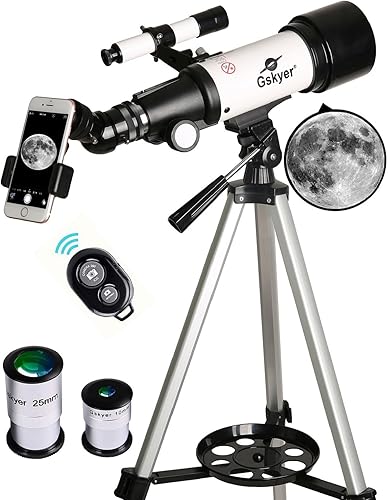
Gskyer Telescope: Best for most balconies
- 70mm aperture
- 400mm focal length
- Adjustable aluminum tripod
- Carry bag, phone adapter and wireless remote
The 70mm refractor balances light gathering, a short 400mm tube and portable storage. Its adjustable tripod and phone accessories fit casual balcony astronomy.
Pros
- Compact 400mm optical tube
- Adjustable tripod
- Carry bag included
Cons
- Manual focus
- Needs a stable, level balcony surface
The Gskyer Telescope is the strongest general pick for a balcony because its 70mm aperture and 400mm focal length do not demand the same aiming space as the 600mm and 800mm models here.
Its altazimuth mount supports simple horizontal and vertical aiming. The adjustable aluminum tripod offers different viewing positions, and the carry bag gives you a way to store the telescope and tripod when the balcony is needed for another purpose.
The optical setup includes fully coated optics, two replaceable eyepieces, a 3X Barlow lens and a 5x24 finder scope with cross-hair lines. The included phone adapter and wireless remote can help you frame phone images without touching the screen during capture.
This is a good fit for lunar viewing, beginner astronomy and occasional daytime targets. The trade-off is manual focus and a 70mm aperture, so a 90mm model may suit you better if your balcony has enough room and you want more light gathering.
MEEZAA Telescope: Best for a larger balcony
- 90mm aperture
- 800mm focal length
- 32X to 240X magnification
- Stainless steel tripod and carry bag
The 90mm aperture gathers more light than the smaller models here, while the 800mm focal length favors lunar and planetary viewing. Its longer tube needs more balcony clearance.
Pros
- Largest aperture in this group
- Fully multi-coated optics
- Phone adapter included
Cons
- Longer 800mm optical tube
- Needs more room to aim
The MEEZAA Telescope is the best choice here when your balcony can fit a longer tube and you want the largest aperture in the group.
Its 90mm aperture and 800mm focal length favor brighter, more detailed views of the Moon and planets.
Fully multi-coated optical glass lenses work with two eyepieces and a 3X Barlow lens for a stated 32X to 240X range. A finder scope helps you locate a target before using the main eyepiece.
The stainless steel tripod adjusts from 28 to 46 inches. Its accessory tray keeps eyepieces close, while the carry bag helps with storage and transport.
That height suits standing observers and can help you aim over a rail that would block a lower position.
Measure your available depth first. The 80cm optical tube needs more room to turn around a railing.
On a deep balcony, that length benefits close lunar views. On a narrow balcony, the rear of the tube may hit a wall or door.
Start at low power each night. Find and center the target, focus carefully, then move to a stronger eyepiece or Barlow.
CELTICBIRD Telescope for Adults High Powered: Best for adjustable tripod height
- 80mm aperture
- 600mm focal length
- 17.7 to 52 in adjustable tripod
- Backpack, phone adapter and moon filter
The 80mm refractor offers a middle ground between compact size and light gathering. Its wide tripod height range helps when balcony rails, chairs or standing positions affect your view.
Pros
- Adjustable aluminum tripod
- Backpack included
- Moon filter included
Cons
- 600mm tube needs aiming room
- Manual focus
The CELTICBIRD Telescope for Adults High Powered suits balconies where the observer's height and rail position change the usable viewing area.
Its 17.7 to 52 inch adjustable tripod gives more height range than most of the picks here.
The 80mm aperture and 600mm focal length sit between the compact 400mm models and the larger 800mm models.
Two eyepieces provide 30X and 66X magnification, and the 5x24 finder scope helps with initial aiming.
The wider tripod range is useful when children and adults share the same telescope on different nights.
A lower height can bring the eyepiece closer to a seated observer, while a taller height can help you clear a rail or planter box.
The backpack makes storage easier when floor space is shared.
A phone adapter supports phone images, while the moon filter is intended for more comfortable lunar viewing.
The moon filter is worth trying on a bright Moon, where glare can wash out surface detail.
Leave it in the bag for fainter targets, where you may want every bit of available light.
The main trade-off is tube length.
It is more capable than a very short starter scope, but you need to check that the 60cm optical tube can point above the balcony rail without striking the wall or ceiling.
Test the aiming path at the lowest and highest tripod settings before you settle on a spot.
HUGERSTAR Telescope: Best for moon viewing
- 90mm aperture
- 800mm focal length
- 32X to 240X magnification
- Moon filter and phone adapter
This 90mm refractor combines a long focal length with a moon filter for balcony observers focused on bright lunar views. The carry bag helps with storage when the balcony is shared.
Pros
- 90mm aperture
- Moon filter included
- Adjustable stainless steel tripod
Cons
- Long 800mm optical tube
- Needs clear space behind the tripod
The HUGERSTAR Telescope is a strong balcony pick for buyers who want a 90mm aperture and a moon filter in one beginner-focused kit.
Its 800mm focal length supports the same general high-magnification use as the MEEZAA 90mm model.
The telescope includes 10mm and 25mm eyepieces, a 3X Barlow lens and a 5x24 finder scope.
Together, the stated magnification range is 32X to 240X, although high magnification requires careful focus and a steady tripod.
Its stainless steel tripod adjusts from 28.7 to 46.4 inches.
The accessory tray gives the eyepieces a place to rest, and the carry bag helps you clear the balcony when the telescope is not in use.
That tray is a small detail that matters outdoors, where a loose eyepiece can roll, get dusty or fall between deck boards.
Keep the tray level and use it as the home for spare eyepieces rather than balancing them on a rail.
The moon filter can reduce glare during lunar observing.
It will not make a bright Moon more detailed by itself, but it can make the view easier to study for longer.
The compromise is the long 80cm optical tube, which makes this a better fit for a deep balcony than a narrow ledge.
If you have at least a few steps of clear space behind the tripod, the length is easier to manage.
If not, a shorter 400mm or 500mm model may leave you with more room to move.
MEEZAA Telescope for Adults & Kids: Best for family balconies
- 80mm aperture
- 500mm focal length
- 20X to 150X magnification
- Waterproof backpack and phone adapter
The 500mm tube is easier to place than the 600mm and 800mm models, while the adjustable tripod works for adults and children ages 8 to 12. The backpack helps keep balcony gear together.
Pros
- Shorter tube than the 600mm and 800mm picks
- Waterproof backpack
- 20X to 150X range
Cons
- Manual focus
- Lower maximum magnification than several picks
The MEEZAA Telescope for Adults & Kids is the best family choice when you need a shorter tube than the 600mm and 800mm models.
Its 80mm aperture and 500mm focal length give a useful middle ground for family stargazing.
The included 25mm and 10mm eyepieces, 3X Barlow lens and 5x24 finder scope provide a stated 20X to 150X range.
The 45-degree zenith mirror gives upright images for daytime landscape viewing as well as night use.
Its aluminum tripod adjusts from 16.92 to 44.48 inches.
The waterproof backpack keeps the telescope and accessories together, and the phone adapter supports phone photos and videos.
That backpack helps when the balcony is also used for plants, chairs or drying laundry.
Everything can go back into one place after a session, which lowers the chance of losing a small eyepiece.
This model may work well when adults and children share the same balcony setup.
The lower tripod heights make it easier for a child to look through the eyepiece without climbing or straining.
An adult can raise the tripod later in the same session without changing the balcony layout.
It still needs a flat, stable surface, and its 50cm optical tube requires more clearance than the Gskyer or SARBLUE.
Check that the tube can swing past a door frame or wall when you aim across the sky.
For daytime use, start with the lower magnification eyepiece and a distant landscape target.
That gives new users a calm way to learn focusing before they try the Moon at night.
Aomekie Telescope for Adults: Best for a small setup
- 70mm aperture
- 400mm focal length
- 15 to 51 in adjustable tripod
- Moon filter and phone adapter
This 70mm refractor keeps the optical tube short and the tripod height flexible. It suits beginners who want lunar viewing and daytime landscape use in a limited space.
Pros
- Short 400mm focal length
- Moon filter included
- Light 1.5 kg weight
Cons
- 70mm aperture
- No carry bag listed in the included items
The Aomekie Telescope for Adults is a practical choice for a smaller balcony where you want a 70mm aperture and 400mm focal length without moving up to a longer tube.
The K25mm eyepiece gives 16X magnification for locating a target, while the K6mm gives about 67X for a closer view.
The 5x24 finder scope supports aiming, and the moon filter can make bright lunar viewing more comfortable.
The aluminum tripod adjusts from 15 to 51 inches.
Its manually operated altazimuth mount lets you aim horizontally and vertically, while the 45-degree erect-image diagonal supports upright daytime views.
That wide height range is helpful when the best viewing spot changes with the season.
In winter you may stand further back to clear a rail, while in summer a lower position may give a steadier view.
At 1.5kg, it is one of the lighter choices here.
A light setup is easier to lift through a balcony door and easier to store in a cupboard.
It also makes the telescope more inviting for a first time user who does not want a heavy routine.
The included items cover the telescope, tripod, eyepieces, moon filter, phone adapter and diagonal, but a carry bag is not listed among those items, so plan storage accordingly.
A spare case, a padded bag or a clear corner of a cupboard will help keep dust off the optics.
That small planning step protects the view and keeps a shared balcony tidy.
SARBLUE Maksutov-Cassegrain Telescope for Adults Kids Astronomy: Best for the shortest tube
- 60mm aperture
- 750mm focal length
- 200mm optical tube
- Tabletop tripod and phone adapter
The Mak60 has a 750mm focal length inside a 200mm tube, making it the easiest model here to store on a crowded balcony. Its tabletop tripod needs a solid raised surface.
Pros
- Shortest optical tube
- Compact Maksutov-Cassegrain design
- 37.5X eyepiece included
Cons
- Smallest aperture here
- Tabletop tripod limits placement
The SARBLUE Maksutov-Cassegrain Telescope for Adults Kids Astronomy is the best option when storage length is the main balcony problem.
Its 750mm focal length sits inside a 200mm optical tube, which is much shorter than the refractor tubes here.
The compact Maksutov-Cassegrain design uses fully multi-coated optics and a 60mm objective lens.
Its 20mm eyepiece provides 37.5X magnification, and the phone adapter can position a smartphone over the eyepiece.
This model uses a tabletop tripod rather than a full-height tripod.
You will need a sturdy table, shelf or other raised surface that gives the telescope a clear view over the railing.
A solid table also raises the eyepiece to a comfortable height, which can suit seated observers.
It will not suit a balcony where the only flat surface is a narrow rail or an unstable plant stand.
The short tube is the major advantage for a crowded balcony.
You can store it in a much smaller space and bring it out for a short session without rearranging furniture.
The trade-off is the 60mm aperture, the smallest in this group, so buyers who have room for a floor tripod may prefer a larger refractor.
For bright targets and casual daytime landscapes, that trade-off can still work well.
For fainter night sky views, the larger apertures in this guide will have an advantage.
Choose this model when compact storage is your clear priority, and pair it with a sturdy raised surface.
UncleHu 80mm Aperture: Best for flexible aiming
- 80mm aperture
- 600mm focal length
- 26X to 450X magnification
- 360-degree horizontal and 180-degree vertical movement
The UncleHu combines an 80mm aperture with a tripod that moves horizontally and vertically. It suits balconies where the viewing angle changes often, but its 600mm tube needs room.
Pros
- Flexible tripod movement
- 80mm aperture
- Carrying bag included
Cons
- 600mm tube is not the shortest
- Very high stated magnification needs steady support
The UncleHu 80mm Aperture suits a balcony where targets appear at changing heights and directions.
Its tripod offers 360-degree horizontal and 180-degree vertical movement, giving you broad aiming flexibility.
The 80mm aperture and 600mm focal length support lunar, planetary and daytime viewing.
The kit includes 23mm, 10mm and 4mm eyepieces plus a 3X Barlow lens, with a stated 26X to 450X magnification range.
The aluminum tripod adjusts from 22 to 49 inches.
A 45-degree zenith mirror gives upright images, and the 5x24 finder scope with crosshairs helps center targets before you move to a higher magnification.
That three eyepiece choice lets you start wide and move closer in steps.
It also gives you room to find the setting that balances detail and a steady view on a given night.
The carrying bag and accessory tray help with balcony storage.
The tray keeps spare eyepieces off the floor, and the bag gives the tube a home when the balcony is needed for something else.
The 600mm optical tube is not the shortest here, and very high stated magnification will be more demanding on focus and stability than low-power viewing.
Treat the highest settings as a bonus for calm nights, not as the default for every session.
Start low, focus well, and let the tripod settle before you increase power.
That approach suits beginners who want flexibility without losing simplicity.
How do you choose a telescope for a narrow balcony?
Choose the shortest telescope that still gives you the aperture and viewing range you want. For most narrow balconies, start with a 400mm or 500mm refractor, then move to a 600mm or 800mm model only after checking the available depth.
Measure the floor and the viewing clearance
Measure the usable floor area, not the full balcony. Leave enough space for the tripod legs, your observing position and the path needed to turn the telescope.
A long focal length does not always mean a long tube. The SARBLUE has a 750mm focal length in a 200mm optical tube because it uses a Maksutov-Cassegrain design.
Refractors such as the 800mm MEEZAA and HUGERSTAR use longer optical tubes.
Also check the rail height. A tripod that is too low may aim directly at the rail, while a tripod that is too high can make the eyepiece awkward to reach.
Match aperture to the view you want
Aperture controls how much light the telescope can collect. The 90mm MEEZAA and HUGERSTAR models have more aperture than the 60mm SARBLUE and 70mm Gskyer and Aomekie models.
For bright lunar and planetary targets, the compact models can still be useful. If you want more light gathering and your balcony has enough room, the 80mm and 90mm refractors offer a stronger fit.
The best small telescopes for astronomy guide can help if you are choosing mainly by tube size and storage. For city balconies, our guide to the best telescope for light pollution covers the limits created by bright skies.
Prefer simple mounts for beginner use
An altazimuth mount is a sensible starting point for a balcony because it moves up, down, left and right. The Gskyer, MEEZAA, CELTICBIRD, HUGERSTAR and Aomekie models use altazimuth mounts.
A tabletop tripod can save space, but it changes where you can place the telescope. The SARBLUE needs a solid raised surface, while the full-height tripod models can stand on the balcony floor.
For setup help, use How to Use a Telescope for Beginners: A Beginner’s Guide. If you are comparing optical quality across brands, see Which Telescope Brands Have the Best Optics?.
How should you use a telescope on a balcony?
Set the tripod on a firm, level surface, tighten the adjustments and begin with the lowest-power eyepiece. Focus on a bright target first, then change eyepieces only after the telescope is centered.
Balcony floors transmit movement from footsteps and doors. Keep one person still while another looks, and avoid touching the tube while focusing, since even a light touch can shift the view at higher power.
Use the finder scope to locate the Moon or another bright target. A phone adapter works best after focusing through the eyepiece, and results depend on alignment and conditions.
Take test images, check the screen and adjust focus with small movements. Wait for the telescope to adjust to outdoor conditions, since moisture can form on the objective when temperatures differ.
Never point any telescope at the Sun. Direct sunlight can cause serious eye injury at every power and with every accessory.
For daytime viewing, the Aomekie and MEEZAA 80mm models include upright-image options. The Gskyer also supports terrestrial viewing, while the SARBLUE suits terrestrial and celestial targets.
Birds, rooftops and distant trees are good practice targets in daylight. Store the telescope in its bag or backpack and keep eyepieces in a tray or case.
Which telescope is best for your balcony?
The Gskyer Telescope is best for most beginners because its 70mm aperture, 400mm focal length, adjustable tripod and carry bag balance viewing with limited space.
Pick the SARBLUE Mak60 if storage length is your main problem and you have a stable table. Its 200mm tube is the shortest here, but it needs a raised surface and has the smallest aperture.
Choose the MEEZAA or HUGERSTAR 90mm models when your balcony is deep enough for an 800mm refractor and you want more aperture for the Moon and bright planets.
Choose the MEEZAA 80mm for family use, the CELTICBIRD for wide tripod height, the Aomekie for a light 400mm setup, or the UncleHu for broad tripod movement.
For phone-friendly compact viewing, compare these picks with the best handheld telescope for stargazing.
Measure your balcony, note rail height and check space behind the tripod before you decide. The best choice is the one you can set up, aim and store without stress.
Our top 3 picks at a glance
-
1
-
2
-
3
Best for adjustable tripod height
CELTICBIRD Telescope for Adults High Powered
9.5/10 our score
See it on Amazon
Frequently asked questions
What is the best telescope for a balcony?
The Gskyer Telescope is the best telescope for a balcony for most beginners because its 70mm aperture and 400mm focal length keep the setup manageable. Its adjustable aluminum tripod, carry bag, phone adapter and wireless remote also suit a small outdoor observing area.
Choose the SARBLUE Mak60 if storage length matters most, or a 90mm MEEZAA or HUGERSTAR if your balcony has enough clearance.
What should you look for in a balcony telescope?
Look for a short optical tube, a tripod that fits your viewing height, and an altazimuth mount that moves simply up, down and side to side. Check the balcony's usable floor depth, rail height and the space needed behind the tripod before choosing.
A larger aperture can gather more light, but a longer tube may be harder to aim around rails and walls.
Can you use a telescope on an apartment balcony?
Yes, you can use a telescope on an apartment balcony if the tripod sits securely on a flat surface and the viewing direction is clear. Balcony rails, walls and nearby buildings can limit the field of view, so a short focal length or compact tube may be easier to use.
Never point a telescope at the Sun.
Is a tabletop telescope good for a balcony?
A tabletop telescope can be good for a balcony when you have a stable table, shelf or other raised surface. The SARBLUE Mak60 uses a tabletop tripod and has a 200mm optical tube, so it stores easily, but it cannot stand on the floor like a full-height tripod.
Keep the support steady before focusing.