9 Best Telescopes for Light Pollution (November 2026)
The best telescopes for light pollution include the SVBONY Telescope Filter for adding nebula contrast, the DWARFLAB Dwarf Mini Smart Telescope for easy urban imaging, and the ZWO Seestar S30 Pro Smart Telescope for wide-field smart imaging.
On this page (7 sections)
- Which telescope for light pollution is best for most people?
- How we chose these telescopes for bright urban skies
- The best telescopes for light pollution by use
- Should you choose a smart telescope or a manual telescope?
- How do light pollution filters help?
- How should you use a telescope in a city?
- What is the final best telescope for light pollution?
The best telescope for light pollution is the DWARFLAB Dwarf Mini Smart Telescope for simple urban deep-sky imaging. Choose a UHC filter when you already own a compatible telescope and mainly observe emission nebulae, or choose a larger manual reflector when you want more optical light-gathering ability.
Bright skies change the best setup. A telescope for light pollution needs either a way to improve contrast, a way to process captured light, or enough aperture to make brighter targets easier to study.
This guide compares smart telescopes, filters, refractors and reflectors. We checked the stated features and buyer patterns against the needs of city and suburban observers.
Our score weighs specs, features and buyer feedback against what you're shopping for.
Our picks at a glance
-
1
-
2
-
3
 Best for wide-field smart imaging
ZWO Seestar S30 Pro Smart Telescope
9.3/10 our score
See it on Amazon
- 4
 Check it
Celestron UHC/LPR Light Pollution Reduction Filter
Best for 1.25 in visual viewing - 5
 Check it
DWARFLAB Dwarf 3 Smart Telescope
Best for portable all-around imaging - 6
 Check it
Hawkko 90mm Aperture 900mm Telescope for Adults
Best for a traditional beginner setup - 7
 Check it
SVBONY SV503 Telescope for Adults High Powered
Best for advanced refractor imaging - 8
 Check it
SOLOMARK Telescope 130EQ Newtonian Reflector Telescopes
Best for manual deep-sky learning - 9
 Check it
HSL 150EQ Astronomical Reflector Telescope for Adults
Best for the largest aperture
Which telescope for light pollution is best for most people?
The DWARFLAB Dwarf Mini is the easiest overall choice for capturing deep-sky images from an urban location. Its app control, Auto GOTO, built-in light pollution filters and exposures up to 90 seconds reduce manual work.
In a bright city, the hard part is often keeping the view steady, holding focus and separating a faint nebula from a washed-out background. The Dwarf Mini handles much of that for you.
It is aimed at digital imaging rather than direct eyepiece viewing. You select a target in the app, let the system track it and rely on processing to bring out detail after capture.
Its 1.85 lb body makes observing more practical from a balcony, shared patio or short walk to a slightly darker corner. That is far easier than moving a large manual telescope.
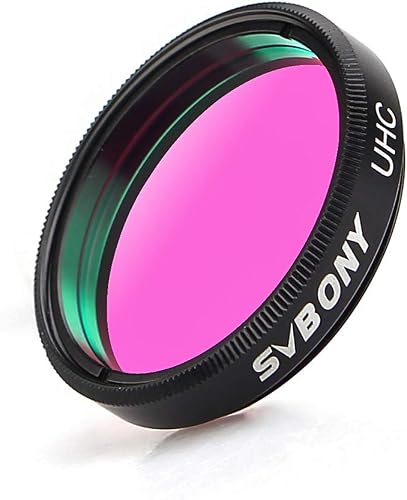
The SVBONY Telescope Filter solves a different problem. Its 1.25 in UHC design selectively reduces some artificial-light wavelengths and darkens the background around emission nebulae.
That suits an owner who already has a compatible telescope. You keep your mount, eyepieces and habits, then add a small contrast tool for suitable targets.
It works best on emission nebulae, where a darker sky makes the outline and inner structure easier to follow. It is less likely to transform galaxies, star clusters or planets.
For astrophotography, results still depend on the light source and exposure. Comparing the same field with and without the filter is the safest way to judge it.
The Seestar S30 Pro and Dwarf 3 sit between those paths. Both automate image capture, while the Seestar S30 Pro leans toward wide-field scenes and the Dwarf 3 adds a second camera for broader use.
A traditional telescope still makes sense for eyepiece observing. The Hawkko, SOLOMARK and HSL models offer larger apertures, but they require more setup, aiming and tracking practice.
For most people, the deciding factor is how you want to spend the night. Choose automation for processed images, a filter for nebula contrast or a manual telescope for direct visual observing.
How we chose these telescopes for bright urban skies
The best telescope for light pollution should match your observing method first. Smart telescopes suit people who want automatic target finding and processed images, while optical telescopes suit people who want direct eyepiece views.
We looked for these practical traits:
- Built-in or compatible ways to improve contrast.
- Aperture that supports brighter views of the Moon, planets and deep-sky targets.
- Tracking that suits the user's experience.
- A setup size you can store and move to a darker location.
- Clear limits where the product works better for imaging than visual observing.
Light pollution filters are selective, not universal. They can help with emission nebulae, but they do not turn a bright city sky into a dark-sky site.
For a portable setup, compare these picks with our guide to What Is a Good Travel Telescope? What to Know.
If you plan to observe away from home, our roundup of best telescopes for camping covers the portability trade-off.
| Product | Best for | Type | Material | Use | Our score |
|---|---|---|---|---|---|
| SVBONY Telescope Filter | adding nebula contrast | 1.25 in UHC filter | Optical glass lens and aluminum frame | Nebula viewing and astrophotography | 9.7 |
| DWARFLAB Dwarf Mini Smart Telescope | easy urban imaging | 9.5 | |||
| ZWO Seestar S30 Pro Smart Telescope | wide-field smart imaging | 9.3 | |||
| Celestron UHC/LPR Light Pollution Reduction Filter | 1.25 in visual viewing | UHC/LPR filter | Visual nebula observation | 9.2 | |
| DWARFLAB Dwarf 3 Smart Telescope | portable all-around imaging | 9.1 | |||
| Hawkko 90mm Aperture 900mm Telescope for Adults | a traditional beginner setup | 9.0 | |||
| SVBONY SV503 Telescope for Adults High Powered | advanced refractor imaging | 8.1 | |||
| SOLOMARK Telescope 130EQ Newtonian Reflector Telescopes | manual deep-sky learning | 7.9 | |||
| HSL 150EQ Astronomical Reflector Telescope for Adults | the largest aperture | 7.8 |
The best telescopes for light pollution by use
The right pick depends on whether you want processed images, direct views, a filter upgrade or the largest practical aperture. These products are listed from highest score to lowest score.
SVBONY Telescope Filter: Best for adding nebula contrast
- 1.25 in UHC filter
- Optical glass lens
- Aluminum frame
- Designed to reduce selected artificial-light wavelengths
This 1.25 in UHC filter darkens the sky background and can improve emission-nebula contrast from urban or suburban sites. It is an accessory rather than a telescope, so pair it with a compatible setup.
Pros
- Standard 1.25 in thread
- Useful for emission nebulae
- Compact accessory
Cons
- Does not remove all sky glow
- Results depend on the light source and telescope
The SVBONY Telescope Filter is the most targeted choice for a telescope owner who mainly wants more contrast around emission nebulae. Its 1.25 in barrel uses a standard filter thread for compatible 1.25 in eyepieces and other accessories.
The optical glass lens sits in an aluminum frame. UHC filters selectively reduce the transmission of certain wavelengths, especially some produced by artificial light, so the sky background can look darker while nebula contrast improves.
This is useful for objects such as the M42 Nebula, the Dumbbell Nebula and the Lagoon Nebula. The filter can work at low and high powers, but the result depends on the target, telescope and local light source.
SVBONY also identifies it for astrophotography. A halo can appear in some imaging situations, so adjust exposure and compare results instead of assuming every target will improve equally.
Choose it when you already have a 1.25 in telescope accessory thread and want a compact contrast tool. It is not a replacement for aperture or a darker observing site.
DWARFLAB Dwarf Mini Smart Telescope: Best for easy urban imaging
- 1.85 lb portable design
- Auto GOTO
- Built-in light pollution filters
- Up to 90-second exposures
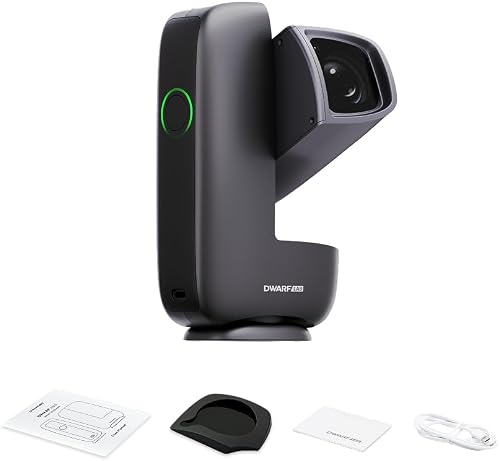
The Dwarf Mini combines app control, automatic tracking and built-in light pollution filters in a 1.85 lb body. It suits beginners who want processed deep-sky images without a large manual setup.
Pros
- Very portable
- Automatic target finding
- Built-in processing
Cons
- Small 30 mm objective lens
- Digital workflow is different from eyepiece viewing
The DWARFLAB Dwarf Mini is the best all-around answer for an urban observer who wants to capture deep-sky detail with minimal setup. It weighs 1.85 lb, uses app control and includes Auto GOTO, 360-degree pivot freedom and equatorial mode.
Its 30 mm objective lens and 150 mm focal length fit a small all-in-one design. The Sony IMX662 sensor, built-in light pollution filters and smart cloud processing are aimed at digital imaging rather than traditional eyepiece observing.
The Dwarf Mini supports single-frame exposures up to 90 seconds. Automatic tracking, stacking and one-tap processing can help city observers work with faint nebulae and star clusters without manually guiding the scope throughout an exposure.
The box includes the telescope, 1 filter, a USB-C to USB-C charging cable and a cleaning cloth. Its small size suits a balcony, patio or quick trip outside, while the battery-powered design avoids a fixed installation.
Choose it if your priority is simple urban astrophotography. Pick a manual telescope instead if you want the direct eyepiece experience and the process of finding objects yourself.
ZWO Seestar S30 Pro Smart Telescope: Best for wide-field smart imaging
- App control
- Built-in light pollution filters
- 4K dual-camera imaging
- Automatic mosaic stitching
The Seestar S30 Pro is a compact app-controlled system for deep-sky and wide-field imaging in bright locations. Its built-in filters and automatic tracking reduce the amount of manual setup.
Pros
- Wide 4.6-degree field of view
- Automatic GOTO and tracking
- Tripod included
Cons
- Designed for deep-sky imaging rather than planetary observation
- Needs to stay stationary during deep-sky imaging
The ZWO Seestar S30 Pro is a strong choice for wide-field smart imaging under bright skies. It combines app control, automatic GOTO, automatic tracking and built-in light pollution filters in a 3.6 lb system.
Its 30 mm objective lens has a 160 mm focal length and a 4.6-degree field of view. That wide view suits large sky scenes, the Milky Way and star trails, while the 4K dual-camera system also supports deep-sky imaging.
The S30 Pro includes a tripod, filter, Type-C cable, quick-start guide and safety instructions. Automatic mosaic stitching and AI noise reduction reduce the amount of manual processing needed after capture.
This model is designed for deep-sky objects and is not intended for planetary observation. Keep it stationary during deep-sky imaging so its tracking remains stable and accurate.
Choose it when you want a compact smart system with a wide view. For a lighter package, the Dwarf Mini is easier to carry.
For a broader daytime and nighttime imaging role, consider the Dwarf 3.
Celestron UHC/LPR Light Pollution Reduction Filter: Best for 1.25 in visual viewing
- 1.25 in UHC/LPR filter
- Multi-coated optical glass
- Darker sky background
- Designed to reduce selected artificial-light wavelengths
This Celestron filter is a focused upgrade for a compatible 1.25 in eyepiece or camera thread. It is aimed at emission nebulae, where a darker background can make faint structure easier to separate.
Pros
- Standard 1.25 in size
- High-transmission optical coating
- Useful on smaller telescopes
Cons
- Most useful on suitable nebula targets
- Cannot replace a telescope with more light-gathering ability
The Celestron UHC/LPR filter is the best fit for a visual observer who already uses a compatible 1.25 in eyepiece or camera thread. It selectively reduces certain artificial-light wavelengths and unwanted sky glow.
Its 1.25 in optical-glass format uses multi-layer coatings and is designed to preserve useful transmission across its bandpass. The intended result is a darker background and stronger contrast around emission nebulae.
Celestron identifies the filter for smaller 4 in to 11 in telescopes as well as larger instruments. That makes it a flexible accessory for owners who want to improve contrast without replacing their telescope.
The filter is most useful on suitable nebula targets. It will not make every galaxy, star cluster or planet look better, and it cannot remove all forms of city brightness.
Choose this filter when visual nebula observing is your main goal. Compare it with the SVBONY filter by checking your existing accessories, since both use a 1.25 in format but target the same general contrast problem.
DWARFLAB Dwarf 3 Smart Telescope: Best for portable all-around imaging
- 3 lb design
- Dual imaging system
- 4K auto-tracking
- Cloud-powered processing
The Dwarf 3 adds a dual-camera system to a portable smart telescope. Its telephoto lens handles deep-space subjects while the wide-angle camera covers the Milky Way and star trails.
Pros
- Portable 3 lb design
- Two imaging views
- Automatic tracking
Cons
- More dependent on app-based imaging
- Not a traditional eyepiece telescope
The DWARFLAB Dwarf 3 suits observers who want a portable smart telescope with more imaging range than a single-view design. It weighs 3 lb and uses a dual imaging system with a telephoto lens and a wide-angle lens.
The telephoto lens handles distant wildlife, landscapes and deep-space objects. The wide-angle camera covers the Milky Way and star trails, giving this model a broader role than a telescope used only after dark.
The Dwarf 3 includes 4K auto-tracking, Auto GOTO, equatorial mode and cloud-powered image processing. The app can process images with one touch, which keeps the workflow accessible if you do not want to use a computer.
The box includes a carrying bag, magnetic filters, a filter pouch, a wipe cloth and a USB-C cable. Its 35 mm objective lens is larger than the 30 mm objectives on the Dwarf Mini and Seestar S30 Pro.
Choose it for portable all-around imaging. Its app-based approach is less suitable if your main pleasure is manual eyepiece observing.
Hawkko 90mm Aperture 900mm Telescope for Adults: Best for a traditional beginner setup
- 90 mm aperture
- 900 mm focal length
- 36X to 270X magnification range
- 25 mm and 10 mm eyepieces
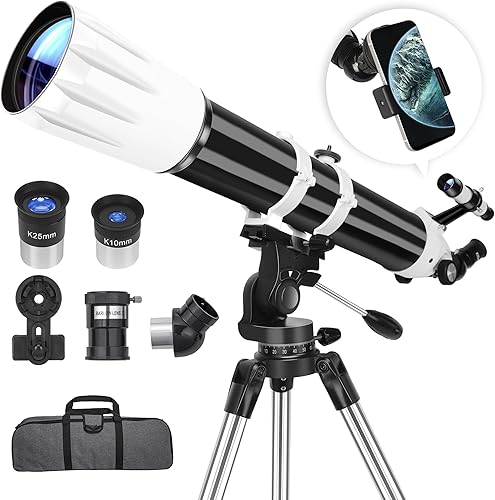
The Hawkko gives beginners a conventional refractor with a 90 mm aperture and manual altazimuth mount. Its included eyepieces and 3X Barlow lens offer several starting magnifications for the Moon and brighter targets.
Pros
- Larger aperture than the smart scopes here
- Complete beginner accessory kit
- Portable carry bag
Cons
- Manual aiming and focusing
- High magnification needs steady setup and careful technique
The Hawkko 90mm Aperture 900mm Telescope is the most approachable traditional setup in this group. Its 90 mm multi-coated refractor uses a 900 mm focal length and a manual altazimuth mount.
The stated magnification range is 36X to 270X. The kit includes 25 mm and 10 mm eyepieces, a 3X Barlow lens, a finder scope, a zenith mirror, a smartphone adapter, a stainless steel tripod, an accessory tray and a carry bag.
That complete set gives a beginner several ways to start without adding separate basic accessories. The tripod height adjusts from 28 in to 46 in, and the altazimuth mount supports smooth 360-degree rotation.
In bright skies, use it first on the Moon, planets and other brighter targets. Its 90 mm aperture is useful, but magnification alone cannot overcome a bright background, so steady focusing and careful target choice matter.
Choose it when you want a conventional telescope for backyard observing and occasional trips. If you want automatic tracking and processed deep-sky images, select one of the smart models instead.
SVBONY SV503 Telescope for Adults High Powered: Best for advanced refractor imaging
- 102 mm aperture
- 714 mm focal length
- S-FPL51 ED glass
- Dual-speed focuser
The SV503 is a 102 mm ED refractor for observers who want a larger optical tube and camera-focused adjustments. Its dual-speed focuser, field rotator and 90 mm focus travel suit a more deliberate imaging setup.
Pros
- Largest refractor aperture here
- ED glass helps reduce color distortion
- 360-degree field rotator
Cons
- Requires separate observing support
- Manual focus and no finderscope
The SVBONY SV503 is the strongest refractor choice for a more advanced camera-focused setup. It has a 102 mm aperture, 714 mm focal length and S-FPL51 ED glass designed to reduce color distortion.
Its dual-speed focuser provides finer adjustment, while the 360-degree field rotator helps align a camera without rotating the optical tube. The 90 mm focus travel leaves room for astrophotography accessories such as filter wheels and field flatteners.
The retractable 133 mm hood blocks stray light, helps prevent dew and protects the objective lens. The tube includes a 2 in to 1.25 in adapter, a 1.25 in dust cover, a dovetail plate, a lens cover and a pair of telescope tube rings.
This is a manual-focus optical tube with a tripod mount and no finderscope. Plan the rest of the support and aiming system before choosing it.
Choose it when you want an ED refractor for visual observation and astrophotography. It is less convenient than a smart telescope for quick, automatic city-sky imaging.
SOLOMARK Telescope 130EQ Newtonian Reflector Telescopes: Best for manual deep-sky learning
- 130 mm aperture
- 650 mm focal length
- German equatorial mount
- 1.5X Barlow and Moon filter
The SOLOMARK 130EQ uses a 130 mm reflector and an equatorial mount for manual observing. Its larger aperture can help under bright skies, but the manual mount takes more setup and tracking practice than a smart scope.
Pros
- 130 mm light-gathering aperture
- Equatorial tracking design
- Moon filter and smartphone adapter included
Cons
- More involved setup
- Manual finding and focusing
The SOLOMARK 130EQ is the better fit for learning manual deep-sky observing with a larger reflector. Its 130 mm aperture gathers more light than the 90 mm Hawkko and uses a 650 mm focal length.
The German equatorial mount includes dial controls and fine-turning cables. After alignment and setup, the design supports manual tracking of the Moon and planets, but it takes more practice than an altazimuth mount or automatic GOTO system.
The kit includes 2 eyepieces, a 1.5X erecting Barlow lens, a 1.25 in 13% transmission Moon filter and a cellphone adapter. The adjustable aluminum alloy tripod includes a tray for small accessories.
The fully coated glass optics and carbon-fiber-covered structure are intended to support brighter, more detailed views. In a city, the aperture helps, but the brightest targets remain the most practical starting points.
Choose it if you want the process of learning an equatorial mount. For a faster first night, the Hawkko is simpler to aim, while the smart scopes automate more of the session.
HSL 150EQ Astronomical Reflector Telescope for Adults: Best for the largest aperture
- 150 mm aperture
- 700 mm focal length
- Manual German equatorial mount
- Five-color filter set and 3X Barlow lens
The HSL 150EQ has the largest aperture in this group, which gives it the strongest light-gathering case for a manual telescope. It needs more room and setup time than the compact smart options.
Pros
- Largest aperture here
- Slow-motion altitude lever
- Color filter set included
Cons
- Manual focusing and tracking
- Longer, less portable optical tube
The HSL 150EQ offers the largest aperture in this roundup. Its 150 mm reflector uses a 700 mm focal length and a manual German equatorial mount with a slow-motion altitude lever.
The larger mirror gives this model the strongest light-gathering case here, but it also makes setup, storage and transport more demanding. A bright location still limits contrast, so the extra aperture works best when paired with sensible target selection.
The set includes a 5-color filter set, a mobile phone adapter, eyepiece and positive phase eyepiece, plus a 3X Barlow lens. The stated combinations include 90X, 112.5X and 345X magnification.
The included color filters are intended to show different planet details and cloud structures. High magnification needs careful focusing and a stable setup, especially when the target is moving across the field.
Choose it when maximum manual aperture matters more than portability. If you observe from a balcony or small patio, measure the space before choosing this longer optical tube.
Should you choose a smart telescope or a manual telescope?
Choose a smart telescope if you want automatic target finding, tracking and processed images from a bright location. The Dwarf Mini, Seestar S30 Pro and Dwarf 3 all reduce the manual work required to capture deep-sky subjects.
Choose a manual telescope if you want to look through an eyepiece and learn the sky directly. The Hawkko uses an altazimuth mount for simpler manual movement, while the SOLOMARK and HSL use equatorial mounts for a more involved tracking process.
Smart scopes do not automatically provide the largest optical aperture. Manual models may show brighter views of suitable targets, but they need more attention to setup, focus, alignment and tracking.
For a compact observing area, see our guide to the best telescope for a balcony. If storage and transport are your main limits, compare the choices with our roundup of best small telescopes for astronomy.
How do light pollution filters help?
A UHC or LPR filter helps by selectively reducing some wavelengths associated with artificial light. The darker background can improve the contrast of emission nebulae, making their shape easier to separate from the surrounding sky.
That is why these filters are often described as contrast tools rather than light boosters. They do not add light from the target, and they do not make the whole sky dark.
The SVBONY and Celestron filters both use a 1.25 in format. Check that your eyepiece, diagonal, camera or filter holder accepts that thread before choosing one.
Compatibility sounds simple, but it is worth checking before a clear night arrives. A filter that does not fit the front of the eyepiece or the accessory in use will not help at the telescope.
Filters work best when matched to the target. They are not a general brightness switch, and they cannot restore the contrast lost to every type of city glow.
Emission nebulae are the clearest case because much of their light sits in the wavelengths these filters are designed to preserve. Other deep-sky objects may gain little, and some may look dimmer.
Your local lighting also matters. If the main glow around you does not overlap well with the wavelengths the filter blocks, the change may be small or hard to notice.
Try the view without the filter first, then add it and compare the same target. This makes it easier to see whether the filter is helping your telescope and local sky.
Use the same magnification and give each view a fair moment before deciding. A quick glance can miss the difference in background tone and nebula structure.
For visual observing, keep the comparison simple and honest. If the nebula looks clearer and the background looks darker, the filter is doing its job for that target.
For imaging, compare exposures in the same way rather than judging one frame in isolation. A slider or exposure change can affect halos and background brightness, so consistency matters.
Store the filter in its case or a clean pouch and handle the glass by the frame. Dust and fingerprints can scatter light and reduce the benefit you paid for.
A filter is a low-cost addition when it suits your targets and accessories. It works best as part of a plan that also includes sensible target choice and a steady setup.
How should you use a telescope in a city?
Start with the brightest targets and control stray light around your observing position. The Moon and planets are practical first targets, while emission nebulae are the deep-sky objects most likely to benefit from a UHC or LPR filter.
Keep the telescope steady and focus carefully before increasing magnification. A larger number on an eyepiece or Barlow lens does not create more detail if the air, mount or focus cannot support it.
Use a dark hood or position the telescope away from direct lamps when possible. For smart telescopes, keep the unit stationary during deep-sky imaging and allow the tracking and processing features to work before judging the result.
If you're new to setup, read How to Use a Telescope for Beginners: A Beginner’s Guide before your first session. It covers the basic process of mounting, aiming and focusing.
What is the final best telescope for light pollution?
Pick the DWARFLAB Dwarf Mini if you want the easiest path to urban deep-sky images. Its app control, Auto GOTO and built-in light pollution filters suit people who want processed results with limited manual setup.
The 1.85 lb body makes it easier to use from a balcony, patio or nearby open space. You still need clear skies and a stable position, but the setup is far simpler than a large manual telescope.
Pick the SVBONY Telescope Filter or Celestron UHC/LPR filter if you already own a compatible telescope and mainly observe emission nebulae. Both use a 1.25 in format and aim to darken the background for better contrast.
That route suits visual observers who enjoy finding objects and looking through an eyepiece. It also suits owners who want to improve a current setup before considering a new telescope.
Choose the Hawkko for a complete beginner refractor with a 90 mm aperture and included eyepieces. It is a conventional choice for the Moon, planets and brighter targets, with a manual altazimuth mount to learn.
Choose the SOLOMARK for manual equatorial learning with a 130 mm reflector. The German equatorial mount rewards practice, but it needs more setup time and patience than the simpler Hawkko mount.
Choose the HSL for the largest aperture in this group at 150 mm. That extra light-gathering ability is useful, yet the longer tube and manual mount demand more space and care.
Choose the Seestar S30 Pro for wide-field smart imaging. Its 4.6-degree field of view, built-in light pollution filters and 4K dual-camera system suit large sky scenes as well as deep-sky capture.
Choose the Dwarf 3 for portable dual-camera use. The telephoto and wide-angle lenses cover distant deep-space subjects, the Milky Way and star trails.
The SVBONY SV503 deserves a look if you want an ED refractor for a more deliberate setup. Its 102 mm aperture, dual-speed focuser and field rotator point toward camera-focused observing rather than quick automatic sessions.
The best telescope for light pollution is the one that matches how you want to observe. Start with your preferred method, then choose the aperture, filter or automation level you can use consistently.
Prioritize ease of setup and storage if you observe from home. If you can travel to a darker site, a larger manual telescope may become more rewarding.
Think about your first ten sessions, not just your first night. The setup you will actually use, focus and return to is the one most likely to teach you the sky.
Our top 3 picks at a glance
-
1
-
2
-
3
Best for wide-field smart imaging
ZWO Seestar S30 Pro Smart Telescope
9.3/10 our score
See it on Amazon
Frequently asked questions
What is the best telescope for light pollution?
The best telescope for light pollution depends on how you observe. A smart telescope such as the DWARFLAB Dwarf Mini uses automatic tracking, built-in light pollution filters and image processing for urban deep-sky imaging.
For visual observing, choose a larger aperture and add a suitable UHC or LPR filter for emission nebulae.
Can a telescope see through city light pollution?
Yes, but city light reduces contrast and makes faint objects harder to see. The Moon, planets and bright star clusters remain practical targets.
A UHC or LPR filter can darken the background for some emission nebulae, while image stacking and processing can help smart telescopes produce clearer deep-sky images.
Are light pollution filters worth it?
A light pollution filter can be useful for emission nebulae when its thread matches your eyepiece or camera. It does not remove every type of sky glow, and it cannot make all deep-sky objects bright.
Use it as a contrast tool, then compare the view with and without the filter.
Is a smart telescope better for a bright city?
A smart telescope can be easier in a bright city because automatic tracking, built-in filters and image processing reduce manual work. It is best for app-based imaging rather than traditional eyepiece viewing.
If you want to learn manual observing, a larger refractor or reflector may be a better fit.
What aperture is good for light pollution?
Aperture helps gather more light, but it does not remove the bright sky background. The 90 mm Hawkko, 102 mm SVBONY, 130 mm SOLOMARK and 150 mm HSL offer progressively larger apertures.
Choose the largest setup you can store, move and keep steady while observing.